|
|
|
|
|
|
|
|
|
 Posted: Thu Apr 26, 2007 8:30 am Posted: Thu Apr 26, 2007 8:30 am
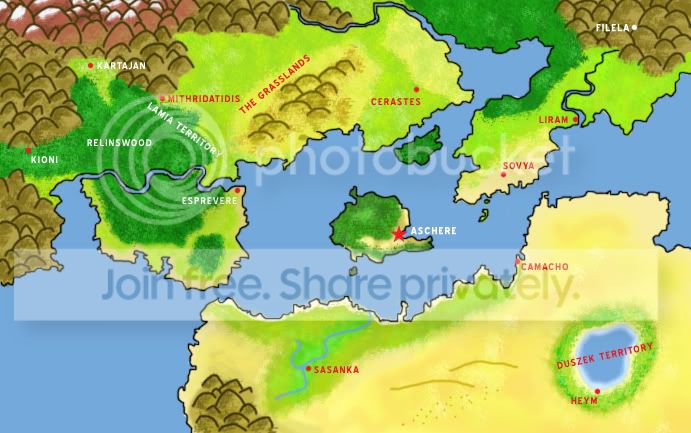
LOCATION MAP Not actual size. :]
|
 |
|
|
|
|
|
|
|
|
|
|
|
|
|
Posted: Sat Apr 28, 2007 6:13 pm
HUMANS The Human "nation" is Aludra itself - or so they believe. Humans live pretty much anywhere that is inhabitable, though their presence is lessened in areas such as the Ejderha nation and the Duszek nation. There are four major human cities, though they are by no means the only ones in Aludra.
Cerastes - In the center of the upper continent of Muliphen, on the very edge of the green hills is the great human city of Cerastes. Cerastes is very large and densely populated, with gothic architecture and a culture that is essentially traditional Western European in nature. Their economy is struggling and they are currently the primary backers in the war with the Ejderha.
Kartajan - Dense forests take up most of the terrain before the rolling hills of western Muliphen sweep upward into mountains. The harsh environment hasn't stopped the humans from establishing one of their four great cities in there, in the central north. The culture of Kartajan and its people is similar to Slavic or Norse culture. The cold temperatures make dressing in heavy furs a necessity.
Aschere - The great city on the Island of Murzim is elaborated upon further below.
Sasanka - Sasanka is one of the four great human cities. It can be found in Furud; although not a coastal city, it drains into the Sea of Adhara, giving its people a way to easily trade. Sasanka is fairly evenly split between Humans and Pennier; the culture is Arabian, with architecture that resembles Egyptian - sans pyramids - and Persian.
Sovya - In the land of the Ejderha, Filela-Liram, is the recently acquired city of Sovya (formerly known as Nasaja). The city was taken in one of the many disputes between humans and Ejderha. With the ongoing conflict between the humans and the Ejderha and the risk of pirates, it takes a brave man to try to make his way in Sovya. For more information on this city, refer to the Ejderha nation's section.
The Grasslands - Central Muliphen is mostly hills covered in tall grass, filled with an abundance of strange animals and small pockets of humans. The people of the Grasslands are considerably less developed, exhibiting a slightly more primitive tribal culture. The people of the Grasslands are at least mostly aware of the other races, since that is a high traffic area, but they prefer to preserve their tribal nature. The Grasslands can be well compared to an African savannah in terms of culture and wildlife.
Relinswood - The dense forest in western Muliphen is known as the Relinswood. Naturally one of the most savage and magical areas of Aludra, though it is rare, some human tribes have formed within it over the years. Many travelers insist these humans are actually ghosts and spirits of the forest, but the truth is far more mundane. For more information on this location, see the Muscheron nation's section. For more information on the humans in the Relinswood, continue reading.
Kioni Village - On the far western side of the Relinswood, at mountain's edge, rests the village of Kioni. This village is the largest, most civilized gathering of humans in the Relinswood. Homes are modest with architecture reminiscent of ancient Japan and are built both up the side of the mountain as well as in the nearby forest. Culturally, these humans are not too far removed from their neighbors the Muscherons who they share good relations with. They are highly respectful of nature, believing that there are good and bad spirits in everything as well as believing in many gods such as the god of luck and prosperity. They are also highly superstitious with a rich oral folklore and belief in ghosts and bakemono that the village must be protected from. Their religious philosophy is Shinto influenced. Their names are Vietnamese influenced.
The people of Kioni share a common belief that they are descended from the animal spirits they share the woods with and that each person is born with their own totem animal. The warriors of this village typically wear attire reflecting their totem animal including masks and fur accents. As a rite of passage, those wishing to become a full-fledged warriors must go on a vision quest as instructed to them by their totem animal. There is no specific age that a totem animal comes to a warrior and many warriors eagerly anticipate the night they will be visited by their totem animal in their dreams.
NB: As Kioni is a simple backwater village, high society elements such as geisha and courtesans are not present here. Clothing materials are simple and practical and styles are reminiscent of early historical Japan.
Camacho - Along the coast of northern Furud lies the Port City of Camacho, the largest and oldest haven for pirates. Camacho is an even rougher city than Sovya and is primarily populated with people you would never bring home to your mother. For more information on this city, refer to the pirate nation's section.
|
|
|
|
|
|
|
|
|
|
|
|
|
|
|
|
|
|
Posted: Sat Apr 28, 2007 6:16 pm
PENNIER Though Pennier seem to be everywhere and not particularly native to one place over the other, they will all acknowledge their home nation as Ravelle. It's easy to locate as the capital city of Esprevere is right at the eastern delta of { the one really big river } and constitutes the south part of the peninsula below the river. Though Ravelle is ruled by the Pennier, the population is just about half and half with humans and contains an assortment of other minorities. Ravelle is a theocracy, as the king is as much the head of the religion as he is the ruler of the country. Because of this, many of the laws are biased in the favour of Aileism, and it makes it hard to argue with the decisions made. Ravelle unfortunately suffers from a very unstable economy with a huge gap between the upper classes and lower classes who live in abject poverty. But at least Ravelle is very peaceful with other nations most of the time and wars are rare... but when they have happened in the past things have gone poorly for them. Ravelle has a very sad standing army. The king nearly always male, though there have been a number queens in the past when there has been no suitable male heir. Apart from this, it isn't entirely unusual to see females involved in government and with positions of authority. The current king is named Marsile d'Outremer and rules with his wife Gisela and they have a few very young children. The king is believed to be ordained by the goddess and acts as her hands, eyes, ears and mouth. The royal line has remained unbroken since the founding of Ravelle (so they say) and the religious association with the government makes overthrowing it a little harder, should someone feel the need. Recently someone did, and the Fin de Saison rose against the establishment. They were publicly dubbed such because of frequent promises that the current state of things in Ravelle was going to end and a new spring would be brought in by them. They claimed that the king was unworthy of the goddess' grace and was no longer connected to her, but was lying and using his authority to enslave the poor. A short but violent period enveloped Esprevere, though the movement didn't get far outside the city. Many rebels and officials were killed in the frequent clashes. This rebellion was exterminated less than 4 years after it began, and most of the leaders, with the exception of a few, were arrested and executed. What led to their downfall was one of the Saison members turning on his allies in exchange for the safety of himself and his family, and so he tipped off the government about a planned assassination attempt on the royal family. They were effectively stopped and arrested, though some narrowly escaped. The majority of the revolution's body, largely commoners and sympathetic youths, disappeared into the city. Ravelle is currently working on it's recovery after the bloodshed and fear. Ravelle attracts a lot of tourists because it's known for high culture and art. Many aspiring artists move to Esprevere because of it's artistic reputation, but it's also known for being a great city of education as well. It sounds very prestigious to have gone to a school in Ravelle. Note: Aileism in Murzim is quite different than it is in Esprevere. While in the capital city it's known for it's strictness and rejection of social outsiders, the church at Murzim is much more welcoming. Because of the fact that it embraces anyone who wants to see out the goddess regardless of background and has even welcomed a traitor to the crown, it has been officially disavowed by King Marsile and is not considered a true part of the church. Murzim Aileists are technically considered heretics. Another note: The Fin de Saison movement started about 7 years ago and it was ended about 4 years ago. NAMES TO KNOWRavelle - The united Pennier nation.
Esprevere - The capital city.
King Marsile d'Outremer - King of Ravelle. Popular with the aristocrats, unpopular with the lower classes.
Queen Gisela d'Outremer - Young queen of Ravelle. Very beautiful, somewhat of a style icon. Likewise popular with the aristocrats, unpopular with the lower classes.
Princess Ava d'Outremer - The six-year-old princess of Ravelle.
Prince Bernard d'Outremer - The three-year-old crown prince of Ravelle.
Blaise Labarre - The primary militaristic figure of the Saison rebellion and the brains of the operation, though he was a poor public speaker. He is credited for causing most of the violence of the movement, and is currently very dead. An influential follower of his was Auguste Renoir.
|
|
|
|
|
|
|
|
|
|
|
|
|
|
|
Posted: Sat Apr 28, 2007 6:24 pm
EJDERHA The Ejderha nation of Filela-Liram occupies the eastern region of the Muliphen continent. The capital city, Filela, is located deep inside the Pinuran Mountains and is heavily guarded against those who are not welcome. The other major city, Liram, is located on the south side of the mouth of the Ledojia River and doubles as a major trading post and fortress against invaders. Several smaller cities dot the coast and forest, all of which maintain a military presence. Very few non-Ejderha can claim to have ever set foot inside the city of Filela. The city itself is quite immense and exists within a series of interconnected caverns inside the Pinuran Mountains. Unlike the crude fortress-like architecture seen in most Ejderha cities, Filela's buildings are far more refined and reminiscent of Turkish architecture. At the center of the city is the imperial palace which doubles as the military academy. Liram is, relatively, a much more open city than Filela is. At the same time, it's far more militaristic than Filela is as it was originally a military outpost that grew into a bustling city and it does not enjoy the protection from invaders that Filela does. Those who visit the city often comment that even the air in Liram is tense. Traditionally rulers of the Ejderha are appointed by the departing ruler from among the highest ranking military figures and there is no bias towards male or female rulers. However, the current ruler is a woman named Ceyden who gained power after a military coup and has been ruling for roughly 15 years now. This is not the first time in Ejderha history that regime change has come by force. Filela-Liram is not a popular vacation destination as it has something of a Wild West meets Spartans reputation. Most non-Ejderha in the region are traders or on some form of business. Or at least, that's how it used to be. For roughly the last seven years, the Ejderha have been trying to hold off a human-led army from Cerastes seeking entry into Filela for the purpose of gaining access to the legendary eitr, a substance that is said to flow in the Pinuran mountains and is believed to have magical properties which may hold secrets to eternal life, though cynics will say the only reason war was declared was to distract people from Cerastes' failing economy. The Ejderha insist that such a substance does not exist, though ancient tomes do describe a life-giving water, however the wording is so antiquated and poetic it is impossible to decipher the truth in the claims. While the Ejderha have held them out of the main territory of Filela-Liram, much of the southern coastal region is now occupied by humans. The largest city held by the humans is Nasaja, now renamed to Sovya, which fell into human hands after a particularly bloody battle five years ago. Sovya is slowly developing into a bustling human city, now populated by those willing to take on the risk of Ejderha invasion for the sake of a serious payout. It has very little in terms of government making it quite comparable to the Wild West. It should be noted that despite a heavy interest in trade and military, the Ejderha have yet to build a strong naval power and thus between the sea and the heavy fortifications along the human's side of the Filela-Liram border, they have been unsuccessful in all historic attempts to expand past Filela-Liram's borders. NAMES TO KNOWFilela-Liram - The united Ejderha nation.
Filela - The capitol city of the Ejderha, located deep within the Pinuran Mountains. Target of the human invasion. Non-Ejderha are rarely welcomed inside.
Liram - The other major city of the Ejderha. Trade between the Ejderha and other peoples of Aludra occurs here.
Ledojia River - The river connecting Liram to Filela. Heavily patrolled against unknown peoples traveling it.
Pinuran Mountains - The northern mountain range that houses the city of Filela and is believed to possess eitr.
Nasaja - Former name of Sovya. Site of a bloody battle between humans and Ejderha.
Sovya - Major human controlled city on Ejderha soil. Captured within the past five years.
Ceydon - Leader of the Ejderha who gained power through a military coup 15 years ago. Lives in Filela. Currently trying to protect her land against a human invasion.
Eitr - A substance that is said to flow in the Pinuran mountains and is believed to have magical properties which may hold secrets to eternal life.
|
|
|
|
|
|
|
|
|
|
|
|
|
|
|
|
|
|
Posted: Sat Apr 28, 2007 6:26 pm
DUSZEK For centuries the Duszek have lived comfortably in a land that would normally seem most unwelcoming. Their largest and greatest city, Heym, rests on the southern edge of The Great Oasis and is surrounded on all other sides by a wall. The Duszek have laid claim to all of The Great Oasis, and many small (fortified) cities and villages are established on the water source's banks. The Duszek army is small, but still appropriate, given the population size. Although well defended by city walls and the surrounding environment, it's not very difficult for an outsider to enter one of the cities once they've arrived there. In fact, most Duszek, having never seen outsiders, are very curious about them, and people love to gawk, gossip, poke and prod at merchants and adventurers who seek refuge from the heat within the city walls. On the other hand, Duszek do not appreciate door-to-door evangelical Pennier. The Duszek people are ruled by a Council of Elders who are based in Heym; the elders, six in number, are, usually, the (former) heads of the five "towers" - organizations that control various aspects of the city. The current elders are: Basia (F; 620yrs), former High Astronomer of the Heym Observatory; Zbigniew (M; 500yrs), former Head Sage at the Tower of Wisdom; Avishag (F; 470yrs), former General of the Duszek army; Chaim (M; 512yrs), former Head Agronomist at the Tower of Agriculture; Bosmat (F; 699yrs) former High Priestess of The Path of the Flow; Dekel (M; 240yrs) current Speaker for the People. The Speaker of the People, always the youngest, is elected by the population at large as a representative of the mindset of the younger generations. In general, though, the Speaker of the People has very little say in important decisions, since he or she is so young. The Duszek have a defined social hierarchy that may not be as evident as in other cultures, because they like to hide their poor in the back, but it consists of: adventurers, merchants & artisans, the military, farmers, religious officials, scholars & mystics (magic users), and, at the top, the Council of Elders. In general, there's not much poverty in the Duszek nation, but what is there is generally kept under wraps - the poor and homeless are ushered into specific slum areas. NAMES TO KNOWThe Great Oasis - The Duszek home territory. Generally referred to as "The Great Oasis" or the "Duszek Territory."
Heym - The capitol city of the Duszek.
Basia, Zbigniew, Avishag, Chaim, Bosmat, Dekel - The Council of Elders.
|
|
|
|
|
|
|
|
|
|
|
|
|
|
|
Posted: Sat Apr 28, 2007 6:29 pm
LAMIA Unlike many of the other races, the Lamia have no defined nation and instead lay claim to a vague stretch of territory that runs from the mountains, down the east edge of the Relinswood to finally stopping at the ocean. Rather than having cities and other settlements dotting this area the Lamia are known for their nomadic lifestyle and the presence of 4-5 caravans or tribes that travel up and down this path, sometimes extending themselves further towards human territories in the grasslands for trading. There are also some Lamia that make their home permanently in towns and villages within the Relinswood proper, though they're never very far in past the edges.
The Lamia have one decently sized city, Mithridatidis, that rests at the northernmost edge of their stretch of land. Outside of the Lamia community it's theorized to be as dangerous as the likes of Camacho or Sovya, but in actuality it's a very tame locale. The problem is that Mithridatidis doesn't allow entrance to any non-Lamia who has not been personally approved by their ruling family. The population is therefore 99.9% Lamia, and looks like a combination of a tribal village and a chunk of some bustling metropolis' lower class district. Though dirty and with houses and buildings constructed of anything the people can get their hands on, the city is organized, efficient and crime is very low. The residents live comfortably and there are constantly caravans coming in and out of the city, which is effectively walled off. Outside of it there is a very small district, Polemo, where any non-Lamia visitors wait while the caravans go outside. The population there is mostly human and Pennier.
Despite the disorganized nature of the Lamia nation as a whole, there is a strong, intense feeling of community. They follow laws and decrees set forth by their ruling family that are then passed through any lines of communication possible so it reaches the small Lamia communities in other cities far outside Lamia territory. The current ruling family is overseen by a middle aged and beloved matron named Orithyia Archelaus, who has a multitude of children and a lover who's quite a bit younger than herself.
The Lamia community on Murzim is as tightly knit as ever and is in steady communication with the mother city of Mithridatidis.
NAMES TO KNOWMithridatidis - The so-called mother city of the Lamia people. The largest permanent settlement of the Lamia. It allows almost no non-Lamia residents.
Polemo - The area outside of Mithridatidis where non-Lamia must wait since they're not allowed inside the actual city.
Matron Orithyia Archelaus - The 53-year-old matron of the Lamia's ruling family. She's known for being very good natured and liking younger men.
|
|
|
|
|
|
|
|
|
|
|
|
|
|
|
|
|
|
Posted: Tue May 01, 2007 9:03 pm
MUSCHERONS The Muscheron "nation" comprises much of the inhabitable world of Aludra, though they avoid the Desert and Lamia territory. The largest population of Muscherons is deep in the Relinswood. In more civilized areas of Aludra, the Relinswood is more so a location parents threaten to send naughty children than a place anyone would visit. The actual Relinswood is not nearly as dangerous as parents would lead their children to believe, but it is quite bizarre. An area of extreme magical concentration, almost immediately upon entering the woods, a thick fog makes it difficult to see. The magic is made tangible in the overgrown and savage wildlife making its home in the woods. It is said that long ago this is where the Muscherons first came to be. In terms of government, there is no single unifying ruler of the Muscherons. Instead each pocket of Muscherons has their own local tribal leader, and methods of choosing rulers will vary from tribe to tribe, as Muscherons do not place high value on convention. Some follow lineage, while others might prize strength, wisdom, age or a combination of factors. The leader of the Murzim Muscherons is a 20-year-old male named Milkweed who accepted the position upon his father's death a few years ago. Milkweed is largely responsible for encouraging the local Muscherons to cause grief for the other inhabitants of the island. Muscheron villages are very large, yet mostly unseen by travellers as they are generally built deep into the woods and off the ground, with the highest ranking society members living high up in treetops. Their homes look quite similar to larger versions of Smurf homes, though many Muscherons choose to sleep outdoors, as weather permits. Like squirrels, Muscherons enjoy pelting people who invade their territories with nuts. NAMES TO KNOWOruliha - Tribe located deep in the forests of Murzim, but as far as Muscheron villages go, this is one of the easier ones for outsiders to seek out.
Relinswood - A sprawling, densely foggy forest made wild and dangerous by high concentrations of magical energy.
Midoluk - This community is so large, it's practically a city. Based in the Relinswood, and difficult to find even for some Muscherons.
Milkweed of Oruliha - Twenty-year-old tribal leader of Oruliha. Resents the Asterion League's encroachment on what he considers "ancient Muscheron territory," i.e. the forests of Murzim Island.
Flax of Oruliha - Father of Milkweed and previous leader of Oruliha, who died four years prior. Known to be more tolerant than his son, which may or may not be a good thing, depending on the Muscheron.
Bluebell of Ehalel - Folk hero hailing from one of the tribes near Ejderha lands. She was already a seasoned warrior in the early days of the League, and supposedly taught Meissa a few things before the two had a falling out over hunting practices. More fancifully, Bluebell's said to have located a nest of baby dragons toward the end of her life, but nothing concrete ever came out of this story.
|
|
|
|
|
|
|
|
|
|
|
|
|
|
|
Posted: Thu May 03, 2007 6:52 pm
PIRATES Though not a race unto themselves, pirates make their presence well enough known in Aludra to warrant their own section. Pirates come from all walks of life (and all races), but they are united by a desire for personal profit at the expense of others. (Though some insist they pirate purely for the thrill of high seas adventure, many observers would say these are the pirates to beware of the most, as at least the other kind is honest!) While traveling the seas, it's best to be wary of any lone boatman crying for help, as it's likely the distraction right before pirates attack your vessel.
Piracy is a mostly recent phenomenon in Aludra and has particularly thrived since the Humans went to war with the Ejderha. While pirates can be found all over the Sea of Adhara, the most dangerous sea routes for traders are those around Sovya and Liram. Unsurprisingly, there is no central leader of the pirates, and anyone who owns their own vessel is considered a Captain and therefore worthy of respect - or at least, worthy of staying on their good side since they hold the purse strings.
Though pirates spend most of their time on the seas, a few port cities have popped up along the Adhara coast that specifically cater to them. The oldest and largest is Camacho, located in the last bit of grassy stretch in the north of Furud. The Port City of Camacho is known for its cheap alcohol and cheap women, as well as being generally safe for less reputable sorts due to the natures of its closest neighbors: the anti-social Duszek to the south, and the otherwise distracted humans and Ejderha across the sea to the north. While some opportunists choose to make Camacho their home, it is generally agreed that even Sovya is a safer place for entrepreneurs than Camacho.
As a general rule, pirates avoid Aschere due to the high concentration of soldiers of fortune in that area. On the other hand, many enjoy visiting Sovya knowing that they are unpopular visitors and likely to find a good fight.
|
|
|
|
|
|
|
|
|
|
|
|
|
|
|
|
|
|
Posted: Wed May 16, 2007 1:36 pm
ISLAND OF MURZIM Murzim is covered mostly by deciduous tropical forests, and what isn't jungle-like is beach. The island's relative seclusion but proximity to all the nations of Aludra leave it well-positioned as the cultural hub of the world, especially when it comes to its largest city, Aschere.
Considered by humans to be one of the four Great Cities of Aludra, Aschere has boomed since its founding thanks to nearby bountiful jungles and naval trade. For much of its history, the city was ruled by a line of nobles who declared all of Murzim to be under their jurisdiction, regularly bringing humans in conflict with the other inhabitants of the island (notably Muscherons). Some decades ago, leadership semi-peacefully transferred to the hands of a non-noble regent, and from there, Aschere developed a more diplomatic and cooperative reputation.
Aschere is one of the most racially diverse locations in the world, a fact which is only enhanced by the current regent's refusal to take part in any wars not directly concerning Murzim. This move has proved controversial with several nations, including its major trade partners, Cerastes and the Ejderha nation. Recently, when Regent Tolbire refused to hand over a Pennier revolutionary for trial, Ravelle declared all followers of Murzim Aileism to be heretics in the eyes of the central church.
Much of Aschere lies along the coast of the Sea of Adhara. Most of the shore area has been built up with docks that stretch out into the water, leaving very little in the way of sandy beaches within the city's limits. Although the Harbour District is probably the least clean part of the city, it still has its charms. The freshest fish and best taverns can be found on the water, but the shadiest characters also tend to hang out in this area.
Two great trade roads connect Aschere to the two small towns on the island - Sothis and Alshira. Legally, they're still vassals of Aschere, but in practice, Sothis and Alshira have been autonomous for at least fifty years. Nonetheless, the nature of being island towns leaves them dependant on Aschere's prosperity.
NAMES TO KNOWRegent Ileas Tolbire - This 61-year-old human male is the city's second regent, and has been in power for over ten years. His determination to keep Murzim a "neutral safe zone" in Aludra has gained him both passionate supporters and passionate critics.
Asterion League - Adventurer's guild with an illustrious hundred-year history, and perhaps Aschere's most famous export.
Sothis - Small town located west of Aschere.
Alshira - Small town located east of Aschere. Should pirates wish to deal in the risky business of Murzim goods, this is the place to do it.
|
|
|
|
|
|
|
|
|
|
|
|
|
|
|
Posted: Wed May 16, 2007 2:14 pm
ASTERION Located on the northwestern end of Aschere, Asterion was once the enormous estate of one of the city's richest families. It took only a few short years for the prodigal daughter of Asterion to convert the near-empty estate into a thriving headquarters for fellow adventurers, which continues growing and evolving to this day.
The guild "hall" actually consists of several adjacent buildings, making the guild's property easily the largest in the city. The buildings are all made of solid grey stone, and placed close to one another. It's roughly a three minute walk from one end of the property to the other, and easily navigable since all buildings are clearly marked for the benefit of newcomers.The Main Hall - The main hall is the second largest building in the area. As you enter, you may either ascend a set of large stairs to a second level, or remain on the first where a number of small tables are arranged and, in the back, a tavern bar can be found. The second level - a balcony - offers more seating, along with set ups for gambling games such as billiards, cards or darts.
The Arena - Centrally located on the property and the largest building on the grounds, the arena is the staging area for whenever the guild has auditions. The arena covers a broad oval area, floored with sand, and surrounded by a rise of spectator seats. In its off time, the arena's "stage" can be used for running and field games. Sometimes guild members might race mounts, but this is frowned upon thanks to accidents in the past.
The Meissa Courtyard - Formal name for the open area between the main hall and Asterion's immense entry gate, although most drop the "Meissa" part when talking about it. This is the guild's other training area, and something of a hazard zone considering the flying discuses, dropped weights and various equipment like hurdles and gyms. Most everything here was built by guild members, past or present. If you manage to ignore all that, there's also a nice cobblestone path along the side and some pretty flowerbeds.
Chara Place - Following that cobblestone path past the main hall and the arena will eventually lead you to a set of small apartments for guild members. Most guild members do live on the property, as it is the cheapest, most convenient option.
Shops - Scattered throughout the compound, mostly in the housing area with makeshift stands around the arena and main hall during big events. The first floor of the apartment building provides space for small businesses. More enterprising guild members may choose to set up shop elsewhere in Aschere.
Stable - Where the adventurers' mounts are housed. NAMES TO KNOWMeissa - Founder of the Asterion League. Retired from hunting approximately sixty years ago, passing away soon after that. Last of her family, and left no descendants. Those who can remember her say she was tenacious, well-spoken, and tough as a leather knot.
Ottavia - Former head of Ranged Weaponry Division. Close friends with Sisel. Deceased 15 yrs ago.
Yric Thurston - Former head of Ranged Weaponry Division. Inherited the position from Ottavia. Retired from the guild within the last year.
Laico Siegmyrth - Former head of Melee Weaponry Division. Friends with Cleph. Retired from the guild within the last six months.
Sisel Chaikin - Head of Offensive Magic Division (for ~15 yrs). See profile for more details.
Cleph Baradel - Head of Support Magic Division (for 7 yrs). See profile for more details.
Auguste Renoir - Head of Ranged Weaponry Division. Inherited the position from Yric. See profile for more details.
Piraya Baradel - Head of Melee Weaponry Division. Inherited the position from Laico. See profile for more details.
|
|
|
|
|
|
|
|
|
|
|
|
|
|
|
|
|
|
Posted: Thu May 17, 2007 1:39 pm
PLAYER CREATED LOCATIONS This post will be used in the future to document locations created by accepted players.
|
|
|
|
|
|
|
|
|
|
|
|
|
|
|
Posted: Thu May 17, 2007 1:40 pm
LEVEL OF TECHNOLOGY Just as in our world, the level of technology in Aludra can vary drastically by location. The most advanced areas are those of the Pennier and the major human cities, while the least advanced are the Grasslands, Muscheron areas, and Relinswood.
01. Guns are present in Aludra, but they are still relatively rare, and flintlock only. Guns were created by humans living in Cerastes and therefore are most heavily in use by humans, but the days of guns usurping swords and shields have yet to come. Pennier, due to their close relations to humans, also have decent access to guns and the Ejderha have taken interest in them since the human invasion, but have very little access to them.
02. Planes, trains, and automobiles do not yet exist. People in Aludra still rely on boats, animals, and animal-drawn buggies for their major forms of transportation.
03. Aludra has not yet discovered electricity. That said, some areas have used magic enchantments as forms of power. Most areas probably still heat their homes by burning wood and coal.
|
|
|
|
|
|
|
|
|
|
|
|
|
|
|
|
|
|
|




 Reply
Reply
