|
|
| What would be most useful for you to learn in Korean? |
| hangeul/한글 |
|
11% |
[ 1 ] |
| basic conversational phrases |
|
0% |
[ 0 ] |
| grammar points |
|
33% |
[ 3 ] |
| all of the above |
|
55% |
[ 5 ] |
|
| Total Votes : 9 |
|
|
|
|
|
|
|
|
 Posted: Sat Jun 19, 2010 1:42 pm Posted: Sat Jun 19, 2010 1:42 pm
Korean | 한국어
Lesson 4: Quiz!
Lesson 5 posted, 08/16! 안녕하세요, 여러분~Hello, everyone~ Welcome to basic Korean language lessons! So you've decided you want to learn the Korean language. Perhaps you are a fan of Asian dramas. Maybe you really enjoy singing along with SNSD, but you don't know what their acronym stands for. Maybe Rain was awesome in "Ninja Assassin". Or maybe Kim Jong-Il has piqued your interest. Whatever your interest, it's time to start with the basics.----- 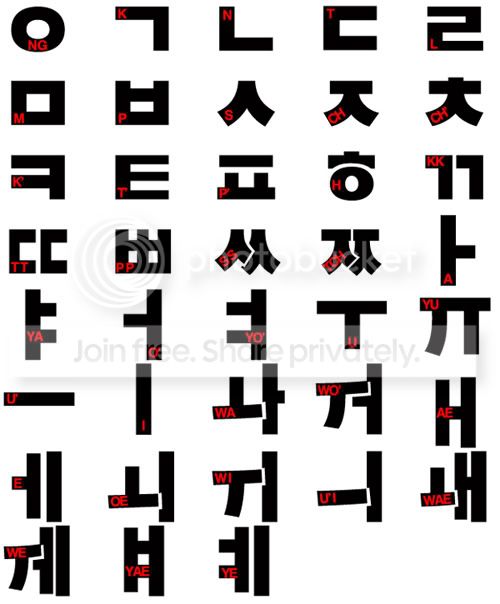 This chart of hanguel may be of use to you. This chart of hanguel may be of use to you.----- "Korean (한국어/조선말*) is the official language of Korea, both South and North. It is also one of the two official languages in the Yanbian Korean Autonomous Prefecture in China. There are about 78 million Korean speakers worldwide. In the 15th century a national writing system was commissioned by Sejong the Great, the system being currently called Hangeul. Prior to the development of Hangeul, Koreans used Hanja (Chinese characters) to write for over a millennium. The genealogical classification of the Korean language is debated by a small number of linguists. Most classify it as a language isolate while a few consider it to be in the Altaic language family. Some believe it to be distantly related to Japanese-Ryukyuan. The Korean language is agglutinative in its morphology and SOV in its syntax." -- taken from Wikipedia. *조선말/Joseonmal is what Korean is called in the DPRK, or North Korea. ----- Lesson ContentsLessons can be changed according to demands from students. Please PM with requests/questions.1. Introduction to Hangeul. (Complete. Please PM questions and feedback in regards to this lesson.) 2. Hello. I'm Patricia .(Complete.) 3. No, I'm an office worker. (Complete.) 4. Where is the bathroom? (Complete.) 5. Do you have any Korean friends? (Complete.)
|
 |
|
|
|
|
|
|
|
|
|
|
|
|
|
Posted: Sat Jun 19, 2010 2:13 pm
Lesson 1 | 제1과
Introduction to Hangeul Hangeul, the Korean writing system.In 1443, King Sejong gathered together a group of scholars to create Hangeul, the Korean writing system used today. Until that time, spoken Korean was put into writing using classical Chinese characters (漢字/한자/ hanja), which restricted literacy to the few favored scholars (양반/ yangban). King Sejong wished to create an alphabet that would allow anyone to be able to read and write in just a short period of study, earning him the distinction of being one of two Korean kings with the appellate "the Great". ----- The origins of HanguelVowels in Hanguel symbolize natural phenomena. Vowels are built from the following elements: " · " (representing heaven/sky) " ㅡ " (representing land/earth) " ㅣ " (representing a person) So, for example, ㅣ + · = ㅏ. At present, there are twenty-one vowels in Korean. ----- The basic six vowels. ㅏ -- a, as in "f ather" ㅓ -- eo, as in " up" in American English, "t op" in British English ㅗ -- o. as in "g o ㅜ -- u, as in "wh o ㅡ -- eu, as in "tak en ㅣ -- i, as in t eeth Silent "ㅇ".In Hangeul one can form a syllable with one vowel (and no consonant), but in order to form a syllable, a silent "ㅇ" must be placed in front of the vowel. ----- Practice!Practice writing/speaking aloud these Korean words that use only vowels.1. 이2. 이3. 오4. 아이5. 오이1. "i", teeth
2. "i", two
3. "o", five
4. "ai", child
5. "oi", cucumber ----- Four combined vowels with "y".The basic vowels "ㅏ, ㅓ, ㅗ, ㅜ" are combined with "y" to form the vowels "ㅑ, ㅕ, ㅛ, ㅠ". The mouth positions are the same. ㅑ -- ya, as in " yard" ㅕ -- yeo, as in " yawn" ㅛ -- yo, as in " yogurt" in American English, " yodel" in British English ㅠ -- yu, as in " you" 아 becomes 야, and so on. Essentially, an extra stroke is added to the basic vowels, with the exception of "이". ----- Four vowel combinations.The following vowels have similar sounds. ㅐ -- ae, as in " and" ㅒ -- yae, as in " yeh" or " Yale ㅔ -- e, as in " end" ㅖ -- ye, as in " yes" The pronunciation of the above vowels is hard to distinguish in everyday speech. For practical purposes, you can consider the pronunciations the same (애 = 에, 얘 = 예). ----- Seven vowel combinations.The following is an introduction to seven vowels which are combinations of two or more vowels. ㅘ -- wa, as in " want" in American English, " once" in British English. ㅝ -- wo, as in " once" in American English, " want" in British English. ㅙ -- wae, as in " wag" ㅞ -- we, as in " wedding" ㅚ -- oe, as in " weight" ㅟ -- wi, as in " we" ㅢ -- ui, as in "g ooey" Using the silent "ㅇ", the basic vowels are put together to make these sounds. For example, ㅗ + ㅏ = 와. -----
|
|
|
|
|
|
|
|
|
|
|
|
|
|
|
|
|
|
Posted: Sun Jun 20, 2010 9:03 pm
Lesson 1 | 제1과
Introduction to Hanguel (cont.) The consonants "ㄱ, ㄴ, ㅁ, ㅅ, ㅇ" are the basic consonants in Korean, and each consonant's shape depicts the position of the tongue/lips/throat/etc when making the sound. For instance, the sound made by "ㄴ" comes from the tongue touching the roof of the mouth, and the shape of "ㄴ" is meant to illustrate the tongue in that position. At present, there are nineteen consonants in Korean. ----- The basic five consonants.ㄱ -- k, as in "pic k or g, as in " good" ㄴ -- n, as in " no" ㅁ -- m, as in " mom" ㅅ -- s, as in " sad" or sh, as in " sheet"* ㅇ -- ø, no sound When combining consonants and vowels, replace the silent "ㅇ" with a consonant. ㄱ + 아 = 가ㄴ + 이 = 니ㅁ + 우 = 무ㅅ + 오 = 소*When "ㅅ" is combined with the vowel, "ㅣ, ㅑ, ㅕ, ㅛ, ㅠ", is is pronounced sh. -- Practice!Practice writing/speaking aloud these Korean words that use only the five basic consonants and six basic vowels.1. 나무2. 고기3. 소4. 나이5. 어머니6. 가수1. "namu", tree
2. "gogi", meat
3. "so", cow
4. "nai", age
5. "eomeoni", mother
6. "gasu", singer -----
Four (more) consonants.
The next four consonants are similar to the basic consonants, but with additional strokes. "ㄷ" and "ㄹ" are derived from "ㄴ"; "ㅂ" is derived from "ㅁ"; and "ㅈ" is derived from "ㅅ".
ㄷ -- t, as in
battle; d, as in "deep"
ㄹ -- l, as in "ball; r, as in "x=ray"
ㅂ -- p, as in "pop; b, as in "baby"
ㅈ -- j, as in "juice"
When combining consonants and vowels, replace the silent "ㅇ" with a consonant.
ㄷ + 오 = 도
ㄹ + 우 = 루
ㅂ + 아 = 바
ㅈ + 이 = 이지 -- Practice!
Practice writing/speaking aloud these Korean words that use only the five basic consonants and six basic vowels.
1. 머리
2. 구두
3. 지도
4. 바다
5. 아버지
6. 여자 1. "mori", head
2. "gudu", shoes
3. "jido", map
4. "bada", sea
5. "abeoji", father
6. "yeoja", woman
-----
|
|
|
|
|
|
|
|
|
|
|
|
|
|
|
Posted: Mon Jun 21, 2010 9:06 pm
Lesson 1 | 제1과
Introduction to Hanguel (fin.) Nine final consonants.A consonant which occurs below the vowel is called a final consonant (batchim/받침)* and is pronounced after the vowel. In most cases, the pronunciation of the final consonant is the same as when it is pronounced as an initial sound. However, "ㅇ" is soundless as an initial consonant, but is pronounced as "ng" when it occurs as a final consonant. And "ㄷ, ㅅ, ㅈ" are all pronounced as "t" when they occur as final consonants. *This is why 받침 can be romanized batchim instead of badchim. ㄱ -- k, as in "coo k" ㄴ -- n, as in "noo n" ㄹ* -- l, as in "ca ll" ㅁ -- m, as in "hu m" ㅂ -- p, as in "cho p" ㅇ -- ng, as in "ri ng" ㄷ = ㅅ = ㅈ -- t, as in "ge t" Remember that there are only seven possible pronunciations for final consonants. *When "ㄹ" occurs between two vowel sounds (i.e. 머리), it is pronounced close to "r".
When "ㄹ" occurs as a final consonant, it is pronounced more like "l". ----- Five aspirated consonants.The consonants "ㅋ, ㅍ, ㅌ, ㅊ, ㅎ" are derived from the following consonants "ㄱ, ㅂ, ㄷ, ㅈ, ㅇ", but with stronger sounds. "ㅋ" is derived from "ㄱ"; "ㅍ" is derived from "ㅂ"; "ㅌ" is derived from "ㄷ"; "ㅊ" is derived from "ㅈ"; and "ㅎ" is derived from "ㅇ". ㅋ -- k, as in " kite" ㅍ -- p, as in " peace" ㅌ -- t, as in " tiger" ㅊ -- ch, as in " chicken" ㅎ -- h, as in " house" When they occur as final consonants, these consonants are read as follows. ㅋ = ㄱㅍ = ㅂㅌ = ㄷㅊ = ㅈ = ㄷㅎ = ㄷ----- Five tensed consonants.The following consonants are derived from the basic consonants, but these consonants are pronounced with an explosive sound (a sound produced by your almost-closed vocal chords vibrating as you let the air out). "ㄲ" is derived from "ㄱ" and "ㅋ"; "ㅃ" is derived from "ㅂ" and "ㅍ"; "ㄸ" is derived from "ㄷ" and "ㅌ"; "ㅆ" is derived from "ㅅ"; and "ㅉ" is derived from "ㅈ" and "ㅊ". ㄲ -- kk, as in " gotcha!" ㅃ -- pp, as in " bad!" ㄸ -- tt, as in " duh!" ㅆ -- ss, as in " sang" (with a strong pronunciation) ㅉ -- jj, as in "got cha!" ---- One last thing, Double final consonants.Occasionally two consonants appear below the vowel; this is called a double consonant. Sometimes only the first consonant is pronounced and sometimes only the second one is pronounced. In words with these double final consonants, "ㄴㅈ, ㄴㅎ, ㄹㅂ, ㅂㅅ", only the first final consonant is pronounced. 앉다 (anta*/to sit), 않다 (anta*/to not), 여덟 (yeodeol/eight), 값 (gap/price) In word with these double final consonants, "ㄹㄱ, ㄹㅁ", only the second consonant is pronounced. 닭 (dak/chicken), 삶 (sam/existence) *I chose to romanize the 다 as "ta", using a ㅌ/t sound instead, as batchim follow liason rules and affect pronunciation. ----- Practice!Practice writing/speaking aloud these Korean words.1. 밖2. 갔다3. 빵4. 토끼5. 비싸요6. 사과7. 돼지8. 외국인9. 부엌10. 꽃1. "bakk", outside
2. "gatda", went/gone
3. "bbang", bread
4. "tokki", rabbit
5. "bissayo", expensive
6. "sagwa", apple
7. "dwaeji", pig
8. "woegukin", foreigner
9. "bueok", kitchen
10. "kkot", flower
|
|
|
|
|
|
|
|
|
|
|
|
|
|
|
|
|
|
Posted: Sun Jun 27, 2010 8:51 pm
Lesson 2 | 제2과
Hello. I'm Patricia. 안녕하세요? 저는 패트리샤예요.In this lesson, we will discuss the following: 1. 예요/이에요 “is” 2. Question words 뭐 “what” and 어느 “which” 3. Topic marker 은/는 4. Countries and nationalities. ----- Key Sentences and Grammar.가: 이름이 뭐예요? 나: 저는 패트리샤 예요. 예요/이에요 “is”.Think of this pattern like an equal sign; it helps describe some equivalence between two things (such as “I am Patricia” or “She is a teacher”). ending in a vowel패트리샤 예요. I am Patricia. ending in a consonant
폴이에요.
I am Paul. The question word 뭐 “what”.Use 뭐 like the English word “what” when asking questions.* 가: 이름이 뭐예요? ( What is your name?) 나: 패트리샤예요. (I am Patricia.) *Korean is an SOV language. Therefore, 뭐+예요 goes at the end of the question.
이름이 뭐예요? (o)
뭐 이름이에요? (x) ----- Topic marker 은/는.The topic marker, as its name implies, designates the topic of a sentence. Not every sentence has to have a topic marker, however. Rather, the topic marker appears when one wants to stress a new topic. Think of how, when making introductions, you might use your hands to indicate the people to whom you’re referring. When making introductions in Korean, the topic marker functions like this gesture, emphasizing each person in turn. ending in a vowel저 는 패트리샤예요. I am Patricia. ( introducing yourself) ending in a consonant
선생님은 미국 사람이에요.
The teacher is American. ----- Countries and nationalities.가: 어느 나라 사람이에요? 나: 저는 한국 사람이에요. Describe someone’s nationality by saying the country name and then the word 사람 (saram/person)*. 보기: 한국 – Korea 한국 사람 – Korean *한국사람 (colloquial) = 한국인 (formal) The question word 어느 “which”.The question word 어느 followed by a noun allows you to ask someone to specify which among a category or group of objects. 가: 어느 나라 사람이에요? ( Which country are you from?) 나: 저는 미국 사람이에요. (I am American.)
|
|
|
|
|
|
|
|
|
|
|
|
|
|
|
Posted: Sun Jun 27, 2010 9:11 pm
Lesson 2 | 제2과
Hello. I'm Patricia. (cont.)
Dialogue 1 | 대화1 앤: 안녕하세요?* 사토루: 안녕하세요? 앤: 이름이 뭐예요? 사토루: 저는 사토루예요. 반갑습니다. 앤: 반갑습니다. Ann: Hello.
Satoru: Hello.
Ann: What’s your name?
Satoru: I am Satoru. What’s your name?
Ann: I am Ann. Nice to meet you.
Satoru: Nice to meet you. New vocabulary.이름 name 뭐 what 저는 I New expressions.안녕하세요? Hello. 이름이 뭐예요? What is your name? 반갑습니다. Nice to meet you. *안녕하세요? “Hello”.
Although this phrase is a greeting, you should pronounce it like a question, with your tone rising at the end. If you are meeting someone for the first time, bow your head a bit as you make your greeting.----- Dialogue 2 | 대화2 마크: 안녕하세요? 저는 마크예요. 유진: 안녕하세요? 저는 유진이에요. 마크: 유진 씨는 어느 나라 사람이에요? 유진: 저는 한국 사람이에요. 마크 씨는 어느 나라 사람이에요? 마크: 저는 미국 사람이에요. (The conversation continues for some time.) 유진: 다음에 또 봐요. 마크: 다음에 또 봐요. Mark: Hello. I am Mark.
Yujin: Hello. I am Yujin.
Mark: Yujin, which country are you from?
Yujin: I am Korean. Mark, which country are you from?
Mark: I am American.
(The conversation continues for some time.)
Yujin: See you later.
Mark: See you later. New vocabulary.씨 Mr., Miss, Mrs. 어느 which 나라 country 사람 person 한국 Korea 한국 사람 Korean (person) 미국 U.S.A. 미국 사람 American 다음에 next time 또 again 봐요 (I) see New expressions.어느 나라 사람이에요? Which country are you from? 다음에 또 봐요. See you later. *Use people’s names rather than the pronoun “you”.
In Korean, it’s not polite to use the pronoun “you” to someone you have just met. Instead, use the person’s full name or his given name followed by 씨 to indicate respect. But don’t use 씨 when referring to yourself!----- Useful phrases.Hello and goodbye.가: 안녕하세요? 나: 안녕하세요? 가: Hello.
나: Hello.
(When meeting someone for the first time, bow your head to indicated respect.) 가: 안영히 가세요. 나: 안녕히 가세요. 가: Goodbye.
나: Goodbye.
(When both are leaving.) 가: 안녕히 가세요. 나: 안녕히 계세요. 가: Goodbye.
나: Goodbye.
(When a person stays, he or she says 안녕히 가세요 to the person who leaves.
When a person leaves, he or she says 안녕히 계세요 to the person who stays.) ----- Pronunciation.사람이에요 --> /사라미에요/.When a noun ends in a final consonant and is followed by a vowel, the final consonant is pronounced as if it is the initial consonant of the next syllable (liason). But when the final consonant "ㅇ", pronounced as "ng" (such as 가방), the word is pronounced as written. (1) 폴이에요 --> /포리에요/(2) 선생님이에요 --> /선생니미에요/(3) 가방이에요 --> 가방이에요
|
|
|
|
|
|
|
|
|
|
|
|
|
|
|
|
|
|
Posted: Mon Jun 28, 2010 9:10 pm
Lesson 2 | 제2과
Hello. I'm Patricia. (fin.) Additional vocabulary. 아시아 | Asia1 한국 아시아 | Asia1 한국 | Korea 2 일본 | Japan 3 중국 | China 4 대만 | Taiwan 5 필리핀 | Philippines 6 인도네시아 | Indonesia 7 싱가포르 | Singapore 8 말레이시아 | Malaysia 유럽 | Europe9 영국 | Great Britain 10 독일 | Germany 11 프랑스 | France 12 러시아 | Russia 아메리카 | America13 미국 | U.S.A. 14 캐나다 | Canada 15 멕시코 | Mexico 16 브라질 | Brazil 17 아르헨티나 | Argentina 오세아니아 | Oceania18 호주 | Australia 19 뉴질랜드 | New Zealand 아프리카 | Africa20 가나 | Ghana 21 남아공 | South Africa ----- Quiz!Read the sentences and choose the correct answer, as in the example.보기: 이름이 뭐예요?1. 저는 지나 (예요./이에요.) 2. 저는 제임스 (예요./이에요.) 3. 저는 앤 (예요./이에요.) Read the sentence and write the correct answer, as in the example.보기: 어느 나라 사람이에요?I am Australian. -- 저는 호주 사람이에요.
4. I am Korean. 5. I am Japanese. 6. I am American. Read the following dialogue and complete the questions. (7~8 )7. 가: 이름이 _____ 예요? 나: 민수예요. 8. 가: _____ 사람이에요? 나: 한국 사람이에요. Read the following dialogue and write the appropriate sentence to fill in the blank. (9~10)가: 안녕하세요? 나: 안녕하세요? ___9___? 가: 저는 제인이에요. 나: _____10_____? 가: 캐나다 사람이에요. Please send answers via PM.
|
|
|
|
|
|
|
|
|
|
|
|
|
|
|
Posted: Sun Jul 04, 2010 9:23 pm
Lesson 3 | 제3과
No, I’m an office worker. 아니요, 회사원이에요.In this lesson, we will discuss the following: 1. 네/아니요 “yes/no” 2. Leaving out the subject of a sentence 3. Asking questions 4. Languages. ----- Key Sentences and Grammar.가: 폴 씨는 학생이에요? 나: 네, 학생이에요. 네/아니요 “yes/no”.Yes/no questions can be answered affirmatively with 네 and negatively with 아니요. 1. 가: 제인 씨는 선생님이에요? (Jane, are you a teacher?) 나: 네. ( Yes.) 2. 가: 메이 씨는 학생이에요? (Mei, are you a student?) 나: 아니요, 저는 의사예요. ( No, I am a doctor.) Leaving out the subject of a sentence.In Korean, rather than repeat the subject of the sentence, if the subject is understood you can leave it out. 가: 어느 나라 사람이에요? (Which country are you from?) 나: (저는) 호주 사람이에요. (I am Australian.) However, when changing the topic, do not leave the subject out of the first sentence. 가: 저는 한국 사람이에요. (I am Korean.) 제임스 씨는 어느 나라 사람이에요? (James, which country are you from?) 나: 영국 사람이에요. (I am British.) ----- Asking questions.가: 리에 씨는 회사원이에요? 나: 아니요, 일본어 선생님이에요. Think of questions and answers such as: “Who is he?” “He is Paul.” In English, questions and answers have different structures. Verbs, subjects, and objects move around depending on the context. In Korean, however, the structure of a question is the same as its answer. When answering a question, simply replace the question word (which, where, when, who, what, how) with your answer, keeping the original sentence structure. With yes/no questions, the question and answer can be exactly the same, except for the intonation – all questions end with a rising tone. 가: 마크 씨는 회사원이에요? ↑ (Mark, are you an office worker?) 나: 네, 저는 회사원이에요. ↓ (Yes, I am an office worker.) 가: 마크 씨는 어느 나라 사람이에요? ↑ (Mark, which country are you from?) 나: 처는 미국 사람이에요. ↓ (I am American.) ----- Languages.Names of languages are formed by placing 말 or 어 (literally, they mean language) after the name of the country. The only difference is that 말 is more informal, which 어 is more formal. English, however, is just 영어 without referring to a country.* country ----- language한국 (Korea) ----- 한구어/한국말 (Korean) 일본 (Japan) ----- 일본어/일본말 (Japanese) 중국 (China) ----- 중국어/중국말 (Chinese) 미국 (U.S.A.) ----- 영어* (English) 외국 (foreign country) ----- 외국어/외국말 (foreign language) *영어 (o)
영어말 (x)
|
|
|
|
|
|
|
|
|
|
|
|
|
|
|
|
|
|
Posted: Mon Jul 05, 2010 9:10 pm
Lesson 3 | 제3과
No, I’m an office worker. (cont.)
Dialogue 1 | 대화1 유진: 마크 씨는 학생이에요? 마크: 아니요. 유진: 그럼*, 선생님이에요? 마크: 아니요. 유진: 그럼, 회사원이에요? 마크: 네, 맞아요. 회사원이에요. Yujin: Mark, are you a student?
Mark: No.
Yujin: Then, are you a teacher?
Mark: No.
Yujin: Then, are you an office worker?
Mark: Yes, that’s right. I’m an office worker. New vocabulary.학생 student 그럼 then 선생님 teacher 회사원 office worker New expressions.아니요. No. 네. Yes. 맞아요. That’s right. *그럼 “Then”.
When asking a question to change a topic, 그럼 is usually followed by a pause. 그럼 is a frequently used short form of 그러면.----- Dialogue 2 | 대화2 제인: 진수 씨는 무슨 일 해요? 진수: 저는 회사원이에요. 제인 씨는 학생이에요? 제인: 아니요. 진수: 그럼, 무슨 일 해요? 제인: 영어 선생님이에요. 진수: 아, 그래요? Jane: Jinsu, what kind of work do you do?
Jinsu: I am an office worker.
Jane, are you a student?
Jane: No.
Jinsu: Then, what kind of work do you do?
Jane: I’m an English teacher.
Jinsu: Oh, really? New vocabulary.무슨 what kind of 일 work 해요 (I) do 영어 English New expressions.무슨 일 해요? What kind of work do you do? 아, 그래요? Oh, really? *The meaning of the honorific 님.
The 님 in 선생님 is an honorific. In Korea, 님 is attached to many jobs and titles to indicate respect. In particular, in the workplace where rank and status are clear, a subordinate will call a superior not by his/her name but rather by a title such as 사장님 (사장 the president of a company + 님 honorific). Usually you would not add the honorific 님 when referring to your own title/job.
*아, 그래요? “Oh, really?/Oh, is that right?/Oh yeah?”.
This phrase is not a serious question, but a polite way to show interest and attention, like the phrases “Oh, really?/Oh, is that right?/Oh yeah?” in English. Depending on nuance, this phrase can have many different meanings. In this case, this is written like a question, but the meaning is not really a question, so your tone should not rise too much at the end.----- Useful phrases.Greetings.In Korea, greetings differ depending on the formality of the situation and the age and status of the person you are greeting. 가: 안녕하세요? 가: Hello.
(When greeting someone older than you.
For example, parents, grandparents.) 가: 안녕하세요? 나: 안녕하세요? 가: Hello.
나: Hello.
(When greeting a stranger, or greeting someone you know but you need to speak politely to.
For example, teachers, older neighbors, strangers, co-workers.) 가: 안녕? 나: 안녕? 가: Hi.
나: Hi.
(When greeting a friend of the same age, especially a friend from youth.
For example, childhood friends, school friends.) 가: 안녕하십니까? 나: 안녕하십니까? 가: Hello.
나: Hello.
(When meeting someone of higher status, or with whom you have a working relationship.
For example, a boss, customers.) ----- Pronunciation.감사합니다 --> /감사함니다/.When a “ㄱ,ㄷ,ㅂ” final consonant is followed by an initial consonant “ㄴ,ㅁ”, the “ㄱ,ㄷ,ㅂ” is pronounced as /ㅇ,ㄴ,ㅁ/ accordingly. (1) ㄱ --> /ㅇ/ -- 한국말 → 한 궁말, 부엌문 → 부 엉문 (2) ㄷ --> /ㄴ/ – 닫는 → 단는, 씻는 → 씬는 (3) ㅂ --> /ㅁ/ – 미안합니다 → 미안 함니다, 앞문 → 암문
|
|
|
|
|
|
|
|
|
|
|
|
|
|
|
Posted: Tue Jul 06, 2010 10:33 pm
Lesson 3 | 제3과
No, I'm an office worker. (fin.) Additional vocabulary.1 학생 | student 2 선생님 | teacher 3 회사원 | office worker 4 의사 | doctor 5 간호사 | nurse 6 택시기사 | taxi driver 7 주부 | housewife 8 운동선수 | athlete 9 경찰 | police officer 10 군인 | soldier 11 교수 | professor 12 신부 | priest 13 수녀 | nun 14 목사 | pastor 15 변호사 | lawyer 16 승려 | monk 17 번역가 | translator 18 통역사 | interpreter ----- Quiz!Read the sentences and choose the correct answer.1. James, England 가: 제임스 씨예요? 나: (네/아니요), 제임스예요. 가: 미국 사람이에요? 나: (네/아니요), 영국 사람이에요. 2. Mei, China 가: 리에 씨예요? 나: (네/아니요), 메이예요. 가: 중국 사람이에요? 나: (네/아니요), 중국 사람이에요. Read the sentence and write the correct answer, as in the example.보기: "Hola."가: 독일어 선생님이에요? 나: 아니요, 스페인어 선생님이에요. 3. "Thank you." 가: 프랑스어 선생님이에요? 나: 아니요, _____ 선생님이에요. 4. "안녕하세요." 가: 일본어 선생님이에요? 나: 아니요, _____ 선생님이에요. Match each question to it's answer. (5~7)5. 학생이에요? -------------- a. 영어 선생님이에요. 6. 무슨 일 해요? ------------- b. 아니요, 캐나다 사람이에요. 7. 미국 사람이에요? ---------- c. 네, 학생이에요. Read the following dialogue and write the appropriate sentence to fill in the blank. (8~10)가: 톰 씨는 선생님이에요? 나: 아니요. 가: 그럼, ____8____? 나: 네, 회사원이에요. 유미 씨는 학생이에요? 가: 아니요. 나: 무슨 ____9____? 가: ____10____. Please send answers via PM.
|
|
|
|
|
|
|
|
|
|
|
|
|
|
|
|
|
|
Posted: Tue Jul 13, 2010 3:22 am
Lesson 4 | 제4과
Where is the bathroom? 아니요, 회사원이에요.In this lesson, we will discuss the following: 1. 있어요/없어요 “there is(are)/there is(are) not” 2. Place marker 에 3. The question word 어디 "where" 4. Location. ----- Key Sentences and Grammar.가: 마크 씨가 어디에 있어요? 나: 사무실 에 있어요. 있어요/없어요 “there is(are)/there is(are) not”.Use 있어요 when something exists, 없어요 when something does not. Place the subject marker 이/가 after the noun which exists (or not) and then 있어요/없어요. 보기: 의자가 있어요. ( There is a chair.) 의자가 없어요. ( There is not a chair.) Place marker 에.Putting the place marker 에 after a noun indicates a spacial location.* 보기: 폴이 공원 에 있어요. = 공원 에 폴이 있어요. (Paul is at the park.) It doesn't matter whether the object is specified before the location, or vice versa. However, 있어요 and 없어요 always come at the end. (SOV language, remember?)*Occasionally, 에서 will be seen. This place marker is unique in that it indicates a place in which something is done. For example, 도서관에서 공부해요. = I study at the library. ----- The question word 어디 "where".Using 어디, followed by the place marker 에 with the verb 있어요 allows you to ask where something is located. 가: 선생님이 어디에 있어요? ( Where is the teacher?) 나: (선생님이) 학교에 있어요. ((The teacher) is at school.) 가: 책이 어디에 있어요? 나: 책상 위에 있어요. ----- Locations.1 위 | on 2 아래 | under 3 앞 | in front of 4 뒤 | behind 5 옆 | next to 6 오른쪽 | on the right 7 왼쪽 | on the left 8 하고 ~ 사이 | between the ~ and the ~ 9 안 | inside 10 빡 | outside
|
|
|
|
|
|
|
|
|
|
|
|
|
|
|
Posted: Thu Jul 22, 2010 5:11 pm
WOO HOO KOREAN!
I will be reviewing with your wonderful basic information here, and be back in August. I am PRAYING that our university resumes Korean tutoring class and that I can take it. I had a few lessons last semester and fell in love with the language and kdramas. xd
And Rain WAS awesome in Ninja Assassin. ninja
|
|
|
|
|
|
|
|
|
|
|
|
|
|
|
|
|
|
Posted: Sun Aug 08, 2010 8:59 pm
안녕하세요, 여러분!
어제밤에 늦게 한국에서 돌아왔어서 아직도 다음 과업이 써지 않았어요.
죄송하지만 일때문에 정말 바빠서 오늘밤에 시간이 있으면 쓸거예요.
그때까지이 비디오를 보세요~^^ Hello everyone!
I returned to Korea late last night, so I haven't finished writing the next lesson yet.
I'm sorry, but because of work I've been really busy, so I will write it tonight if I have time.
Until then, watch this video~^^
|
|
|
|
|
|
|
|
|
|
|
|
|
|
|
Posted: Wed Aug 11, 2010 5:18 pm
Lesson 4 | 제4과
Where is the bathroom? (cont.)
Dialogue 1 | 대화1 폴: 저, 이 근처에 화장실 있어요? 메이: 네, 있어요. 폴: 어디에 있어요? 메이: 저기 자판기 옆에 있어요. 폴: 감사합니다. 메이: 네.* Paul: Excuse me, is there a bathroom near here?
Mei: Yes, there is.
Paul: Where is it?
Mei: Over there, next to the vending machine.
Paul: Thank you.
Mei: You're welcome. New vocabulary.이 근처에 near here 화장실 bathroom 있어요 there is 어디에 where 저기 over there 자판기 vending machine 옆에 next to New expressions.저 Excuse me.* 이 근처에 ~ 있어요? Is there ~ near here? 어디에 있어요? Where is it? 감사합니다. Thank you. 네. You're welcome. *저 "Excuse me".
저 is a polite way to get someone's attention in order to ask them something. You can use it with someone nearby who you don't know. 저 is followed by a small pause to allow the person to pay attention, and then you can begin your conversation. 저기요 is also used this way.
*네. "You're welcome".
There are various ways of expressing thanks/your welcome, depending on the situation. 네 is often used with strangers or in formal situations in order to convey a feeling of politeness.----- Dialogue 2 | 대화2 유진: 마크 씨, 집에 어디에 있어요? 마크: 신촌에 있어요. 유진: 신촌 어디에 있어요? 마크: 신촌 약국 알아요? 유진: 아니요, 몰라요. 마크: 그럼, 신촌 백화점 일아요? 유진: 네, 알아요. 마크: 신촌 백화점 바로 뒤에 있어요. Yujin: Mark, where is your house?
Mark: It's in Sinchon.
Yujin: Where in Sinchon?*
Mark: Do you know Sinchon Pharmacy?
Yujin: No, I don't.
Mark: Then do you know Sinchon Department Store?
Yujin: Yes, I do.
Mark: My house is right* behind Sinchon Department Store. New vocabulary.집 house 신촌 Sinchon (an area of Seoul) 약국 pharmacy 알아요 I know 몰라요 I don't know 백화점 department store 바로 right, just 뒤에 behind New expressions.~ 알아요? Do you know ~? 신촌 어디에 있어요? Where in Sinchon? 바로 뒤에 있어요. It is right behind. *신촌 어디에 있어요? "Where in Sinchon?"
This pattern is used when you are trying to find a more exact location. The area you're asking about is followed by the phrase 어디에 있어요?
*바로 "right, just, precisely, exactly"
Used for emphasis; place 바로 right in front of the word you want to emphasize.----- Useful phrases.Saying thanks.In Korean, the same things may be said in different ways, depending on the situation and whom you are talking. 가: 감사합니다. 나: 네. 가: Thank you.
나: You're welcome.
(When speaking politely in a formal situation.
For instance, to a customer, a person that is older than you, or a stranger.) 가: 고마워요. 나: 아니에요. 가: Thank you.
나: It's nothing.
(When speaking politely in a semi-formal situation.
For instance, to a close co-worker.) 가: 고마워! 나: 뭘. 가: Thanks!
나: It's nothing.
(When speaking friendly in an informal situation.
For example, to a classmate or childhood friend.) ----- Pronunciation.없어요 --> /업써요/.Sometimes a word (such as 없) contains a double final consonant. If the second consonant is "ㅅ" and it is followed by a vowel (as in 없어요), this "ㅅ" is pronounced as a strong /ㅆ/ sound in the next syllable. So 없어요 is pronounced as /업써요/. (1) 값이 --> /갑 씨/ (2) 몫이에요 --> /목 씨에요/
|
|
|
|
|
|
|
|
|
|
|
|
|
|
|
|
|
|
Posted: Wed Aug 11, 2010 10:30 pm
Lesson 4 | 제4과
Where is the bathroom? (fin.) Additional vocabulary.1 집 | house 2 편의점 | convenience store 3 은행 | bank 4 병원 | hospital 5 약국 | pharmacy 6 학교 | school 7 극장 | theater 8 백화점 | department store 9 식당 | restaurant 10 회사 | company 11 가게 | store 12 시장 | market 13 주차장 | parking lot 14 주유소 | gas station 15 대사관 | embassy 16 공항 | airport 17 공원 | park 18 서점 | bookstore 19 우체국 | post office 20 커피숍 | coffee shop ----- Quiz!Read the English sentences and fill in the correct answer. (1~4)1. Paul is at a restaurant. 가: 폴 씨가 어디에 있어요? 나: _____에 있어요. 2. Ann is at the hospital. 가: 앤 씨가 어디에 있어요? 나: _____에 있어요. 3. In-ho is at home. 가: 인호 씨가 어디에 있어요? 나: __________. 4. Rie is at the pharmacy. 가: 리에 씨가 어디에 있어요? 나: __________. Read the following dialogue and complete the questions. (5~6)5. 가: 마크 씨가 _____ 있어요? 나: 공원에 있어요. 6. 가: 제인 싸가 __________? 나: 병원에 있어요. Read the English sentence and write the correct answer in the blank. (7~9)7. The clock is on the table. 가: 시계가 어디에 있어요? 나: 책상 ____에 있어요. 8. The book is next to the glasses. 가: 책이 어디에 있어요? 나: 안경 _____에 있어요. 9. The glasses are between the book and the clock. 가: 안경이 어디에 있어요? 나: 책하고 시게 _____에 있어요. Read the following and explain where Paul's house is in English. (10)"풀 씨 집 근처에 빌딩이 많이 있어요. 폴 씨 집 엪에 식당이 있어요. 폴 씨 집 앞에 병원이 있어요. 폴 씨 집 오른쪽에 편의점이 있어요. 그런데 폴 씨 집 옆에 은행이 없어요." Please send answers via PM.
|
|
|
|
|
|
|
|
|
|
|
|
|
|
|
|
|
|