|
|
|
|
|
|
|
|
|
 Posted: Tue Jul 03, 2007 11:35 am Posted: Tue Jul 03, 2007 11:35 am

This thread has been created to give our fellow members a basic idea about the Egyptian religion, along with a few of their Gods. Religion in ancient Egypt was not unlike modern times. Today, not everyone believes in the same way, or of the same god. Egypt was no different. Individual kings worshipped their own gods, as did the workers, priests, merchants and peasants. Pre-dynastic Egypt had formulated the ideas and beliefs of a "greater being", which was expressed in pictures, but some scholars suggest that "writing" was invented in order to communicate spiritual thoughts to the masses.
Now the pictures had ideas, and took on human traits. The gods lived, died, hunted, went into battle, gave birth, ate, drank, and had human emotions. The gods reigns overlapped, and, in some instances, merged. Their was no organized hierarchy structure of their reign. The dominance of the gods depended on the beliefs of the reigning king. Their area of dominance depended on where the king wanted his capital.
Likewise, the myths changed with the location of the gods, as did their names. Names in ancient Egypt were very mystic and powerful. It was thought that if you inscribed your enemies' name on something, then broke it, that enemy would either be afflicted, or possibly die. If you knew a name you had power. In the same respect, using a name could be beneficial. Each god had five names, and each was associated with an element, such as air, with celestial bodies, or were a descriptive statement about the god, such as strong, virile or majestic.
The creator of all things was either Re, Amun, Ptah, Khnum or Aten, depending on which version of the myth was currently in use. The heavens were represented by Hathor, Bat, and Horus. Osiris was an earth god as was Ptah. The annual flooding of the Nile was Hapi. Storms, evil and confusion were Seth. His counterpart was Ma'at, who represented balance, justice and truth. The moon was Thoth and Khonsu. Re, the sun god, took on many forms, and transcended most of the borders that contained the other gods. The actual shape of the sun, the disk (or, aten), was deified into another god, Aten.
As mentioned earlier, certain gods were worshipped in different areas. Local cities or villages, known as nomes, often had unique gods that were known only to that region. On occasion, these gods attained country -wide recognition and became the myths and legends that were passed on from century to century.
 Borrowed in part from www .touregypt.net/gods1.htm
|
 |
|
|
|
|
|
|
|
|
|
|
|
|
|
Posted: Tue Jul 03, 2007 11:36 am
No overall male or female figures that equate to the Lord and Lady are given, as the Egyptian civilization was the longest in human history. Gods and goddesses changed or gained or lost prominence over the centuries. This is just a basic list:
Amon
first worshipped as the God of fertility and for a time, he was considered the most important God of Egypt
Anath
the Goddess of heaven and protector of the pharaoh
Anhur
God of war, "the Saviour"
Anubis
the God of the dead and protection
Anukis
the Goddess of Water
Apis
a symbol of fertility and the undying soul in the form of a black wolf
Aten
Sun God who lost footing among other Gods and was replaced by Ra
Bastet (Bast)
Goddess of cats, fertility and the moon
Bes
God of good fortune, protector of pregnant women
Beset
Feminine side of Bes
Geb
God of the earth
Hathor
God of business, beauty, joy, love, harmony, children, and the all seeing "Eye of Ra"
Horus
God of the sky, son of Osiris.
Hauhet
Goddess of infinity
Hekat
Goddess of midwifery and childbirth
Hu
Male counterpart to Hauhet
Input
Female counterpart to Anubis
Isis
Goddess of all, divine mother, parter of Osiris
Ius-a'as
Goddess of creatation
Ma'at
Goddess of truth
Mehet-Weret
Goddess of sky and floods
Merit
Goddess of music
Min
God of roads, fertility, agriculture and the protector of travelers
Neith
Goddess of destiny, war, the mother of Ra, protector of the dead, she was bisexual
Nekhbet
Primal mother Goddess and divine nurse
Nephthys
Goddess of secrets, initiation and the dead
Nut
Goddess of the sky
Osiris
God of vegetation and the dead, parter to Isis
Ptah
God of learning, architecture and building
Ra
God of the sun, son of Neith
Renenet
Goddess of prosperity and the home
Sekhmet
Goddess of protection, associated of Bastet
Selket
Goddess of scorpions, dead, travelers and the weather
Seshat
Goddess of writing and libraries
Seth
God of storms and chaos
Shu
Goddess of moisture
Sobek
Crocodile God of lakes and protection
Taweret
Goddess of childbirth in the form of a hippo
Tefnut
God of air
Thoth
God of knowlegde, wisdom and the moon
Wadjet
Serpent Goddess of protection, children and the land
Wenut
"the swift one" - moves things quickly, is a hare or serpent
Wosret
the powerful woman
|
|
|
|
|
|
|
|
|
|
|
|
|
|
|
|
|
|
Posted: Tue Jul 03, 2007 11:37 am
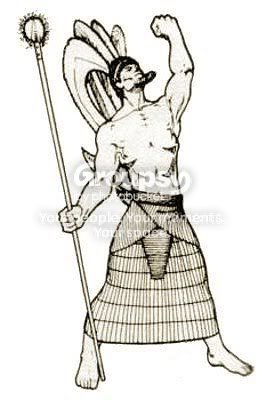 In early Egyptian mythology, Anhur was originally a foreign god of war, who started being worshipped in the Egyptian area of Abydos, and particularly in Thinis, during the 11th dynasty. Myths told that he had brought his wife, Menhit, who was his female counterpart, from Nubia, and his name reflects this - it means (one who) leads back the distant one. One of his titles was Slayer of Enemies. Anhur was depicted as a bearded man wearing a robe and a headdress with four feathers, holding a spear or lance, or occasionally as a lion-headed god (representing strength and power). In some depictions, the robe was more similar to a kilt. Due to his position as a war god, he was patron of the ancient Egyptian army, and the personification of royal warriors. Indeed, at festivals honoring him, mock battles were staged. During the Roman Era the Emperor Tiberius was depicted on the walls of Egyptian temples wearing the distinctive four-plumed crown of Anhur. In the New Kingdom, his popularity increased and Anhur was also titled Saviour, becoming to the people their deliverer from human burden, due to their view of war as their source of freedom and victory. The aspects of war, and saviour, shared with Horus, contributed to Anhur's eventual identification with the much greater Horus.
|
|
|
|
|
|
|
|
|
|
|
|
|
|
|
Posted: Tue Jul 03, 2007 11:38 am
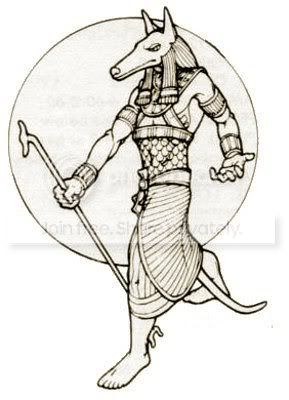 Anubis was the guardian of the dead, who greeted the souls in the Underworld and protected them on their journey. It was he who deemed the deceased worthy of becoming a star. Ancient Egyptian texts say that Anubis silently walked through the shadows of life and death and lurked in dark places. He was watchful by day as well as by night. He also weighed the heart of the dead against the feather symbol of Ma'at, the goddess of truth. One of the reasons that the ancient Egyptians took such care to preserve their dead with sweet-smelling herbs was that it was believed Anubis would check each person with his keen canine nose. Only if they smelled pure would he allow them to enter the Kingdom of the Dead. Anubis was portrayed as a jackal-headed man, or as a jackal wearing ribbons and holding a flagellum in the crook of its arm. Some think that he was not pictured as a jackal but as a dog, fox, wolf, or hybrid instead. Very rarely is he ever shown fully human. Anubis was always shown as a black jackal or dog, even though real jackals are typically tan or a light brown. To the Egyptians black was the color of regeneration, death, and the night. It was also the color that the body turned during mummification. The reason for Anubis' animal being canine is based on what the ancient Egyptians themselves observed of the creature - dogs and jackals often haunted the edges of the desert, especially near the cemeteries where the dead were buried. In fact, it is thought that the Egyptians began the practice of making elaborate graves and tombs to protect the dead from desecration by jackals. A statue of Anubis, jackal-form, was found in Tutankhamen's tomb. When pet dogs died, they were mummified and buried in temples dedicated to Anubis. Following the merging of the Ennead and Ogdoad belief systems, as a result of the identification of Atum with Ra, and their compatibility, Anubis became considered a lesser god in the underworld, giving way to the more popular Osiris. Indeed, when the Legend of Osiris and Isis emerged, it was said that when Osiris had died, Osiris' organs were given to Anubis as a gift. Since he had been more associated with beliefs about the weighing of the heart than had Osiris, Anubis retained this aspect, and became considered more the gatekeeper and ruler of the underworld, the "Guardian of the veil" (of "death"). As such, he was said to protect souls as they journeyed there, and thus be the patron of lost souls (and consequently orphans). Rather than god of death, he had become god of dying, and consequently funeral arrangements. It was as the god of dying that his identity merged with that of Wepwawet, a similar jackal-headed god, associated with funerary practice, who had been worshiped in Upper Egypt, whereas Anubis' cult had centered in Lower Egypt. As one of the most important funerary rites in Egypt involved the process of embalming, so it was that Anubis became the god of embalming, in the process gaining titles such as "He who belongs to the mummy wrappings", and "He who is before the divine [embalming] booth". High priests often wore the Anubis mask to perform the ceremonial deeds of embalming. It also became said, frequently in the Book of the Dead, that it had been Anubis who embalmed the dead body of Osiris (which would make him the older sibling of Horus), with the assistance of the other main funerary deities involved - Nephthys and Isis. Having become god of embalming, Anubis became strongly associated with the (currently) mysterious and ancient imiut fetish, present during funerary rites, and Bast, who by this time was goddess of ointment, initially became thought of as his mother. No public procession in Egypt would be conducted without an Anubis to march at the head, the "go-between" of gods and men. The ancient Egyptians swore "by the Dog" when making oaths they would not break. However, as lesser of the two gods of the underworld, he gradually became considered the son of Osiris, but Osiris' wife, Isis, was not considered his mother, since she too inappropriately was associated with life. Instead, his mother became considered to be Nephthys, who had become strongly associated with funerary practice, indeed had in some ways become the personification of mourning, and was said to supply bandages to the deceased. Subsequently, this apparent infidelity of Osiris was explained in myth, in which it was said that a sexually frustrated Nephthys had disguised herself as Isis in order to appeal to her husband, Set, but he did not notice her as he was infertile (some modern versions depict Set as a homosexual, but these have little bearing on the original myth). However, Isis' husband Osiris mistook Nephthys for his wife, which resulted in Anubis' birth. Other versions of the myth depict Set as the father, and it remains unclear as to whether Set was truly infertile or not. In later times, during the Ptolemaic period, as their functions were similar, Anubis was identified as the Greek god Hermes, becoming Hermanubis. The centre of this cult was in uten-ha/Sa-ka/ Cynopolis, a place whose Greek name simply means "city of dogs". In Book XI of "The Golden a**" by Apuleius, we find evidence that the worship of this god was maintained in Rome at least up to the 2nd century. Indeed, Hermanubis also appears in the alchemical and hermetical literature of the Middle Ages and the Renaissance. Although the Greeks and Romans typically scorned Egypt's animal-headed gods as bizarre and primitive (they mockingly called Anubis the "Barker"), Anubis was sometimes associated with Sirius in heaven, and Cerberus in hell. Early Christians were also repulsed by Anubis; the writer Tertillian claimed that the Egyptians practiced a "despicable religion" in which the worshiper is "led like a slave by the greedy throat and filthy habits of a dog." Although it is true that his two emblematic creatures, the jackal and the dog, were in the ancient world notorious scavengers, one of the main functions of Anubis was to release the human body at death from the uncleanness that possessed it. He washed the body, embalmed it, perfumed it with myrrh, wrapped it with clean linen and received it at the door of the tomb – to the Egyptians he was "Lord of the Cleansing Room." As the Greeks and Christians did not embalm the bodies of their dead (and death itself was considered to be a terrifying thing), they associated the holy Anubis with disease and decay.
|
|
|
|
|
|
|
|
|
|
|
|
|
|
|
|
|
|
Posted: Tue Jul 03, 2007 11:39 am
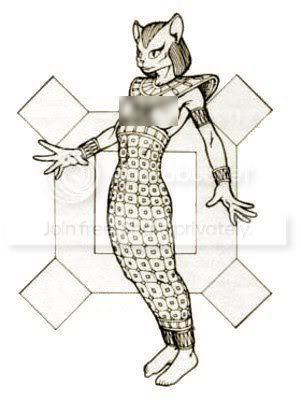 In Egyptian mythology, Bast (also spelled Bastet, Baset, Ubasti, and Pasht) is an ancient goddess, worshipped at least since the Second Dynasty. The centre of her cult was in Per-Bast (Bubastis in Greek), which was named after her. Originally she was viewed as the protector goddess of Lower Egypt, and consequently depicted as a fierce lion. Indeed, her name means (female) devourer. As protectress, she was seen as defender of the pharaoh, and consequently of the chief god, Ra, who was a solar deity, gaining her the titles Lady of Flame and Eye of Ra. Bast was originally a goddess of the sun, but later changed by the Greeks to a goddess of the moon. In Greek mythology, Bast is also known as Aelurus. Later scribes sometimes named her Bastet, a variation on Bast consisting of an additional feminine suffix to the one already present, thought to have been added to emphasise pronunciation. Since Bastet would literally mean (female) of the ointment jar, Bast gradually became thought of as the goddess of perfumes, earning the title perfumed protector. In connection with this, when Anubis became the god of embalming, Bast, as goddess of ointment, came to be regarded as his mother, although this association was broken in later years, when Anubis became Nephthys' son. This gentler characteristic, of Bast as goddess of perfumes, together with Lower Egypt's loss in the wars between Upper and Lower Egypt, led to a decrease in her ferocity. Thus, by the Middle Kingdom she was generally regarded as a domestic cat rather than a lionness. Occasionally, however, she was depicted holding a lionness mask, which hinted at suppressed ferocity. Because domestic cats tend to be tender and protective toward their offspring, Bast was also regarded as a good mother, and she was sometimes depicted with numerous kittens. Consequently, a woman who wanted children sometimes wore an amulet showing the goddess with kittens, the number of which indicated her own desired number of children. Due to the severe disaster to the food supply that could be caused by simple vermin such as mice and rats, and their ability to fight and kill snakes, especially cobras, cats in Egypt were revered heavily, sometimes being given golden jewelry to wear, and being allowed to eat from the same plates as their owners. Consequently, as the main cat (rather than lion) deity, Bast was strongly revered as the patron of cats, and thus it was in the temple at Per-Bast that dead (and mummified) cats were brought for burial. Over 300,000 mummified cats were discovered when Bast's temple at Per-Bast was excavated. As a cat/lion goddess, and protector of the lands, when, during the New Kingdom, the fierce lion god Maahes became part of Egyptian mythology, she was identified, in the Lower Kingdom, as his mother. This paralleled the identification of the fierce lion goddess Sekhmet, as his mother in the Upper Kingdom. As divine mother, and more especially as protectress, for Lower Egypt, she became strongly associated with Wadjet, the patron goddess of Lower Egypt, eventually becoming Wadjet-Bast, paralleling the similar pair of patron (Nekhbet) and lioness protector (Sekhmet) for Upper Egypt. Eventually, her position as patron and protector of Lower Egypt, lead to her being identified as the more substantial goddess Mut, whose cult had risen to power with that of Amun, and eventually being absorbed into her as Mut-Wadjet-Bast. Shortly after, Mut also absorbed the identities of the Sekhmet-Nekhbet pairing as well. This merging of identities of similar goddesses has lead to considerable confusion, leading to some associating things such as the title Mistress of the Sistrum (more properly belonging to Hathor, who had become thought of as an aspect of Isis, as had Mut), and the idea of her as a lunar goddess (more properly an attribute of Mut). Indeed, much of this confusion occurred to subsequent generations, as the identities slowly merged, leading to the Greeks, who sometimes named her Ailuros (Greek for cat), thinking of Bast as a version of Artemis, their own moon goddess. And thus, to fit their own cosmology, to the Greeks, Bast was thought of as the sister of Horus, who they identified as Apollo (Artemis' brother), and consequently the daughter of Isis and Osiris.
|
|
|
|
|
|
|
|
|
|
|
|
|
|
|
Posted: Tue Jul 03, 2007 11:40 am
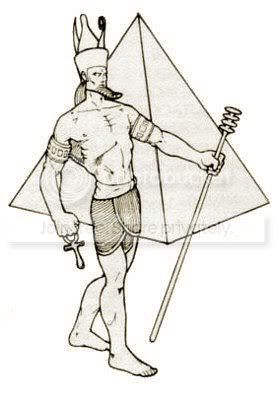 Amongst the group who believed in the Ennead, a form of Egyptian mythology centred in Heliopolis, Geb (also spelt Seb, and Keb) was the personification of the earth, and indeed this is what his name means - earth, and thus it was said that when he laughed, it caused earthquakes. Since the Egyptians held that their underworld was literally that, under the earth, Geb was sometimes seen as containing the dead, or imprisoning those not worthy to go to Aaru. In the Ennead, he is the husband of Nut, the sky, the son of the primordial elements Tefnut (moisture) and Shu (dryness), and the father to the four lesser gods of the system - Osiris, Set, Isis, and Nephthys. In this context, Geb was said to have originally been engaged in eternal sex with Nut, and had to be separated from her by Tefnut. Consequently, in early depictions he was shown reclining, with his phallus pointed towards Nut. As time progressed, the hieroglyph used in his name became more associated with the habitable land of Egypt, and so thus vegetation. Likewise, since it was used as his name, he too became associated with vegetation, with barley being said to grow upon his ribs, and was depicted with plants and other green patches on his body. Gradually, vegetation began to be thought of as something that ought to be fat, and plump, and so the hieroglyph was used in these words too. Because of this association with fatness, and vegetation, and so forth, the individual glyph became used as the word for goose. Indeed, the accession of a new pharaoh was announced by releasing four wild geese, to the four corners of the sky, to bless his reign with prosperity. This led to Geb's name also taking the meaning goose, and so, it was for this reason that Geb became called the Great Cackler, and subsequently represented as a black goose, where black represented the fertile soil. When the Ennead and Ogdoad later merged, it was thus Geb who was considered the goose who laid the egg from which Ra emerged. His association with vegetation, and sometimes with the underworld, also brought him the occasional interpretation that he was the husband of Renenutet, a minor goddess of the harvest, who was the mother of Nehebkau, a god associated with the underworld, who was on the same occasions said to be his son by her. He is also the predecessor of the Greek titan Kronos.
The Hymn of Geb says:
-
Behold, I rejoice on my standard, on my seat.
-
I am the creator of darkness,
-
making his place in the limits of the sky,
-
the ruler of infinity.
-
I rejoice in the lord of the palace.
-
My nest is unseen; I have broken the egg.
-
I am the lord of millions of years.
-
I have made my nest in the limits of the sky,
-
and descended to the earth as the Goose,
-
who drives out all sins.
|
|
|
|
|
|
|
|
|
|
|
|
|
|
|
|
|
|
Posted: Tue Jul 03, 2007 11:41 am
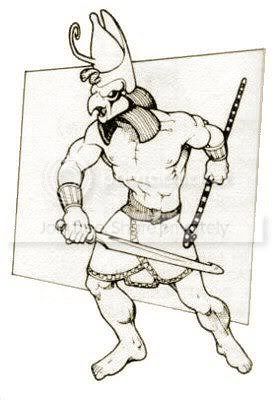 Horus is an ancient god of the Ancient Egyptian religion, whose cult survived so long that he evolved dramatically over time and gained many names. The most well known name is the Greek Horus, representing the Egyptian Heru/Har, which is the basic element in most of the other names of Horus. Horus was so important that the Eye of Horus became an important Egyptian symbol of power. He had a man's body and a falcon's head. He only had one eye because after Osiris was murdered by his brother Set, Horus fought with Set for the throne of Egypt. In this battle Horus lost one of his eyes and later this became a sign of protection in Egypt. In one story he has said to have cut off his mother's head. Horus united Egypt and bestowed divinity upon the pharaoh. Horus is recorded in Egyptian hieroglyphs as ḥr.w and is reconstructed to have been pronounced *Ḥāru, meaning "Falcon". By Coptic times, the name became Hōr. It was adopted into Greek as Ὡρος Hōros. The original name also survives in later Egyptian names such as Har-Si-Ese literally "Horus, son of Isis". Sky god Horus is the god of the sky, and the son of Osiris. His mother is Isis. Since he was god of the sky, Horus became depicted as a falcon, or as a falcon-headed man, leading to Horus' name, (in Egyptian, Heru), which meant The distant one. Horus was also sometimes known as Nekheny (meaning falcon), although it has been proposed that Nekheny may have been another falcon-god, worshipped at Nekhen (city of the hawk), that became identified as Horus very early on. In this form, he was sometimes given the title Kemwer, meaning (the) great black (one). As Horus was the son of Osiris, and god of the sky, he became closely associated with the Pharaoh of Upper Egypt (where Horus was worshipped), and became their patron. The association with the Pharaoh brought with it the idea that he was the son of Isis, in her original form, who was regarded as a deification of the Queen. It was said that after the world was created, Horus landed on a perch, known as the djeba, which literally translates as finger, in order to rest, which consequently became considered sacred. On some occasions, Horus was referred to as lord of the djeba (i.e. lord of the perch or lord of the finger), a form in which he was especially worshipped at Buto, known as Djebauti, meaning (ones) of the djeba (the reason for the plural is not understood, and may just have been a result of Epenthesis, or Paragoge). The form of Djebauti eventually became depicted as an heron, nevertheless continuing to rest on the sacred perch. Sun god Since Horus was said to be the sky, it was natural that he was rapidly considered to also contain the sun and moon. It became said that the sun was one of his eyes and the moon the other, and that they traversed the sky when he, a falcon, flew across it. Thus he became known as Harmerty - Horus of two eyes. Later, the reason that the moon was not as bright as the sun was explained by a tale, known as the contestings of Horus and Set, originating as a metaphor for the conquest of Lower Egypt by Upper Egypt in about 3000BC. In this tale, it was said that Set, the patron of Lower Egypt, and Horus, the patron of Upper Egypt, had battled for Egypt brutally, with neither side victorious, until eventually the gods sided with Horus. As Horus was the ultimate victor he became known as Harsiesis, Heru-ur or Har-Wer (ḥr.w wr 'Horus the Great'), but more usually translated as Horus the Elder. In the struggle Set had lost a testicle, explaining why the desert, which Set represented, is infertile. Horus' left eye had also been gouged out, which explained why the moon, which it represented, was so weak compared to the sun. It was also said that during a new-moon, Horus had become blinded and was titled Mekhenty-er-irty (mḫnty r ỉr.ty 'He who has no eyes'), while when the moon became visible again, he was re-titled Khenty-irty (ḫnty r ỉr.ty 'He who has eyes'). While blind, it was considered that Horus was quite dangerous, sometimes attacking his friends after mistaking them for enemies. Ultimately, as another sun god, Horus became identified with Ra as Ra-Herakhty rˁ-ˁḫr-3iḫṯ, literally Ra, who is Horus of the two horizons. However, this identification proved to be awkward, for it made Ra the son of Hathor, and therefore a created being rather than the creator. And, even worse, it made Ra into Horus, who was the son of Ra, i.e. it made Ra his own son and father, in a standard sexually-reproductive manner, an idea that would not be considered comprehensible until the Hellenic era. Consequently Ra and Horus never completely merged into a single falcon-headed sun god. Nevertheless the idea of making the identification persisted, and Ra continued to be depicted as falcon-headed. Likewise, as Ra-Herakhty, in an allusion to the Ogdoad creation myth, Horus was occasionally shown in art as a naked boy with a finger in his mouth sitting on a lotus with his mother. In the form of a youth, Horus was referred to as Neferhor. This is also spelled Nefer Hor, Nephoros or Nopheros (nfr ḥr.w) meaning 'The Good Horus'. In an attempt to resolve the conflict, Ra-Herakhty was occasionally said to be married to Iusaaset, which was technically his own shadow, having previously been Atum's shadow, before Atum was identified as Ra, in the form Atum-Ra, and thus of Ra-Herakhty when Ra was also identified as a form of Horus. In the version of the Ogdoad creation myth used by the Thoth cult, Thoth created Ra-Herakhty, via an egg, and so was said to be the father of Neferhor. Conqueror of Set By the Nineteenth dynasty, the previous brief enmity between Set and Horus, in which Horus had ripped off one of Set's testicles, was revitalised as a separate tale. According to Papyrus Chester-Beatty I, Set was considered to have been homosexual and is depicted as trying to prove his dominance by seducing Horus and then having intercourse with him. However, Horus places his hand between his thighs and catches Set's semen, then subsequently throws it in the river, so that he may not be said to have been inseminated by Set. Horus then deliberately spreads his own semen on some lettuce, which was Set's favorite food (the Egyptians thought that lettuce was phallic). After Set has eaten the lettuce, they go to the gods to try to settle the argument over the rule of Egypt. The gods first listen to Set's claim of dominance over Horus, and call his semen forth, but it answers from the river, invalidating his claim. Then, the gods listen to Horus' claim of having dominated Set, and call his semen forth, and it answers from inside Set.[1] In consequence, Horus is declared the ruler of Egypt. This myth, along with others, could be seen as an explanation of how the two kingdoms of Egypt (Upper and Lower) came to be united. Horus was seen as the God of Upper Egypt, and Set as the God of Lower Egypt. In this myth, the respective Upper and Lower deities have a fight, through which Horus is the victor. However, some of Horus (representing Upper Egypt) enters into Set (Lower Egypt) thus explaining why Upper Egypt is dominant over the Lower Egyptians. Brother of Isis When Ra assimilated Atum into Atum-Ra, Horus became considered part of what had been the Ennead. Since Atum had had no wife, having produced his children by masturbating de facto (the concept of masturbation being offensive in Egypt--Atum's hand being considered a female part), Hathor was easily inserted as the mother of the previously motherless subsequent generation of children. However, Horus did not fit in so easily, since if he was identified as the son of Hathor and Atum-Ra in the Ennead, he would then be the brother of the primordial air and moisture, and the uncle of the sky and earth, between which there was initially nothing, which was not very consistent with him being the sun. Instead, he was made the brother of Osiris, Isis, Set, and Nephthys, as this was the only plausible level at which he could meaningfully rule over the sun and the Pharaoh's kingdom. It was in this form that he was worshipped at Behdet as Har-Behedti (also abbreviated Bebti). Since Horus had become more and more identified with the sun since his identification as Ra, his identification as also the moon suffered, so it was possible for the rise of other moon gods, without complicating the system of belief too much. Consequently, Chons became the moon god. Thoth, who had also been the moon god, became much more associated with secondary mythological aspects of the moon, such as wisdom, healing, and peace making. When the cult of Thoth arose in power, Thoth was retroactively inserted into the earlier myths, making Thoth the one whose magic caused Set and Horus' semen to respond--in the tale of the contestings of Set and Horus, for example. Thoth's priests went on to explain how it was that there were 5 children of Geb and Nut. They said that Thoth had prophesied the birth of a great king of the gods and so Ra, afraid of being usurped, had cursed Nut with not being able to give birth at any point in the year. In order to remove this curse, Thoth proceeded to gamble with Chons, winning 1/72nd of moonlight from him. Prior to this time in Egyptian history, the calendar had 360 days, and so 1/72 of moonlight each day corresponded to 5 extra days, and so the tale states that Nut was able to give birth on each of these extra days, having 5 children. The Egyptian calendar was reformed around this time, and gained the 5 extra days, which, by coincidence, meant that this could be used to explain the 5 children of Nut.
|
|
|
|
|
|
|
|
|
|
|
|
|
|
|
Posted: Tue Jul 03, 2007 11:41 am
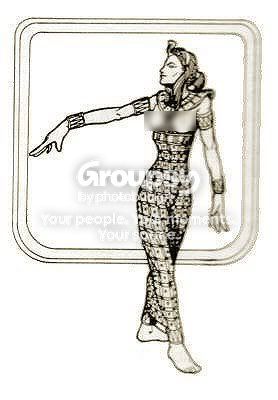 Isis is a goddess in Egyptian mythology. She was most prominent mythologically as the wife and sister of Osiris and mother of Horus, and was worshipped as the archetypal wife and mother. Her name literally means "(female) of throne", that is, "Queen of the throne", which was portrayed by the emblem worn on her head, that of a throne. However, the hieroglyph of her name originally meant "(female) of flesh", i.e. mortal, and she may simply have represented deified, historical queens. Her origins are uncertain but are believed to have come from the Nile Delta; however, unlike other Egyptian deities, she did not have a centralised cult at any point throughout her worship. First mentions of Isis date back to the Fifth dynasty of Egypt which is when the first literary inscriptions are found, but her cult became prominent late in Egyptian history, when it began to absorb the cults of many other goddesses. It eventually spread outside Egypt throughout the Middle East and Europe, with temples dedicated to her built as far away as the British Isles. Pockets of her worship remained in Christian Europe as late as the 6th century. As the deification of the wife of the pharaoh, the first prominent role of Isis was as the assistant to the deceased king. Thus she gained a funerary association, her name appearing over 80 times in the Pyramid Texts, and was said to be the mother of the four gods who protected the canopic jars - more specifically, Isis was viewed as protector of the liver-jar-god Imsety. This association with the Pharaoh's wife also brought the idea that Isis was considered the spouse of Horus, who was protector, and later the deification, of the Pharaoh himself. Consequently, on occasion, her mother was said to be Hathor, the mother of Horus. By the Middle Kingdom, as the funeral texts spread to be used by non-royals, her role also grows to protect the nobles and even the commoners. By the New Kingdom, Isis gains prominence as the mother / protector of the Pharaoh. She is said to breastfeed the pharaoh with her milk, and is often depicted visually as such. The role of her name and her throne-crown is uncertain. Some egyptologists believe that being the throne-mother was Isis' original function, however a more modern view states that aspects of the role came later by association. In many African tribes, the king's throne is known as the mother of the king, and that fits well with either theories, giving us more insight into the thinking of ancient Egyptians. In another area of Egypt, when the pantheon was formalised, Isis became one of the Ennead of Heliopolis, as a daughter of Nut and Geb, and sister to Osiris, Nephthys, and Set. As a funerary deity, she was associated with Osiris, god of the underworld (Duat), and thus was considered his wife. The two females - Isis and Nephthys were often depicted on coffins, with wings outstretched, as protectors against evil. A later legend, ultimately a result of the replacement of another god of the underworld when the cult of Osiris gained more authority, tells of the birth of Anubis. The tale describes how Nephthys became sexually frustrated with Set and disguised herself as the much more attractive Isis to try to seduce him. The ploy failed, but Osiris now found Nepthys very attractive, as he thought she was Isis. They coupled, resulting in the birth of Anubis. In fear of Set's anger, Nephthys persuaded Isis to adopt Anubis, so that Set would not find out. The tale describes both why Anubis is seen as an underworld deity (he is a son of Osiris), and why he couldn't inherit Osiris' position (he was not a legitimate heir), neatly preserving Osiris' position as lord of the underworld. However, it should be remembered that this story was only a later creation of the Osirian cult who wanted to depict Set in an evil position, as the enemy of Osiris. In another myth, Set had a banquet for Osiris in which he brought in a beautiful box and said that whoever could fit in the box perfectly would get to keep it. Set had measured Osiris in his sleep so that he was the only person that could fit in the box. Once it was Osiris' turn to see if he could fit in the box, Set closed the lid on him so that the box was now a coffin for Osiris. Set flung the box in the Nile so that it would float far away. Isis went looking for the box so that Osiris could have a proper burial. She found the box in a tree in Byblos, and brought it back to Egypt and hid it in a swamp. Set went hunting that night and found the box. To make it so Isis could never find Osiris again, Set chopped Osiris' body into fourteen pieces and scattered them all over Egypt. Isis and Nephthys, her sister went looking for his pieces, but could only find thirteen of the fourteen. The last piece, his p***s, had been swallowed by a crab, so Isis fashioned one out of gold. Isis used her magic to put Osiris' body back together. Isis managed to bring Osiris back to life for one night, in which they conceived Horus. Beliefs about Ra himself had been hovering around the identification of Ra, a sun god, with Horus, another sun god (as the compound Ra-Herakhty), and so for some time, Isis had intermittently been considered the wife of Ra, since she was the mother of Horus. Consequently, since there was not anything logically troubling by identifying Isis as Ra's wife, Hathor unlike identifying Ra as her own son, she and Hathor became considered the same deity, Isis-Hathor. Sometimes the alternative consideration arose, that Isis, in the Ennead, was a child of Atum-Ra, and so should have been a child of Ra's wife, Hathor, although this was less favoured as Isis had enough in common with Hathor to be considered one and the same. It was this merger with Hathor that proved to be the most significant event in the history of Egyptian mythology. By merging with Hathor, Isis became the mother of Horus, rather than his wife, and thus, when beliefs of Ra absorbed Atum into Atum-Ra, it also had to be taken into account that Isis was one of the Ennead, as the wife of Osiris. However, it had to be explained how Osiris, who as god of the dead, was dead, could be considered a father to Horus, who was not considered dead. This led to the evolution of the idea that Osiris needed to be resurrected, and so to the Legend of Osiris and Isis, of which Plutarch's De Iside et Osiride contains the most extensive account known today, a myth so significant that it is the most famous of all Egyptian myths. A statue of Isis nursing Horus, housed in the Louvre.Yet another set of myths detail the adventures of Isis after the birth of Osiris' posthumous son, Horus. Many dangers faced Horus after birth, and Isis fled with the newborn to escape the wrath of Set, the murderer of her husband. In one instance, Isis heals Horus from a lethal scorpion sting; she also performs other miracles in relation to the so-called cippi, or the plaques of Horus. Isis protected and raised Horus until he was old enough to face Set, and subsequently became the king of Egypt. In order to resurrect Osiris for the purpose of having the child Horus, it was necessary for Isis to learn magic, and so it was that Isis tricked Ra (i.e. Amun-Ra/Atum-Ra) into telling her his "secret name", by causing a snake to bite him, to which Isis had the only cure, so that he would use his "secret name" to survive. This aspect becomes central in magic spells, and Isis is often implored to use the true name of Ra while performing rituals. By the late Egyptian history, Isis becomes the most important, and most powerful magical deity of the Egyptian pantheon. Magic is central to the entire mythology of Isis; arguably more so than any other Egyptian deity. In consequence of her deeply magical nature, Isis also became a goddess of magic (though Thoth was always the leading god of magic). The prior goddess to hold the quadruple roles of healer, protector of the canopic jars, protector of marriage, and goddess of magic, Serket, became considered an aspect of her. Thus it is not surprising that Isis had a central role in Egyptian magic spells and ritual, especially those of protection and healing. In many spells, she is also completely merged even with Horus, where invocations of Isis are supposed to automatically involve Horus' powers as well. After the authority of Thebes had risen, and made Amun into a much more significant god, it later waned, and Amun was assimilated into Ra. In consequence, Amun's consort, Mut, the doting, infertile, and implicitly virginal mother, who by this point had absorbed other goddesses herself, was assimilated into Ra's wife, Isis-Hathor as Mut-Isis-Nekhbet. On occasion, Mut's infertility and implicit virginity was taken into consideration, and so Horus, who was too significant to ignore, had to be explained by saying that Isis became pregnant with magic, when she transformed herself into a kite and flew over Osiris' dead body. Mut's husband was Amun, who had by this time become identified with Min as Amun-Min (also known by his epithet - Kamutef). Since Mut had become part of Isis, it was natural to try to make Amun, part of Osiris, the husband of Isis, but this was not easily reconcilable, because Amun-Min was a fertility god and Osiris was the god of the dead. Consequently they remained regarded separately, and Isis was sometimes said to be the lover of Min. Subsequently, as at this stage Amun-Min was considered an aspect of Ra (Amun-Ra), he was also considered an aspect of Horus, since Horus was identified as Ra, and thus Isis' son was on rare occasions said to be Min instead, which neatly avoided having confusion over Horus's status as was held at being the husband and son of Isis.
|
|
|
|
|
|
|
|
|
|
|
|
|
|
|
|
|
|
Posted: Tue Jul 03, 2007 11:42 am
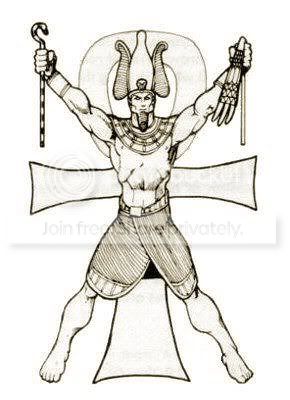 Osiris (Greek language, also Usiris; the Egyptian language name is variously transliterated Asar, Aser, Ausar, Wesir, or Ausare) is the Egyptian god of life, death, and fertility. He is one of the oldest Gods for whom records have survived and first appears in the pyramid texts around 2400 BC, when his cult is already well established. He was widely worshipped until the forceable suppression of paganism in the Christian era. Osiris was not only the redeemer and merciful judge of the dead in the afterlife, but also the underworld agency that granted all life, including sprouting vegetation and the fertile flooding of the Nile River. The Kings of Egypt were associated with Osiris in death such that as Osiris rose from the dead so would they, in union with him, inherit eternal life through a process of imitative magic. By the New Kingdom all men, not just pharaohs, were believed to be associated with Osiris at death if they incurred the costs of the assimilation rituals. Osiris is the oldest son of the Earth god, Geb, and the sky goddess, Nut as well as being brother and husband of Isis, with Horus being considered his posthumously begotten son. He is usually depicted as a green-skinned pharaoh wearing the Atef crown, a form of the white crown of upper Egypt with a plume of feathers to either side. Typically he is also depicted holding the crook and flail which signify divine authority in Egyptian kings, but which were originally unique to Osiris and his own origin-gods (see below), and his feet and lower body are wrapped, as though already partly mummified. The information we have on the myths of Osiris is derived from allusions contained in the pyramid texts, and, much later, in narrative style from the writings of Plutarch and Diodorus Siculus. The origin of Osiris's name is a mystery which forms an obstacle to knowing the pronunciation of its hieroglyphic form. The majority of current thinking is that the Egyptian name is pronounced aser where the a is the letter ayin (i.e. a short 'a' pronounced from the back of the throat as if swallowing). The name was first recorded in Egyptian hieroglyphs only as ws-ir or os-ir because the Egyptian writing system omitted vowels. It is reconstructed to have been pronounced Us-iri (oos-ee-ree) meaning 'Throne of the Eye' and survives into the Coptic language as Ousire. Father of Anubis When the Ennead and Ogdoad cosmogenies became merged, with the identification of Ra as Atum (Atum-Ra), gradually Anubis (Ogdoad system) was replaced by Osiris, whose cult had become more significant. In order to explain this, Anubis was said to have given way to Osiris out of respect, and, as an underworld deity, was subsequently identified as being Osiris' son. Abydos, which had been a strong centre of the cult of Anubis, became a centre of the cult of Osiris. However, as Isis, Osiris' wife, represented life in the Ennead, it was considered somewhat inappropriate for her to be the mother of a god associated with death such as Anubis, and so instead, it was usually said that Nephthys, the other of the two female children of Geb and Nut, was his mother. To explain the apparent infidelity of Osiris, it was said that a sexually frustrated Nephthys had disguised herself as Isis to get more attention from her husband, Set, but did not succeed, although Osiris then mistook her for Isis, and they procreated, resulting in Anubis' birth. Father of Horus Later, when Hathor's identity (from the Ogdoad) was assimilated into that of Isis, Horus, who had been Isis' husband (in the Ogdoad), became considered her son, and thus, since Osiris was Isis' husband (in the Ennead), Osiris also became considered Horus' father. Attempts to explain how Osiris, a god of the dead, could give rise to someone so definitely alive as Horus, lead to the development of the Legend of Osiris and Isis, which became the greatest myth in Egyptian mythology. The myth described Osiris as having been killed by his brother Seth who wanted Osiris' throne. Isis briefly brought Osiris back to life by use of a spell that she learned from her father. This spell gave her time to become pregnant by Osiris before he again died. Isis later gave birth to Horus. As such, since Horus was born after Osiris' resurrection, Horus became thought of as representing new beginnings. This combination, Osiris-Horus, was therefore a life-death-rebirth deity, and thus associated with the new harvest each year. Ptah-Seker (who resulted from the identification of Ptah as Seker), who was god of re-incarnation, thus gradually became identified with Osiris, the two becoming Ptah-Seker-Osiris (rarely known as Ptah-Seker-Atum, although this was just the name, and involved Osiris rather than Atum). As the sun was thought to spend the night in the underworld, and subsequently be re-incarnated, as both king of the underworld, and god of reincarnation, Ptah-Seker-Osiris was identified. Ram god Since Osiris was considered dead, as God of the dead, Osiris' soul, or rather his Ba, was occasionally worshipped in its own right, almost as if it were a distinct god, especially so in the Delta city of Mendes. This aspect of Osiris was referred to as Banebdjed (also spelt Banebded or Banebdjedet, which is technically feminine) which literally means The ba of the lord of the djed, which roughly means The soul of the lord of the pillar of stability. The djed, a type of pillar, was usually understood as the backbone of Osiris, and, at the same time, as the Nile, the backbone of Egypt. The Nile, supplying water, and Osiris (strongly connected to the vegetation) who died only to be resurrected represented continuity and therefore stability. As Banebdjed, Osiris was given epithets such as Lord of the Sky and Life of the (sun god) Ra, since Ra, when he had become identified with Atum, was considered Osiris' ancestor, from whom his regal authority was inherited. Ba does not, however, quite mean soul in the western sense, and also has to do with power, reputation, force of character, especially in the case of a god. Since the ba was associated with power, and also happened to be a word for ram in Egyptian, Banebdjed was depicted as a ram, or as Ram-headed. A living, sacred ram, was even kept at Mendes and worshipped as the incarnation of the god, and upon death, the rams were mummified and buried in a ram-specific necropolis. As regards the association of Osiris with the ram, the god's traditional crook and flail are of course the instruments of the shepherd, which has suggested to some scholars also an Osiris' origin in herding tribes of the upper Nile. The crook and flail were originally symbols of the minor agricultural deity Anedijti, and passed to Osiris later. From Osiris they eventually passed to Egyptian kings in general as symbols of divine authority. In Mendes, they had considered Hatmehit, a local fish-goddess, as the most important god/goddess, and so when the cult of Osiris became more significant, Banebdjed was identified in Mendes as deriving his authority from being married to Hatmehit. Later, when Horus became identified as the child of Osiris (in this form Horus is known as Harpocrates in Greek and Har-pa-khered in Egyptian), Banebdjed was consequently said to be Horus' father, as Banebdjed is an aspect of Osiris. In occult writings, Banebdjed is often called the goat of Mendes, and identified with Baphomet; the fact that Banebdjed was a ram (sheep), not a goat, is apparently overlooked. The cult of Osiris had a particularly strong interest towards the concept of immortality. Plutarch recounts one version of the myth surrounding the cult in which Set (Osiris's evil brother) fooled Osiris into getting into a coffin, which he then shut, had sealed with lead and threw into the Nile. Osiris's wife, Isis, searched for his remains until she finally found him embedded in a tree trunk, which was holding up the roof of a palace in Byblos on the Phoenician coast. She managed to remove the coffin and open it, but Osiris was already dead. She used a spell she had learned from her father and brought him back to life so he could impregnate her. After they finished, he died again, so she hid his body in the desert. Months later, she gave birth to Horus. While she was off raising him, Set had been out hunting one night and he came across the body of Osiris. Enraged, he tore the body into fourteen pieces and scattered them throughout the land. Isis gathered up all the parts of the body, less the phallus which was eaten by a fish thereafter considered tabu by the Egyptians, and bandaged them together for a proper burial. The gods were impressed by the devotion of Isis and thus restored Osiris to life in the form of a different kind of existence as the god of the underworld. Because of his death and resurrection, Osiris is associated with the flooding and retreating of the Nile and thus with the crops along the Nile valley. Diodorus Siculus gives another version of the myth in which Osiris is described as an ancient king who taught the Egyptians the arts of civilization, including agriculture. Osiris is murdered by his evil brother Seth, whom Diodorus associates with the evil Typhon of Greek mythology. Typhon divides the body into twenty six pieces which he distributes amongst his fellow conspirators in order to implicate them in the murder. Isis and Horus avenge the death of Osiris and slay Typhon. Isis recovers all the parts of Osiris body, less the phallus, and secretly buries them. She made replicas of them and distributed them to several locations which then became centres of Osiris worship.
|
|
|
|
|
|
|
|
|
|
|
|
|
|
|
Posted: Tue Jul 03, 2007 11:43 am
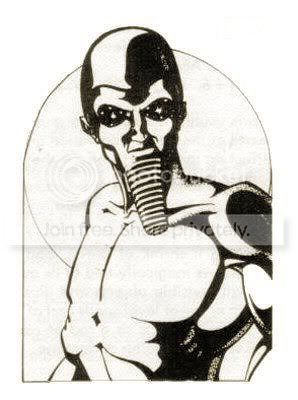 In Egyptian mythology, Ptah (also spelt Peteh) was the deification of the primordial mound in the Ennead cosmogony, which was more literally referred to as Ta-tenen (also spelt Tathenen), meaning risen land, or as Tanen, meaning submerged land. The importance Ptah was given in history can readily be understood since the name Egypt derives from Classical Greek Aigyptos which in turn derives from the native name of a temple at Memphis (transcribed as Ḥwt-k3-Ptḥ or Hut-ka-Ptah "temple of the Ka of Ptah"). It was said (in the Shabaka Stone) that it was Ptah who called the world into being, having dreamt creation in his heart, and speaking it, his name meaning opener, in the sense of opener of the mouth. Indeed the opening of the mouth ceremony, performed by priests at funerals to release souls from their corpses, was said to have been created by Ptah. Atum was said to have been created by Ptah to rule over the creation, sitting upon the primordial mound. In art, he is portrayed as a bearded mummified man, often wearing a skull cap, with his hands holding an ankh, was, and djed, the symbols of life, power and stability, respectively. It was also considered that Ptah manifested himself in the Apis bull. In Memphis, Ptah was worshipped in his own right, and was seen as Atum's father, or rather, the father of Nefertum, the younger form of Atum. When the beliefs about the Ennead and Ogdoad were later merged, and Atum was identified as Ra (Atum-Ra), himself seen as Horus (Ra-Herakhty), this led to Ptah being said to be married to Sekhmet, at the time considered the earlier form of Hathor, Horus', thus Atum's, mother. Since Ptah was the primordial mound, and had called creation into being, he was considered the god of craftsmen, and in particular stone-based crafts. Eventually, due to the connection of these things to tombs, and that at Thebes, the craftsmen regarded him so highly as to say that he controlled their destiny. Consequently, first amongst the craftsmen, then the population as a whole, Ptah also became a god of reincarnation. Since Seker was also god of craftsmen, and of re-incarnation, Seker was later assimilated with Ptah becoming Ptah-Seker. Ptah-Seker gradually became seen as the personification of the sun during the night, since the sun appears to be re-incarnated at this time, and Ptah was the primordial mound, which lay beneath the earth. Consequently, Ptah-Seker became considered an underworld deity, and eventually, by the Middle Kingdom, become assimilated by Osiris, the lord of the underworld, occasionally being known as Ptah-Seker-Osiris. Legend has it that Ancient Egyptians believed saying Ptah's name would give the spouse of the speaker great fertility. Ptah's original name in Ancient Egyptian is reconstructed to have been pronounced as *Pitáḥ based on the occurrence of his name in hieroglyphics, ptḥ, surviving into Coptic as Ptah, just as it is now written in English. The name was also borrowed early on into Greek as Φθα Phtha.
|
|
|
|
|
|
|
|
|
|
|
|
|
|
|
|
|
|
Posted: Tue Jul 03, 2007 11:44 am
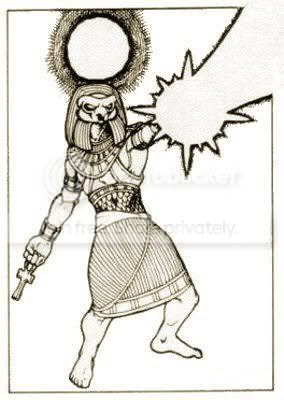 Ra (Arabic: رع)(sometimes Rê based on the attested Coptic name and reconstructed as *Rīʕu (ree-uh-uh) also Phra and later as Amon-Ra, meaning literally "sun") was a major deity in ancient Egyptian religion. Identified primarily with the mid-day Sun the chief cult centre of Ra was based in Heliopolis meaning "City of the Sun". In later Egyptian dynastic times, Ra was subsumed into the god Horus, as Re-Horakhty (and many variant spellings). He commanded sky, earth, underworld. He was associated with the falcon. According to E. A. Wallis Budge he was the One god of Egyptian Monotheism, of which all other gods and goddesses were aspects, manifestations, phases, or forms of the god.[1]Ra itself, however, was also a monotheistic God. A Hymn to Ra (approx. 1370 BCE) was written to stress the pantheistic nature of Ra to combat encroaching polytheism. In it, several gods and goddesses are described, not as beings in their own right, but certain forms of Ra. For example: "Praise be unto thee, O Ra, thou exalted Power, who dost enter into the habitations of Ament, behold [thy] body is Temu." "Praise be unto thee, O Ra, thou exalted Power, who dost enter into the hidden palace of Anubis, behold [thy] body is Khepera." Ra is most commonly pronounced 'rah'. It is more likely, however, that it should be pronounced as 'ray', hence the alternative spelling Re rather than Ra. It is not known for sure what Ra's name means, but it is thought it may be a variant of or linked to 'creative', if not an original word for 'sun'. Ra often replaces Atum as the father, grandfather and great-grandfather of the gods of the Ennead, and creator of the world. Ra created Sekhmet, who becomes Hathor after she has sufficiently punished mankind as an avenging Eye of Ra, and so is often said to be the father of both and brother to the god, Osiris. Mankind was supposedly created from Ra's tears or sweat, leading to the Egyptians calling themselves the "Cattle of Ra". Ra is primarily depicted as a man in artwork, wearing a Pharaoh's crown (a sign of his kingship over the gods) and the sun disk on his head. Often he had a falcon's head, much like Horus. Sometimes, Ra is portrayed differently according to the position of the sun in the sky. At sunrise he was an infant, at noon a man, and at sunset an old man. This constant aging was suggested by the Egyptians as the reason Ra stayed separate from the world and let Osiris and/or Horus rule in his place. This idea is often coupled with the myth in which Isis is able to trick an elderly Ra, having ruled on earth as a human Pharaoh, into revealing his secret name, and thus the secret of his power. Ra shared many of his symbols with other solar deities, in particular Horus. The Benu bird is Ra's ba and a symbol of fire and rebirth; The sun disk, also shown as the hieroglyphic ⊙ ; Ankh, symbolizing the life given by the sun; Obelisk, representative of the rays of the sun and worshiped as a home of a solar god; Pyramids, aligned east/west Falcon; Bull; Uraeus, a cobra commonly seen wrapped around the sun disk. As the sun, Ra was thought to see everything. For the Egyptians, the sun most basically represented light, warmth and therefore growth. This made Ra hugely important to Egyptians, and it is probably therefore no coincidence that he is also seen as the ruler of all. The sun was either seen as the body or eye of Ra. The sun was thought to travel in a boat, to protect its fires from the primordial waters (Nun) of the underworld it passed through during the night. Ra traveled in the sunboat with various gods, including Ma'at who guided the boat's course and Set and Mehen who defended against monsters in the underworld. These monsters included Apep, the serpent who tried to stop the sunboat's journey every day by consuming it. So, the Egyptians saw the sunrise as the rebirth of the sun through Nut, the sky, and thus attributed the concept of rebirth and renewal to Ra, strengthening his role as a creator god. As the cults of various solar deities rose and fell, Ra's role as the most well-known solar god in the Egyptian pantheon constantly changed. Horus, Ra, Aten and Amun-Ra exchanged roles as actually being worshiped as the sun, even though all three retained their solar links. Ra, and sometimes Horus, were broken down into several smaller aspect gods, who presided over the sun at sunrise, noon and sunset. As with most widely worshiped Egyptian godforms, Ra's identity was often confused with other gods as different regional religions were merged in an attempt to unite the country. Amun and Amun-Ra Amun was a member of the Ogdoad, representing creation energies with Amaunet, and was a very early patron of Thebes. He was believed to create via breath, and thus was identified with the wind rather than the sun. As the cults of Amun and Ra became increasingly popular in Upper and Lower Egypt respectively, they were combined to create Amun-Ra, a solar creator god. It is hard to distinguish exactly when this combination happened, with references being made in pyramid texts to Amun-Ra as early as the V Dynasty. The most common belief is that Amun-Ra was invented as the new state deity by the (Theban) rulers of the New Kingdom to unite worshipers of Amun with the older cult of Ra, beginning around the XVIII Dynasty. Ironically, the cult of Amun-Ra was effectively just as monotheistic as Akhenaten's worship of Aten, and the cult became so powerful that it rivalled the monarchy. Atum and Atum-Ra Atum-Ra (or Ra-Atum) was another composite deity formed from two completely separate deities. However, Ra shared more similarities with Atum than with Amun. Atum was more closely linked with the sun, and was also a creator god of the Ennead. Both Ra and Atum were regarded as the father of the gods and Pharaohs, and were widely worshiped. So, it was almost inevitable that the two cults were merged under the name of Atum-Ra. Ra-Horakhty In Egyptian mythology, Ra-Horakhty was more of a title, or manifestation, than a composite god. It translates as "Ra, who is Horus of the Horizons". It was intended to link Horakhty (as a sunrise-orientated aspect of Horus) to Ra. It has been suggested that Ra-Horakhty simply refers to the sun's journey from horizon to horizon as Ra, or that it means to show Ra as a symbolic god of hope and rebirth. (See earlier section: Ra and the sun) This link was probably encouraged by Ra and Horus' common link to the sun and the Pharaoh. Khepri and Khnum Khepri was the scarab beetle that rolled up the sun in the mornings, and was sometimes seen as the morning manifestation of Ra. Similarly, the ram-headed god Khnum was also seen as the evening manifestation of Ra. The idea of different gods (or different aspects of Ra) ruling over different times of the day was fairly common, but variable. With Khepri and Khnum taking precedence over sunrise and sunset, Ra was often the representation of midday, when the sun reached its peak at noon. Sometimes different aspects of Horus were used instead of Ra's aspects. In Thelema's Liber Resh vel Helios, Ra represents the rising sun, with Hathor as the midday sun and Tum as the setting sun. Ptah Ra was rarely combined with Ptah, but as per the Memphite creation myth he was often said to be Ptah's first creation, through his divine will, especially when associated with Atum or Amun. His cult began to grow from roughly the II Dynasty, establishing Ra as the sun god. By the IV Dynasty the Pharaohs were seen to be Ra's manifestations on earth, referred to as "Sons of Ra". His worship increased massively in the V Dynasty, when he became a state deity and Pharaohs had specially aligned pyramids, obelisks and solar temples built in his honour. The first Pyramid Texts began to arise, giving Ra more and more significance in the journey of the Pharaoh through the underworld. By XI Dynasty, Ra had become much like the theist Christian God. Mythology told that he had created the world for man, and that evil was a result of mankind's actions. In this respect Ra was closely affiliated with Ma'at, goddess of law and truth. It was even implied that he would punish the evil after death. The Middle Kingdom saw Ra being increasingly combined and affiliated with other deities, especially Amun and Osiris. During the New Kingdom, the worship of Ra becomes yet more complicated and grand. The walls of tombs were dedicated to extremely detailed texts that told of Ra's journey through the underworld. Ra was also now said to carry the prayers and blessings of the living with the souls of the dead on the sunboat. The New Kingdom appears to be when the idea that Ra aged with the sun was most popular. Many acts of worship included hymns, prayers and spells to help Ra and the sunboat overcome Apep. Though worship of Ra was very widespread, his cult center was in Heliopolis, the home of the Ennead that he was thought to be the head of as Atum. The Holiday of 'The Receiving of Ra' was celebrated on May 26th in the Gregorian calendar.
|
|
|
|
|
|
|
|
|
|
|
|
|
|
|
Posted: Tue Jul 03, 2007 11:45 am
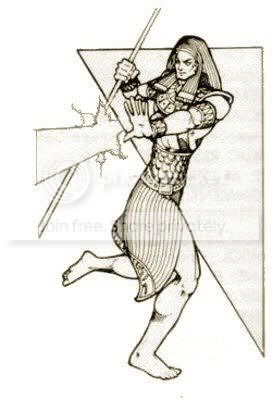 In Egyptian mythology, Seker (also spelt Sokar, and Sokaris, and in Greek, Socharis) was originally, during the Old Kingdom, the deification of the act of separating the Ba from the Ka, roughly the separation of soul from the body, after death. This was said to be enabled by the funerary ceremony of opening the mouth, and thus Seker was given his name, meaning cleaning of the mouth. The Ba, roughly equivalent to the soul, was shown in art, as a human-headed bird fluttering above the Ka, roughly equivalent to the, now mummified, empty shell of the body. Consequently, Seker became depicted as a mummified human who was falcon-headed, and had green skin, symbolising rebirth. The usual depiction of the Ba in this form led to Seker gaining the epithet great lord with two wings opened. A statue of Seker was often placed in tombs, the bottom of it containing the deceased's Book of the Dead, to encourage the successful separation and release of the Ba. In Memphis, Seker was worshipped as the patron god of the necropolis, and so was known as (one who is) on the sand; the necropolis itself, then became known as Sakkara after his name. In Thebes he had a dedicated festival, known as the Henu Festival, in which an image of Seker was carried in a barque, representing the ferry that carried the deceased through Aaru. His name could also be decomposed to mean adorned one, and so Seker gradually also became associated with the secondary function of being the patron god of jewellers, armourers, and other metal workers. Consequently, during the Middle Kingdom when Ptah became viewed as a god of craftsmen, and a god of reincarnation, Seker, as a god of a class of craftsmen, and a god involved in starting the process of reincarnation, became closely associated with Ptah. Eventually, Seker's identity was subsumed into that of Ptah, becoming Ptah-Seker. By the start of the New Kingdom, Ptah-Seker, as a funerary god, had become subsumed into the now much more important god of death, Osiris, becoming Ptah-Seker-Osiris.
|
|
|
|
|
|
|
|
|
|
|
|
|
|
|
|
|
|
Posted: Tue Jul 03, 2007 11:46 am
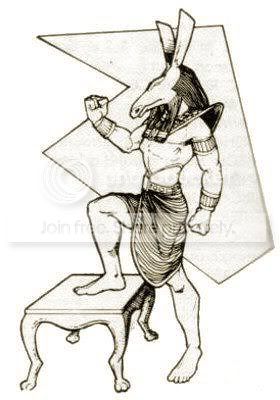 In Egyptian mythology, Set (also spelled Sutekh, Setesh, Seteh, Seth) is an ancient god, who was originally the god of the desert, one of the two main biomes that constitutes Egypt, the other being the small fertile area on either side of the Nile. Due to developments in the Egyptian language over the 3,000 years that Set was worshipped, by the Greek period, the t in Set was pronounced so indistinguishably from th that the Greeks spelt it as Seth. The exact translation of Set is unknown for certain, but is usually considered to be either (one who) dazzles or pillar of stability, one connected to the desert, and the other more to the institution of monarchy. It is reconstructed to have been originally pronounced *Sūtaḫ based on the occurrence of his name in Egyptian hieroglyphics (swtḫ), and his later mention in the Coptic documents with the name Sēt. As he was the god of the desert, Set was associated with sandstorms, and desert caravans. Due to the extreme hostility of the desert environment, Set was viewed as immensely powerful, and was regarded consequently as the chief god. One of the more common epithets was that he was great of strength, and in one of the Pyramid Texts it states that the king's strength is that of Set. As chief god, he was patron of Lower Egypt, where he was worshipped, most notably at Ombos. The alternate form of his name, spelt Setesh (stš), and later Sutekh (swtḫ), designates this supremacy, the extra sh and kh signifying majesty. Set formed part of the Ennead of Heliopolis, as a son of the earth (Geb) and sky (Nut), husband to the fertile land around the Nile (Nebt-het/Nephthys), and brother to death (Ausare/Osiris), and life (Aset/Isis). The word for desert, in Egyptian, was Tesherit, which is very similar to the word for red, Tesher (in fact, it has the appearance of a feminine form of the word for red). Consequently, Set became associated with things that were red, including people with red hair, which is not an attribute that Egyptians generally had, and so he became considered to also be a god of foreigners.[citation needed] Set's attributes as desert god led to him also being associated with gazelles, and donkeys, both creatures living on the desert edge. Since sandstorms were said to be under his control as lord of the desert, and were the main form of storm in the dry climate of Egypt, during the Ramesside Period, Set was identified as various Canaanite storm deities, including Baal. In art, Set was mostly depicted as a mysterious and unknown creature, referred to by Egyptologists as the Set animal or Typhonic beast, with a curved snout, square ears, forked tail, and canine body, or sometimes as a human with only the head of the Set animal. It has no complete resemblance to any known creature, although it does resemble a composite of an aardvark and a jackal, both of which are desert creatures, and the main species of aardvark present in ancient Egypt additionally had a reddish appearance (due to thin fur, which shows the skin beneath it). In some descriptions he has the head of a greyhound. The earliest known representation of Set comes from a tomb dating to the Naqada I phase of the Predynastic Period (circa 4000 BC–3500 BC), and the Set-animal is even found on a mace-head of the Scorpion King, a Protodynastic ruler. A new theory[citation needed] has it that the head of the Set animal is a representation of Mormyrus kannamae (Nile Mormyrid), which resides in the waters near Kom Ombo, one of the sites of a temple of Set, with the two square fins being what are normally interpreted as ears. However, it may be that part or all of the Set animal was based on the Salawa, a similarly mysterious canine creature, with forked tail and square ears, one member of which was claimed to have been found and killed in 1996 by the local population of a region of Upper Egypt. The myth of Set's conflict with Horus, Osiris and Isis appears in many Egyptian sources, including the Pyramid Texts, the Coffin Texts, the Shabaka Stone, inscriptions on the walls of the Horus temple at Edfu, and various papyrus sources. The Chester Beatty Papyrus No. 1 contains the legend known as The Contention of Horus and Set. Classical authors also recorded the story, notably Plutarch's De Iside et Osiride. These myths generally portray Osiris as a wise king and bringer of civilization, happily married to his sister Isis. Set was his envious younger brother, and he killed and dismembered Osiris. Isis reassembled Osiris' corpse and another god (in some myths Thoth and in others Anubis) embalmed him. As the archetypal mummy, Osiris reigned over the Afterworld as judge of the dead. Osiris' son Horus was conceived by Isis with Osiris' corpse, or in some versions, only with pieces of his corpse. Horus naturally became the enemy of Set, and many myths describe their conflicts. In some of these myths Set is portrayed as Horus' older brother rather than uncle. In one of their fights Set gouged out Horus's left eye, which represented the moon; perhaps this myth served to explain why the moon is less bright than the sun. Eventually however, using both cunning and strength, Horus vanquished and emasculated Set. The gods punished Set by forcing him to carry Osiris on his back, or by sacrificing him as a bull for their food. In some versions of the myth, Set is given dominion over the surrounding deserts as compensation for his loss of Egypt. Generally Set, as the enemy of the legitimate line of rulers, served as a symbol for disorder, evil and trickery. The myth incorporated moral lessons for relationships between fathers and sons, older and younger brothers, and husbands and wives. Perhaps the myth also records historical events. According to the Shabaka Stone, Geb divided Egypt into two halves, giving Upper Egypt (the desert south) to Set and Lower Egypt (the region of the delta in the north) to Horus, in order to end their feud. However, according to the stone, in a later judgment Geb gave all Egypt to Horus. Interpreting this myth as a historical record would lead one to believe that Lower Egypt (Horus' land) conquered Upper Egypt (Set's land); but in fact Upper Egypt conquered Lower Egypt. So the myth cannot be simply interpreted. Several theories exist to explain the discrepancy. For instance, since both Horus and Set were worshiped in Upper Egypt prior to unification, perhaps the myth reflects a struggle within Upper Egypt prior to unification, in which a Horus-worshipping group subjected a Set-worshiping group. Regardless, once the two lands were united, Seth and Horus were often shown together crowning the new pharaohs, as a symbol of their power over both Lower and Upper Egypt. Queens of the 1st Dynasty bore the title "She Who Sees Horus and Set." The Pyramid Texts present the pharoah as a fusion of the two deities. Evidently, pharoahs believed that they balanced and reconciled competing cosmic principles. Eventually the dual-god Horus-Set appeared, combining features of both deities (as was common in Egyptian theology, the most familiar example being Amun-Re). Later Egyptians interpreted the myth of the conflict between Set and Osiris/Horus as an analogy for the struggle between the desert (represented by Set) and the fertilizing floods of the Nile (Osiris/Horus). As the Ogdoad system became more assimilated with the Ennead one, as a result of creeping increase of the identification of Atum as Ra, itself a result of the joining of Upper and Lower Egypt, Set's position in this became considered. With Horus as Ra's heir on Earth, Set, previously the chief god, for Lower Egypt, required an appropriate role as well, and so was identified as Ra's main hero, who fought Apep each night, during Ra's journey (as sun god) across the underworld. He was thus often depicted standing on the prow of Ra's night barque spearing Apep in the form of a serpent, turtle, or other dangerous water animals. Surprisingly, in some Late Period representations, such as in the Persian Period temple at Hibis in the Khargah Oasis, Set was represented in this role with a falcon's head, taking on the guise of Horus, despite the fact that Set was usually considered in quite a different position with regard to heroism. This assimilation also led to Anubis being displaced, in areas where he was worshipped, as ruler of the underworld, with his situation being explained by his being the son of Osiris. As Isis represented life, Anubis' mother was identified instead as Nephthys. This led to an explanation in which Nephthys, frustrated by Set's lack of sexual interest in her, disguised herself as the more attractive Isis, but failed to gain Set's attention because he was infertile. Osiris mistook Nephthys for Isis and they had conceived Anubis resulting in Anubis' birth. In some later texts, after Set lost the connection to the desert, and thus infertility, Anubis was identified as Set's son, as Set is Nephthys' husband. If one looks in the mythology, Set has a great many wives, including some foreign Goddesses, and several children. Some of the most notable wives (beyond Nephthys/Nebet Het) are Neith (with whom he is said to have fathered Sobek), Amtcheret (by whom he is said to have fathered Upuat - though Upuat is also said to be a son of Aser/Osiris in some places), Tuaweret, Hetepsabet (one of the Hours, a feminine was-beast headed goddess who is variously described as wife or daughter of Set), and the two Canaanite deities Anat and Astarte, both of whom are equally skilled in love and war - two things which Set himself was famous for. Naturally, when, during the Second Intermediate Period the mysterious foreign Hyksos gained the rulership of Egypt, and ruled the Nile Delta, from Avaris, they chose Set, originally Lower Egypt's chief god, as their patron, and so Set became worshipped as the chief god once again. However, following this invasion, Egyptian attitudes towards foreigners could be best described as xenophobic, and eventually the Hyksos were deposed. During this period, Set (previously a hero), as the Hyksos' patron, came to embody all that the Egyptians disliked about the foreign rulers, and so he gradually absorbed the identities of all the previous evil gods, particularly Apep. When the Legend of Osiris and Isis grew up, Set was consequently identified as the killer of Osiris in it, having hacked Osiris' body into pieces, dispersing them, so that he could not be resurrected. Interpreting the ears as fins, the head of the Set-animal resembles the Oxyrhynchus fish, and so it was said that as a final precaution, an Oxyrhynchus fish ate Osiris' p***s. Now that he had become the embodiment of evil, Set was consequently sometimes depicted as one of the creatures that the Egyptians most feared, crocodiles, and hippopotamus, and by the time of the New Kingdom, he was often associated with the villainous gods of other rising empires. One such case was Baal, an identification in which Set was described as being the consort of ‘Ashtart or ‘Anat, wife of Baal. Set was also identified by the Egyptians with the Hittite deity Teshub, who was a vicious storm god, as was Set. The Greeks later linked Set with Typhon because both were evil forces, storm deities and sons of the Earth that attacked the main gods. Some scholars hold that after Egypt's conquest by the Persian ruler Cambyses II, Set also became associated with foreign oppressors, including the Achaemenid Persians, Ptolemaic dynasty, and Romans. Indeed, it was during the time that Set was particularly vilified, and his defeat by Horus widely celebrated. Nevertheless, throughout this period, in some distant locations he was still regarded as the heroic chief deity; for example, there was a temple dedicated to Set in the village of Mut al-Kharab, in the Dakhlah Oasis.
|
|
|
|
|
|
|
|
|
|
|
|
|
|
|
Posted: Tue Jul 03, 2007 11:47 am
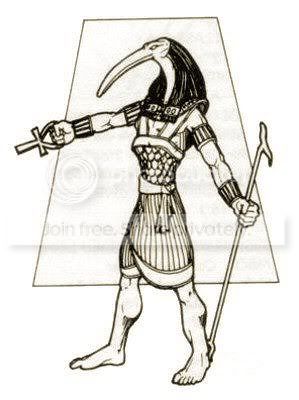 Thoth (his Greek name derived from the Egyptian *ḏiḥautī, written by Egyptians as ḏḥwty) was considered one of the most important deities of the Egyptian pantheon, often depicted with the head of an ibis. His feminine counterpart was Ma'at. His chief shrine was at Khemennu, where he was the head of the local company of gods, later renamed Hermopolis by the Greeks (in reference to him through the Greeks' interpretation that he was the same as Hermes) and Eshmûnên by the Arabs. He also had shrines in Abydos, Hesert, Urit, Per-Ab, Rekhui, Ta-ur, Sep, Hat, Pselket, Talmsis, Antcha-Mutet, Bah, Amen-heri-ab, and Ta-kens. He was considered the heart and tongue of Ra as well as the means by which Ra's will was translated into speech. He has also been likened to the Logos of Plato and the mind of God. In the Egyptian mythology, he has played many vital and prominent roles, including being one of the two gods (the other being Ma'at) who stood on either side of Ra's boat. He has further been involved in arbitration, magic, writing, science, and the judging of the dead. According to Theodor Hopfner, Thoth's Egyptian name written as ḏḥwty originated from ḏḥw, claimed to be the oldest known name for the ibis although normally written as hbj. The addition of -ty denotes that he possessed the attributes of the ibis. Hence his name means "He who is like the ibis". The Egyptian pronunciation of ḏḥwty is not fully known, but may be reconstructed as *ḏiḥautī, based on the Ancient Greek borrowing Θωθ Thōth or Theut and the fact that it evolved into Sahidic Coptic variously as Thoout, Thōth, Thoot, Thaut as well as Bohairic Coptic Thōout. The final -y may even have been pronounced as a consonant, not a vowel. However, many write "Djehuty", inserting the letter 'e' automatically between consonants in Egyptian words, and writing 'w' as 'u', as a convention of convenience for English speakers, not the transliteration employed by Egyptologists. Djehuty is sometimes alternatively rendered as Tahuti, Tehuti, Zehuti, Techu, or Tetu. Thoth is the Greek version derived from the letters ḏḥwty. Not counting differences in spelling, Thoth had many names and titles, like other gods and goddesses. Similarly, each Pharaoh, considered a god himself, had five different names used in public. Among his alternate names are A, Sheps, Lord of Khemennu, Asten, Khenti, Mehi, Hab, and A'an. In addition, Thoth was also known by specific aspects of himself, for instance the moon god A'ah-Djehuty, representing the moon for the entire month, or as jt-nṯr "god father". Further, the Greeks related Thoth to their god Hermes due to his similar attributes and functions. One of Thoth 's titles, "Three times great, great" was translated to the Greek τρισμεγιστος (Trismegistos) making Hermes Trismegistus. Thoth has been depicted in many ways depending on the era and on the aspect the artist wished to convey. Usually, he is depicted in human form with the head of an ibis. In this form, he can be represented as the reckoner of times and seasons by a lunar disk sitting in a crescent moon being placed atop his head. When depicted as a form of Shu or Ankher, he will wear the respective god's headdress. He also is sometimes seen wearing the atef crown and the United Crowns of Upper and Lower Egypt. When not depicted in this common form, he sometimes takes the form of the ibis directly. He also appears as a baboon when he is A'an, the god of equilibrium. In the form of A'ah-Djehuty he took a more human-looking form. These forms are all symbolic and are metaphors for Thoth's attributes. The Egyptians did not believe these gods actually looked like humans with animal heads. For example, Thoth's counterpart Ma'at is often depicted with an ostrich feather for a head. Egyptologists disagree on Thoth's nature depending upon their view of the Egyptian pantheon. Most egyptologists today side with Sir Flinders Petrie that Egyptian religion was strictly polytheistic, in which Thoth would be a separate god. His contemporary adversary, E. A. Wallis Budge, however, thought Egyptian religion to be primarily monotheistic where all the gods and goddesses were aspects of the God Ra, similar to the Trinity in Christianity and devas in Hinduism. In this view, Thoth would be the aspect of Ra which the Egyptian mind would relate to the heart and tongue. His roles in Egyptian mythology were many. Thoth served as a mediating power, especially between good and evil, making sure neither had a decisive victory over the other. He also served as scribe of the gods, credited with the invention of writing and alphabets (ie. hieroglyphs) themselves. In the underworld, Duat, he appeared as an ape, A'an, the god of equilibrium, who reported when the scales weighing the deceased's heart against the feather, representing the principle of Ma'at, was exactly even. The ancient Egyptians regarded Thoth as One, self-begotten, and self-produced. He was the master of both physical and moral (ie. Divine) law, making proper use of Ma'at. He is credited with making the calculations for the establishment of the heavens, stars, Earth, and everything in them. Compare this to how his feminine counterpart, Ma'at was the force which maintained the Universe. He is said to direct the motions of the heavenly bodies. Without his words, the Egyptians believed, the gods would not exist. His power was almost unlimited in the Underworld and rivalled that of Ra and Osiris. The Egyptians credited him as the author of all works of science, religion, philosophy, and magic. The Greeks further declared him the inventor of astronomy, astrology, the science of numbers, mathematics, geometry, land surveying, medicine, botany, theology, civilized government, the alphabet, reading, writing, and oratory. They further claimed he was the true author of every work of every branch of knowledge, human and divine. Thoth has played a prominent role in many of the Egyptian myths. Displaying his role as arbitrator, he had overseen the three epic battles between good and evil. All three battles are fundamentally the same and belong to different periods. The first battle took place between Ra and Apep, the second between Heru-Bekhutet and Set, and the third between Horus, the son of Osiris, and Set. In each instance, the former god represented good while the latter represented evil. If one god was seriously injured, Thoth would heal them to prevent either from overtaking the other. Thoth was also prominent in the Osiris myth, being of great aid to Isis. After Isis gathered together the pieces of Osiris' dismembered body, he gave her the words to resurrect him so she could be impregnated and bring forth Horus, named for his uncle. When Horus was slain, Thoth gave the formulae to resurrect him as well. Similar to God speaking the words to create the heavens and Earth in Judeo-Christian mythology, Thoth, being the god who always speaks the words that fulfill the wishes of Ra, spoke the words that created the heavens and Earth in Egyptian mythology. Mythology also accredits him with the creation of the 365 day calendar. Originally, according to the myth, the year was only 360 days long and Nut with sterility during these days, unable to bear children. Thoth gambled with Khonsu, the moon, for 1/72nd of its light (360/72 = 5), or 5 days, and won. During these 5 days, she gave birth to Kheru-ur (Horus the Elder, Face of Heaven), Osiris, Set, Isis, and Nepthys. In the Ogdoad cosmogony myth, Thoth gave birth to Ra, Atum, Nefertum, and Khepri by laying an egg while in the form of an ibis, or later as a goose laying a golden egg. He was originally the deification of the moon in the Ogdoad belief system. Initially, in that system, the moon had been seen to be the eye of Horus, the sky god, which had been semi-blinded (thus darker) in a fight against Set, the other eye being the sun. However, over time it began to be considered separately, becoming a lunar deity in its own right, and was said to have been another son of Ra. As the crescent moon strongly resembles the curved beak of the ibis, this separate deity was named Djehuty (i.e. Thoth), meaning ibis. Thoth became associated with the Moon, due to the Ancient Egyptians observation that Baboons (sacred to Thoth) 'sang' to the moon at night. The Moon not only provides light at night, allowing the time to still be measured without the sun, but its phases and prominence gave it a significant importance in early astrology/astronomy. The cycles of the moon also organized much of Egyptian society's civil, and religious, rituals, and events. Consequently, Thoth gradually became seen as a god of wisdom, magic, and the measurement, and regulation, of events, and of time. He was thus said to be the secretary and counsellor of Ra, and with Ma'at (truth/order) stood next to Ra on the nightly voyage across the sky, Ra being a sun god. Thoth became credited by the ancient Egyptians as the inventor of writing, and was also considered to have been the scribe of the underworld, and the moon became occasionally considered a separate entity, now that Thoth had less association with it, and more with wisdom. For this reason Thoth was universally worshipped by ancient Egyptian Scribes. Many scribes had a painting or a picture of Thoth in their "office". Likewise, one of the symbols for scribes was that of the ibis. In art, Thoth was usually depicted with the head of an ibis, deriving from his name, and the curve of the ibis' beak, which resembles the crescent moon. Sometimes, he was depicted as a baboon holding up a crescent moon, as the baboon was seen as a nocturnal, and intelligent, creature. The association with baboons led to him occasionally being said to have as a consort Astennu, one of the (male) baboons at the place of judgement in the underworld, and on other occasions, Astennu was said to be Thoth himself. During the late period of Egyptian history a cult of Thoth gained prominence, due to its main centre, Khnum (Hermopolis Magna), also becoming the capital, and millions of dead ibis were mummified and buried in his honour. The rise of his cult also led to his cult seeking to adjust mythology to give Thoth a greater role. Thoth was inserted in many tales as the wise counsel and persuader, and his association with learning, and measurement, led him to be connected with Seshat, the earlier deification of wisdom, who was said to be his daughter, or variably his wife. Thoth's qualities also led to him being identified by the Greeks with their closest matching god - Hermes, with whom Thoth was eventually combined, as Hermes Trismegistus, also leading to the Greeks naming Thoth's cult centre as Hermopolis, meaning city of Hermes. It is also viewed that Thoth was the God of Scribe and not a messenger. Anubis was viewed as the messenger of the gods, as he travelled in and out of the Underworld, to the presence of the gods, and to humans, as well. Some call this fusion Hermanubis. It is in more favor that Thoth was a record keeper, and not the messenger. There is also an Egyptian pharaoh of the Sixteenth dynasty of Egypt named Djehuty (Thoth) after him, and who reigned for three years. Thoth, like many Egyptian gods and nobility, held many titles. Among these were "Scribe of Ma'at in the Company of the Gods," "Lord of Ma'at," "Lord of Divine Words," "Judge of the Two Combatant Gods," "Judge of the Rekhekhui, the pacifier of the Gods, who Dwelleth in Unnu, the Great God in the Temple of Abtiti," "Twice Great," "Thrice Great," " and "Three Times Great, Great." One of the most popular and cited works on the Tarot was connected to this deity. Written by the occultist Aleister Crowley, The Book of Thoth is a philosophical text on the usage of Tarot and, most notably, Crowley's own created Tarot Deck, the Thoth Tarot which he also referred to as The Book of Thoth, where the name is taken from a "non-existent" (translations from papyrus of an actual Book of Thoth DO exist, titled 'The Ancient Egyptian Book of Thoth' by Jasnow and Zauzich) book in Egyptian mythology, believed to contain ancient knowledge originally brought to man by this deity. Crowley commissioned Lady Frieda Harris to assist him in painting the Thoth Deck. A text entitled The Emerald Tablets of Thoth-The-Atlantean has been claimed to have been translated by a man named Doreal. The introduction claims them to be written by an Atlantean Priest-King named Thoth, who settled a colony in Egypt after Atlantis sunk. Doreal further claims the texts are 36,000 years old. Regardless of the authenticity of the text, it contains much Hermetic and Egyptian symbolism that Doreal misses. It is also interesting to note that of legend there is apparently some connection between Thoth, and the number 42. Many historians and researches of Thoth claim that it is not 'The Book of Thoth' or the 'Emerald Tablets of Thoth', but actually the '42 Books of Thoth' These books are often also referred to as the 42 Books of Instructions or the 42 Books of Thoth which describe the instructions for achieving immortality plus 2 more books kept separately, mirroringthe 42+2 chromosomes and the sacred geometry embedded in the Great Pyramid.
|
|
|
|
|
|
|
|
|
|
|
|
|
|
|
|
|
|
Posted: Tue Jul 03, 2007 11:48 am
Amun (also spelled Amon, Amoun, Amen, and rarely Imen, Greek Αμμον Ammon, and Άμμον Hammon, Egyptian Yamanu) was the name of a deity, in Egyptian mythology, who gradually rose to become one of the most important deities in Ancient Egypt, before fading into obscurity.
Amun's name is first recorded in Egyptian records as imn, meaning "The hidden (one)". Since vowels were not written in Egyptian hieroglyphics, Egyptologists have reconstructed the name to have been pronounced *Yamānu (yah-maa-nuh) originally. The name survives into the Coptic language as Amoun.
Gradually, as god of air, he came to be associated with the breath of life, which created the ba, particularly in Thebes. By the First Intermediate Period this had led to him being thought of, in these areas, as the creator god, titled father of the gods, preceding the Ogdoad, although also part of it. As he became more significant, he was assigned a wife (Amunet being his own female aspect, more than a distinct wife), and since he was the creator, his wife was considered the divine mother from which the cosmos emerged, who in the areas where Amun was worshipped was, by this time, Mut.
Amun became depicted in human form, seated on a throne, wearing on his head a plain deep circlet from which rise two straight parallel plumes, possibly symbolic of the tail feathers of a bird, a reference to his earlier status as a wind god.
Having become more important than Menthu, the local war god of Thebes, Menthu's authority became said to exist because he was the son of Amun. However, as Mut was infertile, it was believed that she, and thus Amun, had adopted Menthu instead. In later years, due to the shape of a pool outside the sacred temple of Mut at Thebes, Menthu was replaced, as their adopted son, by Chons, the moon god.
When the armies of the Eighteenth dynasty evicted the Hyksos rulers from Egypt, Thebes (where the victors were based) became the most important city, and so Amun became nationally important. The Pharaohs attributed all their successful enterprises to Amun, and they lavished their wealth and captured spoil on his temples. And so, when the Greeks reported back on their visits to Egypt, Amun, as king of the gods, became identified by the Greeks with Zeus, and so his consort Mut with Hera.
As the Egyptians considered themselves oppressed during the period of Hyksos rule, the victory under the supreme god Amun, was seen as his championing of the underdog. Consequently, Amun was viewed as upholding the rights to justice of the poor, being titled Vizier of the poor, and aiding those who travelled in his name, as the Protector of the road. Since he upheld Ma'at, those who prayed to Amun were required first to demonstrate that they were worthy, by confessing their sins.
When, subsequently, Egypt conquered Kush, they identified the chief deity of the Kushites as Amun. This deity was depicted as Ram headed, specifically a woolly Ram with curved horns, and so Amun started becoming associated with the Ram. Indeed, due to the aged appearance of it, they came to believe that this had been the original form of Amun, and that Kush was where he had been born.
However, since rams, due to their rutting, were considered a symbol of virility, Amun became thought of as a fertility deity, and so started to absorb the identity of Min, becoming Amun-Min. This association with virility led to Amun-Min gaining the epithet Kamutef, meaning Bull of his mother, in which form he was often found depicted on the walls of Karnak, ithyphallic, and with a scourge.
As Amun's cult grew bigger, Amun rapidly became identified with the chief God that was worshipped in other areas, Ra-Herakhty, the merged identities of Ra, and Horus. This identification led to a merger of identities, with Amun becoming Amun-Ra. As Ra had been the father of Shu, and Tefnut, and the remainder of the Ennead, so Amun-Ra was likewise identified as their father.
Ra-Herakhty had been a sun god, and so this became true of Amun-Ra as well, Amun becoming considered the hidden aspect of the sun (e.g. during the night), in contrast to Ra-Herakhty as the visible aspect, since Amun clearly meant the one who is hidden. This complexity over the sun led to a gradual movement towards the support of a more pure form of deity.
During the eighteenth dynasty, the pharaoh Akhenaten (also known as Amenhotep IV) introduced the worship of Aten, an unseeable god whose power was manifested both literally and symbolically in the sun's disc. He defaced the symbols of the old gods and based his new religion around one new god, the Aten. However, this abrupt change was unpopular, particularly with the previous priesthoods, who found themselves without power. Consequently, when Akhenaten died, his name was struck out, and all his changes undone, almost as if they had not occurred. The correct form a mentioning Akhenaten were figures akin to 'crazy one from Akhenaten'[citation needed]. Worship of the Aten was replaced, and that of Amun-Ra restored. The priests persuaded the new underage pharaoh Tutankhaten (most likely Akhenaten's son), whose name meant "the living image of Aten", to change his name to Tutankhamun, "the living image of Amun".
After the Twentieth dynasty moved the centre of power back to Thebes, the powerbase of Amun's cult had been renewed, and the authority of Amun began to weaken. Under the Twenty-first dynasty the secondary line of priest kings of Thebes upheld his dignity to the best of their power, and the Twenty-second favoured Thebes.
As the sovereignty weakened the division between Upper and Lower Egypt asserted itself, and thereafter Thebes would have rapidly decayed had it not been for the piety of the kings of Nubia towards Amun, whose worship had long prevailed in their country. Thebes was at first their Egyptian capital, and they honoured Amun greatly, although their wealth and culture were not sufficient to affect much.
However, in the rest of Egypt, his cult was rapidly overtaken, in popularity, by the less divisive cult of the Legend of Osiris and Isis, which had not been associated with Akhenaten's actions. And so there, his identity became first subsumed into Ra (Ra-Herakhty), who still remained an identifiable figure in the Osiris cult, but ultimately, became merely an aspect of Horus.
In areas outside of Egypt, where the Egyptians had previously brought the worship of Amun, Amun's fate was not as bad. In Nubia, where his name was pronounced Amane, he remained the national god, with his priesthoods at Meroe and Nobatia, via an oracle, regulating the whole government of the country, choosing the king, and directing his military expeditions. According to Diodorus Siculus, they were even able to compel kings to commit suicide, although this behaviour stopped when Arkamane, in the 3rd century BC, slew them.
Likewise, in Libya, there remained an oracle of Amun in the desert, at the oasis of Siwa. Such was its reputation among the Greeks that Alexander the Great journeyed there, after the battle of Issus, and during his occupation of Egypt, in order to be acknowledged the son of the god. Even during this occupation, Amun, identified as a form of Zeus, continued to be the great god of Thebes, in its decay.
Derived terms Several words derive from Amun via the Greek form Ammon: ammonia and ammonite. Ammonia, as well as being the chemical, is a genus name in the foraminifera. Both these foraminiferans (shelled Protozoa) and ammonites (extinct shelled cephalopods) have/had spiral shells resembling a ram's, and Ammon's, horns. The regions of the hippocampus in the brain are called the cornu ammonis – literally "Amun's Horns", due to the horned appearance of the dark and light bands of cellular layers. The religious term Amen is also said to originate from the time before the Exodus when the ancient Israelitess were slaves in Egypt.
In Egyptian mythology, Hathor (Egyptian for house of Horus) was originally a personification of the Milky Way, which was seen as the milk that flowed from the udders of a heavenly cow. Hathor was an ancient goddess, worshipped as a cow-deity from at least 2700 BC, during the 2nd dynasty, and possibly even by the Scorpion King. The name Hathor refers to the encirclement by her, in the form of the Milky Way, of the night sky and consequently of the god of the sky, Horus. She was originally seen as the daughter of Ra, the creator whose own cosmic birth was formalised as the Ogdoad cosmogeny.
An alternate name for her, which persisted for 3,000 years, was Mehturt (also spelt Mehurt, Mehet-Weret, and Mehet-uret), meaning great flood, a direct reference to her being the milky way. The Milky Way was seen as a waterway in the heavens, sailed upon by both the sun god and the king, leading the Egyptians to describe it as The Nile in the Sky. Due to this, and the name mehturt, she was identified as responsible for the yearly inundation of the Nile. Another consequence of this name is that she was seen as a herald of imminent birth, as when the amniotic sac breaks and floods its waters, it is a medical indicator that the child is due to be born extremely soon.
Hathor was also favoured as a protector in desert regions.
Some egyptologists associate Hathor with artificial light as evidenced by what has been purported to be a representation of an electric lamp in a temple dedicated to her worship. Though other scholars believe the representation to be that of a lotus flower, spawning a snake within.
Eventually, Hathor's identity as a cow, meant that her Hathor became identified with another ancient cow-goddess of fertility, Bata. It still remains an unanswered question amongst Egyptologists as to why Bata survived as an independent goddess for so long. Bata was, in some respects, connected to the Ba, an aspect of the soul, and so Hathor gained an association with the afterlife. It was said that, with her motherly character, she greeted the souls of the dead in the underworld, and proffered them with refreshments of food, and of drink. She was also sometimes described as mistress of the acropolis.
The assimilation of Bata, who was associated with the sistrum, a musical instrument, brought with it an association with music. In this form, Hathor's cult became centred in Dendera and was led by priests who were also dancers, singers, and other entertainers. Hathor's temple at Dendera contains an image, that has come to be known as the Dendera Light, which some have controversially claimed may be a depiction of an electric lamp. Hathor also became associated with the menat, the turquoise musical necklace often worn by women. A hymn to Hathor says:
Thou art the Mistress of Jubilation, the Queen of the Dance, the Mistress of Music, the Queen of the Harp Playing, the Lady of the Choral Dance, the Queen of Wreath Weaving, the Mistress of Inebriety Without End.
Essentially, Hathor had become a goddess of Joy, and so she was deeply loved by the general population, and truly revered by women, who aspired to embody her multifaceted role as wife, mother, and lover. In this capacity, she gained the titles of Lady of the House of Jubilation, and The One Who Fills the Sanctuary with Joy. The worship of Hathor was so popular that more festivals were dedicated to her honour than any other Egyptian deity, and more children were named after this goddess than any other. Even Hathor's priesthood was unusual, in that both men and women became her priests.
The Middle Kingdom was founded when Upper Egypt's Pharaoh, Mentuhotep II, took control over Lower Egypt, which had become independent during the First Intermediate Period by force. This unification had been achieved by a brutal war that was to last some 28 years, but when it ceased, calm returned, and the reign of the next Pharaoh, Mentuhotep III, was peaceful, and Egypt once again became prosperous. A tale, from the perspective of Lower Egypt, developed around this.
In the tale, Ra (representing the Pharaoh of Upper Egypt) was no longer respected by the people (of Lower Egypt) and they ceased to obey his authority, which made him so angry that he sent out Sekhmet (war goddess of Upper Egypt) to destroy them, but Sekhmet was so bloodthirsty that she could not be stopped. Ra pours blood-coloured beer on the ground, tricking Sekhmet, who thinks to be blood, into drinking it, which makes her stop the slaughter, and become loving, and kind.
The form that Sekhmet had become by the end of the tale was identical in character to Hathor, and so a cult arose, at the start of the Middle Kingdom, which dualistically identified Sekhmet with Hathor, making them one goddess, Sekhmet-Hathor, with two sides. Consequently, Hathor, as Sekhmet-Hathor, was sometimes depicted as a lioness. Sometimes this joint name was corrupted to Sekhathor (also spelt Sechat-Hor, Sekhat-Heru), meaning (one who) remembers Horus (the uncorrupted form would mean (the) powerful house of Horus. However, the two goddesses were so different, indeed almost diametrically opposed, that the identification did not last.
When Horus was identified as Ra, under the name Ra-Herakhty, Hathor's position became unclear, since she had been the wife of Ra, but mother of Horus. Many attempts to solve this gave Ra-Herakhty a new wife, Ausaas, to solve this issue around who Ra-Herakhty's wife was. However, this left open the question of how Hathor could be his mother, since this would imply that Ra-Herakhty was a child of Hathor, rather than a creator.
In areas where the cult of Thoth was strong, Thoth was identified as the creator, leading to it being said that Thoth was the father of Ra-Herakhty, thus Hathor, as the mother of Ra-Herakhty, was in this version referred to as Thoth's wife. Since Ra-Herakhty was, in this version of the Ogdoad cosmogeny, depicted as a young child, often referred to as Neferhor, when considered the wife of Thoth, Hathor was often depicted as a female nursing a child.
Since Thoth's wife had earlier been considered to be Seshat, Hathor began to be attributed with many of Seshat's features. Since Seshat was associated with records, and with acting as witness at the judgement of souls, these aspects became attributed to Hathor, which, together with her position as goddess of all that was good, lead to her being described as the (one who) expels evil, which in Egyptian is Nechmetawaj also spelt Nehmet-awai, and Nehmetawy). Nechmetawaj can also be understood to mean (one who) recovers stolen goods, and so, in this form, she became goddess of stolen goods.
Outside the Thoth cult, it was considered important to retain the position of Ra-Herakhty (i.e. Ra) as self-created (via only the primal forces of the Ogdoad). Consequently, Hathor could not be identified as Ra-Herakhty's mother. Hathor's role in the process of death, that of welcoming the newly dead with food and drink, lead, in such circumstances, to her being identified as a jolly wife for Nehebkau, the guardian of the entrance to the underworld, and binder of the Ka. Nethertheless, in this form, she retained the name of Nechmetawaj, since her aspect as a returner of stolen goods was important to society, and so considered worth noting.
Hathor was worshipped in Canaan in the 11th century BC, which at that time was ruled by Egypt, at her holy city of Hazor, which the Old Testament claims was destroyed by Joshua (Joshua 11:13, 21). The Sinai Tablets show that the Hebrew workers in the mines of Sinai about 1500 BC worshipped Hathor, whom they identified with the goddess Astarte. Some theories state that the golden calf mentioned in the Bible was meant to be a statue of the goddess Hathor (Exodus 32:4-32:6.).
The Greeks also loved Hathor and equated her with their own goddess of love and beauty, Aphrodite.
Some ancient texts refer to a serpent of light residing in the heavens. This is believed to have been inspired by the Milky Way (a similar allusion to the ouroboros).
Ma'at, reconstructed to have been pronounced as *Muʔʕat (Muh-aht), was the Ancient Egyptian concept of law, morality, and justice which was deified as a goddess. Ma'at was seen as being charged with regulating the stars, seasons, and the actions of both mortals and gods. As a goddess, her masculine counterpart was Thoth and their attributes go hand in hand. Like Thoth, she was seen to represent the Logos of Plato. Her primary role in Egyptian mythology dealt with the weighing of words that took place in the underworld, Duat.
The goddess Ma'at is the personification of physical and moral law, order, and truth represented as a woman, sitting or standing, holding a sceptre in one hand and an ankh in the other. Sometimes she is depicted with wings on each arm or a woman with an ostrich feather for a head.
Because it was the pharaoh's duty to ensure truth and justice, many of them were referred to as Meri-Ma'at (Beloved of Ma'at). Since she was considered as merely the concept of order and truth, it was thought that she came into existence at the moment of creation, having no creator. When beliefs about Thoth arose and started to consume the earlier beliefs at Hermopolis about the Ogdoad, it was said that she was the mother of the Ogdoad and Thoth the father.
In Duat, the Egyptian underworld, the hearts of the dead were said to be weighed against the single Shu feather, symbolically representing the concept of Ma'at, in the Hall of Two Truths. A heart which was unworthy was devoured by Ammit and its owner condemned to remain in Duat. Those people with good, (and pure), hearts were sent on to Osiris in Aaru. The weighing of the heart, pictured on papyrus, (in the Book of the Dead, typically, or in tomb scenes, etc.), shows Anubis overseeing the weighing, the "lion-like" Ammit seated awaiting the results and the eating of the heart, the vertical heart on one flat surface of the balance scale, and the vertical Shu-feather standing on the other balance scale surface. Other traditions hold that Anubis brought the soul before the posthumous Osiris who performed the actual weighing.
Ma'at was commonly depicted in art as a woman with outstretched wings and a "curved" ostrich feather on her head or sometimes just as a feather. These images are on some sarcophagi as a symbol of protection for the souls of the dead. Egyptians believed that without Ma'at there would be only the primal chaos, ending the world. It was seen as the Pharaoh's necessity to apply just law.
Ma'at as a principle was at least partially codified into a set of laws, and expressed a ubiquitous concept of right from wrong characterized by concepts of truth and a respect for and adherence to a divine order believed to be set forth at the time of the world's creation. This divine order was primarily conceived of as being modeled in various environmental/agricultural and social relationships. It somewhat resembles the underlying concepts of Taoism and Confucianism at times. Many of these concepts were codified into laws, and many of the concepts were often discussed by ancient Egyptian philosophers and officials who referenced the spiritual text known as the Book of the Dead. Later scholars and philosophers would also embody concepts from the Wisdom Literature, or seboyet. These spiritual texts dealt with common social or professional situations and how each was best to be resolved or addressed in the spirit of ma'at- it was very practical advice, and highly case-based, so that few specific and general rules could be derived from them. During the Greek period, Greek law existed alongside that of the Egyptian law, but usually these laws favored the Greeks. When the Romans took control of Egypt, the Roman legal system which existed throughout the Roman empire was imposed in Egypt. In addition to the importance of the ma'at, several other principles within Ancient Egyptian law were essential, including an adherence to tradition as opposed to change, the importance of rhetorical skill, and the significance of achieving impartiality and social equality. Thus, "to the Egyptian mind, Ma'at bound all things together in an indestructible unity: the universe, the natural world, the state and the individual were all seen as parts of the wider order generated by Ma'at.
One aspect of ancient Egyptian funerary literature which is often mistaken for a codified ethic of ma'at is Chapter 125 of the Book of the Dead, often called the 42 Declarations of Purity or the Negative Confession. These declarations actually varied somewhat from tomb to tomb, and so can not be considered a canonical definition of ma'at. They appear rather to express each tomb owner's individual conception of ma'at, as well as working as a magical absolution (misdeeds or mistakes made by the tomb owner in life could be declared as not having been done, and through the power of the written word wipe that particular misdeed from his or her afterlife record). Many of the lines are similar, however, and they can help to give the student a "flavor" for the sorts of things which ma'at governed (which was basically everything- from the most formal to the most mundane aspect of life). Many versions are given online, unfortunately seldom do they ever note the tomb from which they came or whether they are a collection from various different tombs. Generally, they are each addressed to a specific deity, described in his or her most fearsome aspect. Ahmed Osman might believe the Book of the Dead preceded the Ten Commandments.
The doctrine of Ma'at is represented in the declarations to Rekhti-merti-f-ent-Ma'at and the 42 negative affirmations listed in the Papyrus of Ani:
Declarations to Rekhti-merti-f-ent-Ma'at
Verily I have come to thee, I have brought to thee Ma'at.
1. I have driven away for thee wickedness.
2. I have not done iniquity to mankind.
3. Not have I done harm unto animals.
4. Not have I done wickedness in the place of Ma'at.
5. Not have I known evil.
6. Not have I acted wickedly.
7. Not have I done each day and every works above what I should do.
8. Not hath come forth my name to the boat of the Prince.
9. Not have I despised God.
10. Not have I caused misery.
11. Not have I caused affliction.
12. Not have I done what is abominable to God.
13. Not have I caused harm to be done to the servant by his chief.
14. Not have I caused pain.
15. Not have I made to weep.
16. Not have I killed.
17. Not have I made the order for killing for me.
18. Not have I done harm to mankind.
19. Not have I taken aught of the oblations in the temples.
20. Not have I purloined the cakes of the gods.
21. Not have I carried off the offerings of the blessed dead.
22. Not have I fornicated.
23. Not have I defiled myself.
24. Not have I added to, not have I diminished the offerings.
25. Not have I stolen from the orchard.
26. Not have I trampled down the fields.
27. I have not added to the weight of the balance.
28. Not have I diminished from the weight of the balance.
29. Not have I carried off the milk from the mouth of the babe.
30. Not have I driven away the cattle which were upon their pastures.
31. Not have I captured the birds of the preserves of the gods.
32. Not have I taken the fishes [with bait] of their own bodies.
33. Not have I turned back water at its season.
34. Not have I cut a cutting in water running.
35. Not have I extinguished a flame at its hour.
36. Not have I violated the times for the chosen offerings.
37. Not have I driven back the cattle of divine things.
38. I have not repulsed God in his manifestations.
I, even I, am pure. Times four.
42 Negative Confessions
1. Not have I done wrong.
2. Not have I despoiled.
3. Not have I robbed.
4. Not have I slain men: twice.
5. Not have I defrauded the offerings.
6. Not have I diminished [oblations].
7. Not have I despoiled the things of the god.
8. Not have I spoken lies.
9. Not have I carried off food.
10. Not have I afflicted [any]
11. Not have I committed fornication.
12. Not have I made to weep.
13. Not have I eaten my heart.
14. Not have I transgressed.
15. Not have I acted deceitfully.
16. Not have I desolated ploughed lands.
17. Not have I been an eavesdropper.
18. Not have I set my mouth in motion [against any man].
19. Not have I raged except with a cause.
20. Not have I defiled the wife of a man.
21. Not have I defiled the wife of a man.
22. Not have I polluted myself.
23. Not have I caused terror.
24. Not have I committed offense
25. Not have I inflamed myself with rage.
26. Not have I made deaf myself to the words of right and truth.
27. Not have I caused grief.
28. Not have I acted insolently.
29. Not have I stirred up strife.
30. Not have I judged hastily.
31. Not have I been an eavesdropper.
32. Not have I multiplied my words upon words.
33. Not have I harmed, not have I done evil.
34. Not have I made curses of the king.
35. Not have I fouled water.
36. Not have I made haughty my voice.
37. Not have I have I cursed God.
38. Not have I committed theft.
39. Not have I defrauded the offerings of the gods.
40. Not have I carried away offerings from the beatified ones.
41. Not have I carried off the food of the infant, not have I sinned against the god of the town.
42. Not have I slaughtered the cattle divine.
In Egyptian mythology, Nephthys (spelled Nebet-het, and Nebt-het, in transliteration from Egyptian hieroglyphs) is one of the Ennead of Heliopolis, a daughter of Nut and Geb, and the sister/wife of Set.
Nephthys was known in ancient Egyptian temple theologies and cosmologies as "The Useful Goddess" or the "Excellent Goddess" because she represented divine assistance on a number of levels. Nephthys was also a ferocious, potentially dangerous divinity, capable of incinerating the enemies of the Pharaoh with her fiery breath. As the "nursing mother" of the god Horus, Nephthys was also considered to be the nurse of the Pharaoh himself. These protective qualities made her a goddess of great flexibility who did not, as is often stated, live constantly in the shadow of her sister, Isis. Moreover, Nephthys was one of the few goddesses especially associated with the sacred sistrum rattle because she was indeed the tutelary goddess of the seventh Nome of Upper Egypt. This nome and its city, Hwt, were considered (at least by Greco-Roman times) to be the particular "fiefdom of Nephthys."
Nephthys is a goddess of undetermined origin, but contrary to many erroneous claims, her Egyptian name did not, in any way, mean "Lady of the House" as a human home. Rather, her name means, quite specifically, "Lady of the Temple Enclosure," which likely indicates the association of this goddess with one particular temple or some specific aspect of the Egyptian temple that is now partially lost to modern understanding. We do know, at least that (along with her sister Isis) Nephthys represented the temple pylon or the great flagstaff heralding the Divine Dwelling.
By the time of the Fifth Dynasty Pyramid Texts, Nephthys appears as a goddess of the Heliopolis cosmic family, the female companion of the war-like deity Set. She is likewise the counterpart of her sister Isis in her capacity as a protective goddess who symbolized the transitional death experience, just as Isis represented the transitional birth experience. In the funerary role, Nephthys was often depicted as a kite, a milan falcon, or as a woman with a falcon's wings, usually outstretched as a symbol of protection. She was almost without fail depicted as crowned by the hieroglyphics signifying her name, which were a combination of signs for the sacred temple enclosure (hwt), along with the sign for neb,or "mistress (Lady)," atop the enclosure.
Because Set represented the barren desert, he was generally viewed as a sterile deity. Therefore, Nepthys was, in some districts, seen as a childless entity as well. Her early association with the kite or the Egyptian hawk (and its piercing, mournful cries), reminded the ancients of the lamentations offered for the dead by wailing women, and thus Nephthys was associated with death and putrefaction from the earliest known epoch.
Indeed, in the Pyramid Texts her hair is compared to the strips of linen that enshroud the deceased Pharaoh, who is encouraged to "break free" from the tresses of Nephthys and ascend to the afterlife. In this sense, Nephthys was viewed as an ominous but crucial impediment; the Pharaoh becomes strong for his journey to the afterlife by breaking free from Nephthys. The same could be applied later to all of the dead, who considered Nephthys as a necessary companion. According to the Pyramid Texts, Nephthys, along with Isis, was a force before whom demons trembled in fear, and whose magical spells were necessary for navigating the various levels of Duat, or the afterlife. In a similar vein, Nephthys was not viewed as the polar opposite of Isis, but rather as a different reflection of the same reality: eternal life in transition. Thus, Nephthys was seen as occupying the night-bark on the journey of Ra, the sun god, particularly when he entered Duatat the transitional time of dusk, or twilight. Isis was his companion at the coming of dawn.
Nephthys plays an important role in the Osirian myth-cycle, for it is her magical power in conjunction with that of Isis that not only reconstitutes and resurrects the body of Osiris, but serves to fiercely protect and nurture the child Horus. In Egyptian temples, the magical powers that kept chaos at bay were intrinsically linked to the protection of the Osirian "mummy" residing in each temple. As part of the crucial protective dyad, Nephthys was essential to the maintenance of ma'at, or balance for the good of temple, town, kingdom, and royal household. Though Nephthys was normally depicted in myth as being estranged from Set and loyal to Osiris and Isis, she was nevertheless worshipped as Set's companion and, in many localities, she shared both his fearsome and his ribald attributes.
Again, Nephthys was a goddess with far more flexibility than many researches have previously bothered to note. As a mortuary goddess, she was one of the four protectresses of the sacred Canopic jars and of the genii Hapi, in particular. Hapii guarded the embalmed lungs, and as Mistress, Nephthys was a goddess capable of delivering the "breath of life" to the deceased via her wings. In the city of Memphis, Nephthys was honored with the title "Queen of the Embalmer's Shop," and elsewhere associated with the dog-headed god Anubis, who in some myths is considered to be her offspring via an illicit relationship with Osiris, when sister Isis wasn't watching. Other myth-cycles and inscriptions, however, describe Anubis as the offspring of the goddess Hesat, or of a union between Nephthys and Ra.
Nephthys' greatest role was clearly as the stalwart companion of Isis. Because of the power shared between the two sisters, the ancient Egyptians naturally had great recourse to Nephthys. She was quite often described in temple texts as a youthful, nubile, and beautiful young goddess, which would facilitate her later identification with Hathor. At the same time, Nephthys was a particularly festive deity whose temple rites and feasts included the liberal consumption of beer. In various texts, Nephthys is shown offering the Pharaoh beer "to make him happy" and using her magic to prevent any possibilty of "hangover." Elsewhere, Nephthys is a goddess who gives the Pharaoh power to see "that which is hidden by moonlight." This fits well with textual themes that consider Nephthys to be a goddess whose unique domain was darkness, or the edge of the desert.
Contrary to the majority of commentators, Nephthys was not a neglected goddess in ancient Egypt who possessed no temple or worship of her own. Indeed, relatively recent archaeological excavations have shed new light upon this normally underrated divinity.
The Ramessid Pharaohs were particularly devoted to Set and Nephthys and, in the 19th Dynasty built or refurbished a temple of Nephthys in the town of Sepermeru, midway between Oxyrhynchos and Herakleopolis, near the Fayyum. Here, as Papyrus Wilbour notes, Nephthys boasted a hierarchical priesthood of her own; two prophets and a wa'ab priest are mentioned in taxation records for "Nepthys of Sepermeru." The foundations of her temple there were uncovered in the 1980s alongside the foundations of a temple to her spouse.
Nephthys was also, in Egyptian mythology and temple rites, considered the unique protectress of the Sacred Phoenix, or the Bennu Bird. In this capacity, she was given the name Nephthys-Kheresket, and a wealth of temple texts from Edfu, Dendara, Philae, El Qa'la, Esna, etc. refer to Nephthys as the supreme goddess of the 7th Nome and of the Temple of the Sistrum in the city of Hwt. There, Nephthys was the great protectress of the resident Osirian relic, the Bennu Bird, and of the local Horus manifestation. The sistrum was offered specifically to Nephthys as goddess of the city and district. A priest of "Nephthys of Hwt" Diospolis Parva is indeed mentioned in the Book of the Dead preserved at the Louvre in Paris. This Book of the Dead belonged to the mummy of this particular priest.
There is a temple of Nephthys at Komir in Upper Egypt, between Esna and El Kab. In this town, Nephthys was associated with the goddess Anukis. At Komir, Nephthys was honored especially for her role as the chief protectress of the Osirian relic at nearby Esna. The ruined sanctuary at Komir preserves two niches--one for Nephthys and one for Anukis, while the rear wall of the temple preserves an elaborate "Hymn to Nephthys" from the Roman Emperor Antoninus Pius. In this hymn, the emperor notes that Nephthys is the "Mistress of many festivals...who loves the day of festival, the goddess for whom men and women play the tambourine."
There was also a cult of Nephthys at Qaw El Kebir or Antaeopolis, where the goddess was worshipped as the companion of the warrior deity Antiwey, a fusion of Horus and Set. A "prophet of Nephthys" is attested for this town by the Chicago Stelaand to this day a curious painting of Nephthys and Antaeus can be found etched into the cliffsides near the site.
At Edfu, Nephthys was one of the chief deities and owned her own Festival Day called "The Heart of Nephthys Rejoices." Nephthys was a dangerous goddess at Edfu, associated with Sekhmet and Mehyt, and her fiery breath is one of the forces that protect the sanctuary. She is also associated here with the goddess Seshat, Mistress of the Temple Library and Keeper of Royal Annals. Many scholars agree that Seshat is indeed a derivative or subordinate form of Nephthys.
Elsewhere, Nephthys was worshipped in temples at Kharga, Kellis, and Daklah Oasis dedicated to triads of Osiris, Isis and Nephthys, but likewise in temples of Set. Nephthys was indeed one of the "Lords (or "Mistresses") of the Oases." She was one of the four great deities (or "chiefs") of the temple at Busiris, and was likewise venerated at Dendera, El Qa'la, Philae, Su, Thebes, and Shenhur.
|
|
|
|
|
|
|
|
|
|
|
|
|
|
|
|
|
|


