





Here's the full lecture as a PDF: Towards a Corporate Cultural Theory
I will post some parts I think are interesting. Let me know if this makes sense... and I'm not just nuts.
Anthony J. Evans
a. Egalitarian
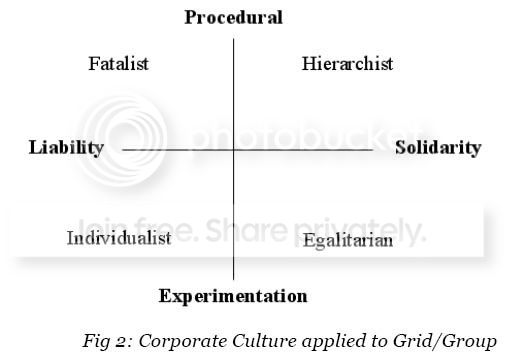
An egalitarian organisation would closely resemble a sect, since it draws stark boundaries between it’s own culture and that of non-members. It provides an immense sense of identity for its members, who share norms and values. Within the group there is little formality or structure and therefore no explicit leadership, creating a fragile organisation. This creates a genuine problem for the egalitarian firm to overcome, “it is prone to internal factions which eventually lead to splitting. It is well-devised for protest but poorly devised for exercise of power” (Douglas (1996[1970]). This provides further theoretical validation for the theory that companies can struggle to maintain market leadership if they’ve historically been viewed as an alternative. The visions are stark with little middle ground for compromise, and Douglas and Wildavsky (1983) show how this is the prevailing cultural mindset for fringe environmental groups. The “green revolution” that has created Corporate Social Responsibility has generated egalitarian rhetoric, but perhaps little substantive change. By contrast more recent movements toward “ethical” companies have generated more egalitarian organisations, and their growth will be constrained by the extent to which they remain egalitarian. Beyond a certain scale requires bureaucracy, and niche companies have a dilemma about whether to grow or retain their founding values – throughout which debate will roar and loyalty questioned.
b. Hierarchist
Douglas has defended the concept of hierarchy when it’s been applied crudely to reality, “Hierarchy is presented as a simple monolithic centralized top-down command system like a caricature of General Motors in the 1960s” (Douglas 1996[1970]), but as an ideal-type this caricature is accurate.
The fundamental concern of a hierarchical organisation is the preservation of order, and all systems are created with this principle as their chief goal. Clarity of roles, procedures and regulations are defining characteristics since they demonstrate the form of the order. The maintenance of order requires control, and therefore the use of discipline and authority. When these aims are pursued they generate a detachment from personal moral judgement, and – at the extreme- invokes the collaborators who acted submissively in accordance to the chain of command, “after 1958 he [Maurice Papon] assumed charge of the Paris police, under orders from de Gaulle to “hold the city” against rioting Algerian nationalists. Those orders, as usual, were carried out with maximum efficiency; in one operation in 1961 up to 200 Algerians were killed, their bodies for days afterwards dragged out of the Seine. He had done his duty, Mr Papon said later. He had kept order.”
In the communications office of a former-Soviet nuclear bunker in Ligatne, Latvia, a sign reads “Without communication there is no order. Without order there is no communication.”8 The centralised manner in which communication is organised within a hierarchical organisation shows this phrase to be classic Communist doublespeak: there can be no conversation in the sense of dialogue, merely the conveyance of instructions from one person to another. Under this system there is no dialogue, and therefore no communication.
c. Individualist
An “individualistic organisation” appears to be an oxymoron, but this merely underlines how ineffective a corporation operated along such lines would be. Although the individualist/collectivist “Group” axis is similar to the dominant political fault-lines of right vs. left, it’s important to delve deeper and realise that socialism and fascism are both collectivist ideologies, in contrast to a third position of individualism. Furthermore, this libertarian use of the term is not what is meant in Grid/Group since it is perfectly consistent for a libertarian to have altruistic preferences. Individualism in this context goes beyond the economic assumption of self-interest to imply selfishness, and an autistic ego devoid of social norms or c0nsideration for others.
A corporation comprised of individualists would be a collection of Gordon Gekko’s following profits regardless of respect for the law or personal integrity. Employees would stab each other in the back at any opportunity, destroying the potential for inter-firm trust or cooperation. Non-pecuniary activities would have no value, creating a short-termism and rapid turnover of personnel. In as much as teamwork is profitable to exploit a particular opportunity, groups would assemble and disband rapidly.
d. Fatalist
An organisation comprising of fatalists would be consumed by total apathy. Members are isolated, subordinated, and passively obeying highly regimented and controlled functions. They would be automated creatures following repetitive tasks. The assembly-line producer has fatalistic elements, but for an entire organisation to be comprised of fatalists would mean that the directions were provided by external impulses: by nature, or by God. There would be no genuine action, just reaction to stimuli. As George Orwell said, “the great redeeming feature of poverty is that it annihilates the future”. Notice how this explains the downtrodden, un-empowered, un-unionised underclass but in actual fact does not necessarily mean material deprivation. In Roman Holiday Audrey Hepburn plays a European princess rebelling against the strict procedures imposed upon her, demonstrating a spirit missing from a fatalist but a circumstance that’s similar. Also Mars (1982) points out the fatalist’s paradox whereby the fact that they abide by rules makes them powerless, and yet if they were to break the rules (and put a spanner in the works) the consequences would be severe – by the nature of their acquiescence a reversal would be grave.
All of the above paint pretty depressing pictures of what an organisation might look like. Although in some cases we can recognise characteristics of these cases in the real world, fortunately they’ll never occur in such stylised forms. Such organisations would be impossible to exist, and consequently any real-world analysis will create a cloudier picture than the pristine horrors just seen. As we do step into the real world though, it’s imperative to retain the theoretical clarity provided by ideal-types.
-----
a. Dealing with the whistle blower
For any organisation effective communication channels are an important condition for renewal and innovation, and dialogue is the preserve of the egalitarian culture. The Financial Times has quoted a senior executive at BP declaring, “We have a leadership style that probably is too directive and doesn’t listen sufficiently well…[a particular BP practice] needs to be deplored with great judgement and wisdom”. These two points are in conflict, because the former laments that hierarchy overpowers egalitarianism whilst the latter sees hierarchy as a solution. Those remarks were made to his colleagues and despite the inherent contradiction can play a role in creating an in-house solution. When employees voice their criticisms to outsiders it is called “whistle blowing”, a concept that has come to the fore following Sherron Watkins lifting the lid on Enron. The term is usually defined to imply that the criticism being made is potentially damaging, and is raised to an authority figure outside the immediate group (whether internally or externally). Whistle blowing is an intriguing area because, as the quote above demonstrates, it has an inherent contradiction in terms of the methods to resolve the problem. If a worker is frustrated or offended by a particular incident the common action is to do nothing: a fatalist would acquiesce and just get on with things (being a “snitch” would only make life more difficult); an individualist will be aware that whistle blowing is costly and therefore keep quiet for their own sake12; and the hierarchist would be a team-player and not want to rock the boat13. It is only an egalitarian culture that would produce the sense of righteousness (strong group) and empowerment (weak grid) to self-sacrifice and expose the problems.14 “Why observers do or do not blow the whistle…may be clarified by the theory of exit and voice” (Applebaum and Mousseau 2006), and that theory of exit and voice exists within the egalitarian enclave governed by strong distinctions between internal and external, and dialogue, “Enclave is a good solution for organising protest and dissent” (Douglas1970).
The American Institute of Certified Public Accountants provides guidance for potential whistleblowers, suggesting concerns are escalated to a higher level of management. It is striking that the regulator’s solution is hierarchical, despite the prospective whistleblower being an egalitarian phenomena: the process conflicts with the underlying values, it is senseless to “solve” an egalitarian phenomena with hierarchical mechanisms. Rather, the culture that generates whistle blowers can be actively cultivated so that information is known before mistakes arise.
Ultimately whistle-blowing is a last resort, and a sure sign of an ineffective organisation: it is the egalitarian’s damaging parting shot that contains valuable information. Effective internal communication channels would permit criticism and debate, turning the whistleblower’s knowledge into an advantage (Vinten 2003).
-----
d. Coping with nihilism
The majority of a company’s employees don’t have a direct role in an organisations transformation, and so although a “participatory workforce” is a lofty ambition, in practice it is little more than a rhetorical gesture. Therefore managers who wish to incorporate and accommodate their entire staff must recognise the existence of a majority of passive workers. Indeed since fatalism is inextricably linked to the following of orders from above, and reforms alter those orders being sent, the act of reform can produce precisely the mindset they seek to destroy. If staff receive constantly changing directions the rational response is to cease trying to participate and simply adapt passively to what’s occurring.
Indeed the fatalist’s biggest fear is that they’ll be required to “participate”, and relinquish the structure of their role. Fatalism isn’t a motivational issue, and is a legitimate and important component of a successful organisation: it should be treated with respect, and not abused.
In a fatalistic company staff perform their roles with little interpersonal contact, drawing their identity and meaning outside of the workplace. I spent a year working in a fatalistic office environment, where the beginning and end of the working day were treated as stark boundaries. Colleagues would loiter outside rather than arrive early, and regardless of the task being undertaken would leave work to the second of the end of a shift. The premises were on Liverpool’s Albert Dock, and throughout the lunch hour a hybrid bus/boat called the “Duck Bus” would occasionally drive tourists in from the city centre, and float across the docks. A tradition emerged that should the Duck Bus appear we’d get another round of drinks in, regardless of how long we had left. It signified that during the working day even simple tasks would be contracted out to fate, and the use of superstition. On one occasion a disciplinary issue arose and several colleagues were summoned to a meeting with a manager. She was visibly taken aback when we all refused to inform her of the full details of what had happened, and who was to blame. In our separate roles as employees the fatalist mindset was fitting, and a crucial aspect of this is following instructions. However outside of work we had developed into a group of friends with our own sense of loyalty and solidarity that superseded the procedural values typically demonstrated at work. In other words, an egalitarian enclave had developed outside of the companies boundaries, but containing a group of colleagues. This phenomenon suggests that team-building exercises that take staff outside of the company are inherently risky. Firstly, they are resented because such egalitarian pursuits conflict with a fatalist’s preference to be non-participatory. Secondly they might do more to strengthen the group bonds of an external egalitarian enclave than generate corporate solidarity. The classic example is the Christmas Party where senior management become marginalised as the masses run amok. It is a volatile event because it merges the work environment with leisure, and relationships in each are organised in fundamentally different ways. This creates tension, and risks empowering an egalitarian minority to the detriment of the wider department. An unhappy ending to this might be a clash between a fatalist worker and a hierarchical manager in a social environment with different roles. When a colleague was fired for a Christmas Party-related misdemeanour, the attitude of the remaining enclave was typically sectarian by renouncing his group membership. I haven’t seen him since, and his antics have passed into folklore.
-----
Hierarchists favour order; individualist’s liberty; egalitarian's justice; and fatalist’s survival… with such alternative and (at times) conflicting values it is inherently difficult to create a flourishing organisation where all members are satisfied. Most staff incentive schemes treat all employees as having the same objectives, and even if management wish this were true, the state of nature is one of diversity. A hierarchist wants promotion, and individualist cash; egalitarian shared prizes; a fatalist more holiday allowance. This is true for corporations and society alike.
An egalitarian organisation would closely resemble a sect, since it draws stark boundaries between it’s own culture and that of non-members. It provides an immense sense of identity for its members, who share norms and values. Within the group there is little formality or structure and therefore no explicit leadership, creating a fragile organisation. This creates a genuine problem for the egalitarian firm to overcome, “it is prone to internal factions which eventually lead to splitting. It is well-devised for protest but poorly devised for exercise of power” (Douglas (1996[1970]). This provides further theoretical validation for the theory that companies can struggle to maintain market leadership if they’ve historically been viewed as an alternative. The visions are stark with little middle ground for compromise, and Douglas and Wildavsky (1983) show how this is the prevailing cultural mindset for fringe environmental groups. The “green revolution” that has created Corporate Social Responsibility has generated egalitarian rhetoric, but perhaps little substantive change. By contrast more recent movements toward “ethical” companies have generated more egalitarian organisations, and their growth will be constrained by the extent to which they remain egalitarian. Beyond a certain scale requires bureaucracy, and niche companies have a dilemma about whether to grow or retain their founding values – throughout which debate will roar and loyalty questioned.
b. Hierarchist
Douglas has defended the concept of hierarchy when it’s been applied crudely to reality, “Hierarchy is presented as a simple monolithic centralized top-down command system like a caricature of General Motors in the 1960s” (Douglas 1996[1970]), but as an ideal-type this caricature is accurate.
The fundamental concern of a hierarchical organisation is the preservation of order, and all systems are created with this principle as their chief goal. Clarity of roles, procedures and regulations are defining characteristics since they demonstrate the form of the order. The maintenance of order requires control, and therefore the use of discipline and authority. When these aims are pursued they generate a detachment from personal moral judgement, and – at the extreme- invokes the collaborators who acted submissively in accordance to the chain of command, “after 1958 he [Maurice Papon] assumed charge of the Paris police, under orders from de Gaulle to “hold the city” against rioting Algerian nationalists. Those orders, as usual, were carried out with maximum efficiency; in one operation in 1961 up to 200 Algerians were killed, their bodies for days afterwards dragged out of the Seine. He had done his duty, Mr Papon said later. He had kept order.”
In the communications office of a former-Soviet nuclear bunker in Ligatne, Latvia, a sign reads “Without communication there is no order. Without order there is no communication.”8 The centralised manner in which communication is organised within a hierarchical organisation shows this phrase to be classic Communist doublespeak: there can be no conversation in the sense of dialogue, merely the conveyance of instructions from one person to another. Under this system there is no dialogue, and therefore no communication.
c. Individualist
An “individualistic organisation” appears to be an oxymoron, but this merely underlines how ineffective a corporation operated along such lines would be. Although the individualist/collectivist “Group” axis is similar to the dominant political fault-lines of right vs. left, it’s important to delve deeper and realise that socialism and fascism are both collectivist ideologies, in contrast to a third position of individualism. Furthermore, this libertarian use of the term is not what is meant in Grid/Group since it is perfectly consistent for a libertarian to have altruistic preferences. Individualism in this context goes beyond the economic assumption of self-interest to imply selfishness, and an autistic ego devoid of social norms or c0nsideration for others.
A corporation comprised of individualists would be a collection of Gordon Gekko’s following profits regardless of respect for the law or personal integrity. Employees would stab each other in the back at any opportunity, destroying the potential for inter-firm trust or cooperation. Non-pecuniary activities would have no value, creating a short-termism and rapid turnover of personnel. In as much as teamwork is profitable to exploit a particular opportunity, groups would assemble and disband rapidly.
d. Fatalist
An organisation comprising of fatalists would be consumed by total apathy. Members are isolated, subordinated, and passively obeying highly regimented and controlled functions. They would be automated creatures following repetitive tasks. The assembly-line producer has fatalistic elements, but for an entire organisation to be comprised of fatalists would mean that the directions were provided by external impulses: by nature, or by God. There would be no genuine action, just reaction to stimuli. As George Orwell said, “the great redeeming feature of poverty is that it annihilates the future”. Notice how this explains the downtrodden, un-empowered, un-unionised underclass but in actual fact does not necessarily mean material deprivation. In Roman Holiday Audrey Hepburn plays a European princess rebelling against the strict procedures imposed upon her, demonstrating a spirit missing from a fatalist but a circumstance that’s similar. Also Mars (1982) points out the fatalist’s paradox whereby the fact that they abide by rules makes them powerless, and yet if they were to break the rules (and put a spanner in the works) the consequences would be severe – by the nature of their acquiescence a reversal would be grave.
All of the above paint pretty depressing pictures of what an organisation might look like. Although in some cases we can recognise characteristics of these cases in the real world, fortunately they’ll never occur in such stylised forms. Such organisations would be impossible to exist, and consequently any real-world analysis will create a cloudier picture than the pristine horrors just seen. As we do step into the real world though, it’s imperative to retain the theoretical clarity provided by ideal-types.
-----
a. Dealing with the whistle blower
For any organisation effective communication channels are an important condition for renewal and innovation, and dialogue is the preserve of the egalitarian culture. The Financial Times has quoted a senior executive at BP declaring, “We have a leadership style that probably is too directive and doesn’t listen sufficiently well…[a particular BP practice] needs to be deplored with great judgement and wisdom”. These two points are in conflict, because the former laments that hierarchy overpowers egalitarianism whilst the latter sees hierarchy as a solution. Those remarks were made to his colleagues and despite the inherent contradiction can play a role in creating an in-house solution. When employees voice their criticisms to outsiders it is called “whistle blowing”, a concept that has come to the fore following Sherron Watkins lifting the lid on Enron. The term is usually defined to imply that the criticism being made is potentially damaging, and is raised to an authority figure outside the immediate group (whether internally or externally). Whistle blowing is an intriguing area because, as the quote above demonstrates, it has an inherent contradiction in terms of the methods to resolve the problem. If a worker is frustrated or offended by a particular incident the common action is to do nothing: a fatalist would acquiesce and just get on with things (being a “snitch” would only make life more difficult); an individualist will be aware that whistle blowing is costly and therefore keep quiet for their own sake12; and the hierarchist would be a team-player and not want to rock the boat13. It is only an egalitarian culture that would produce the sense of righteousness (strong group) and empowerment (weak grid) to self-sacrifice and expose the problems.14 “Why observers do or do not blow the whistle…may be clarified by the theory of exit and voice” (Applebaum and Mousseau 2006), and that theory of exit and voice exists within the egalitarian enclave governed by strong distinctions between internal and external, and dialogue, “Enclave is a good solution for organising protest and dissent” (Douglas1970).
The American Institute of Certified Public Accountants provides guidance for potential whistleblowers, suggesting concerns are escalated to a higher level of management. It is striking that the regulator’s solution is hierarchical, despite the prospective whistleblower being an egalitarian phenomena: the process conflicts with the underlying values, it is senseless to “solve” an egalitarian phenomena with hierarchical mechanisms. Rather, the culture that generates whistle blowers can be actively cultivated so that information is known before mistakes arise.
Ultimately whistle-blowing is a last resort, and a sure sign of an ineffective organisation: it is the egalitarian’s damaging parting shot that contains valuable information. Effective internal communication channels would permit criticism and debate, turning the whistleblower’s knowledge into an advantage (Vinten 2003).
-----
d. Coping with nihilism
The majority of a company’s employees don’t have a direct role in an organisations transformation, and so although a “participatory workforce” is a lofty ambition, in practice it is little more than a rhetorical gesture. Therefore managers who wish to incorporate and accommodate their entire staff must recognise the existence of a majority of passive workers. Indeed since fatalism is inextricably linked to the following of orders from above, and reforms alter those orders being sent, the act of reform can produce precisely the mindset they seek to destroy. If staff receive constantly changing directions the rational response is to cease trying to participate and simply adapt passively to what’s occurring.
Indeed the fatalist’s biggest fear is that they’ll be required to “participate”, and relinquish the structure of their role. Fatalism isn’t a motivational issue, and is a legitimate and important component of a successful organisation: it should be treated with respect, and not abused.
In a fatalistic company staff perform their roles with little interpersonal contact, drawing their identity and meaning outside of the workplace. I spent a year working in a fatalistic office environment, where the beginning and end of the working day were treated as stark boundaries. Colleagues would loiter outside rather than arrive early, and regardless of the task being undertaken would leave work to the second of the end of a shift. The premises were on Liverpool’s Albert Dock, and throughout the lunch hour a hybrid bus/boat called the “Duck Bus” would occasionally drive tourists in from the city centre, and float across the docks. A tradition emerged that should the Duck Bus appear we’d get another round of drinks in, regardless of how long we had left. It signified that during the working day even simple tasks would be contracted out to fate, and the use of superstition. On one occasion a disciplinary issue arose and several colleagues were summoned to a meeting with a manager. She was visibly taken aback when we all refused to inform her of the full details of what had happened, and who was to blame. In our separate roles as employees the fatalist mindset was fitting, and a crucial aspect of this is following instructions. However outside of work we had developed into a group of friends with our own sense of loyalty and solidarity that superseded the procedural values typically demonstrated at work. In other words, an egalitarian enclave had developed outside of the companies boundaries, but containing a group of colleagues. This phenomenon suggests that team-building exercises that take staff outside of the company are inherently risky. Firstly, they are resented because such egalitarian pursuits conflict with a fatalist’s preference to be non-participatory. Secondly they might do more to strengthen the group bonds of an external egalitarian enclave than generate corporate solidarity. The classic example is the Christmas Party where senior management become marginalised as the masses run amok. It is a volatile event because it merges the work environment with leisure, and relationships in each are organised in fundamentally different ways. This creates tension, and risks empowering an egalitarian minority to the detriment of the wider department. An unhappy ending to this might be a clash between a fatalist worker and a hierarchical manager in a social environment with different roles. When a colleague was fired for a Christmas Party-related misdemeanour, the attitude of the remaining enclave was typically sectarian by renouncing his group membership. I haven’t seen him since, and his antics have passed into folklore.
-----
Hierarchists favour order; individualist’s liberty; egalitarian's justice; and fatalist’s survival… with such alternative and (at times) conflicting values it is inherently difficult to create a flourishing organisation where all members are satisfied. Most staff incentive schemes treat all employees as having the same objectives, and even if management wish this were true, the state of nature is one of diversity. A hierarchist wants promotion, and individualist cash; egalitarian shared prizes; a fatalist more holiday allowance. This is true for corporations and society alike.
The fatalist one is of interest to me because it sounds so much like Marx's conception of alienation. One can also see how people can be mistaken for the wrong group when viewed from black and white extremes.
Yeah, I know. Sorry if I made you read.