|
|
|
|
|
|
|
|
|
 Posted: Mon Jun 25, 2007 5:09 pm Posted: Mon Jun 25, 2007 5:09 pm
The Tools of the Craft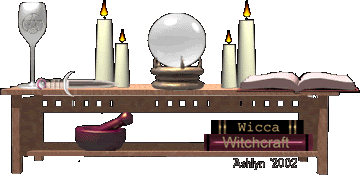 Everyone loves toys and Witches are no exception. We have a wide variety of tools we use to aid us in our workings. None of these are mandatory. You do not need tools to be Wiccan or to perform Witchcraft. Tools have no energy, save the power we give them. You will need to decide for yourself what you want to work with. Before using any tool, especial if it is old, it needs to be cleansed and consecrated. I will provide a Consecration Ritual later on. And remember, never touch another Witch's tools without express consent. This is a list of the tools. I'll go into further explanation in the posts below.
Altar
Athame
Bell
Besom
Boline
Book of Shadows
Candles
Cauldron
Censer
Chalice
Incense
Mortar and Pestle
Robes
Sword
Pentacle
Wand/Staff Please remember that None of these is absolutely necessary to be a wiccan, nor is it a complete list of all the tools you can own.
|
 |
|
|
|
|
|
|
|
|
|
|
|
|
|
Posted: Wed Jun 27, 2007 11:20 am
The Altar 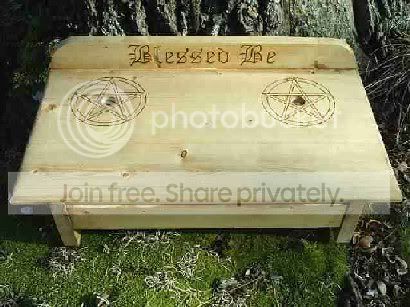 Usually wooden, but can be made of anything really, it is a shelf, table, etc. that faces North or East and holds your tools. It should be big enough to allow you room to work. What you keep on it and how it is arranged is up to you, though specific traditions or covens may have a specific display. Technically anything can work as an altar, from a flat rock by a river, to a windowsill in an apartment. I use a small wooden coffee table. There is not necessarily a "right" way of setting up an altar in Wicca. Ask ten Wiccans what's on their altars, you'll get thirteen different answers. If you're not following a specific tradition, you have the luxury of figuring out for yourself what works for you. There is a general structure to follow, but there is much room for creativity and individuality. The magical tools represent the elements. The altar cloth really can be made of whatever material you like and color or pattern you like. Plain colored cloths seem to work the best for most occasions. Black is a popular choice. You could use colors that correspond to your interests or specialties in the Craft, such as a green cloth if you're interested in herbal magic, or purple for religion and spirituality. Patterned cloths are nice for Sabbats. The altar stands in the middle of the circle, and is set to face either north for the Goddess and the Earth, or east, the place of fresh beginnings, where the Sun and Moon rise. The Athame 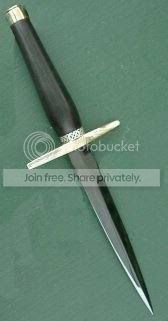 The Athame is the practitioner's ritual knife, symbolising the masculine principle, associated to the element of Air, and according to several authors also with Fire (for the fire used during the forging of the blade). The Athame traditionally must have a black handle and a double-edged blade, even though we're not really going to use the blade too often. The main function of the Athame (and the Sword) is to direct the user's energy, whether when tracing the circle, or casting a spell. It's also used, raised high as a greeting, when calling the four quarters when casting the circle. Some traditions also used a smaller, white handed knife, the boline, for everything that implies cutting or carving, and the Athame is never used for cutting anything on the physical plane. Bell 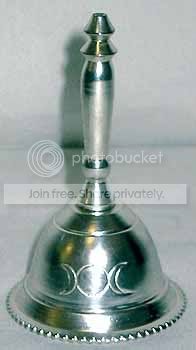 Bells have been around for many years and they come in all kinds of different shapes and sizes, as well as different tones and sounds. The rhythmic sound and vibrations cause certain waves and can be used for magical purposes, while at other times it marks a plateu in a ritual. The bell has magical associations and has been believed for centuries to possess a magical and/or spiritual power in of itself. Bells are associated with the divine, whereby their sound is symbolic of creative power, their very shape a symbol of the Female Force and its secret Celestial Vault. Although the bell is an unconventional tool on the main, it is said that once you use it in a ritual, you might just feel the need to keep using it. High Magic and even some Christian churches use bells within their varied rituals. Hundreds of years ago, rural folks knew that loud noise drove away evil spirits, and the bell is a prime example of a good noisemaker. The ringing of a bell causes vibrations which are the source of great power. Variations on the bell include the shaking of a sistrum, a ritual rattle, or the use of a singing bowl. All of these can help bring harmony to a magical circle. In some forms of Wicca, the bell is rung to begin or end a rite, or to evoke the Goddess.
|
|
|
|
|
|
|
|
|
|
|
|
|
|
|
|
|
|
Posted: Wed Jun 27, 2007 11:34 am
Besom  The broom might be, along with the cauldron, the most famous tool connected popularly with witches. Traditionally an element symbolising the union of the masculine and feminine principles, was used not for flying, but for the ritual cleaning of the working space, and protection and fertility rites. Some authors suggest the broom was the perfect place to hide the wand during the Witch Hunt, disguising it as an element of daily use. Sir James Frazer in "The Golden Bough" gathers multiple examples of rituals that involved the use of a broom, generally as a symbol of fertility or fecundating energy. According to one of those, to assist the fertility of the fields a young woman had to circle them once they were sown, naked and riding a broomstick. In these rituals might be seen the remains of the primal fertility rituals, where the High Priest and the High Priestess symbolised the marriage of Earth and Sky, the Goddess and the God, renewing the fertility of the land. Another version suggests that if we want a cleansing broom, it should be made of willow wands, which was believed of old to cast off evil spirits. This was believed to the point of considering the whipping with willow wands a sure method of exorcism. The truth is, our ritual broom must be of the old style, made of wigs or straw, and it must be reserved to a symbolic pass to cleanse the place of any type of energies before starting any ritual, and as every tool named so far, must be kept for this purpose only. The best results will be achieved if we make it ourselves, but due to the difficulty of this task, we can safely leave it in someone else's hands, if we're careful enough to do the energetical cleansing before using it. It's use is not strictly necessary, so let us not despair if we can't find a broom maker where we are: we can easily go on with our celebrations without the broom, as long as we replace the cleansing action with a similar one. Boline  In Wicca the boline (also spelled bolline) is a white-handled ritual knife, one of several magical tools used in Wicca. Unlike the athame, which in most traditions is never used for actual physical cutting, the boline is used for cutting cords and herbs, carving candles, etc. It has a small, straight or crescent-shaped blade and a handle which is traditionally white in colour. The boline has been adopted by several other modern forms of witchcraft including Eclectic Wicca. Amongst these later traditions opinions vary as to whether the boline is truly a magical tool or is merely of utilitarian purpose. Sometimes a knife called a kirfane (spellings vary) is used, for roughly the same purposes as the boline. According to the Kitchen Witchcraft philosophy, the use of magical tools for mundane purposes like cooking is actively encouraged, and as such there is little or no need for a boline as a separate tool from the athame. Some traditions, such as that of Robert Cochran, also prescribe the use of a single knife for both ritual and practical purposes. Many of the Bolines advertised in on-line 'magick shops' have a characteristic crescent shape, and are described as being for harvesting herbs . Book of Shadows  The Book of Shadows is a book that the practitioner must keep, where he'll write every ritual as they're done, spells, incense mixtures, and basically every thing that has to do with his work as a witch. It is not necessary for the Book to be a delicately calligraphed volume, but it must be kept for this sole purpose. It's also quite convenient for it to be the kind that can have pages added to it: a rigid folder will do. Another thing we must keep in mind when getting one is the size of the volume we choose: very big and it will be a bit uncomfortable to keep on the altar, very small and we'll hardly be able to read what we wrote on it. We must remember when writing that reading to candles is not exactly easy, and is quite a common mistake the first times to forget about this. Sadly, you don't realise this till you start the ritual, and then you must spend the whole time guessing what you wrote. An option to make reading easier is to write in clear, rather big handwriting; another is to print the pages from the computer, using a clear font... it's about time witches get modern wink In the Book of Shadows we can also keep other notes, like for instance different meditations, thoughts after the rituals or the results of the spells we might have cast, turning it into a magical diary of sorts, but this is strictly for the practitioner to decide. Another book that might be related to the Book of Shadows, but that is not remotely necessary (even though it might be useful) is the Book of Dreams, where we'll write in the mornings the dreams we had the night before. This I see more convenient to whoever wants to work in depth with their dreams, but of course you don't even need to be Wiccan. Anybody who is in any kind of therapy, whether it's psychological, shamanic, or any other where dreams are important, will also find this book useful.
|
|
|
|
|
|
|
|
|
|
|
|
|
|
|
Posted: Wed Jun 27, 2007 11:37 am
Candles 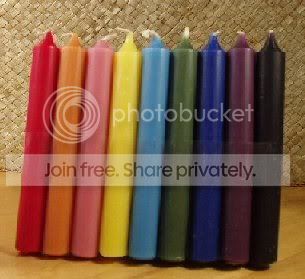 Candles in general are used to represent the light of the Goddess, the Moon, and the element of Fire. They can be either masculine or feminine, depending on their purpose. They are used in nearly all rituals, and their main color is white. For most workings, there should be six basic white candles-two altar candles (one at each side) and four smaller candles placed in the North, South, East and West. This represents the Goddess, the God, and the Four Elements together in harmony. Depending on the ritual being performed, candles of any color may be used. For example, I change the color of my altar candles to purple in Spring tide and to yellow or green in Autumn. Some rituals use additional "working" candles, lit only after the ritual has been done, used for their purpose, and blown out before any of the other candles. As you plan your rituals and workings, you will come to find what works for you. The color meaning are as follows: Yellow
Activity, Creativity, unity; brings power of concentration and imagination to a ritual; use in rituals where you wish to gain another’s confidence or persuade someone, or in rituals that require solar energy.
White
A balance of all colors; Spiritual enlightenment, cleansing, clairvoyance, healing, truth seeking; Rituals involving lunar energy' May be substituted for any color candle.
Purple
Power, success, idealism, psychic manifestations; ideals for rituals to secure ambitions, independence, financial rewards, or to make contact with the spiritual other world; increases Neptune energy.
Silver
Removes negativity and encourages stability; helps develop psychic abilities; attracts the influence of the Mother Goddess.
Red
Health, passion, love, fertility, strength, courage, will power; increases magnetism in rituals; draws Aries and Scorpio energy.
Pink
Promotes romance, friendship; standard color for rituals to draw affections; a color of femininity, honor, service, brings friendly, lively conversation to the dinner table.
Orange
Creativity, ability to speak one's mind, ambition, career matters and the Law, self-confidence. Solar color and also stands for Leo.
Green
Promotes prosperity, fertility, success; stimulates rituals for good luck, money, harmony, and rejuvenation.
Gold
Fosters understanding and attracts the powers of cosmic influences; beneficial in rituals intended to bring about fast luck or money, or in rituals needing solar energy.
Brown
Earthly, balanced color; for rituals of materiel increase; eliminates indecisiveness; improves powers of concentration, study, telepathy; increases financial success; good for animal magic; locates objects that have been lost.
Blue
Primary spiritual color; for rituals to obtain wisdom, harmony, inner light, or peace; confers truth and guidance.
Black
Opens up the deeper levels of the unconscious; use in rituals to induce a deep meditation state, or to banish evil or negativity as in uncrossing rituals; attracts Saturn energy. *Candle color meanings borrowed From CollegeWicca.comCauldron 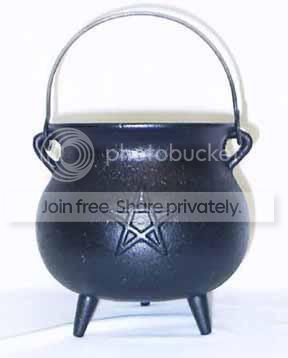 The Cauldron has a mythological based on the Celtic traditions, and another on popular beliefs. It has been associated with witches from the beginning, as the place where the infamous potions were boiled. The symbology takes it both as a tool of transformation (elements enter it in one state and leave it in another) and as an image of the mother's womb. Celtic mythology tells us about the Goddess Cerridwen, who cooked in her cauldron the potion for wisdom for a year and a day, curiously the same time one needs to serve as an acolyte before being formally initiated. There are many mentions to the witches' cauldron, and among the most famous we can name the one featured in a scene in Shakespeare's Macbeth, when they make a potion as Macbeth decides his future as a traitor. Another legend taken from the Mabinogion tells us of a cauldron that has the virtue of bringing dead warriors back to life. The cauldron we're talking about here doesn't need to be enormous like we see in the movies. It's still somewhat easy to find cooking pots very much like we need, even though they're not the average nowadays. During rituals, depending on the size, we can either put it on the altar, or on the floor, to our left. The uses of the cauldron varies. As representing the Primal Womb, is obviously feminine, belonging to the element of water. But as it's solidly built, and usually isolated from the floor by three legs, we can use it, for instance, for every ritual that requires a small fire, or the burning of an element (paper or candles), without worries about security risks. It'll be useful in every case we need to symbolise a transformation or rebirth. Also, when full of water it can symbolise the element, though we'll generally use the chalice. Another of it's ritual uses can be as a place to discard every material used along the ritual, for instance matches or ashes, to keep them off the altar. As with all tools, but with this in particular due to it's possible uses, we must remember to scrupulously clean it after it's use. If necessary, it can be replaced by a small metal bowl if we need to burn something, or with the chalice if we just need it to contain water. Censor 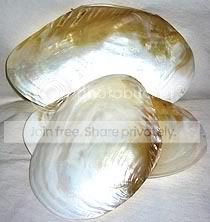 The censer is one of the basically elements in arranging the altar for ritual. Whether we use our incense in sticks, cones or grain, we must have a vessel to hold the ashes and isolates the altar from the heat of the burning incense. If we're using sticks, the best will be to have a shallow, wide mouth recipient (like a soup bowl), full of sand, where we'll nail the sticks to consume. The same if we're using cones. If we want to use grains, the censer must be heat-proof, for the burning coals will release extreme heat. This last type is the most advisable, since it gives us the freedom of making our own mixes from scratch, using a few basic elements and adding herbs or even flowers if wanting to. In every case, it's better if the recipient has some kind of handle, or chains like the old Church censers, to handle it without getting nasty burns. We must keep in mind that in some cases we'll have to walk around with it, for instance, if we're doing a house cleansing, but think of what your needs are. The better materials are clay, ceramic or bronze, being the former the cheaper but more fragile, and the later the most expensive. Even things from nature can be used. I live near a river that has clams living in it... so I use an old clam shell. The censer and the coals slowly consuming, represent the elements of Fire and Air in the rituals, both masculine. Generally, the censer will be placed on the right of the altar, needing a case similar to the one we ought to have with lit candles.
|
|
|
|
|
|
|
|
|
|
|
|
|
|
|
|
|
|
Posted: Wed Jun 27, 2007 11:39 am
Chalice 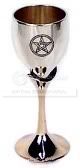 The chalice is a smaller version of the cauldron as a representation of the eternal feminine and the element of water. We're talking about a goblet, usually of the round type, in which we'll have water represented during rituals, even though on occasions it might contain some other liquid, for example wine during the simple feast. The selection of the appropriate chalice is a delicate task. We could use a glass one, even though the traditional is made of metal: gold, brass, silver or the like. We must be very careful when choosing, preferring the ones with their inside covered in glass, silver or stainless steel, because metals like copper and brass can be poisonous when in contact with alcohol. We must also consider the size, preferring the middle-sized, to make it easier to handle. It's not necessary to get a very ornate one; it's perfectly valid to use, if wanting to, one of Grannie's crystal glasses, if we perform the appropriate ritual cleansing. Shops specialising in wedding gifts are bound to have sets of two metal goblets perfectly capable of handling alcoholic beverages (the ones that have problems when reacting chemically with the metal), and so can be a good place to find our chalice. Having an extra one can be useful if we want to perform rituals where we need both water and wine (or similar), and we won't have the cauldron available or we'll be using it for other purposes. Personally, I'd rather have two chalices: a brass one for solar celebrations, and a silver one for the lunar ones. The ritual uses of the chalice centre mainly in being the holder of the chosen liquid, whether it's water to purify the circle, or the chosen drink for the simple feast or ritual libation. Usually it's use will be the first, and even if we can replace it with any glass, due to the ease of getting hold of one, I think it's better to chose once and for all, and use the chalice regularly, not occasionally. Incense 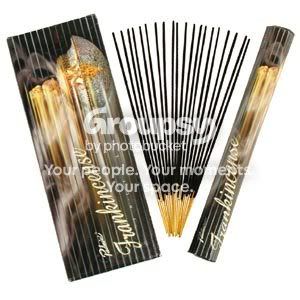 Incense is often used in ritual and represents the element Air. There is a plethora of choices out there, from stick incense to cone incense, to powder incense, to resin incense, and all the different scents and flavors. Choose your favorite based on mood and need. Different blends are better for different rituals, you'll need to experiment to see what works best for you when. Here's a short list of the some of the better correspondences: Amber
love, comfort, happiness, healing
Ambergris
dreams, aphrodisiac
Angelica
protection, harmony, integration, insight and understanding, stability, meditation
Anise
emotional balance
Apple Blossom
happiness, love, friendship
Basil
concentration, assertiveness, decisiveness, trust, integrity, enthusiasm, mental clarity, cheerfulness, confidence, courage
Bayberry
protection, prosperity, happiness, control
Benzoin
astral projection, purification, clears negative energy, emotional balance, eases sadness, depression, weariness, grief, anger, & anxiety
Bergamot
money, prosperity, uplifting of spirits, joy, protection, concentration, alertness, confidence, balance, strength, courage, motivation, assertiveness
Cardamom
mental clarity, concentration, confidence, courage, enthusiasm, motivation
Carnation
protection, strength, healing, love, lust
Cedarwood
healing, purification, protection, money, balance, grounding, clarity, insight, wisdom
Chamomile
harmony, peace, calm, spiritual, inner peace
Cinnamon
stimulation, wealth, prosperity, business success, strength, lust, healing
Citronella
cleansing, warding off, healing, exorcism
Clove
pain relief, intellectual stimulation, business success, wealth, prosperity, divination, exorcism, protection, eases fears, improves memory and focus
Copal
love, purification, uplifting spirits, protection, exorcism, spirituality
Cypress
strength, comfort, healing, eases anxiety and stress, self-assurance, confidence, physical vitality, willpower, concentration
Dittany of Crete
astral projection, divination
Dragon's Blood
protection, purification, courage, exorcism, magical power, love
Eucalyptus
healing, purification, protection
Frankincense
spirituality, astral strength, protection, consecration, courage, exorcism
Gardenia
peace, love, healing
Ginger
wealth, lust, love, magical power
Hibiscus
divination, love, lust
Honeysuckle
money, happiness, friendship, healing
Hyacinth
happiness, protection
Jasmine
love, money, dreams, purification, wisdom, skills, astral projection
Juniper
calming, protection, healing, exorcism
Lavender
cleansing, healing, love, happiness, relaxation
Lotus
elevates mood, protection, spirituality, healing, meditation
Musk
aphrodisiac, prosperity, courage
Myrrh
spirituality, meditation, healing, consecration, exorcism
Patchouli
money, growth, love, mastery, sensuality
Peppermint
energy, mental stimulant, exorcism, healing
Pine
grounding, strength, cleansing, exorcism, healing
Rose
love, house blessing, fertility, healing
Rosemary
remembrance, memory, energy, exorcism, healing
Sage
wisdom, clarity, purification, exorcism
Sandalwood
spirituality, healing, protection, astral projection, exorcism
Strawberry
love, luck
Vanilla l
lust, mental alertness
Yarrow
courage, exorcism
Ylang-Ylang
love, harmony, euphoria Mortar and Pestle 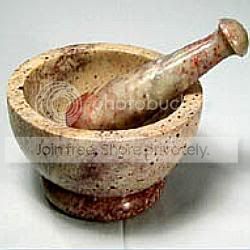 Used to grind herbs for ritual use, to make incense or potpourri.
|
|
|
|
|
|
|
|
|
|
|
|
|
|
|
Posted: Wed Jun 27, 2007 11:40 am
Robes 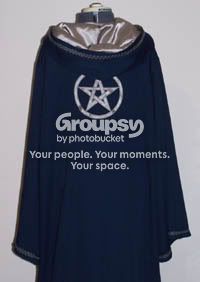 Many group prefer to do they're rituals Skyclad, or naked, but anymore this is an optional thing. Any group that tells you you must do rituals in the nude, probably isn't very reputable and I'd seriously question their motives. Robes are NOT necessary. Any lose fitting, comfortable, clean clothing is fine. However many people think it's better to make a distinction between ritual clothing and everyday clothing. Plus they add a grandeur to rituals that street clothes just can't provide. Robes come in many colors and every color is good for something different. The colors meanings are the same as the candle color meanings. Get robes of many different colors can get pricey, so if you feel you need a robe, get a black one. Black is a neutral color that repels negativity and is good for all rituals. Sword 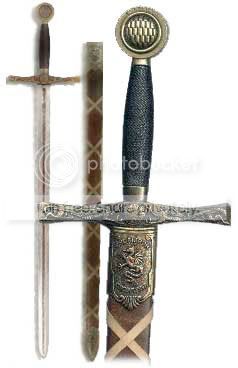 The Sword directly relates to the Athame and has the same attributes and uses and can be used in place of, or in addition to it. The sword is still used by many witches in ritual and magic today, especially with the coming of the modern "Celtic Revival", the sword has actually become a very popular-and quite a showy- magical tool. Most groups who hold rituals indoors usually limit the use of the sword to just one for the Priest/Priestess. Thirteen five- foot swords in a nine foot Circle could get a bit messy. However at festivals and outdoor rituals, Witches often bring their own swords to mark the boundaries or quarter points of the circle. Pentacle 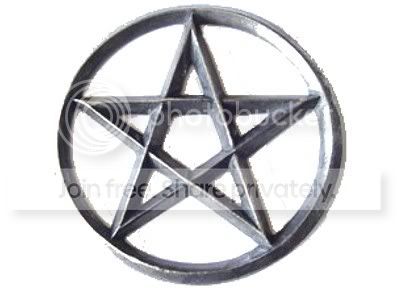 The pentacle is nothing other than a disc, approximately the size of a medium dish, that has a pentacle drawn on it's surface, that is, a five pointed star inscribed inside a circle. It represents the element of Earth, has a feminine character and upon it we'll consecrate the elements we'll use during ritual. The materials used can be assorted: clay, ceramic, metal or wood, is maybe the tool that best adapt to be craftily created by the practitioner. If we can model clay, we can do it ourselves with the pattern already drawn, even with stones engraved. If not, painting over a dish we bough can be an option. If we'll be doing things this way, we must be very careful not to use water soluble paint, because we'd ruin the piece when washing it, and also using non-toxic paint, because every now and then we'll need to place food over it, for instance during the simple feast. Wand/Staff 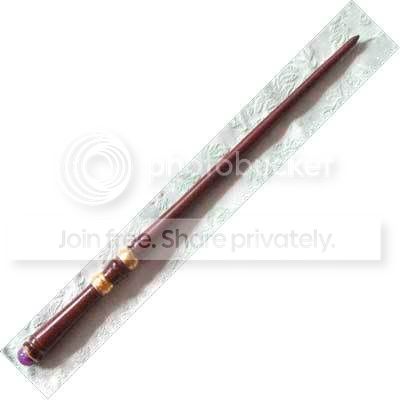 The wand is a popular tool in magic. Whether in the magic wand of the fairy godmothers, or the staff of the magicians in fairy tales, it has survived in the collective image of the magic practitioners as a guide and director of power. And that image is not far from the truth: in ritual, the wand will fulfill the function of conducting the energy we raise during ritual, more or less in a way similar to the athame. Symbolising the masculine energy, and assigned according to tradition to either Fire or Air, the wand will serve us during ritual, maybe with a less aggressive quality than the athame or the sword. There are almost as many different types of wands as there are practitioners, and the difference are seen both in shape, size, and materials used for it's built. Generally they'll be made of wood, the type depending on the affinity each one has with each tree or the uses we're planning for it, even though there are also metal wands, and crystal clear ones (probably acrylic). They can also have a simple ending or a quartz crystal point acting as an "amplifier". The followers of Celtic traditions could very well have a different wand for each month of the lunar tree calendar, with their different attributes, as follows: Birch, purification, the first month, November
Rowan, protection against spells, the second month, December
Alder, protection and prophesy, the third month, January
Willow, feminine, lunar aspects, the fourth month, February
Ash, bonding the inner and outer world, the fifth month, March
Hawthorn, purification and chastity, the sixth month, April
Oak, protection and entrance into the Mysteries, seventh month, May
Holly, superiority in struggle, the eighth month, June
Hazel, intuition, the ninth month, July
Vine, prophesy, tenth month, August
Ivy, search for the Ego, the eleventh month, September
Reed, direct action, twelfth month, October
Elder, beginings and endings, the thirteenth month, the last days of October Other options are the Apple tree for matters of the heart, willow for lunar magic, or oak for magic that implies a great use of the element of Fire. Some authors, like Scott Cunningham, suggest that before using and consecrating it, we should show it to the rising Moon, rubbing it with lavender and invoking the Goddess, and with fresh leaves at the rising Sun, invoking the God, so that it's imbued with both energies.
We can also use, of course, pieces of wood bought at a store, if we're going for a smoother appearance. Personally, I'd rather go either for finding it during a walk in the woods, or finding a tree, asking permission, cut a branch, wait till it dries and then consecrate it. It might be longer, but I think it helps in the process of getting a tool more attuned to ourselves.
After this process, and decorating it at will, follows the consecration ritual. The important part, whatever the method we use, is that we feel affinity with our chosen tool. 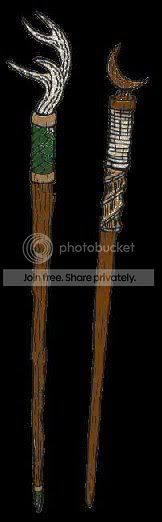 The Staff directly relates to the wand and has the same attributes and uses. Staves are used very frequently by witches today. In the old days most all travelers carried a staff and has only phased out in the last hundred years or so and in fact the gentleman's cane has only phased out in the last sixty or so years and in London is replaced by the umbrella to city businessmen, but where Boy Scouts around the world still maintain the tradition. There are many beautiful hand crafted staves that are both functional and works of art even today and I had one specially made and measured and accompanies me (instead of the staff sometimes) on hikes and walks into the mountains, forests, jungles and glades wherever I happen to be traveling deep in the heart of Mother Nature''s loving hands. The staff is a very important tool in some traditions. It is used to mark quarter points or as a "stang" to hold banners representing elements or other unique symbolic flags. Many traditional Witches use ONLY a staff as a working tool, or sometimes a smaller walking stick or cane and is driven into the ground to act as a makeshift alter to hang things from. It also acts as their one and true wand and directs energy and charge objects. The staff may of course be used in much the same manner as the wand. It is usually matched "to your measure"- which originally meant it reached to your shoulder - although some were traditionally longer and nowadays somewhat shorter. If you are to use a staff, cut one that feels right for you, or if you are to continuously walk with a shorter cane or stick, have one crafted even. Don't forget that the staff holds the same attributes as the wand and should have more or less a phallic shape at the top. mine has a large crystal embedded in the end, which can be withdrawn for special purposes. It was said at one time, some staffs had a hole drilled through into which a thin piece of magnetized steel was driven all the way through. Whether hearsay, or High Magic's ideal, that is going a little too far
|
|
|
|
|
|
|
|
|
|
|
|
|
|
|
|
|
|
Posted: Wed Jun 27, 2007 1:00 pm
Now that you have your tools you need to consecrate them, especially if you're using pre-own, old or found object. All tools need to be consecrated though, even ones that are bought new. They need to be cleaned, attuned to you, and abided with your energies. Here's a simple consecration ritual for you to use or adapt to make your own. The Consecration As a first step, we should do a physical cleansing of the object, careful to correct every tiny manufacturing defect we might find, as well as dirt or dust it could have. As we do this, we must visualise all the negative energy the object might have leaving it. Once it's free of these, we can move on to the next step, that is the consecration ritual. To do this, we place whatever we're going to consecrate on the pentacle, and touching it with our projective hand, and using the name and material of the tool, we say (for instance, if it's a sword): I consecrate you, sword of steel, to cleanse you and purify you, to serve me into the circle. In the name of the Mother Goddess and Father God you're consecrated. After this we charge it, rubbing it in a single direction and visualising that it soaks in our energy; we pour some salt, pass it through the smoke of the incense, through the candle flames (or over them) and then pour some water, each time calling the elements to consecrate it. Some authors suggest the use of a drop of the user's blood mixed in the water to strengthen the bond between user and tool. If we choose to do this, we must be VERY careful: a single drop taken from a finger, using an antiseptic needle bought at a chemist, will work. When we're done, we raise the tool with both hands, saying: I charge you by the Ancient: the Goddess and the God for the virtues of the Sun, the Moon and the Stars by the powers of Air, Fire, Water and Earth May I get everything I want through you. Ancient Gods, charge this tool with Your powers. We lower the tool, and we can start using it. This ritual was taken from "Wicca: A guide for the Solitary Practitioner" by Scott Cunningham, based on the consecration of ritual implements found in the "Key of Solomon".
|
|
|
|
|
|
|
|
|
|
|
|
|
|
|
Posted: Mon Jul 02, 2007 12:24 am
|
|
|
|
|
|
|
|
|
|
|
|
|
Posted: Mon Jul 02, 2007 12:30 am
|
|
|
|
|
|
|
|
|
|
Posted: Mon Jul 02, 2007 12:31 am
Ok... there you go...... if I forgot any tools or you want to know more about a certain tool...... I'll try to help out!
|
|
|
|
|
|
|
|
|
|
|
|
|
|
|
|
|
|
|