|
|
|
|
|
|
|
|
|
 Posted: Sun Jun 10, 2007 4:26 am Posted: Sun Jun 10, 2007 4:26 am
The World of Athlaias This island kingdom exists in a world parallel to ours, located in another plane, but connected to Earth since the dawn of time. Every now and then a natural portal opens up somewhere, sometimes for a few minutes, other times for a few days The portal themselves are like a tunnel, a hole in the fabric of space that sends everything that crossed in a swift, but tumbling ride to the other side. And once it closes there’s no telling when and where the next one will be The fauna and flora found here is a collection of survivors that come from several parts of our world, and occasionally some interbreeding between different species. There are even some pre-historic descendents in some isolated pockets up in the high mountains, but all plants or small animals Humans have made their presence here as well from ancient times, but never in the amount it is today. The few ruins that survived the passage of time, and the occasional reuse of building materials, are a clear reminder of that About the world itself, it has more similarities than just its inhabitants It orbits around a single sun and possesses 4 seasons as well, the snow covered winter, the wet awakening of spring, the hot torrid summer and the colourfully rich autumn. The weather behaves much like the temperate areas of our globe, at least in the kingdom, not too hot and not too cold There are some difference though. Besides the unique geology that causes some phenomenons that don't exist in our world, there is a twin set of moons The largest moon, called Sangui, is very much like a close up of Mars, red and barren. But the smallest, named Mare, has several shades of blue and white which seem to change position. But it's too far away to corfirm the nature of those changes, even with the most modern telescopes (existing in this world. If we were to look through one of ours we would see clouds there) Sangui behaves like our moon, though it's much closer (makes it look the triple of the size) and the cycle of the phases takes only 11 days. Mare is further away, enough to not be able to tell any of it's phases, and it's only visible twice every month The calendar was kept roughly the same though. The year is shorter by a few weeks, which made the months last 28 days each. Mare always shows around the beginning and the middle of each month, while Sangui rotates normally Another detail that's different is the amount of hours a day has. Though it changes normally during the year, having more hours of sun during summer than in winter, the day lasts 20 hours here. Therefor the clocks only have 10 instead of 12 hours, the minutes and the seconds remaining the same
|
 |
|
|
|
|
|
|
|
|
|
|
|
|
|
Posted: Sun Jun 10, 2007 6:14 am
The Geography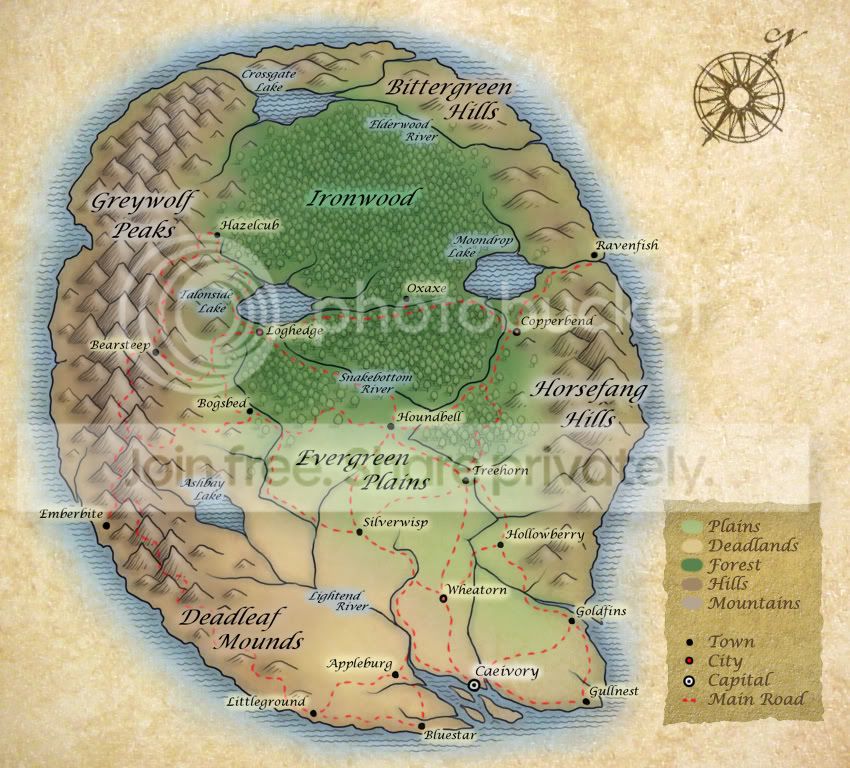 PlainsThere is only one group of plains in this island, named Evergreen because of its richeness in plants and fertility. Irrigated my many rivers and possessing a rich soil, it provides a great ground to build settlements The place is almost completely covered with crops or grazing grounds and has the densest human population, especially near the rivers or the east extremity of the kingdom. The towns are large, the roads broad and often used and there's a great amout of wildlife as well DeadlandsNo one knows why but the Deadleaf Mounds, to the south of Lightend river, are extremely poor. The lands between the rivers are swamps, but as it moves towards the coast, the land gets thougher for plants to develop and animals to live in There a few spots of fertile soil there, but even those aren't very productive. The only richness of this land is the variety of rocks and enriched clay used by the cleric and a few artisans ForestIronwood is by far the biggest and oldest forest in the kingdom. Its a great source of wood and wild game, but its thickness prevents a proper exploration and isolates the few settlements that managed to survive in the loneliness of that sea of green Though its borders are thin, especially the southeast one, its size and location leaves the whole northwestern side of the kingdom pretty much inhabited. Only the main rivers allow the existance of roads, preventing them from being swallowed by the trees. People avoid travelling to that edge of the kingdom because all the market is situated further southeast There are rumours of ruined cities and ancient treasure hidden by the forest, but the wild animals, coutless hidden rivers and swampy areas and the great probability of getting lost have kept them from being found HillsBittergreen and Horsefang Hills surround the north edge of the island. Horsefang is more of a mountain than hills, but it possesses little mineral within it. Its more know for its good cattle and higher altitude crops. There are several small villages built up there who handle the production Bittergreen has scarcely anyone living there. Isolated by the Ironwood forest and surrounded by the sea, its not a place suitable for farming or raising cattle. What grows there is of little quality and the idea of building settlements there has long been abandoned. The only thing that grows well there are rabbits and gull nests MountainsThe only set of high mountians, Greywolf Peaks, surrounds the entire southern and western coast, encasing the Ironwood forest. Though it doesn't possess eternal snow, its high slopes make the establishment of settlements and roads quite tricky. Despite that they are rich in mineral and ore Other important thing they hold are secrets. Treasures from the past easily survive in certain pockets and valleys there. Though hard to find they are quite valued by the high society, which attracts some adventurous hunters and dreamers Lakes, Rivers and the SeaThere are many rivers and a few lakes supplying the land with fresh water. Most of them have never been charted, lying hidden by the forest and in the middle of the mountains. The sea supplies a great source of fish, brought by the strong currents Snakebottom river is the most important in the kingdom. Large, it connects several important cities and serves as one of the fastest traveling routes when it comes to the transport of goods. It's also very rich in freshwater fish and birdlife Lightend river is the longest, but unlike Snakebottom not very rich. People say it's poisoned by the deadlands. Most of the stream is filled with rapids, which makes it unsuitable for traveling Elderwood is the last and smallest of the large rivers, but little is known about its path because of being located in the unhabited part of the kingdom Ashbay lake is said to be a dead pool of water. With grey shores and little life around, most people don't like to stop and capture the few fish that live there. There is an old rumour about the devil's influence on those waters, which makes the numbers of visitors even less Talonside and Moondrop lake are the Snakebottom's river twin lakes. Talonside captures a lot of the richness coming from the forest, with several rivers branching into its depths, while Moondrop is considered to have magical properties because of how clear the water is. Both lakes and an important source of resources, both being quite rich in life And Crossgate lake is filled with misteries. There are manies stories and legends about lost cities built along one of its rivers, but because it's so far no one has managed to confirm it
|
|
|
|
|
|
|
|
|
|
|
|
|
|
|
|
|
|
Posted: Mon Jun 11, 2007 3:32 pm
The Settlements CapitalCaeivoryThe great floating capital of the kingdom, the proud home of the magnificent royal palace, the sacred high church and many other great monuments. It is built upon a floating stone, the biggest of its kind and a natural, though rare occurance in this world. Only the highest of society are allowed to live in its heights, with the rest of the city surrounding it Though heavily medieval it's quite morden in its own way, taking advantage of the odd, natural occurances and the technologies developed around them. The high society enjoys internal plumbing and the graceful flying devices, both powered by the energy surrounding the floating heart of the city (but do not work outside of its sphere of influence), light, fire and cold containing crystals, among other things This metropolis enjoys the latest and finest products produced all over the country and attracts a great number of people. Its location right next to Snakebottom river and the sea cleaned waters of Lightend river, provided with the richness of Evergreen plains and the currents coming from the sea, along with all the goods imported from the other towns, makes it the wealthiest, most sucessful settlement known in the history of this world CitiesCopperbendBuilt on the northern side of the forest, where it meets the Horsefang hills, this city is in charge of supervising the north side of the territory, including the towns of Houndbell, Ravenfish, Oxaxe and Treehorn. Because it deals with a lot of forest and hill landscape, it often has trouble keeping the roads safe from wild animals and thieves and keeping the paths clear from the invading vegetation Its location helps dealing with the neverending problem of the trees covering up the roads, which brings a great deal of wood to later be exported. The closeness to the hills is also a plus, because that location is rich in copper. Not much in the wealth deparment, but is good material to build all sorts of utensils LoghedgeStanding on the coast of the Talonside lake, close to the Greywolf Peaks and inside the beginnings of the Ironwood forest, this city supervises the southeast and western side of the kingdom, including the towns of Bearsteep, Bogsbed, Emberbite and Hazelcub. Ensuring the roads stay safe from animal and human attacks, clear from vegetation and obstacles and intact from the constant attack from the elements is a big task on its own, but there's also the management of the towns and their resources to care for The location helps managing the resources, being the lake and the river a much more reliable way to transport the the goods to the other towns. And being on the edge of the forest means not having to face the thick vegetation to travel to the mountains, though even then the trip can be quite tricky. Being in an isolate spot, far from the richness of resources further down east, means not many travel to this city unless they have specific business there WheatornBuilt close to the capital and in the middle of the plains, this city supervises the south and eastern part of the kingdom, including the towns of Appleburg, Bluestar, Goldfins, Gullnest, Hollowberry, Littleground and Silverwisp. It's a lot more towns to manage than the other 2 cities, but because of the plains it has much less work ensuring the good state of the roads and the probabilities of an ambush by wild animals. And takes less time to travel around and receive news from the towns Because it's located in such a rich location, this city handles a huge wave of goods passing within it. Most of it makes way towards the capital, but there is a great amount of merchants who sell just about anything There is some competition against Treehorn however. Despite being just a town it has grown a lot in the past decades, enough to threaten the city's title of greatest market in the kingdom. There are being attempts to include it under the city's juresdiction so the goods are handled by it and Treehorn's blackmarket, the biggest reason behind the town's wealth, is disolved. But Copperbend doesn't want to lose the easy trade it provides, despite the trouble it has keeping the law there TownsAppleburgOne of the few settlements that manages to survive the deadlands, it's not known for its apples however. It's a small town that survives from the crops that grow in the poor, swampy soil It's an important spot however, a small oasis of rest and refuel to those who have to or just crossed the dead paths to Littleground or to Bluestar. The other thing that keeps this spot on the map are the spotted mud crabs, a food very apreciated by the high class BearsteepBuilt upon the high sloped mountain, this town is quite a big provider of precious minerals and special rocks and crystals It has such a history on mining, a great part of the buildings are set under the thick layer of rock dug generations ago. The rest built on the surface takes care of the crops stubborn enough to survive the harsh winds and the cattle composed mainly of goats, llamas and other mountain adapted species BluestarA survivor of the deadlands, poor on farming and cattle but well known for its good fish. Because of its location the products can easily face a trip by boat instead of the long road to Littleground or to Appleburg and then towards the other cities Though it depends on the import of goods a lot, it manages to survive because of the great density and variety of fish abundant in that area. It's one of the capital's main and freshest suppliers BogsbedNamed after the great number of bogs in that area, this town is built on the only large piece of dry land in that area. Being at the beginning of Lightend river it doesn't share the poor soil from the deadlands but, more than anywhere this stream crosses, the landscape is quite swampy There aren't many crops growing there and the animals breeded are the few adapted to live in such conditions. But the hunting his good and there's a great variety of plants that can't be collected anywhere else so easily. So the town is rather well known for the amount of herbs, mushrooms and other swamp plant it exports to other towns, often used by the clerigs in alchemic potions and such EmberbiteIsolated by the high mountains, this town lives pretty apart from the rest of the kingdom. It survives from its fishing, farming, hunting and mining, but it's most know from the excellent quality of its metal work It's also settled close to one of the few active vulcanic spots on the island. The soil is quite fertile from the rich minerals ejected from the depths of the earth, though they're bursts of dense vapour and not spills of magma This town also has the particularity of using that steam to power the forges and provide heating during winter, but it's a well kept secret by its inhabitants, helped by the isolation of that place GoldfinsA coastal town powered by its fishing market, but also by the good quality of its farming products. Because it's set in a large estuary there's a great variety of waterlife living there and a particularly rich soil for plants to grow on The currents also have the particularlity to wash ashore deposits brought from the high seas, great quantity of things like seaweed, shells, fish bones, shark teeth, coconuts and sometimes even lost dolphins. Most of this doesn't have much value, but it's good material to make amulets related to the powers of the sea GullnestThe most eastern town in the kingdom, it's strangely known for its eggs. There are large colonies of birds living in those shores, but also sea turtles, fish, crabs, etc. It's an area of reproduction for many animals, mostly birds, because of the abundance of food for them brought by the currents The eggs are very appreciated by the high society for their fancy meals, but the people there take measures not to exceed in stealing the eggs. On one side it's a known fact to them that doing so would scare the colonies away (something that had happened in the past and nearly destroyed their economy) and on the other it keeps the rarity and the prices high. They even forbidden anyone else but those who were trained for the job to perform such activities HazelcubThe most western town in the kingdom, it's set right in the middle of the wilderness, the frontier between the mountains and the thick forest. It's a town of hunters but also of woodcutters and miners. The river to Talonside lake allows easy transport of its goods to Loghedge, mostly meats and pelts Occasionally the hunters tell stories about abandoned roads and buildings lost in the middle of the sea of green of the forest. The big city has never been found because the roads are broken and missing in many places, but then again no one is sure if it really exists or it's just a made up story HollowberryBuilt upon one of the best grazing grounds, this town has one of the best cattle and tastier milk in the kingdom. The crops are also quite good, specialized in plants that grow better in higher altitudes The wool is another thing that is produced quite well there. People say there's something special in the pastures tha makes the sheep's fur grow some big and warm, but it's probably just the geographic conditions and the select breeding done over the decades HoundbellOne of the several towns built on the path taking to the capital and joining up the several villages around it to make the trades between them easier and attracting more wealth It's built close to the frontier between the plains and the forest and connects several towns, providing a good place to rest and to trade goods brought from all those places. But it also has products of its own, mostly crops and cattle LittlegroundThe most southern town in the kingdom and built where the deadlands meet the beginning of the mountains, this town has little to offer but what extracts from beneat the soil. The clay and the minerals found there are very appreciated by the artisans to craft all sorts of products There is a great demand by the capital on the crafts produced there, especially by the church and high nobility. Despite the harsh environment it's settled in, the town attracts several artists and merchants who are interested in making good money and gain status just by handling those goods OxaxeBuilt right in the middle of the Ironwood forest this town is relatively recent, though already suffering the first threats of being swallowed by the vegetation. It's a town of woodcutters and hunters, surviving thanks to the river that allows goods to travel with ease It's also a stop for those who need to travel between the Loghedge and Copperbend without having to take the long way around by Houndbell, where the forest isn't as thick and the roads are wider. The river nearly connects the 2 lakes, though some people say the secondary rivers hidden by the forest do indeed connect them RavenfishThe most northern town in the kingdom, a small town built close to the edge where Bittergreen and Horsefang hills meet and that lives almost exclusively of fishing. The north currents bring a lot of fish to the high seas and this is the only town that has the skill and material to venture so far of the coast. Some people even say they train dolphins to herd the schools of fish to the nets Only the salted or smoked fish reaches the capital and the other towns, so Copperbend holds most of the market, to where the noblemen travel to sample the rare and expensive fish from the high seas SilverwispBuilt close to the edge between the plains and the deadlands, this town already starts to suffer the effects from the poor soil from south. Despite that is quite a successful town, mostly known by its wine and cereal production and horses It also tells a legend about a silver crack in the air that shows up every 10 years in a different place. But most importantly it tells that same crack appeared in that town centuries ago and it was from where everyone escaped the terrible evil plaguing the other world TreehornAn important connection point between several towns, this one has a great market where many different goods pour in. It's consider one of the best places to search for any product, or to order one There are many people there that, for the right price, will do anything do obtain the goods ordered to them. There's a large black market sustaining this town, surviving much better than in the cities because of the fast growth and lack of proper supervision
|
|
|
|
|
|
|
|
|
|
|
|
|
|
|
Posted: Sat Jun 16, 2007 12:30 pm
The Documented History Not much is know about this world before the medieval wave arrived. There are signs of previous human occupation, but the ruins were either consumed by time, by the forest or by the people who needed building material for their houses History is written by the winners but there are no mention of those who've lost, besides the occasional ruins that somehow managed to survive. But even with those remains there are few here who take interest on the old roots, unless there are riches involved Either way, the few remains of the first known written documentation speaks of a wave of immigrants. It takes no interest in telling from where they came from or how they arrived here, only mentioning the escape from a great evil plaguing the land But to those who can read between the lines there are a few clues, passages that vaguely mention another world beyond this one. Only the divine explains there the crack of space and bridge between worlds, the undeniable invitation to a safer land where there's no plague haunting the living Knowledge gathered from other sources speaks of what was known as the Black Death back in what they call the Middle Ages, 14th century in both calendars. It offers no explanation to the travel between worlds, but explains why so many people crossed at the same time. No one would want to stay in a land plagued with death and facing the unknown was likely a better option After that only the original documents tell what happened Times were olden has no more unnatural death haunted the doorstep. People spread through the land, built their liveslives and flourished in the unoccupied and wild land. It seemed this new world was not the same as the original one, but people quickly adapted and called it their own But just one century after the arrival there was trouble brewing in the horizon. By comparison the social structure was the same as the one left behind, peasants who's job was to serve the nobility and the clerig who kept the unity under the same religion. But the problem was there was no one from the royal line to represent and control the noblemen The nobles started fighting for supremacy and the best resources, a fight that lasted many decades until it was completely settled. Every lord wanted the supreme title over all others, to be the king and rule all. There was times kingdom would rise and fall with the seasons, while others lasted much longer. In the end only one survived and claimed the throne At the same time the church was facing its own war. Fueled by the many different peculiarities in this world, new ideas and beliefs flourishing all over the place, even within their midst People were turning their backs to God which caused a colision of ideals and beliefs. Society was crumbling from within with no religion to act as a social identity, a unifying factor that helped determine the rights and wrongs and set the ethical limits one could have. It was more than an anarchic situation, the lack of a governing entity like it was happening between the nobility, but a complete loss of morals and ethics by some There was one priest named Protelus that managed to find a solution however. He said that what was found in this world was examples of pure magic, but unlike the past belief that magic was a demonic art, he defended that it was simply another of the works from God. It was a bold claim, since witches and other wise people had always been considered a danger to society, following pagan rites that had survived through the ages Despite everything Protelus managed to include these examples of magic into the doctrines, which by making them official and stating it was examples of God's will, and not something generated by ficticious divinities, strengthened the church enough to overcome all these new religions that had formed through the years and had nearly casted the belief of the faithful into confusion Only the peasants seemed to stay the same, though some managed to turn the chaotic situation into profit. The lack of a stable society offered plenty of opportunities to gain lands and favours, though it was a risky business as well, since there was no protection from those who went against the little law that still standed In the end there was little to no change to their situation, having to serve the lords and owning little to nothing of their own With a new royal line in charge and the faith in the church restored, the times following were times of peace. The country was recovered from the debris of war, new towns settled or taken back from the constantly invading wilderness, while the study and understanding of magic kept reaching new levels But this new age of enlightement and development had its problems, which only kept getting worse as time passed. Knowledge was something that didn't belong to the commoners and increased the gap between the peasants and the nobility. The high noblemen, who barely had any contact with the bottom of the social pyramid, kept increasingly thinking of themselves as higher people who should never migle with such lowly people, reaching the point of treating them much like slaves With the increased demand of work and less recognition for it, the situation started to upset the commoners and inspire thoughts of rebellion. Even those who had higher works were unhappy with the situation It took a couple of generations until the whole thing reached its limit and snapped, but once the revolution was set in motion the whole thing spread like wild fire. The peasants, the servants, most of the soldiers and even some of the lower nobility revolted against the current king, which was known for treating people like cattle, disposing of them as he pleased, and the stuck up court It was a long and hard battle, the commoners counting on their numbers and fiery determination to put an end to that treatment, while the high nobility controlled the magic and easily used it against their opponents. The result was devastating on both sides. Palaces and lands burned to the ground, treason, assassination and other tactical attacks were inflicted upon the nobility, while the commoners suffered from poisoning, diseases, infestations and other large scale attacks powered by the knowledge on the magical skills, mostly alchemic But the victory came to the rebels, which managed to decapitate the kind and appoint a new, more reliable one to take the throne. But negotiations had been made to keep that situation from happening again The feudal system was destroyed, replaced by a new system that allowed much more freedom and rights to the commoners. They could own their own lands and have their own jobs, no longer having to pay for the rights to cultivate their own food in the lord's lands. Instead they only had to pay taxes that ensured the existance of an army to protect them from wild animals, thieves and natural disasters The nobility would be in charge of supervising a certain amount of land and their inhabitants, providing them services and manage the resources for the profit of everyone, including the building of new structures like roads and markets. In return for the services a tax would be demanded, though the start of employing commoners in market companies (something a particular baron came up with and the idea caught up) was a good extra source of income The king ruled over all the other nobles and kept them in line, supervising their activities and preventing them from abusing their powers. Also the organization of the higher resources and the big building projects had to go through him The clerics was the one who gained the biggest responsibility. Besides their previous job to act as judges, having members spread all over the kingdom to supervise the internal affairs and provide religion and unity to the people, they now have the power to dethrone the king if he proved to be corrupt and acting against those who served him. At the same time magic was limited to be used by only the church members, so that under the rules of the doctrines the evil potential of this art would not be explored again Though this system kept things peacefult between the circles, the restriction of magic immediatly caused problems to other people. Doctors, fortune tellers, etc could no longer perform their jobs without being persecuted and arrested. The solution was to allow people to enroll in a special section of the church created for the effect, while forbidding people to learn the job the old way. In time those the old way would die away and only the clerigs would be able to perform magic, as it was agreed But not everyone followed the rule. Despite the pressure imposed by the society many refused to follow the rules estipulated by the doctrines on how they should perform their jobs. That's when the persecution started, marking anyone who refused to follow the new law as heretics and either chasing them out of town or arresting them Since then the few who managed to escape were forced to survive in the most remote corners of the kingdom, where the distance and the geography, along with the popular beliefs of their skills being stronger than this new rule of the church, kept them relatively safe
|
|
|
|
|
|
|
|
|
|
|
|
|
|
|
|
|
|
Posted: Sat Jun 16, 2007 7:02 pm
The Hierarchy Though this is no longer the closed feudal system, the strong hierarchical structure was kept pretty much the same. It's in a pyramid shape, with the commoners in the bottom and the king in the top KingThe top of the pyramid and the rightful ruler of the kingdom. He's in charge of the well being of all those that live under his rule, ensuring peace and stability within the kingdom. To do so he hears the reports the nobles provide the advisors and he takes decisions based upon it The church is under his command as well, but they have the power to take the crown from him if he proves to be going against those he was sworn to care for All big projects and enterprises have to pass by his hands and have his seal of approval. Even the church needs the permission to do it DukeThe cream of the nobility and the members of the court, they are in charge of managing regions and advice the king in his decisions. It’s up to them to collect all the information about the kingdom and ensure communication between the king and the rest of the hierarchy, though the commoners are never heard directly unless in rare occasions MarquisThey are the midterm of the nobility and are in charge of managing the larger settlements and the work of the barons. They never deal with the peasants directly except in more extreme cases BaronsThey are in charge of the settlements and villages, as well as taxes and management of the supplies. It’s also their duty to listen to the commoners complains and ensure their safety CommonersThe base of the society and the largest group of the whole pyramid, they are responsible for all the hard labour and the producers of all the goods that sustain the society Despite their importance they usually receive little to no recognition by the upper circles, considered lowly even in the new system. In return it's not uncommon for the servants to trick and take advantage of their ignorance on the subtleties on how the "lower life" works and despise them in their backs They have a great variety of skills and abilities in the whole, as is to be expected from those who turn rough material into fine products, having a much richer life than one would think. They have to work hard in order to gather the daily needs though HereticsThe bottom of the society and not really part of the pyramid, they are considered outcasts because they refuse to follow the rule of the church. They are composed by healers, gypsies, wise women (aka witches), etc Like the plagued, men and boys throw rocks at them or do other cruel things for amusement, while women avoid them, unless they are looking for a particular kind of spell or curse. They live apart, often up in the wilderness where people won't bother them ChangedThey are considered the same as beasts and lower than the heretics, even if they are sentient and clearly not animals Like beasts they are hunted down and killed or captured and sold as novelties. On one side because the threat they represent, and on the other because of the popular belief their body parts contain power The church is a parallel power built along the side of the pyramid. It lives apart and has a structure of its own, though it’s an important element of the society as they provide the unity and cultural identity in the matters of faith Though it kept most of the original structure, it too suffered some changes High FatherThe leader of the church and the person who represents the doctrines and the will of God. He’s elected in the same way the pope is and has similar functions ArchbishopsThey are in charge in the keeping and development or the church’s knowledge, as well as ensuring all the other members of the clergy have access to the new discoveries They take care of higher management issues as well BishopsThey manage the work of the priests and ensure their location and concentration is enough to serve the population They are also in charge of other management issues to provide the church with the necessary goods for its survival, such as accommodations and provisions PriestsThey teach the doctrine and spread the faith among the people. It’s also their job to attend to the people’s needs, either physical or metaphysical Note: this is the general hierarchy. The full thing would have to include knights, friars, etc and that would be very confusing to some
|
|
|
|
|
|
|
|
|
|
|
|
|
|
|
Posted: Sat Jun 16, 2007 9:34 pm
The Lifestyle This world is very different from our own and it's not in just the twin moons and other oddities. Still very similar to our medieval times, the lifestyle on this world lacks just about all the modern commodities we take for granted The people here evolved seperatly and came up with their own solutions for the same problems, but the lack of an industrial revolution, discovery of electricity, Newton's laws and even Darwin's theory of evolution have kept them behind us in terms of discoveries. But they have some resources we don't possess Below is a rough list of the aspects of their daily lives BathingTaken in the river or in a wooden bathtub, with no plumming to drain out the water in most cases. The higher circles can take baths in metal bathtubs, from copper to even gold It's considered normal to only take a bath once a week or even once a month ClothingThere was some evolution when it came to the fabrics, having more resources to explore with the new plants and animals found here that didn't exist in Europe, but the style hasn't changed much Commoners do a lot of work, so their clothes are planned to last. They have a good access to a good variety of dyes, but the working clothes are very earth toned and with few decorations, though the good, sunday clothes don't follow that general pattern. Women wearing pants or exposing more than the lower arms, neck and face is indecent and breaks the taboo. The too much exposure rule also applies to men, but it's more loose when it comes to the upper body The higher classes have a more extravagant code of clothing, especially the women. The clothes are more confortable, using more colourful dyes, having rich and complex patterns, using fine furs for insulation, but mostly for decoration (especially elegant patterned ones like the ocelot's), with expensive jewlery and fine plumes to enrich the composition CommunicationThough a great number of people is illiterate the most common form of long distance communication is letters. Homing pigeons is rather common as well, used for express messages The use of image crystals or even the rare dreamscape communication is rare and only available to the high circles CurrencyThis is one of the few things that didn't change at all. It's gold, silver and copper coins with the figure of the current king on one of the sides Usually most goods one needs, such food or clothes, costs a few copper coins, occasionally a silver one if it's good quality. The commoners rarely get their hands on the gold coins or more than a handful of silver ones EducationThe type of education one gets varies greatly depending on which circle a person was born in To the commoners having their children going to school was more of a burden than an investment, having to pay for the schooling expenses and not having them helping in the chores and being productive. Often they just learned numbers, basic math and some writting and reading from their parents tutoring, before they were old enough (6 to 9 years old) to learn the family business or to be taken as apprentices if they showed the talent For the noble children their education was a lot less laboral, but still just as difficult. They are schooled by private teachers or in intern schools since early age, learning how to read, write, mathmatics, logic, arts, astronomy, etc. They also learn about politics, military tactics, fighting, dueling and such, varying according to their status Generally, no mater on which circle a person was born into, the girls have a "softer" teaching, more focused on house chores and needs and arts (needlework, singing, etc), the necessary qualities for a good bride and a gifted wife. Boys have the more agressive approach, taking more importance on strength based skills and abilities, qualities for a strong husband and a successful head of the family EntertainmentThere are various forms of entertainment for all classes, though just about all of them are social events. Only the higher classes can afford them as a more private leisure Dancing, music, juggling, puppet shows, fire eating, jousts, feasts, hunting, etc are just some of the many things people have there for fun FoodWith the peasants owning their own lands and having a heavier presence in the market helped improve the quality of the food on their tables, but still the best pieces and the finest recipes belong to the finer tables. Not because it belongs to them, but it's more profitable to sell it than just eat it But compared to the huge variety we have, their recipes are few and very dependant of what the season offers. Plus keeping the food from getting spoiled is always a problem, having to resort to drying, smoking or salting the food to make it last longer. Only the high circles can afford their version of a refrigerator, crystals that produce cold by absorving heat The peasants often eat darker bread, vegetables from that season, meat produced in their farms or local game (fresh or treated [ex: ham]), eggs, fish (fresh if local, treated otherwise), cheese, etc. Drinks are water, milk, beer and weak wine. As for deserts it's often just fruit or occasionally a homemade cake The nobles have white bread, finer and seasoned food, often heavier on meat and all sort of sauces to add more taste, in comparison with the simple way of preparing food the commoners have. The drinks are usually fine, old wine and other well brewed drinks. The deserts are all sorts of cakes and sweets HousesThere is a wide variety of housing styles, from the humble hunting shack to the great palaces. It has suffered some evolution through the centuries but the style still has strong roots on the medieval style, where protection was quite important Houses made of sticks, straw and mud are uncommon these days, mostly used as resting points by hunters or sheperds, located far in the wilderness where no villages or towns exist. Houses with a wooden frame and walls made of clay bricks or more wood are much more common, used by most commoners to build one to 2 stories high buildings The use of stone is costly to cut and transport, so usually only noblemen can afford such materials. The clerig have it too, but mostly just for churches while the other dependencies are made with more affordable building materials JobsPeople, specially the commoners, start to take jobs at a very early age. Usually kids start to work as soon as they're strong enough to handle it, but they're only considered capable workers between the age of 12 and 16, depending on the type of job and the necessary skills Because the population isn't very big and there's always work needing to be done, unemployment is usually not an issues. Getting the job you are aiming for is a different issue though, since competition can easily force one to survive out from the lower jobs Having qualifications is much less importnt than having skills there. As long as one can perform a good job and people buy it, it's what it counts LightingNot having discovered electricity or how to use it to produce light, the lighting of the houses at night in usually done by candles, oil lamps, fireplaces or torches The use of light crystals, a mineral that casts light for a certain amount of time after receiving a vibration is rarely used, both because of how expensive they are and the easy mistake of getting the amount of vibration wrong, which can easily be blinding LiteracyTo the commoners is more important to know how to count than to know how to read. The only time they have to face words is usually the name of an inn, but the visual support drawn on the hanging sign is more than enough to give a good idea of its name They depend more on iconography than written words, reason why a visual symbol often helps to get the point across. That's specially true in the churches, where all the images and scultures tell stories about good deeds of the saints, the wickedness of the demons and the almighty power of God To the noble writting and reading is an important skill to have, even if it's just for status and issuing out love letters. As for the clerig, they are lmost the owners of the written word. Not having the pressing system, writting books is a lenghty and boring job done by specially trained schollars, but necessary to compile all the discoveries on the fields of magic and renovating the existing bibles (so there's at least one volume in every church) PlumbingOnly exists in the capital and even there only for those who can afford it. On the other cases, cesspits are used as toilets (cleaned up by servants on the nobles houses or leading to a moat or stream) and they have jugs and basins instead of running water, though in the capital the floating rock causes an anomally on the gravitational field and liquids float upwards within a close range to it (only happens in the lower capital, on the floating rock the water behaves normally) ReligionHaving its roots in Christianity, the beliefs have stayed pretty much unchanged ever since the new church was established. Like the original is a one god religion where Jesus, virgin Mary and all the saints are adored and Satan and all his demons feared. The only real difference is the embracing and inclusion of magic in its doctrines People are very religious and anyone who doesn't say the daily prayers or doesn't attend to the sunday church is immediatly eyed with suspicion or worse, accused of heresy. Those are disposed of all goods, kicked out of town or publicly punished before thrown in jail if the guards catch them SuperstitionIm times of cultural ignorance this pays a very important role in the way of explaining why things happen and how to predict what will come to be. Most of the old superstitions are very alive here, along with newer ones Related to the heretics, or anything else cast out of society, people like to exasgerate and made up all kinds of stories about them. Most are to induce fear and hatret, but there's the old belief of them possessing unwordly powers, so when someone cannot aid through the church and is desperate enough, they will risk and search for the pagan solution TransportLike in old times, the horse is by far the most popular way of transport. The commoners use the large and heavy ones, strong and well adapted for working in the fields. The elegant and fast horses belong to the noblemen, along with the fierce war breeds that are the pride to any person of the blue blood There are choices available though, especially where the landscape isn't suitable for these animals. Mules and donkeys are calmer and much more suitable for farm work than horses, since they're more resistant and less costly (and wiser). Bovines are used as well, usually to pull heavy carts. Llamas are rarely used for travel, except in the high mountains where the horse hooves are too flat to travel there In long distances wagons and carriages are often used. People can also travel by boat, especially in the rivers and lakes, but when it comes to the sea the ships aren't adapted for long travels, since they never leave sight of the coast (lack of equipment and nautical knowledge). The only flying transport is a kind of floating boat that only works in the capital TrashIn medieval times the trash was often just thrown out the window and washed away by the rain and eaten by the dogs, cats and rats, but here it suffered an improvement In the farms the scraps are often given to the pigs, but in towns and cities works differently. The trash is sweeped away and taken into communitary manure piles by people designated for the job. It's located in a point far from the houses, because of the smell and to keep the animals at bay TravelThough there are several roads and paths connecting the urbanizations, which are kept in good conditions by the locals lords, traveling is still quite slow compared to our world Part of the fault is the speed of the vehicles, but the wavy dirt roads don't help either. The average speed for a horse is 12-15 km/h (7.5-9 mile/h) and it can take a day or 2 for one to reach the next town, sometimes more depending on the terrain. By river is faster when going with the current, taking between a half to a full day to reach the next coastal town WeaponsThough there hasn't been a war for decades, weaponry is still an important part of people's lives. Most people are familiar with the use of swords, daggers, bows, axes, clubs and utensils that can improvise as weapons (like frying pans and pitchforks) The nobles can afford better and more varied weaponry and are trained since young in a wide range of uses, but it's rare to see them use anything but swords and bows, or lances during jousts. Mostly because in more recent times the use of heavy weaponry was restricted to prevent further conflict between the nobles and commoners The use of magic as weapon is also restricted. Occasionally the continuous research discovers something that has the potential to become a weapon, like the current discovery of gunpowder, but its use is forbidden unless in extreme situations. All inventions have to be reported to the king and receive clearance by the royal seal before being put to use
|
|
|
|
|
|
|
|
|
|
|
|
|
|
|
|
|
|
Posted: Tue Jun 19, 2007 12:01 pm
The Church and Tamed Magic Though it still shares almost all the structure and beliefs inherited by the roman church, it's ancestor, the faith in the good, the one God, church as the only path to salvation, etc, the acceptance and inclusion of magic as brought some changes One of them was the persecution of witches, which lost its meaning, but the accusation remains. There are many among the heretics that instead of following the rules and procedures imposed by the church in how to produce magical solutions, they choose to dwell in what they call Natural Magic. This one is born outside their dogmas, rules and procedures, a type of magic they fail to understand and therefor reproduce Just its existance is dangerous to the church, because it means a path not their own. Even magic is a matter of faith and if there's an alternative method, competition, then they aren't sole owners of the way to the truth It's not that they're doing this just to monopolize everyone's attention though. They believed that if people were given a choice then the world would turn into chaos because they didn't all believed in the same thing Anyway, eversince their entrust with the safekeeping of magic and its developmnet, great efforts were made to not only to understand it, but dissect, categorize and divide it by steps. This ensured not only a detailed and clear description, but it prevented any mistakes that could be made by the less skilled or those in training, be them simply harmless or potentially dangerous. It also ensured that no one had the upper hand in how to craft that spell and secrets would not die with the person who created them In a way the Tamed, or Sacred Magic as they call it, is like our science. An hypotheses is formulated and research is done either to prove or contradict it, instead of just deducting and consider the result valid/invalid without proper confirmation. Actually to them magic is everything that has a mystical nature and our technology would very well fit in it. Anything that can't be perceived by plain sight (like water escaping a sieve or a knife leaving a cut in the meat) is labled as such (like a mushroom's poison or a simple papercut) All this careful research is written down in compendiums and carefully guarded along with world maps, historical records and other important information that was to be stored and passed to future generations. Books take a long time to be written down and copied, since the printing press has never been discovered here. So all writen work is highly valuable and carefully stored in the few libraries around the kingdom, the biggest one located in the capital Because of their rarety only a selected few have the permission to consult them, usually the high members of the church. Another thing that helped keeping this knowledge in the hands of the clergy was the fact that they’re basically the only ones literate enough to read and write. The nobles are trained in this art as well, but only the court and the king have enough interest , and influence, to consult books Their magic was branched into different categories, by their fields of influence and different specialties the cleric could obtain within them. All the members of the church know how to perform a basic type of each category for a daily basis, but only the higher members or the research department has a deeper understanding on one or more. There's also those who have a more specialized field of work that focus on only one of them, but usually their skills in the other categories are little or none The specialized members are known as Mages, people wearing a robe with a color and symbol stating their field of work. Their services can be costly, but their rate of success is much bigger than the normal priests. The High Mages are those who do the research and development of magic and don't take cases to solve, unless requested by high nobility who can afford the expenses of removing them from their work AlchemistsProbably the biggest, or at least widest division, it's very much like out chemistry and physics. By application of their properties and laws, along with incantations and other empowering techniques, they develop potions, balms, elixirs, powders, gases and many other concotions Though we have a wider range of discoveries up our sleeves, mostly thanks to the revolution things like electricity caused, they aren't that far behind. Their understanding of the world is still very mystical though, so phenomenons such as the product resulting from the combination of 2 liquids are described as such. Right now they're discovering explosives, but that reaserch is still not yet completed Alchemists wear red robes with white markings, representing a round flask with the infinity symbol in it. It's not uncommon to see them working along with herbalists in the creation of medicines. Otherwise they restrict themselves pretty much to their research, while their servants produce the potions requested daily, such as dyes for example GazersThe smallest of all divisions, it focus on the threads of time and space, trying to observe the past, understand the present and predict the future. Even with all the documentation, not many possess the skill and the predisposition to relax the mind and glimpse upon the vague shadows on the reflective surface they focus on Most are able to act as medium and send sounds and images through the viewing crystals, while only a few are able to establish communication through the awaken mindscape and even less through dreams. It's a much more reliable way to have a private conversation, without the risk of people spying or trying to manipulate the message sent through the crystals The research group is trying to invent an easier, more reliable way to have long distance talks. But at the same time they're investigating other uses for the crystals, namely the storage of information. They are the ones in charge of all crystal technology The Gazers wear black robes with yellow markings, representing a mirror and a candle. Though they're few their services are often requested, another reason they're so interested in finding a new long distance communication system that doesn't involve them having their work interrupted all the time HerbalistsThis division focus on the continuos research and development of their healing techniques. They use a wide range of plants and animal parts (roots, bark, leaves, flowers, berries, seeds, mushrooms, bones, blood, feces, urine, fur, feathers, scales, claws, teeth, organs, etc) to produce pastes, powders and other forms of medication that are either used externally of ingested. That approach is used more to treat problems inside the body, while other techniques like bleeding and surgery dealt with more physical problems, such as fractures, amputations or teeth removal Compared to us they're still far behind in the understanding of the diseases, mostly because they know little about how the internal body works. This is because it's a great taboo to violate the bodies by opening them up and dissecting the parts for study. Though they know the disposition of the organs, they know very little on how digestion is made or what type of gases the lungs absorves and expells and how. They work a lot through popular beliefs and base on the documented trials and errors to cure their patients A good example on their mystical view of things is the mushroom. They know from centuries of experience that the colors often accuse poison, but the different degrees of danger and the beneficial very small quantities can produce is still shrouded in mistery, magical even. And if it has magical properties it can he harvested and perhaps be used to create medicine. That's why they believe plants and animal body parts have special properties Usually one out of 4 children died before reaching the age of 5, while the life expectancy was of about 50-60 years, though a good part of these mortality numbers were mostly caused by accidents that people didn't recovered from than an illness from the start. Though compared to past centuries these numbers are much better than before This is because, despite the still traditional approach they have to medicine, they managed to make quite a few improvements. The discovery of anesthetics and betting more on cleaner facilities were probably the biggest. Also the recent development of microscope lenses has brought a new window to research on, but much work still needs to be done there The Herbalists wear green robes with silver grey markings, representing a spiraling tree over a globe. They have a great number of mages spread through the kingdom, but there are also the lower members who aren't qualified enough to receive such name. They are those who haven't performed the full church ritual to become a clerig and only have knowledge enough to perform the smaller and most common forms of medicine, like midwives or dentists RitualsA dying division nowadays, it deals with all types of rites used to empower other spells and objects. It does so by combining the best time of the year, the phases of the moons, the position of the stars, the adequate stage of growth of plants and animals, the chanting of prayers and formulas, the use of diagrams and symbols, etc more adequate for the type of spell in question It's not that it doesn't have a good rate of success, with all those centuries of practice and refinement written down in the tomes, but it has been gradually being done by the other divisions instead of having them to perform the rituals. Mostly because they don't believe in all the details they go through and how long they have to wait to get their work completed. It's a big argument within the church, the revision of the old techniques and the ritualists are by far the most old fashioned in their methods Despite this internal conflict they still perform a lot of rituals and research on new possibilities. Their most important discovery so far, and still remains as their responsability, is the portal system. It's still kept in secrecy, a lot of research being done about its safety and possibilities, but most because what lies on the other side can be a threat to the world here, a civilization with more advanced magic and far larger numbers The Ritualists wear deep blue robes with light green markings, representing a pentagram within a circle and 2 smaller ones forming a line. The rituals still under their full charge are exorcisms, perform protections against evil for buildings, people, land, etc and empowering objects and animals. Sometimes there are people who request them to cure others without the aid of the herbalists, things like lack of sleep, lazyness and other mind induced problems that can be solved through their mastered illusion and hipnotic techniques SymbolsThe lower level but widest division when it comes to availability of services, it crafts symbols onto objects to provide protection, serve as a love charm or give any other property a person wants it to have. Or instead of giving an attribute to an existing object there's the option to buy specially produced amulets, which are considered more powerful because they were built for the effect, though they are also more expensive Even if everyone knows they're not a very strong type of magic, there's a constant search for it, people who want to ensure there won't be any demons stalking their shadows and to increase their probablilities of having a better, happier life. There are many different types and ways of using them, depending of the wanted effect. Some are eyes drawn on the boats to prevent bad luck from sneaking in, certain gems that improve ones health, burning herbs to purify houses, burned pieces of paper with charms written on, etc etc There's a lot of superstition attached to this, but the mages transformed this in what they believe it's the science of bringing up the special magical properties of an object and put them to a person's service. They believe the more magical is the more powerful the charm will become, so there's a big interest in the rare and exotic findings to serve as parts of pricy amulets The Symbolists wear yellow robes with purple markings, representing a circle with the both the sun and moon drawn in and a calice under it. This division is particular strict when it comes to its members, because there are many people who craft fake amulets and symbols, including heretics. They say all talismans that cause ill effects are their work, because they weren't made by properly trained mages
|
|
|
|
|
|
|
|
|
|
|
|
|
|
|
|
|
|