|
|
|
|
|
|
|
|
|
 Posted: Sun Mar 04, 2007 9:57 pm Posted: Sun Mar 04, 2007 9:57 pm
I believe that the boundaries between intelligence or genius, knowledge, and wisdom are far too often intermingled, and that when a person sees another with one of these qualities, they state that they have all three. There are probably more dimensions to this, but this is what how I would describe it in a more general term.
Intelligence or genius is something a person possesses when they have a powerful intellect, in that they have a good memory, can understand things easily, and can think clearly and effectively. An intelligent person does not necessarily mean that they have knowledge. One can be a great thinker, but if you don't know the facts or how something works, then you can't think in that subject. Even the greatest of geniuses couldn't tell you how a computer works if they never learned of how it works themselves.
Knowledge is simply data, information that a person can gain through many different sources, especially with the technological advances of our world today. Although knowledge is a good thing to have, it does not necessarily equate to intelligence. For example, a person can have a good store of knowledge, but doesn't have the intelligence to make the connections between the bits of data by themselves, or manipulate the information, or see how the information can play out in the world around them.
Wisdom is a combination of intelligence and knowledge, as well as knowing how to combine them and use them together effectively. If an intelligent person knows nothing of politics, than they can't understand how it works. If a knowledgeable person understands politics, but isn't intelligent enough to think about how the politics in the world are happening, then they can't predict what's going to eventually happen. However, if an intelligent person were to learn of how world politics works and see examples of how it has worked in the past, then they could understand what is going on in the world today, and probably predict what is going to happen in the future.
Thoughts?
|
 |
|
|
|
|
|
|
|
|
|
|
|
|
|
Posted: Mon Mar 05, 2007 12:42 pm
P= (Fs)/t (power equates to Work divided by time)
W= Fs (work Equates to Force applied to distance of application)
where
Work= Growth [G]
Force= gaining knowledge (learning) [L]
Space(distance)= Application of Knowledge (wisdom) [W]
Time= Time [t]
Power= Spiritual Power [P]
P= G/t = P=(Lw)/t
|
|
|
|
|
|
|
|
|
|
|
|
|
|
|
|
The Resurrection Vice Captain
|
Posted: Mon Mar 05, 2007 2:41 pm
To be honest, I think you've covered it pretty well. Intelligence is how well you learn, knowledge is what you've learned, and wisdom is how you use it.
|
|
|
|
|
|
|
|
|
|
|
|
|
|
|
Posted: Mon Mar 05, 2007 3:05 pm
The Resurrection To be honest, I think you've covered it pretty well. Intelligence is how well you learn, knowledge is what you've learned, and wisdom is how you use it. Thank you. For some reason, I couldn't get this out of my mind, so I decided to put it on paper. It just bothers me frequently how many people will assume knowledgeable people are geniuses, or geniuses automatically have a vast storage of knowledge. People who see me use knowledge assume that I'm a genius without exception, or people who see me do something smart (i.e., join in a debate) assume that I automatically know everything that matters. Although I suppose this is a complement, it just continues to annoy me.
|
|
|
|
|
|
|
|
|
|
|
|
|
|
|
|
The Resurrection Vice Captain
|
Posted: Mon Mar 05, 2007 7:20 pm
It's understandable. I'm of above average intelligence, because of that people sometimes seem to think I should know everything and/or never do anything stupid. It can get quite irksome.
|
|
|
|
|
|
|
|
|
|
|
|
|
|
|
Posted: Mon Mar 05, 2007 8:16 pm
I figured plenty of people here would sympathize, so I suppose that's one of the reasons I finally got this off of my chest.
|
|
|
|
|
|
|
|
|
|
|
|
|
|
|
|
|
|
Posted: Wed Mar 21, 2007 6:50 am
Most people I see have knowledge, but feel that makes them have "genius." I am certain, from drawing my on conclusions using logical reasoning, that "genius" or "intellect" are the rarest of the three. The second rarest is wisdom. Now I will explain why.
Knowledge is a common trade because this is what most people think intellect is. They think the more they know, the more intelligent they are. They also think the more they know, the more wise they are. Both of these concepts are quite false.
Wisdom comes a very close second to "genius" because wisdom is gained generally through experience (experiencing something or being present while something has occurred). Simply hearing a story is knowledge and choosing your own path, solely by logical reasoning, is "intellect." Wisdom takes intelligence, uses it to recollect events and draw conclusions. These events are part of the "knowledge" spectrum.
Now, I completely agree with you about intellect. It is simply how well the brain computes. It is known knowledge that the majority of us are just okay at this. Only those of us who have scored high on REAL IQ tests (not online ones) have any proof that we have high intellect. Most people lie about their IQ, but that's a different matter entirely.
I believe that the order does go as I've stated. Knowledge, Wisdom, Intellect. Because a lot of people rebel in their childhood. That is a lot of exposure to strange events that people like me don't see (because my high intellect prevents me from doing so, due to the consequences). But that does not mean I'm not wise, for I have seen a lot.
I believe my worst area is knowledge, even though I'm in a Theory of Knowledge class. I know a lot of specialized knowledge that people don't know, and I know a lot of interesting and compelling ideas, but I don't quite know the basics of a lot of things. I know basic chemistry. Basic math. Some physics. A little quantum physics. But I don't get why people do what they do. My Social Quotient is probably very low.
|
|
|
|
|
|
|
|
|
|
|
|
|
|
|
Posted: Sat Mar 24, 2007 11:23 pm
Hmm, a few things yall can address for me
- Where does common sense equate? kinda like the street smarts vs book smarts or whatever.
- At what point do these things become an excess, too much?
- How does the acclimation of the three things affect the entire situation?
|
|
|
|
|
|
|
|
|
|
|
|
|
|
|
|
|
|
Posted: Sat Mar 24, 2007 11:29 pm
As psychologists have shown, we are born with a certain innate mental capacity ( intellegence a ). In the same way that a muscle can be made stronger by use, our intelligence can be increased by the background in which we are brought up and the education we recieve. This is not to say that a child from a stimulating home who has been to a good school simply knows more than a child who lacked these advantages. Life has, in a fact, made him genuinely more intelligent. To put it another way, through having learned, he is better able to learn and to make efficient judgements and decisions. This is known as environmental intelligence ( intelligence b ).
|
|
|
|
|
|
|
|
|
|
|
|
|
|
|
Posted: Sun Mar 25, 2007 11:02 am
Azuren740 Hmm, a few things yall can address for me - Where does common sense equate? kinda like the street smarts vs book smarts or whatever. - At what point do these things become an excess, too much? - How does the acclimation of the three things affect the entire situation? Ah, I've thought about common sense a lot. Common sense really depends on what is believed at that point in time. In a book I was reading it was described how philosophers and scientists believed the universe was formed and structured. "It's common knowledge that the earth is on a turtle's back!" Well, where's the turtle? "Oh, that's easy! He's on top of another turtle!" So you mean to tell me that there is an infinite stack of turtles on which the earth stands? "That's a way you could look at it." A dinner plate on a turtle's back used to be "common knowledge," and it was just "common sense" to know that. gonk As far as "street smarts" vs "book smarts," I feel one can never have too much. It is what they don't know that harms them. As for "common sense" combined with "common knowledge," the two are good to have; it is wise not to walk into a wall repeatedly, and it is good to know left from right. But if a person lives from these very two concepts, they will have a hard time doing anything, except surviving.
|
|
|
|
|
|
|
|
|
|
|
|
|
|
|
|
|
|
Posted: Sun Mar 25, 2007 11:13 am
Kanon Vilente As psychologists have shown, we are born with a certain innate mental capacity ( intellegence a ). In the same way that a muscle can be made stronger by use, our intelligence can be increased by the background in which we are brought up and the education we recieve. This is not to say that a child from a stimulating home who has been to a good school simply knows more than a child who lacked these advantages. Life has, in a fact, made him genuinely more intelligent. To put it another way, through having learned, he is better able to learn and to make efficient judgements and decisions. This is known as environmental intelligence ( intelligence b ). Is this referring to IQ? I agree with that to a certain extent. But it is also my strong belief that diet, and exercise of the brain, can change one's IQ drastically. I know I was born with a natural gift to recognize patterns (my gift is actually uncanny and somewhat unbelievable), but I also know that with practicing simple math, I have gotten a lot better. I "beat" the system in a sense. If I took an IQ test compared to 10 years ago and now (10 years ago it was around 136), I am certain that any "math" area could possibly go up, because I can calculate faster and more efficiently. Puzzles and wording have always been areas of my expertise (they still are), but I feel with practice, anyone can improve their areas in math. But in the same essence I believe IQ is an immeasurable quantity, and that the number doesn't really tell us anything. Except that a person can pass that specific test, and their passing rate in comparison to others (but not everyone else in the world). Now, I agree. My family, however, all came from dysfunctional families themselves. It is part of their knowledge from what they came from, and some sort of miracle (because my family still has it's issues), that I have become the way I am. It is known I am so far the most successful in some areas (morally, physically, sexually, mentally) but in others I lack (motivation in general, sometimes kindness, grades especially). I believe some of this is part of my own choices. I choose to be lazy and make mistakes, mostly because my priorities lie with my passions (art, physics, psychology, philosophy). I love math. But I hate homework. I don't want to study algebra. I want to study calculus so I can reach math regarding physics. But in order to understand calculus, one must understand what has been given to them previously. Something about me feels unmotivated because the math I am doing does not apply to my passion. Therefore, my transcript says I'm an idiot. I suppose the better choice is to bend over backwards and do what I should, rather than bucking against the system because I don't like it. If I continue to chase my goals round and round, I will never reach them, because I must take a linear path to get to them. That's how schooling works. All of my idols had to do it (except Albert Einstein, who was a drop out). It is definitely known fact that a child raised to learn has an easier time learning, and those who aren't have a much harder time starting to learn. It takes them an extra step of de-conditioning themselves.
|
|
|
|
|
|
|
|
|
|
|
|
|
|
|
Posted: Sun Mar 25, 2007 4:33 pm
Ok, so Shikalee, you're saying that the chronological order is knowledge, then wisdom, then intelligence, correct?
|
|
|
|
|
|
|
|
|
|
|
|
|
|
|
|
|
|
Posted: Sun Mar 25, 2007 5:46 pm
Kulshedra Ok, so Shikalee, you're saying that the chronological order is knowledge, then wisdom, then intelligence, correct? In which is most common if we were to draw a pie chart. In fact, I think I will. 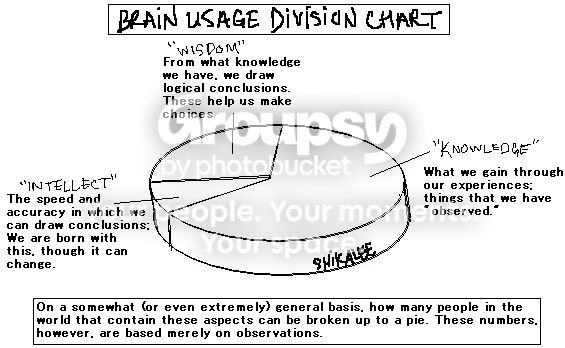 "Chronological" is not really a good word for this. If we look at all of the people in the world, this is how many people (due to my observations, things I have read, this is how I see it) have this aspect. Those of course, containing intellect likely have all three, and those containing wisdom must have knowledge. Now, Intellect does not necessarily fall under one's, "IQ." It is known that in America the Average is somewhere between 90-100. In Japan it is around 112 and in Germany it is around 114. These statistics, however, do not effect the numbers, or, overall percentile, enough to draw the conclusion that more people contain intellect over wisdom. Even 114 is not necessarily all that high. To say who has intellect and who doesn't would be ludicrous; of course everyone have some. But those who excel, that are in "genius" or in a "highly intelligent" level, are fairly small numbers. Those in the 98th percentile are so rare, they have a little happy Mensa-land place... Whatever thing. I don't think one having intellect should have expectations quite this high. I realize this, of course, like any theory, is simply an idea. I'm not claiming it to necessarily be true. I will also say that I have not given this all that much thought. I mean, sure, a little. But it's not like I have done much actual research, nor have I come up with any sort of mathematical proof.
|
|
|
|
|
|
|
|
|
|
|
|
|
|
|
Posted: Sun Mar 25, 2007 7:13 pm
The reason I made this post was, well, basically to disagree with nearly everything you just said. Just making sure you get that. My main arguments are already posted, so either you're purposely disagreeing with me, or you didn't read my top posts. Do I have to reiterate everything I've already said, or do I have to elaborate on what I've said?
|
|
|
|
|
|
|
|
|
|
|
|
|
|
|
|
|
|
Posted: Sun Mar 25, 2007 10:27 pm
Kanon Vilente As psychologists have shown, we are born with a certain innate mental capacity ( intellegence a ). In the same way that a muscle can be made stronger by use, our intelligence can be increased by the background in which we are brought up and the education we recieve. This is not to say that a child from a stimulating home who has been to a good school simply knows more than a child who lacked these advantages. Life has, in a fact, made him genuinely more intelligent. To put it another way, through having learned, he is better able to learn and to make efficient judgements and decisions. This is known as environmental intelligence ( intelligence b ). Yes I know I'm qouting myself. There are many more factors that apply to ones intelligence. Street smarts isn't exactly the greatest thing to have nor knowledge of the streets about the streets and whats happening in the streets. Unless you use the factor that knowledge is power and yes. Information can actually sell for a great amount of money ( far off topic ) And the chart you have created shikalee in regards of trying to determine these areas leaves out a great deal. Uh how should I say this and hopefully you understand this. You can be head strong but brain dumb. And yet you can be wiser, intellignet, and more knowledgable than a genius. I completely forget how the saying goes. rofl Man if anyone remembers this please just put it out there
|
|
|
|
|
|
|
|
|
|
|
|
|
|
|
|
|
|




 Reply
Reply

![Rookherst[KOS]'s avatar](https://a1cdn.gaiaonline.com/dress-up/avatar/ava/1c/32/2b1f6af436321c_flip.png?t=1193918574_6.00_11)