|
|
|
|
|
|
|

plopperscioly_in_USSR Vice Captain
|
 Posted: Thu Nov 09, 2006 10:31 am Posted: Thu Nov 09, 2006 10:31 am
I have devised a few helpful, mathematical formulae which I have posted here.
If you have any questions on these, PM me.Table of Contents
1. Expanding
2. Laws of Exponents
3. Logarithms
4. Quadratic Equations,Distance, and Midpoint Formulas
5. Triangle Congruence Theorems
6. Areas and Pythagorean Theorem
7. Volumes
8. Trigonometric Ratios
9. Special Triangles
10. Law of Sines/Law of Cosines
11. Unit Circle/Value of Trig Ratios
12. Triangle Area Formulas including Hero's formula
13. Trig Identities
14. Direct, Inverse, and Joint Variation
I know this is a little bit not in order of easiest to hardest. That is because I may have some things I have forgotten.
|
|
|
|
|
|
|
|
|
|
|
|
|
|
|
Posted: Thu Nov 09, 2006 2:32 pm
Expanding 1. Distribution Property: a(b+c) = ab+ac 2. Perfect Square Trinomial: (a+b)^2 = a^2 + 2ab + b^2 3. Perfect Square Trinomial: (a-b)^2 = a^2 - 2ab + b^2 4. Double Distribution: (a+b)(a+c) = a^2 + ac + ab + bc 5. Double Distribution: (a+b)(c+d) = ac + ad + bc + bd 6. Perfect Cube: (a+b)^3 = a^3 + 3(a^2)b + 3a(b^2) + b^3 7. Perfect Cube: (a-b)^3 = a^3 - 3(a^2)b + 3a(b^2) - b^3 8. Difference of Squares: a^2 - b^2 = (a-b)(a+b) 9. Sum of Cubes: a^3 + b^3 = (a+b)(a^2 - ab + b^2) 10. GCM/Difference of Squares: (a^3)b-ab = ab(a+1)(a-1) 11. Difference of Cubes: a^3-b^3 = (a-b)(a^2 +ab+b^2)
|
|
|
|
|
|
plopperscioly_in_USSR Vice Captain
|
|
|
|
|
|
|
|
|
|
plopperscioly_in_USSR Vice Captain
|
Posted: Thu Nov 09, 2006 2:33 pm
Laws of Exponents 1. (a^n)(a^m) = a^(n+m) 2. (a^n)/(a^m) = a^(n-m) 3. ((a^n)(a^m))/(a^p) = a^(n+m-p) 4. (a^n)^m = a^nm 5. (ab)^n = (a^n)(b^n) 6. (a/b)^n = (a^n)/(b^n) ----->(When, b is not 0) 7. a^0 = 1 ----->(When, a is not 0) 8. a^(-n) = 1/(a^n) ----->(When, a is not 0) *These only apply if n and m are positive*
|
|
|
|
|
|
|
|
|
|
|
|
|
|
|
Posted: Thu Nov 09, 2006 2:37 pm
Laws of Logarithms ~a denotes base a 1. Log xy = Log x + Log y 2. Log x^n = n Log x 3. Log x = n <--> x = 10^n (Common log) 4. Log~a x = n <--> x=a^n 5. Ln x=n <--> x=e^n (e = natural logarithm = 2.718281828 6. Log (x/y) = Log x - Log y
|
|
|
|
|
|
plopperscioly_in_USSR Vice Captain
|
|
|
|
|
|
|
|
|
|
plopperscioly_in_USSR Vice Captain
|
Posted: Thu Nov 09, 2006 2:38 pm
Quadratic Equation sqrt = the square root of (+-) = plus or minus When given this quadratic equation: ax^2 + bx + c = 0, x = (-b (+-) sqrt(b^2 - 4ac))/2a The quadratic formula can be derived by completing the square. If anyone needs help deriving it, make a thread, and I'll get to you. The Distance Formula For any two points on a coordinate plane, (x1,y1) and (x2,y2), the distance, D, between them is: D = sqrt{(x1-x2)^2 + (y1-y2)^2} The Midpoint Formula For any two points on a coordinate plane, (x1,y1) and (x2,y2), the midpoint, M, between them is: x = [x1 + x2]/2 y = [y1 + y2]/2 M = (x,y)
|
|
|
|
|
|
|
|
|
|
|
|
|
|
|
Posted: Thu Nov 09, 2006 2:39 pm
Triangle Congruence Theorems 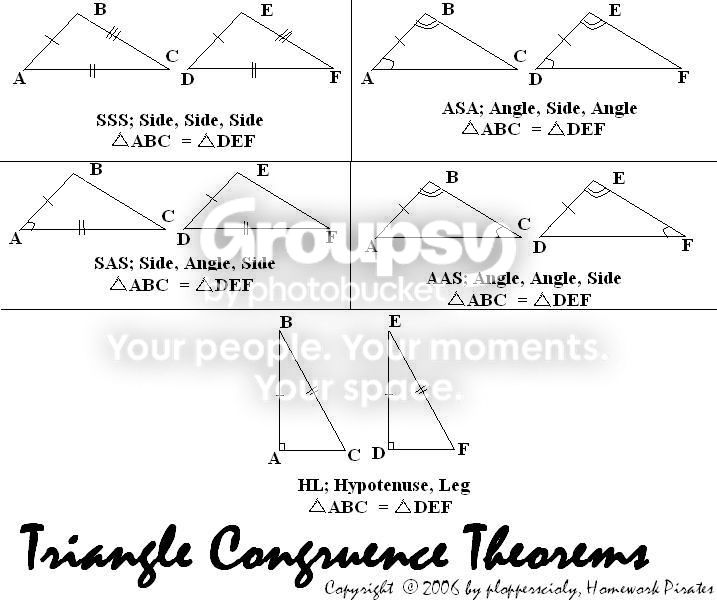
|
|
|
|
|
|
plopperscioly_in_USSR Vice Captain
|
|
|
|
|
|
|
|
|
|
plopperscioly_in_USSR Vice Captain
|
Posted: Thu Nov 09, 2006 2:40 pm
Areas(Also included: Pythagorean Theorem) Note: K = Area C = Circumference rad = If you have angle measure in radians deg = if you have angle measure in degrees 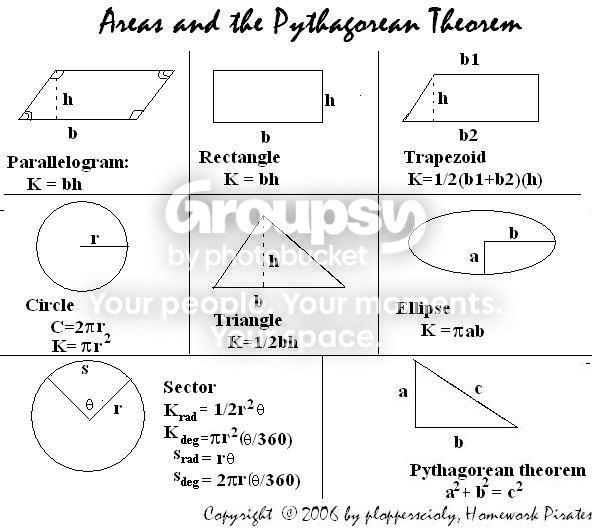
|
|
|
|
|
|
|
|
|
|
|
|
|
|
|
Posted: Thu Nov 09, 2006 2:40 pm
Volumes V=Volume SA = Surface Area 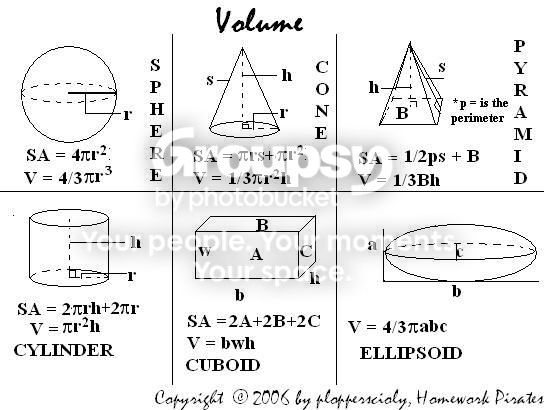
|
|
|
|
|
|
plopperscioly_in_USSR Vice Captain
|
|
|
|
|
|
|
|
|
|
plopperscioly_in_USSR Vice Captain
|
Posted: Thu Nov 09, 2006 2:59 pm
Trigonometric Ratios 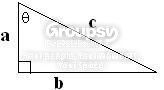 sin  = opp/hyp = b/c cos = adj/hyp = a/c tan = sin /cos = opp/adj = b/a csc = 1/sin = hyp/opp = c/b sec = 1/cos = hyp/adj = c/a cot = 1/tan = cos /sin = a/b
|
|
|
|
|
|
|
|
|
|
|
|
|
|
|
Posted: Thu Nov 09, 2006 3:18 pm
Special Right Triangles 1. 30-60-90 triangles 2. 45-45-90 triangles 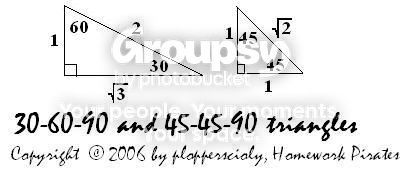 3. 3-4-5 4. 5-12-13 5. 8-15-17 6. 7-24-25 7. 20-21-29 8. 9-40-41
|
|
|
|
|
|
plopperscioly_in_USSR Vice Captain
|
|
|
|
|
|
|
|
|
|
plopperscioly_in_USSR Vice Captain
|
Posted: Thu Nov 09, 2006 4:58 pm
In triangle ABC: 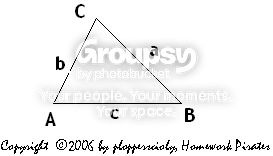 Law of Sines (a/sin A) = (b/sin B) = (c/sin C) Law of Sines is used in solving for triangles when one has: ASA, AAS, SSA* *Note for SSA, either 0, 1, or 2 triangles are possible __________________________________________________________________________________________________________________________ Law of Cosines a^2 = b^2 + c^2 - 2bc(cos A) b^2 = a^2 + c^2 - 2ac(cos B) c^2 = a^2 + b^2 - 2ab(cos C) Also: cos A = (c^2 + b^2 - a^2)/2bc cos B = (a^2 + c^2 - b^2)/2ac cos C = (a^2 + b^2 - c^2)/2ab It is used to solve: SAS or SSS
|
|
|
|
|
|
|
|
|
|
|
|
|
|
|
Posted: Thu Nov 09, 2006 5:17 pm
The Unit Circle 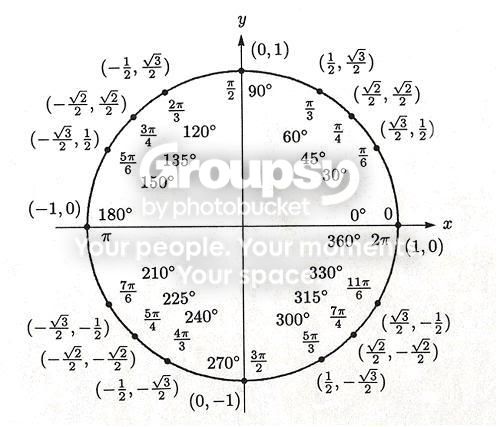 --------------- These are the quadrants in which the trig functions are positive or negative Sine or Cosecant: ````````|```````` ````````|```````` ````+`` |```+```` ________|________ ````````|```````` ````````|```````` ````_```|``` _```` ````````|````````` Cosine or Secant: ````````|```````` ````````|```````` ````_ `` |```+```` ________|________ ````````|```````` ````````|```````` ````_```|``` +```` ````````|````````` Tangent or Cotangent: ````````|```````` ````````|```````` ````_`` |```+```` ________|________ ````````|```````` ````````|```````` ````+```|``` _```` ````````|````````` This is a helpful pneumonic: It goes in the order of the I, II, III, and IV quadrants. All Students Take CCalculus ````````|```````` ````````|```````` ````S`` |```A```` ________|________ ````````|```````` ````````|```````` ````T```|``` C```` ````````|````````` In A, all functions are positive. in S, the sine function is positive (s for sine) in T, the tangent function is positive (t for tangent) in C, the cosine function is positive (c for cosine)
|
|
|
|
|
|
plopperscioly_in_USSR Vice Captain
|
|
|
|
|
|
|
|
|
|
plopperscioly_in_USSR Vice Captain
|
Posted: Thu Nov 09, 2006 5:28 pm
Triangle Area Formulas In this triangle: K = 1/2ab(sin C) = 1/2ac(sin B) = 1/2bc(sin A) Heron's Formula: K = sqrt(s(s-a)(s-b)(s-c))
|
|
|
|
|
|
|
|
|
|
|
|
|
|
|
Posted: Thu Nov 09, 2006 5:41 pm
Trigonometric Identities In this triangle: 1. sin(A + B) = (sin A)(cos B) + (cos A)(sin B) 2. sin(A - B) = (sin A)(cos B) - (cos A)(sin B) 3. cos(A + B) = (cos A)(cos B) - (sin A)(sin B) 4. 3. cos(A - B) = (cos A)(cos B) + (sin A)(sin B) 5. tan(A + B) = ((tan A) + tan(B))/(1-(tan A)(tan B)) 6. tan(A - B) = ((tan A) - tan(B))/(1+(tan A)(tan B)) 7. sin^2 + cos^2 = 1 8. 2cos^2 = 1+cos^2 9. tan^2 + 1 = sec^2 10. cot^2 + 1 = csc^2
|
|
|
|
|
|
plopperscioly_in_USSR Vice Captain
|
|
|
|
|
|
|
|
|
|
plopperscioly_in_USSR Vice Captain
|
Posted: Tue Nov 14, 2006 8:07 pm
Direct, Inverse, and Joint Variation Direct Variation"y varies directly as x" This means that for every constant "k", y/x = k Inverse Variation"y varies inversely as x" This means that for every constant "k", yx = k Joint Variation"y varies directly as x, and inversely as z" This means that for every constant "k", yz/x = k
|
|
|
|
|
|
|
|
|
|
|
|
|
|
|
|
|
|