This is an example of how this system of genetics works. The two Kitsune shown below are going to be used as mock parents for the purpose of this example.
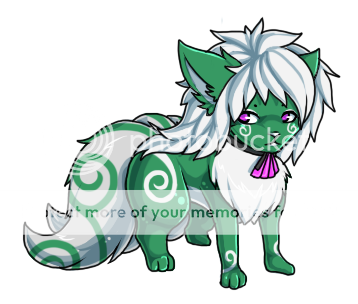
{S(Tessen)S(Tessen)} {B(Teal)b(White)} {m(White)m(White)} {T(Grey)t(Teal)}
{E(Purple)E(Purple)} {P(Swils)P(Swirls)} {c(White)c(Teal)} {n(White)n(White)}
{H(none)h(none)} {F(none)f(none)} {O(none)o(none)} {Z(none)z(none)} 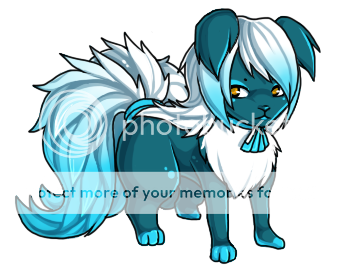
{s(Gunbai)s(Gunbai)} {B(Blue)b(White)} {m(White)m(lightblue)} {t(White)t(LightBlue)}
{E(Gold)E(Gold)} {P(Socks)p(EyeLining)} {c(LightBlue)c(LightBlue)} {N(Blue)N(Blue)}
{H(none)h(none)} {F(none)f(none)} {O(none)o(none)} {Z(none)z(none)} When two Kitsune breed a Punnett Square is generated for each trait. For example:
Species Square----S
----S
s
---Ss
---Ss
s
---Ss
---Ss
^Parent2Traits
A table like this will be created. In this one the Dominate Tessen gene would result in a 100% chance of Tessen offspring. However the children would carry the recessive Gunbai gene to future generations.
Boby Square----B
----b
B
---BB
---Bb
b
---Bb
---bb
^Parent2Traits
This table shows a bit more variety. There are actually 4 different options here.
- B(Blue)B(Teal) Since both are dominate the colorist can choose which one to use.
-B(Blue)b(White) The Blue is dominate so it will be the main color. any minor showing though of a recessive trait is up to the colorist.
-B(Teal)b(White) The Teal is dominate so it will be the main color.
-b(White)b(White) Since both traits are recessive they are predominate on a Kitsune. In the cases where two recessive genes of differing genes the colorist has control just like with double differing dominate.
*In cases were the chances aren't 100% a die/rng will be used based on the chances in the chart.
*Gender is done by die/rng.