





Starship Combat Basics
Disclamer: All Information here is stolen with some edits from Starship Combat That Doesnt Make Me Cry Myself to Sleep.
Objects in Space
Disclamer: All Information here is stolen with some edits from Starship Combat That Doesnt Make Me Cry Myself to Sleep.
Objects in Space
Starship combat takes place on a three-dimensional hex grid, with each hex being 250 feet in diameter. Though the technicality might be disputed in some circles, the universe is sufficiently vast that allowing these dimensions to expand infinitely is a good approximation for such (relatively) small scales. The third dimension, depth, can be modeled with a number next to the ship's token indicating how far above or below the reference plane it is.
The location of the three planes that make up three-dimensional space and where they intersect, as well as their orientation or rotation, is completely arbitrary. Unlike with most character-scale battles, there is no up, down, left or right, nor is there a floor or ceiling; position and rotation are relative. When no other obvious reference point exists, the players' ship is a good origin. Forward and backward are determined by whatever direction the ship was facing when the battle began. Left and right are to the ship's left and right, and up and down are the ship's up and down. Ground level becomes the middle of the ship.
Enemy ships are rotated and placed relative to the players' ship. If the player's ship changes rotation or position, it is easier to simply change the ship itself rather than move the reference plane with it, which would require a reposition and rotation of everything else. The players' ship is good for setting the initial calibration of the battle map, but the grid need not continue to move relative to the ship.
Unlike character-scale combat, where people can twist to face or attack in any direction at the drop of a hat, the facing of a ship is important. Most ships have a rather poor turn radius, so moving to shoot an enemy who slipped behind you to shoot your engines is a trick of maneuverability. Ships have three different kinds of faces: a front, a back, and numerous flanks.

Front: The front of the ship is the direction it is facing. An attacker attacking the front of a ship gains no special bonuses or penalties. Most ship weapons are designed to be able to fire, if not exclusively pointed, forward. The front face is green in the diagram.
Flank: A ship's side is called the flank. Attackers gain a +2 bonus on their attack rolls to hit a ship's flank. The ship has a flank above it, below it, and to its left and its right. Many weapons can fire into one or more flanks. Ships are not usually designed to fly sideways; if the ship is capable, it costs 2 hexes of movement to move into a flank hex. The flank face is yellow in the diagram.
Back: The ship's back is usually its most vulnerable part, since this is where the engines and mechanical systems are located. Attackers who strike the back of a ship gain a +2 bonus to their attack roll, as well as deal 25% more damage. This increase is factored in before armor. Few weapons are designed to fire backwards. Like with most vehicles, backwards movement is not a design priority for starships. Most ships are capable of flying backwards, but doing so costs 2 hexes of movement per hex. The back is red in the diagram.
Objects in Motion...
There is no appreciable friction in the void of space, and objects in motion will continue to move unless prevented from doing so by virtue of inertia. A ship that moved in a previous round does not stop if its pilot gets up and walks away; it continues to move in the same direction and speed until stopped.
Once the pilot establishes a speed and direction, he need only spend fuel and actions to change the ship's velocity. This is why a two month interplanetary trip and a one-minute space battle consume the same amount of fuel; the journey is usually established at the beginning with a single, big boost in speed. The ship simply coasts the rest of the way, while a ship in battle is constantly burning fuel to change direction and speed.
Unless otherwise prevented, a ship will attempt to move in the same direction, at the same speed, and at the same angle or speed of rotation as it did in the last round. Like a player, the ship has two move actions available to it, or it can take a run action as a full-round action. The pilot need only tell the ship what to do. In fact, piloting only requires an actual action on the pilot's part if the maneuver requires more than one move action. Turning the ship within its normal turn radius as part of its move, for instance, does not consume the pilot's action.
Maneuverability
Ships vary in their ability to move about in space, as is determined by their maneuverability. The maneuverability of a ship is in turn set by the size of the ship and the power and capabilities of its engines.
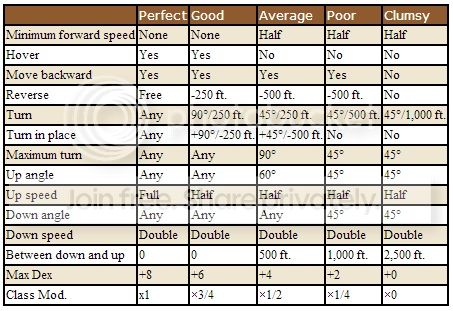
Ships vary in their ability to move about in space, as is determined by their maneuverability. The maneuverability of a ship is in turn set by the size of the ship and the power and capabilities of its engines.
Minimum Forward Speed: If a ship fails to maintain its minimum forward speed while in a planet's atmosphere, it must land at the end of its movement. If it is too high above the ground to land, it falls straight down, descending 250 feet in the first round of falling. If this distance brings it to the ground, it is destroyed as if in a collision with the planet. If the fall doesn’t bring the ship to the ground, it must spend its next turn recovering from the stall. The helmsman must succeed on a DC 20 Pilot check to recover. Otherwise it falls another 250 feet. If it hits the ground, it is destroyed. Otherwise, it has another chance to recover on its next turn. Minimum Forward Speed has no effect in space.
Hover: The ability to stay in one place while in atmosphere. All ships can hover in space.
Move Backward: The ability to move backward without turning around.
Reverse: A ship must spend some of its movement to begin flying backwards. This only applies when the ship first begins moving backwards; subsequent rounds of backwards movement do not carry this cost.
Turn: How much the ship can turn after covering the stated distance.
Turn in Place: Many ships can spend some of their movement to turn in place without actually moving.
Maximum Turn: How much the ship can turn in any one hex.
Up Angle: The angle at which the ship can climb. This applies only in atmosphere. Treat up and down movement in space just like turning.
Up Speed: How fast the ship can climb. This applies only in atmosphere. Treat up and down movement in space just like turning.
Down Angle: The angle at which the ship can descend. This applies only in atmosphere. Treat up and down movement in space just like turning.
Down Speed: A ship can fly down at twice its normal flying speed. This applies only in atmosphere. Treat up and down movement in space just like turning.
Between Down and Up: An average, poor, or clumsy ship must fly level for a minimum distance after descending and before climbing. Any ship can begin descending after a climb without an intervening distance of level flight. This applies only in atmosphere. Treat up and down movement in space just like turning.
Max Dex: The clumsier a ship is, the harder it will be to make it dodge. This number is the maximum amount of Dexterity bonus that the pilot can apply to the ship's Defense. If the Pilot's Dexterity score is higher than this, it drops to this value for purposes of the ship's Defense.
Class Mod: The pilot's Class bonus to Defense is multiplied by this number before being applied to the ship's Defense. Round down.
Objects In Time
Starship combat is composed of rounds, each merely 6 seconds in length, just like character-scale combat. Similarly, starship battles are composed of turns, each one happening near-simultaneously but slightly staggered. Unlike with character-scale combat, these turns are fluidly arranged, and every ship acts in them.
Ships are largely incapable of taking actions themselves. Each action in a space battle is taken by the characters that crew the vessel. This does not mean that combat is made up of hundreds of turns, one for each crewmember; only the heads of various stations, such as engineering or piloting, actually take actions. The rest of the crew is there to make sure the ship is in running order and possibly aid the heads in tricky maneuvers. Ship combat usually has 6 to 8 turns, depending on how many stations are crewed. In small ships with single-digit crews, this number is likely the number of PCs on the ship.
To begin a space battle, one must first determine awareness, like with any battle in d20 Future. This will usually be Computer Use checks to operate the sensors (if they are attended); Spot checks out the window will be a last resort. If one or more ships are aware of the others but some are not, a surprise round occurs. As one might expect, a surprise round is much like a normal round. Those who are aware act, those who are not aware, do not. At the beginning of the first round in which a ship can act, whether that be the surprise round or the first normal round, or perhaps even later, that ship rolls initiative, using the Captain's Initiative bonus but substituting his or her Wisdom for their Dexterity. Initiative determines the order in which the ships act in a turn, with higher results acting earlier. Additionally, an opposed Knowledge (Tactics) check made by the captains of the ship determine in what order the ship crews must select their actions for a round. Lower results indicate the ship must choose earlier, and later captains in the round are aware of the general tactical relation of the ship.
For instance, if the enemy loses the Knowledge (Tactics) check, the players are aware of the tactical climate of each turn, knowing what turns the enemy will be offensive and which turns the enemy will be vulnerable, though the exact nature of the actions remains concealed. This allows more tactically-minded captains to exploit their enemy's plans but can also introduce tactical conundrums, such as if the enemy is going to be vulnerable but extremely aggressive on the same turn.
Once the checks are rolled and awareness is established, the players and enemies may begin choosing actions. Initiative applies only to the ship itself, the players may act on different turns in different rounds, as their tactics dictate. They cannot, however, ready actions or act simultaneously unless an action specifically states that it extends into other turns. When everyone has chosen their action and the round on which they will perform it, the actions are played out. For each turn, each ship takes its assigned action for that turn in Initiative order, playing through each turn until the round is complete, at which point another round begins and the cycle continues until combat is complete.
I'm Givin' 'er All Aye've Got, Cap'n!
Nearly everything on a ship consumes power in some form or another, whether firing missiles, scanning far into space, or simply sitting on standby. A power core can provide weeks or even years of faithful service, but it can only produce a certain amount of energy at any given time. A ship overloaded with activity on all fronts will quickly find itself out of free power, and out of further option. A power core has a Power Rating (PR), indicating the maximum amount of energy it can produce per round. In casual circumstances, a power core will run at a lower speed, and produce only the power necessary to run the systems, no extra. Like living creatures, the heart of a ship beats faster in life-and-death situations, to ensure that all systems have enough power to do what they need to do to protect the crew. A power core produces its maximum amount of energy per round, and any energy left over after all the systems have been fed is placed in a buffer to fuel special actions. A power core's Maximum Capacity (MC) determines how much energy can be buffered at any one time; extra energy is lost.
All systems have a PC, a Power Cost. This number represents the energy a system consumes while running in a low-power mode, such as on standby or while performing routine tasks. Attacking with shipboard weapons or performing special actions with other systems have an additional cost. Ships may have as many systems of any kind installed as they please; the power core's PR is the only limiting factor. Much like shipboard weapons, power cores can be linked in sequence to provide additional power, with only the size of the ship providing a limit to the number of power cores and ultimately all other systems.
An ultralight ship may have 1 power core. A light ship may have 2 power cores, while a mediumweight ship may have 4 power cores and a heavy may have 8 power cores. A superheavy ship may have 16 power cores, but particularly large ships of this size could have more, as the GM determines. Linked cores must be identical, and each doubling adds one-half the base PR to the total generated power. Two linked fission reactors, for instance, generate 60 PC per round. Four would generate 80 PC, eight would generate 100 PC, and sixteen would generate 120 PC.
Shut Down: Anyone can perform this action on their turn. An unused system can be turned off, reducing its PC to 0. The points it would have consumed are instead placed in the buffer. Turning a system on again is a full-round action for the character. The system is not functional until the same turn it was activated on the next round. A cannon re-activated on turn 5 cannot be used until turn 5 of the next round.
