Introduction to Coupons: Anatomy of a Manufacturer’s Coupon
Located below is an image of a standard manufacturer’s coupon as they are found in the U.S. As you can see, it has been divided up into 4 key parts. Every part is important and required for redeeming at your store.
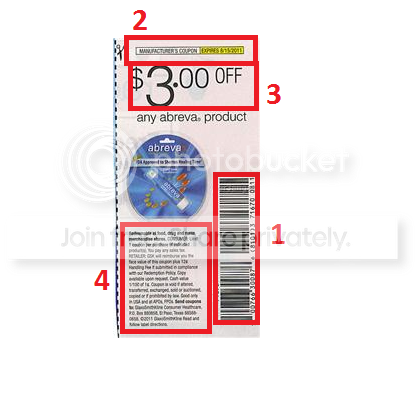
The barcode. All manufacturer coupons come with a barcode. This is to authenticate the coupon in order to make sure that the store receives the credits from the manufacturer. The coupon barcode usually haves two parts (although this is not a mandatory rule), the consumer barcode that actually saves you the (in this case) $3 and the store barcode that is used by the manufacturer. Both parts must be readable by the register’s scanner in order for it to be considered an authentic coupon. (Note: Most manufacturer coupons begin with the number 9)
Expiration/Coupon Type. This identifies with a quick glance if the coupon is a store coupon (to be introduced at a later time) or a manufacturer coupon. It serves as a quick reference for the cashier and for the consumer to help them make sure that all parties are playing by the rules of couponing. It also carries the all-important expiration date. Even if your coupon is authentic and correctly applied to your shopping list, it can NOT be used if it is expired. Don’t try to convince your cashier to take the coupon if it is expired, she legally cannot accept and, if she did, she could be in major trouble with her management for knowingly taking an expired coupon.
Your Savings! This part of the coupon is everyone’s favorite. It shows how much you are saving and what you are saving on (this case being $3 off of Abreva). Not all coupons have a picture of the item and some will say “All sizes excluding travel size” or other details. Make sure you read this part thoroughly to make sure you’re getting the best deal AND that you get the right product.
The fine print. Many people fail to look at this portion of the coupon. They see the small font and automatically assume that it’s all for the cashier BUT THAT’S NOT THE CASE! There are important details in this section that applies to YOU. It gives additional detail as to HOW the coupon is to be used. See the next section to learn more.
Fine Print Details:
There are three major headliners in the fine print. Below, I will explain the differences between them and how to get around them without breaking any major rules in regards to couponing.
“Per Transaction” A transaction is the entire purchase that concludes with a receipt (or ticket). When you pay for your items and are given a receipt, this concludes the transaction. Coupons labeled as “Per Transaction” mean that the limits specified in the coupon (such as 1 coupon per transaction) are iron clad. Most companies have programs on their computer to block additional coupons from being saved. To get around this, break up the transaction.
For example, if your Abreva coupon says “Limit 1 coupon per transaction” but you have three coupons and three Abrevas, simple make 3 separate transactions with an Abreva coupon and product in each. It doesn’t take as long as people make it out to be and it helps you save the money you need while abiding by the details of the coupon. Besides, who is to say that you are not also buying for your roommates or elderly neighbor?
“Per Purchase” These can be confused with “Per Transaction” coupons. A Purchase is different from a Transaction. If your coupon says “Limit 1 per purchase” and you have 3 Abreva products and 3 Abreva coupons, than you can put it all on one receipt, or Transaction. It simply means that you must buy X number of products in order to redeem that coupon.
“Per Customer” It says it all. If your Abreva coupon says “Limit 1 per customer” that means that no matter how many Abrevas and matching coupons you have, you can only use ONE and the register will block any additional coupons and product combos that you present. To get around this, bring some friends and slip them the money for the items BEFORE you get the register. As low as this sounds, it is a common practice because, as hinted before, the cashier does not know you or your roommates. To keep suspicion down to a minimum, try to change up the friends and try to keep form buying one-right-after-the-other. That way, it looks more like 3 people buying the same product by coincidence.
In the next section, I will introduce the Store Coupon how to use it to get the best bang for your buck!