|
|
|
|
|
|
|
|
|
 Posted: Tue May 31, 2011 10:54 pm Posted: Tue May 31, 2011 10:54 pm
Types of Armor
-Helms
-Shield
-Leather
-Mail
-Plate
|
 |
|
|
|
|
|
|
|
|
|
|
|
|
|
Posted: Sat Jun 04, 2011 12:21 am
Helms
Nasalhelms

The nasal helmet was a form of light helmet with a domed or raised centre, usually formed around a basic skull-cap design, with a single protruding strip that extended down over the nose to provide additional facial protection. The helmet appeared throughout Europe late in the 9th century, and became the predominant form of head protection, replacing the previous pudding-bowl design, and the Vendel-style spectical helm. Nasal helmets have been found of both one-piece and Spangenhelm construction, with the later period helmets being made of a single, smooth raised dome to allow weapons to glance off with ease.
Spangenhelms
The Spangenhelm was a light-helm and a popular European war combat helmet design of the Early Middle Ages. The name is of German origin. Spangen refers to the metal strips that form the framework for the helmet and could be translated as clips, and -helm simply means helmet. The strips connect three to six steel or bronze plates. The frame takes a conical design that curves with the shape of the head and culminates in a point. The front of the helmet may include a nose protector (a nasal). Older spangenhelms often include cheek flaps made from metal or leather. Spangenhelms may incorporate mail as neck protection, thus forming a partial aventail. Some spangenhelms include eye protection in a shape that resembles modern eyeglass frames. Other spangenhelms include a full face mask
Great-helms
 The great helm is medium armor, also called pot helm, bucket helm and barrel helm, of the High Middle Ages arose in the late twelfth century in the context of the crusades and remained in use until the fourteenth century. They were used by knights and heavy infantry in most European armies. In its simplest form, the great helm was a flat-topped cylinder of steel that completely covered the head and had only very small openings for the eyes and mouth. Later designs gained more of a curved design, particularly on the top, to deflect or lessen the impact of blows. The great helm is medium armor, also called pot helm, bucket helm and barrel helm, of the High Middle Ages arose in the late twelfth century in the context of the crusades and remained in use until the fourteenth century. They were used by knights and heavy infantry in most European armies. In its simplest form, the great helm was a flat-topped cylinder of steel that completely covered the head and had only very small openings for the eyes and mouth. Later designs gained more of a curved design, particularly on the top, to deflect or lessen the impact of blows.
The style is sometimes referred to as a 'crusader helmet', but also as a 'pot helm', Although the great helm offered greater protection than previous helmets, such as the nasal helm and spangenhelm, it limited the wearer's vision to some extent, and provided poor ventilation.
Barbutes
A barbute is a medium visorless war helmet of fifteenth century Italian design, often with distinctive "T" shaped or "Y" shaped opening for the eyes and mouth. The barbute resembles classical Greek helmets and may have been influenced by a renewed interest in ancient artifacts.
The defining characteristic of the barbute is the fact that the shape of the helmet extends all the way down to cover both sides the face. Regardless of the type of opening—which could be T-shaped, Y-shaped or arch-shaped, this characteristic is practically always present. This made the wearing of a gorget optional. On some examples, there is a central, narrow protrusion extending down from the top of the opening, designed to protect the wearer's nose. Often, barbutes were covered by fabric, most typically heavy velvet. The main differences between the barbute and the Greek hoplite's helm to which it is often compared are the difference in material (Ancient Greeks used bronze) and the lack of a prominent decorative crest. Barbutes were made mostly from a single sheet of steel using the metal smithing process of raising until the piece assumed the desired shape. [2] Often a low ridged crest was forged into the top of the helmet's skull which served to strengthen the helmet without adding a significant amount of weight.The helmets of Gondorian soldiers in The Lord of the Rings film trilogy closely resemble barbutes. When in costume, Magneto (the X-men franchise) wears a barbute.
Sallets
The sallet was a heavy war helmet that replaced the bascinet in northern Europe and Hungary during the mid-15th century. Some sallets were close fitting except at the back of the head where they extended and formed a pointed tail. Some Italian ones followed the shape of the neck, and had an additional plate riveted on. Many sallets were worn with an extended, padded gorget called a bevor that protected the wearer's jaw. Some sallet versions have occularia in the form of a slit in a visor, some have this slit in the front of the helm, or even in the brim. Most sallets needed no breathing holes, as there was a natural gap where it overlapped the bevor near the wearer's mouth. Some Italian sallets had a "bellows visor" with breaths cut into the visor. This helmet design contrasted with the barbute which was popular in Italy at the same time. Unlike the sallet, the barbute itself protected the jaw and neck. So whereas the gorget or bevor were important counterparts to the sallet, they were usually absent in barbutes. Barbutes did not pivot. Sallets did not share the barbute's resemblance to classical Greek or Roman artifacts.
Bascinents (Closed Helmet)
The bascinet is a heavy armor, Medieval European open-faced military helmet, typically fitted with an aventail and hinged visor. The bascinet would be fitted with small holes around the face opening and base, so it could be laced onto the chainmail of the hauberk to give continuous protection to the chin, neck and shoulders. The bascinet, both with and without a visor (visors were often removable for better visibility and ventilation), was the most common helmet worn in Europe during the latter portions of the 14th and early 15th centuries, including during the Hundred Years' War. Contemporary illustrations show nearly every knight and man-at-arms wearing one of a few variants of the basic hounskull helmet. The basic design was intended to direct blows from weapons downward and away from the skull and face of the wearer.
|
|
|
|
|
|
|
|
|
|
|
|
|
|
|
|
|
|
Posted: Sat Jun 04, 2011 12:22 am
Shields
Buckler
The buckler had a variety of roles when it came to swordplay, but five principal means come to the fore as:---
Hand protection: The primary use of the buckler was to protect the sword hand.
Deflector: The buckler's lightness and curved center made it excellent for deflecting attacking blades. Such a deflection would leave the attacker open for a rapid counter-attack.
Blinder: The light blades used in conjunction with the buckler depended on rapid movements, which meant that a single second was an important advantage. The wielder of the buckler could use the buckler to shield his sword-hand's position from view, keeping his opponent from guessing his next strike.
"Metal fist": A buckler could be used to directly attack an opponent by punching with either its flat face or its rim.
Binder: The buckler could be used to bind an opponent's sword hand and weapon as well as their buckler against their body. The buckler was also very useful in grappling, where it allowed an opponent's arms to be easily wrapped up and controlled.
Sight light: In france, a type of buckler was created that had a small door in it. in thes small door was a hole that the soldier would put a candle in to provide light.
Aspis (Round Shield)
Kite Shield
Scutum (Tower Shield)
|
|
|
|
|
|
|
|
|
|
|
|
|
|
|
Posted: Sat Jun 04, 2011 12:23 am
|
|
|
|
|
|
|
|
|
|
|
|
|
Posted: Sat Jun 04, 2011 12:25 am
Mail
Mail or chain mail is a type of armour consisting of small metal rings linked together in a pattern to form a mesh. Mail was a highly successful type of armour and was used by nearly every metalworking culture. Mail armour provided an effective defence against slashing blows by an edged weapon and penetration by thrusting and piercing weapons; in fact the Royal Armoury at Leeds concluded that "... it is almost impossible to penetrate using any conventional medieval weapon..." Generally speaking, mail's resistance to weapons is determined by four factors: linkage type (riveted, butted, or welded), material used (iron versus bronze or steel), weave density (a tighter weave needs a thinner weapon to surpass), and ring thickness (generally ranging from 18 to 14 gauge in most examples). Mail, if a warrior could afford it, could provide a significant advantage to a warrior when combined with competent fighting techniques. However, a good sword blow arriving in exactly perpendicular angle to the surface could cut through the links; when the mail was not riveted, a well placed thrust from a spear or thin sword could penetrate, and a poleaxe or halberd blow could break through the armour. In India, punching daggers known as katars were developed that could pierce the light mail used in the area. Some evidence indicates that during armoured combat the intention was to actually get around the armour rather than through it according to a study of skeletons found in Visby, Sweden, a majority of the skeletons showed wounds on less well protected legs.
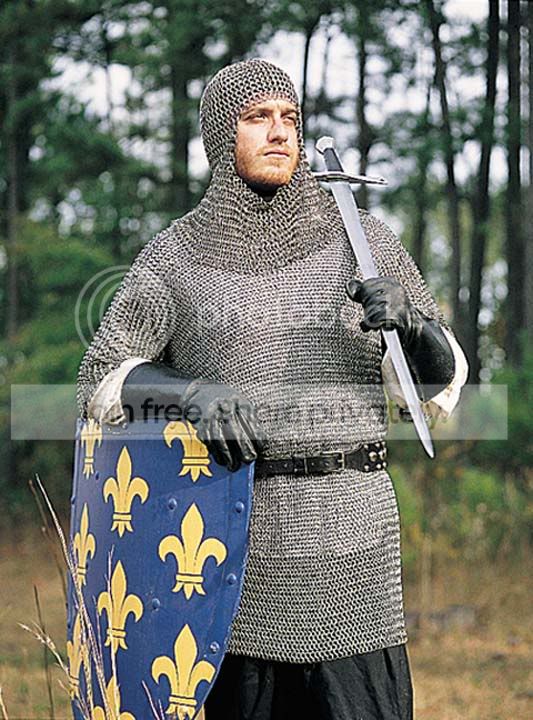
The flexibility of mail meant that a blow would often injure the wearer, potentially causing serious bruising or fractures, and it was a poor defence against head trauma. Mail-clad warriors typically wore separate rigid, helms over their mail coifs for head protection. Likewise, blunt weapons such as maces and warhammers could harm the wearer by their impact without penetrating the armour; usually a soft armour, such as gambeson, was worn under the hauberk. Medieval surgeons were very well capable of setting and caring for bone fractures resulting from blunt weapons. With the poor understanding of hygiene however, cuts that could get infected were much more of a problem. Thus mail armour proved to be sufficient protection in most situations.
|
|
|
|
|
|
|
|
|
|
|
|
|
|
|
Posted: Sat Jun 04, 2011 12:26 am
|
|
|
|
|
|
|
|
|
|
|
|
|
|



 Reply
Reply
