|
|
|
|
|
|
|
|
|
 Posted: Sun Jan 09, 2011 8:49 am Posted: Sun Jan 09, 2011 8:49 am
▅▅▅▅▅▅▅▅▅▅▅▅▅▅▅▅▅▅▅▅▅▅▅▅▅▅▅▅▅▅▅▅▅▅▅▅▅▅▅
So with the 293849300203 pieces of lineart we have, I'm sure you're wondering what breeds we actually offer here in Woof! The different types of dogs are what makes the shop and without them, Woof! would be quite boring. Here in this thread, you will find information and images (the lineart) on every breed we have. Information that includes breed history, general temperaments, appearance, what the breed was made to do, and much more!
You may use this thread to research a potential breed for a future custom, see what kind of dogs you're roleplaying with, or just have a look at all the amazing lineart Micro has done. If you have any questions regarding the breeds, please ask us in the main thread or send us a PM -- we will be happy to answer.

b r e e dxxU P D A T E S
➔ Janurary 08, 2011 . Created the breed thread!
▀▀▀▀▀▀▀▀▀▀▀▀▀▀▀▀▀▀▀▀ ▀▀▀▀▀▀▀▀▀▀ ▀▀▀▀▀▀▀▀▀▀▀▀▀▀▀▀▀▀▀▀
|
 |
|
|
|
|
|
|
|
|
|
|
|
|
|
Posted: Sun Jan 09, 2011 9:35 am
▅▅▅▅▅▅▅▅▅▅▅▅▅▅▅▅▅▅▅▅▅▅▅▅▅▅▅▅▅▅▅▅▅▅▅▅▅▅▅
The Akita Inu is a Japanese breed of large dog. Named for Akita Prefecture, where it is thought to have originated, it is sometimes called the Akita-ken based on the Sino-Japanese reading of the same kanji. In most countries (with the exception of the American and Canadian Kennel Clubs), it is considered a separate breed from the American Akita, as requested by the Japanese Kennel Club. "Inu" means "dog."
a k i t axxS T A T I S T I C S
a k i t axxF A C T S
Breed History
The Akita is perhaps the most renowned and venerated of the native Japanese breeds. Although it bears a likeness to dogs from ancient Japanese tombs, the modern Akita is the result of a concerted nineteenth century effort to restore seven native Japanese dog breeds. The Akita, largest of these breeds, was restored using many breeds and mixed breeds for fighting. Indigenous Odate dogs were also used as the best representatives of native Japanese animals. Over time, Japanese breeds selected against many traits that descended from the fighting ancestors, including the black mask, pinto pattern, and substantial size. However, American breeders have favored these traits.
The first Akita arrived in America in 1937, when Helen Keller returned home from Japan with one. Following World War II, servicemen returned home with Akitas from Japan. The breed's popularity slowly grew until it received AKC recognition in 1972. Since then, it has gained admirers and continues to grow in popularity. Today, the Akita is used as a guard and police dog in Japan.
Breed Temperament
The Akita is bold, independent, stubborn, and tenacious. Demonstrative to its family, it is utterly devoted and will protect family members. It is reserved with strangers and can be aggressive toward other dogs -- it can also be domineering.
Upkeep
The Akita appreciates mental and physical exercise every day -- it needs the chance to run and get out. The Akita is able to live outdoors in temperate or cold climates, but it is happiest if it can spend most of its time with its family.
Form and Function
This is a large and powerful breed, with much substance and heavy bone; it is slightly longer than tall. The Akita's build reflects it's original job of hunting the big game through deep snow and rugged terrain. It's double coat consists of a dense undercoat and straight, harsh, outer coat standing off from the body, about 2 inches or less in length. Such a combination provides ample insulation from water and weather. The Akita is a versatile dog of the large spitz type, able to preform as hunting companions and protectors.
▀▀▀▀▀▀▀▀▀▀▀▀▀▀▀▀▀▀▀▀ ▀▀▀▀▀▀▀▀▀▀ ▀▀▀▀▀▀▀▀▀▀▀▀▀▀▀▀▀▀▀▀
|
|
|
|
|
|
|
|
|
|
|
|
|
|
|
|
|
|
Posted: Sun Jan 09, 2011 12:12 pm
▅▅▅▅▅▅▅▅▅▅▅▅▅▅▅▅▅▅▅▅▅▅▅▅▅▅▅▅▅▅▅▅▅▅▅▅▅▅▅
For many years, Aussies have been valued by stockmen for their inherent versatility and trainability. While they continue to work as stockdogs and compete in herding trials, the breed has earned recognition in other roles due to their trainability and eagerness to please, and are highly regarded for their skills in obedience. Like all working breeds, the Aussie has considerable energy and drive, and usually needs a job to do. It often excels at dog sports such as dog agility, flyball, and frisbee. They are also highly successful search and rescue dogs, disaster dogs, detection dogs, guide, service, and therapy dogs. And, above all, they can be beloved family companions.

a u s t r a l i a nxxs h e p h e r dxxS T A T I S T I C S
a u s t r a l i a nxxs h e p h e r dxxF A C T S
Breed History
The Australian Shepherd is not really an Australian breed, but it came to America by way of Australia. One popular theory of the breed's origin begins during the 1800s when the Basque people of Europe settled in Australia, bringing with them their sheep and sheepdogs. Shortly after, many of these shepherds relocated to the western United States, with their dogs and sheep. American shepherds naturally dubbed these dogs Australian Shepherds because that was their immediate past residence.
The breed kept a low profile until the 1950s, when they were featured in a popular trick-dog act that performed in rodeos and was featured in film. The AKC recognized the Aussie Shepherd in 1993. Its popularity according to AKC statistics underestimates the popularity of this breed as a pet because a large proportion of this working breed remains unregistered with the AKC. It is among the most versatile of breeds, excelling at conformation, obedience, herding, and agility competition.
Breed Temperament
The Australian Shepherd has a great deal of stamina and is loving, bold, alert, confident, independent, smart, and responsive. If it doesn't get a chance to exercise and challenge its strongly developed mental and physical activities, it is apt to become frustrated and difficult to live with. With proper exercise and training, it is a loyal, utterly devoted, and obedient companion. It is reserved with strangers, and has a protective nature. It may try to herd children and small animals by nipping xD!
Upkeep
This breed needs a good workout every day, preferably combining both physical and mental challenges. Even though it is physically able to live outside in temperate climates, it is a breed for which human contact is so vital that it is emotionally unsuited for a life in the yard.
Form and Function
This is an athletic dog of medium size and bone; it is lithe, agile, and slightly longer than it is tall. It is muscular and powerful enough to work all day, without sacrificing the speed and agility necessary to cope with bolting livestock. It's gait it free and easy, and it must be able to change direction easily. Its double coat is weather resistant, with the outer coat of medium texture and length, straight to wavy. The expression is keen, intelligent, and eager.
▀▀▀▀▀▀▀▀▀▀▀▀▀▀▀▀▀▀▀▀ ▀▀▀▀▀▀▀▀▀▀ ▀▀▀▀▀▀▀▀▀▀▀▀▀▀▀▀▀▀▀▀
|
|
|
|
|
|
|
|
|
|
|
|
|
|
|
Posted: Mon Jan 10, 2011 9:08 am
|
|
|
|
|
|
|
|
|
|
|
|
|
Posted: Mon Jan 10, 2011 10:30 am
|
|
|
|
|
|
|
|
|
|
Posted: Mon Jan 10, 2011 10:31 am
▅▅▅▅▅▅▅▅▅▅▅▅▅▅▅▅▅▅▅▅▅▅▅▅▅▅▅▅▅▅▅▅▅▅▅▅▅▅▅
The system by which Russians over the ages named their sighthounds was a series of descriptive terms, not actual names. "Borzói" is the masculine singular form of an archaic Russian adjective that means "fast". "Borzáya sobáka" ("fast dog") is the basic term used by Russians, though the word "sobáka" is usually dropped. The name "Psovaya" derived from the word Psovina, meaning "wavy, silky coat." In Russia today the breed we know as borzoi is therefore officially called "Russkaya Psovaya Borzaya".
b o r z o ixxS T A T I S T I C S
b o r z o ixxF A C T S
Breed History
The Borzoi was bred by the Russian aristocracy for hundreds of years. Coursing of hare for sport was known in Russia as early as the thirteenth century. In the fifteenth and sixteenth centuries, crosses of coursing hounds with bearhounds and with tall Russian sheepdogs were made to increase size and coat, both necessary for wolves in the cold climate. The first standard was written in the 1600s in a book of Borzoi hunting rules. Perhaps no other breed has ever been the focus of hunting on such a grand scale. Over 100 Borzoi might partake in a hunt. Beaters and scenthounds initially trailed the wolf, followed bu hunters on horseback. A pair or trio (consisting of two males and a female) of matched Borzoi was then unleashed when the wolf was sighted. The dogs would strike at the same time, forcing the wolf down and holding it until the hunter arrived to bind the wolf -- and then, often, set it free!
By the 1800s, seven distinct subtypes of Borzoi existed in Russia. Most present Borzoi descended from the Perchino type kept by the Grand Duke Nicolai, and many of the early American imports came directly from the Perchino Kennels. The Russian Czar would often present the Borzoi as gifts to visiting royalty. After the Russian Revolution, the days or nobility were over, and many Borzois were killed. The fate of the breed was left in the hands of foreign royalty who had been given Borzoi and of a few remaining Borzoi kennels. In American, the Borzoi soon gained the reputation as the ultimate glamour dog, often seen at the sides of movie stars. Although only enjoying modest popularity as a pet, the breed remains a popular show dog, coursing dog, and model.
Breed Temperament
A breed of quiet elegance, the Borzoi exemplifies the well-mannered housedog indoors. Outdoors, it races with wild abandon, and will chase any small animal that runs. It is independent, but very sensitive. Although generally good with children, it may not be playful enough to satisfy some children. Some can be timid. It is reserved with strangers.
Upkeep
The Borzoi needs the chance to exert itself daily. Although a ling walk can satisfy most of its needs, it should be combined with a sprint. Borzoi can live outdoors in temperate climates as long as they have soft bedding and good shelter, but most do best as housedogs with access to the yard.
Form and Function
The Borzoi is a running hound capable of hunting large, fierce game in very cold climates. As such, it retains the greyhound build necessary for running at great speed, but it is larger and stronger than the greyhound. It's jaws should be strong enough to hold down a wolf. The long, silky coat, which can either be flat, wavy, or rather curly, provided protection against cold weather and snow. The Borzoi should possess elegance and grace, with flowing lines, weather standing or moving.
▀▀▀▀▀▀▀▀▀▀▀▀▀▀▀▀▀▀▀▀ ▀▀▀▀▀▀▀▀▀▀ ▀▀▀▀▀▀▀▀▀▀▀▀▀▀▀▀▀▀▀▀
|
|
|
|
|
|
|
|
|
|
|
|
|
|
|
|
|
|
Posted: Mon Jan 10, 2011 10:41 am
|
|
|
|
|
|
|
|
|
|
Posted: Mon Jan 10, 2011 11:12 am
▅▅▅▅▅▅▅▅▅▅▅▅▅▅▅▅▅▅▅▅▅▅▅▅▅▅▅▅▅▅▅▅▅▅▅▅▅▅▅
The Cavalier King Charles Spaniel is a small breed of Spaniel-type dog, and is classed as a toy dog by most kennel clubs. It is one of the most popular breeds in the United Kingdom. Since 2000, it has been growing in popularity in the United States. It is a smaller breed of spaniel, and Cavalier adults are often the same size as adolescent dogs of other spaniel breeds. It has a silky coat and commonly an undocked tail. The breed is generally friendly, affectionate and good with both children and other animals.
c a v a l i e rxxs p a n i e lxxS T A T S
c a v a l i e rxxs p a n i e lxxF A C T S
Breed History
As its name implies, the Cavalier King Charles Spaniel is derived from spaniel roots. The European toy dogs were probably the result of breeding small spaniels to Oriental toy breeds such as the Japanese Chin and perhaps the Tibetan Spaniel. These Tudor lapdogs, know as "comforter spaniels," served as lap and foot warmers, and even surrogate hot water bottles! In addition, they served as the vital function of attracting fleas from their owners bodies D: The toy spaniels became especially popular because they appealed to all members of the family. In the 1700s, King Charles II was so enamored with his toy spaniels that he was accused for ignoring matters of state in favor of his dogs. The dogs were so closely associated with him that they became known as the King Charles Spaniels.
The King Charles continued to grace the homes of the wealthy for generations, but with time a shorter-nosed dog was preferred. By the early 1900s, the few dogs that resembled the early members of the breed were considered to be inferior. A twist of fate occurred when a wealthy American, Roswell Eldridge, came to England and offered outlandish prize money for the best "pointed nose" spaniels, most resembling the old type. Breeders bred their old type dogs together in an effort to gain the prize, and in doing so, many came to appreciate the old type. Ironically, these dogs, named Cavalier King Charles Spaniels in honor of the Cavalier King, eventually outstripped their short-nosed counterparts in popularity, becoming one of the most popular breeds in England. They were slower to catch on to America, and many Cavalier owners fought AKC recognition in an effort to control the problems that so often accompany popularity. In 1996, the AKC recognized the Cavalier.
Breed Temperament
The King Charles, in many ways, fits the bill as a perfect housepet. It is sweet, gentle, playful, willing to please, affectionate, and quiet. It is amiable toward other dogs, pets, and strangers. Outdoors, its spaniel heritage kicks in, and it loves to explore, sniff, and chase.
Upkeep
The Cavalier needs a fair amount of exercise every day, either in the form of a moderate walk or a romp in the yard. This is not a breed that should live outdoors.
Form and Function
The Cavalier is an elegant, royal, toy spaniel, slightly longer than tall, with moderate bones. It retains the build of a working spaniel, yet in a smaller version. Its gait is free and elegant, with good reach and drive. Its silky coat is of moderate length, with a slight wave permissible. Long feathering on the feet is a breed characteristic. A hallmark of the breed is its gentle, sweet, melting expression.
▀▀▀▀▀▀▀▀▀▀▀▀▀▀▀▀▀▀▀▀ ▀▀▀▀▀▀▀▀▀▀ ▀▀▀▀▀▀▀▀▀▀▀▀▀▀▀▀▀▀▀▀
|
|
|
|
|
|
|
|
|
|
|
|
|
|
|
|
|
|
Posted: Mon Jan 10, 2011 2:55 pm
▅▅▅▅▅▅▅▅▅▅▅▅▅▅▅▅▅▅▅▅▅▅▅▅▅▅▅▅▅▅▅▅▅▅▅▅▅▅▅
The Corgi is a herding dog breed which originated in Wales. There are two breeds of Corgis, the Pembroke Welsh Corgi and the Cardigan Welsh Corgi. The Corgi is the smallest dog in the Herding Group. Corgis are famed for being the preferred breed of Queen Elizabeth II, who owns several. These dogs have been a dog favored by British royalty for more than seventy years.
Note, the stats and information you see below are based off of the Pembroke Welsh Corgi because the Corgis in the shop do not have tails.
c o r g ixxS T A T I S T I C S
c o r g ixxF A C T S
Breed History
The Corgi was an essential helper to the farmers of South Wales. Although these little dogs specialized in herding cattle, nipping at their heels and then ducking under their kicking hooves, they were most certainly also used in herding sheep and even Welsh ponies. Despite claims for the antiquity of the breed, it is difficult to trace its origins or even authenticate its existence in early times. As a hard working dog, the Corgi was out in the fields when many of the early dog shows were being held. Only in 1926 did a club form and the breed entered the show ring. The first exhibits were straight from the farm and aroused only modest attention. Breeders subsequently strove to improve upon the breed's inherent good looks and were rewarded with increased popularity. The obvious difference between the Pembroke and Cardigan were troublesome to judges -- the Pembroke is smaller, with sharper features, a more foxlike expression, and no tail. In 1934, the Cardigan and Pembroke Corgis were divided into two seperate breeds, after which the Pembroke soared in popularity. It appeal was heightened when it became the favorite of King George VI and Queen Elizabeth II.
Breed Temperament
Quick and quick-witted, the Corgi has an active mind and body. It needs daily physical and mental exercise to be at its best in the house. It is devoted and willing to please, fun loving, amiable, and companionable. It is very good with children, although it can n** at heels in play. It is usually reserved with strangers. Many bark a lot.
Upkeep
The Corgi loves to herd, and a daily herding session would be ideal to meet its exercise requirements. It can do find without herding, however, as long as it gets a moderate walk on the leash or a good play session in the yard. It is physically able to live outdoors in temperate climates, but it is mentally far better suited to share its family's home and have access to a yard.
Form and Function
The Corgi is moderately long and low. Its movement is free and smooth, with good reach and drive. This is a breed that needs to be quick and agile, even after herding all day, in order to avoid the cattle's kicking hooves. It combines a weather resistant undercoat of medium length with a coarser outer coat of slightly longer length. It's expression is intelligent and interested, foxy, but not sly.
▀▀▀▀▀▀▀▀▀▀▀▀▀▀▀▀▀▀▀▀ ▀▀▀▀▀▀▀▀▀▀ ▀▀▀▀▀▀▀▀▀▀▀▀▀▀▀▀▀▀▀▀
|
|
|
|
|
|
|
|
|
|
|
|
|
|
|
Posted: Mon Jan 10, 2011 5:39 pm
▅▅▅▅▅▅▅▅▅▅▅▅▅▅▅▅▅▅▅▅▅▅▅▅▅▅▅▅▅▅▅▅▅▅▅▅▅▅▅
The dachshund is a short-legged, elongated dog breed belonging to the hound family. The standard size dachshund was bred to scent, chase, and flush out badgers and other burrow-dwelling animals, while the miniature dachshund was developed to hunt smaller prey such as rabbits. In the American West they have also been used to hunt prairie dogs.
d a c h s h u n dxxS T A T I S T I C S
d a c h s h u n dxxF A C T S
Breed History
Definitive evidence of the Dachshund as a breed isn't found until the sixteenth century, when reference was made to a "low crooked legged" dog called a Little Burrow Dog, Dacksel, or Badger Dog. The modern name "Dachshund" simply means badger (dachs) dog (hund) in German. These tenacious hunters would follow their quarry, enter its burrow, pull it out, and kill it. The Dachshund comes in three coat varieties and two sizes. The original Dachshunds were smooth coated and arose from crosses of the Bracke, a miniature French pointer, with the Pinscher, a vermin killer of terrier type. Some evidence exists of longer-haired Dachshund like dogs in sixteenth century woodcuts.
Before 1900, very small Dachshunds were kept for going underground after small quarry, such as rabbits. Although some were simply runts, others were intentionally produced by crosses with toy terriers or pinschers. Most of the resulting miniatures lacked Dachshund type, however. By 1910, stricter criteria were adopted for type, and each coat type was crossed with different breeds to achieve the best results. The Dachshund has since found its real niche as a family pet, steadily rising in popularity to hold a place as one of the most popular hounds in America.
Breed Temperament
The Dachshund is bold, curious, and always up for adventure. It likes to hunt and dig, tracking by scent and going to ground after game. It is independent but will join in its family's activities whenever given a chance. It is good with children in its own family, but some may snap at strange children. Most are reserved with strangers, some bark.
Upkeep
Although active, the Dachshund's exercise requirements can be met with moderate walks and games in the yard. It is amenable to city life or apartment living, but is still a hunter at heart and enjoys forays into the wild. It does best as an indoor dog with access to a yard.
Form and Function
The Dachshund's long low-slung body enables it to enter and move freely inside the confines of a den or tunnel, without sacrificing the necessary jaw and body strength to overcome its quarry. Its confidence, hunting instinct, keen nose, and loud voice are also a significant aid in hunting underground. Agility, freedom of movement, and endurance are necessary for the Dachshund's work, and its gait is fluid and smooth. The Dachshund has an energetic, pleasant expression.
▀▀▀▀▀▀▀▀▀▀▀▀▀▀▀▀▀▀▀▀ ▀▀▀▀▀▀▀▀▀▀ ▀▀▀▀▀▀▀▀▀▀▀▀▀▀▀▀▀▀▀▀
|
|
|
|
|
|
|
|
|
|
|
|
|
|
|
|
|
|
Posted: Wed Feb 09, 2011 7:18 am
▅▅▅▅▅▅▅▅▅▅▅▅▅▅▅▅▅▅▅▅▅▅▅▅▅▅▅▅▅▅▅▅▅▅▅▅▅▅▅
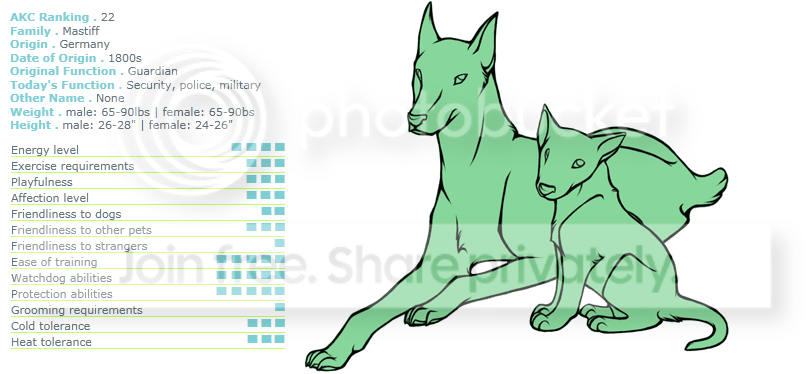
The Doberman Pinscher (alternatively spelled Doberman in many countries) or simply Doberman, is a breed of domestic dog originally developed around 1890 by Karl Friedrich Louis Dobermann. Doberman Pinschers are among the most common of pet breeds, and the breed is well known as an intelligent, alert, and loyal companion dog. Although once commonly used as guard dogs or police dogs, this is less common today.
d o b e r m a nxxS T A T I S T I C S
d o b e r m a nxxF A C T S
Breed History
Few people can claim to have had so great an impact upon the dog world as Louis Dobermann of Germany. Herr Doberman was a door-to-door tax collector who needed a watchful guard dog to accompany him on his rounds. In the late 1800s he set about to create an alert streamlined guard dog, mostly crossing the old German Shepherd and German Pincsher, with later crosses to the Black and Tan Manchester Terrier, Greyhound, and Weimaraner. He soon obtained the prototype of the breed that now bears his name. The original Dobermans were still somewhat heavy boned, round headed; subsequent breeders selected for a more racy-looking dog. The breed evolved in remarkable time; by 1899 the first breed club was formed. The breed continued to attract acclaim, and the first Doberman arrived in America in 1908.
It soon found favor throughout Europe and America as police and guard dogs, and later as a war dog. It prowess in these areas soon brought more admirers, and the Doberman quickly became a valued family protector. Its chiseled silhouette and fearless alert demeanor has made the Doberman a top contender as a show dog. As its fame grew, many families grew to appreciate the breed as a family pet, and the Doberman eventually rose to be the second most popular breed in America in 1977. During this time period, a new challenge arose for the breed, the emergence of the albinistic white Doberman. In an effort to decrease the chance of producing these dogs, the Doberman Pinscher Club of America convinced the AKC to tag the registration numbers of dogs with the likelihood of carrying the albino gene with the letter Z.
Breed Temperament
The Doberman is an intelligent capable guardian, ever on the alert and ready to protect its family or home. It is also a loyal and adventurous companion. It likes to be mentally challenged, and is a gifted obedience pupil. It is sensitive, and very responsive to its owner's wishes, though some can be domineering. It is generally reserved with strangers. It can be aggressive with strange dogs.
Upkeep
This is an active breed that need daily mental and physical exercise lest it become frustrated and destructive. Its exercise requirements can be met with a long jog or walk, or a strenuous run in a safe area. The Doberman can live outside in temperature climates, but it is a much better companion and effective guardian if it shares it human home.
Form and Function
The Doberman is compactly built, muscular, powerful, and square-proportioned. It combines elegance and strength, speed and endurance. Its carriage is proud and alert and its gait is free and vigorous. Its coat is short, smooth, and hard, showing off the exceptionally clean-cut lines of this athletic breed.
▀▀▀▀▀▀▀▀▀▀▀▀▀▀▀▀▀▀▀▀ ▀▀▀▀▀▀▀▀▀▀ ▀▀▀▀▀▀▀▀▀▀▀▀▀▀▀▀▀▀▀▀
|
|
|
|
|
|
|
|
|
|
|
|
|
|
|
Posted: Wed Feb 09, 2011 7:19 am
▅▅▅▅▅▅▅▅▅▅▅▅▅▅▅▅▅▅▅▅▅▅▅▅▅▅▅▅▅▅▅▅▅▅▅▅▅▅▅
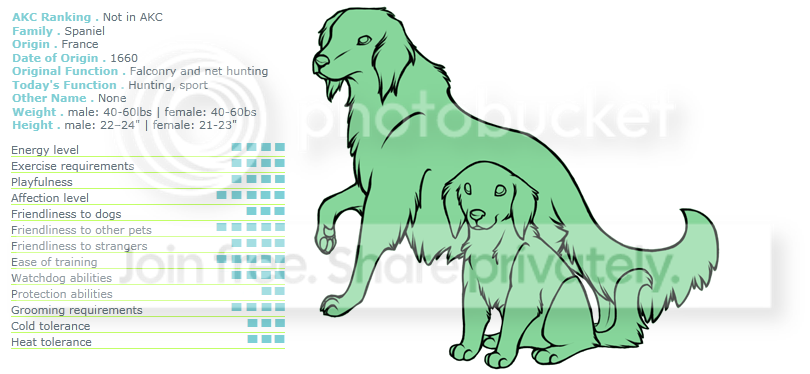
The French Spaniel is a breed of dog of the Spaniel type. It was developed in France as a hunting dog, descended from dogs of the 14th century. Popular with royalty during the Middle Ages, it nearly became extinct by the turn of the 20th century but was saved by the efforts of Father Fournier, a French priest. The breed is recognized by Canadian and international kennel clubs but not by The Kennel Club (UK) or the American Kennel Club.
f r e n c hxxs p a n i e lxxS T A T I S T I C S
f r e n c hxxs p a n i e lxxF A C T S
Breed History
Spaniels were first mentioned in France during the 14th century in Gaston III of Foix-Béarn's work Livre de chasse, later translated into English as The Master of Game. They were speculated to have originated during the Crusades of the 11th century. The French Spaniel was referred to as a specific type of Spaniel by 1660 and was noted as being distinctive from the King Charles Spaniel of the Holland type. The breed was popular during the Middle Ages and with it used for falconry and as a settling dog for net hunting. They became a favorite of French Royalty, who favored them over other breeds of hunting dogs. In addition, Catherine I of Russia (1684–1727) was known to have owned a French Spaniel named Babe. During this period, the French Spaniel was known to have split into several regional types.
James de Connick established the first breed standard for the French Spaniel in 1891. At the turn of the 20th century, the numbers of French Spaniels dropped so low that they nearly became extinct due to competition from foreign sporting dogs -- in particular as French hunters chose to hunt particularly with English breeds of hunting dogs. A French priest named Father Fournier undertook the task of gathering the remaining French Spaniels in his Saint Hillaire kennels in order to preserve the breed. There, he built the lineages that are representatives of those we now have. The French Spaniel Club was founded in 1921, with Father Fournier as the president of the association. The modern French Spaniel is one of a group of recognized spaniels, including the Brittany, Picardy and Blue Picardy.
Breed Temperament
The French Spaniel has a friendly and outgoing personality and is well balanced and patient. It is not a naturally aggressive dog, is eager to please, and thus can be trained easily. A dog of this breed will form a strong bond with its master, being typically a working dog. It has a high level of stamina and requires vigorous exercise.
Upkeep
As an energetic and inquisitive dog, the French Spaniel needs daily mental and physical exertion. Hunting is the first choice to satisfy both needs, but an outing in the field, long walk on leash and good obedience lesson can go far to making the springer a calm and well-behaved house dog. This breed does best if allowed to live in the house with access to a yard.
Form and Function
The French Spaniel is compactly built, upstanding with proud carriage, slightly longer than tall, but with fairly long legs and a deep body. Its build should suggest a combination of strength, agility and endurance, a dog capable of hunting tirelessly under the most difficult of conditions. The outer coat is of medium length, either flat or wavy, and the undercoat is soft and dense. This combination protects the dog from weather, water and thorns.
▀▀▀▀▀▀▀▀▀▀▀▀▀▀▀▀▀▀▀▀ ▀▀▀▀▀▀▀▀▀▀ ▀▀▀▀▀▀▀▀▀▀▀▀▀▀▀▀▀▀▀▀
|
|
|
|
|
|
|
|
|
|
|
|
|
|
|
|
|
|
Posted: Wed Feb 09, 2011 7:20 am
▅▅▅▅▅▅▅▅▅▅▅▅▅▅▅▅▅▅▅▅▅▅▅▅▅▅▅▅▅▅▅▅▅▅▅▅▅▅▅
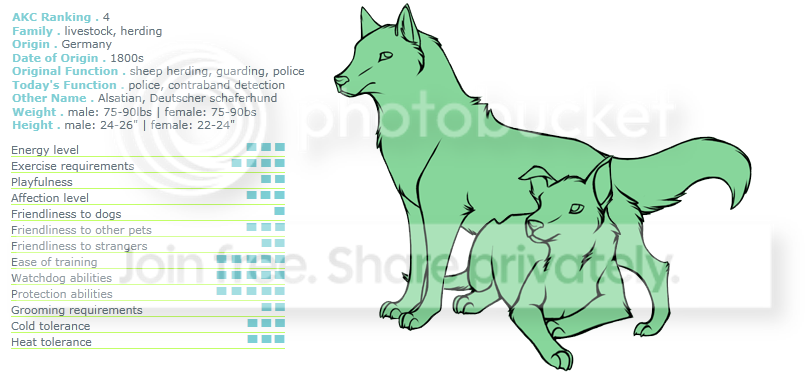
The German Shepherd Dog (GSD, also known as an Alsatian), (German: Deutscher Schäferhund) is a breed of large-sized dog that originated in Germany. The German Shepherd is a relatively new breed of dog, with its origin dating to 1899. As part of the Herding group, the German Shepherd is a working dog developed originally for herding and guarding sheep. Because of its strength, intelligence and abilities in obedience training it is often employed in police and military roles around the world. Due to its loyal and protective nature, the German Shepherd is one of the most registered of breeds.
g e r m a nxxs h e p h e r dxxS T A T I S T I C S
g e r m a nxxs h e p h e r dxxF A C T S
Breed History
Despite an outward appearance slightly resembling a wolf, the German shepherd dog is a fairly recently developed breed and, contrary to namve beliefs, it is no more closely related to the wolf than any other breed of dog. The breed is the result of a conscious effort to produce the ideal shepherd, capable of herding and guarding its flocks. Perhaps never in the history of any breed has such concerted effort been put into improving a dog, mostly due to the formation in 1899 of the Verein fur Deutsche Scharferhunde SV, an organization devoted to overseeing the breeding of the German shepherd. Breeders sought to develop not only a herding dog but also one that could excel at jobs requiring courage, athleticism and intelligence. In short order, the German shepherd had proved itself a more than capable police dog, and subsequent breeding strove to perfect its abilities as an intelligent and fearless companion and guardian.
During World War I, it was the obvious choice for a war sentry. At the same time, the AKC changed the breed's name from German sheepdog to shepherd dog, and Britain changed it to Alsatian wolf dog, both attempts to dissociate the dog from its unpopular German roots. The wolf dog was later dropped as it caused many people to fear the breed. In 1931, the AKC restored the breed's name to German shepherd dog. The greatest boon to the shepherd's popularity came in the form of two dogs, both movie stars: Strongheart and Rin Tin Tin. The German shepherd held the number-one spot in American popularity for many years. Although presently it has dropped from the top spot, the German shepherd remains as one of the most versatile dogs ever created, serving as a police dog, war dog, guide dog, search-and-rescue dog, narcotics- or explosives-detecting dog, show dog, guard dog, pet — and even shepherd.
Breed Temperament
Among the most intelligent of breeds, the German shepherd dog is so intent on its mission — whatever that may be — that it is virtually unsurpassed in working versatility. It is utterly devoted and faithful. Aloof and suspicious toward strangers, it is protective of its home and family. It can be domineering. It can be aggressive toward other dogs, but it is usually good with other pets.
Upkeep
This breed needs daily mental and physical challenges. It enjoys a good exercise session as well as learning session. It can live outside in temperate to cool climates, but it is family-oriented and does equally well as a house dog.
Form and Function
The German shepherd dog has an outline of smooth curves on a body that is longer than it is tall. It is strong, agile and substantial. Its gait is exceptionally outreaching and elastic, covering the ground in great strides. It has a double coat, with the outer coat consisting of dense, straight or slightly wavy of medium length.
▀▀▀▀▀▀▀▀▀▀▀▀▀▀▀▀▀▀▀▀ ▀▀▀▀▀▀▀▀▀▀ ▀▀▀▀▀▀▀▀▀▀▀▀▀▀▀▀▀▀▀▀
|
|
|
|
|
|
|
|
|
|
|
|
|
|
|
Posted: Wed Feb 09, 2011 7:22 am
▅▅▅▅▅▅▅▅▅▅▅▅▅▅▅▅▅▅▅▅▅▅▅▅▅▅▅▅▅▅▅▅▅▅▅▅▅▅▅
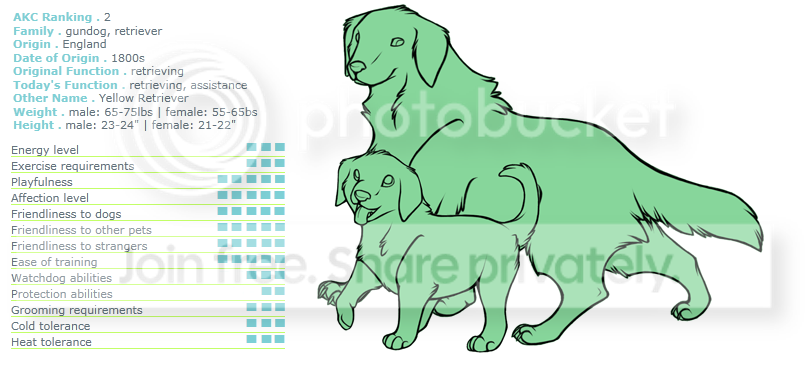
The Golden Retriever is a breed of dog. They were historically developed as gundogs to retrieve shot waterfowl such as ducks and upland game birds during hunting and shooting parties. As such they were bred to have a soft mouth to retrieve game undamaged and have an instinctive love of water. The Golden Retriever has a dense inner coat that provides them with adequate warmth. The outer coat is sleek and water repellent, and lays flat against the body. The official color of the breed is the varying shades of gold that are most often seen.
g o l d e nxxr e t r i e v e rxxS T A T I S T I C S
g o l d e nxxr e t r i e v e rxxF A C T S
Breed History
One of the best documented and most fortuitous efforts to produce a breed resulted in the Golden Retriever. The man responsible for the breed was Lord Tweedmouth, who lived just north of the Scottish border along the Tweed River. With an increasing interest in retrieving dogs in the mid-1800s, a dog that could push through heavy vegetation, brave cold water, swim strongly and retrieve gently was in demand. Lord Tweedmouth bred Nous, a yellow wavy-coated retriever (a descendant of the small Newfoundland and the earlier Labrador breeds used by fisherman) to Belle, a Tweed water spaniel (a popular liver-colored retriever with tightly curled coat). They produced four puppies, which showed promise of being outstanding upland bird dogs. Subsequent judicious crosses were made with other black retrievers, Tweed spaniels, setters and even a bloodhound. The breed was first considered to be a yellow variety of flat-coated retrievers, but was recognized as a separate breed, the yellow or golden retriever, in 1912.
A few of these dogs had come to America by way of Lord Tweedmouth's sons by 1900, but the AKC did not register them as a separate breed until 1927. The breed was valued for the hunting abilities so ably produced by the careful blending of foundation stock. It only later became popular as a pet, show dog and obedience competitor. After it made the transition, however, its rise to the height of popularity was meteoric, and it remains one of the most popular of all breeds in America.
Breed Temperament
Everybody's friend, the Golden Retriever is known for its devoted and obedient nature as a family companion. It is an apt sporting retriever as well and yearns for a day in the field. Ignoring its active nature and powerful physique can lead to behavior problems, and it needs daily physical and mental exercise. It tends to be overly exuberant and boisterous, and its enthusiasm for everything often distracts it during training; however, it is eager to please and enjoys learning. The golden's achievements in competitive obedience are remarkable. It especially enjoys games that involve retrieving and loves to carry items in its mouth.
Upkeep
The Golden Retriever needs daily exercise and human interaction. Challenging obedience lessons, active games or retrieving sessions are all good ways to exercise the golden's mind and body. Although it is capable of living outdoors, it is such a social dog that it is best when it shares its life with its family.
Form and Function
The Golden Retriever is an athletic, strong dog, capable of carrying heavy game over land and water. For this, it needs a broad, powerful head with strong neck and well-developed fore- and hindquarters. It is just slightly longer than tall. The gait is smooth, powerful and ground-covering. The water-repellant coat is dense, with the outer coat straight or wavy.
▀▀▀▀▀▀▀▀▀▀▀▀▀▀▀▀▀▀▀▀ ▀▀▀▀▀▀▀▀▀▀ ▀▀▀▀▀▀▀▀▀▀▀▀▀▀▀▀▀▀▀▀
|
|
|
|
|
|
|
|
|
|
|
|
|
|
|
|
|
|
Posted: Wed Feb 09, 2011 7:29 am
▅▅▅▅▅▅▅▅▅▅▅▅▅▅▅▅▅▅▅▅▅▅▅▅▅▅▅▅▅▅▅▅▅▅▅▅▅▅▅
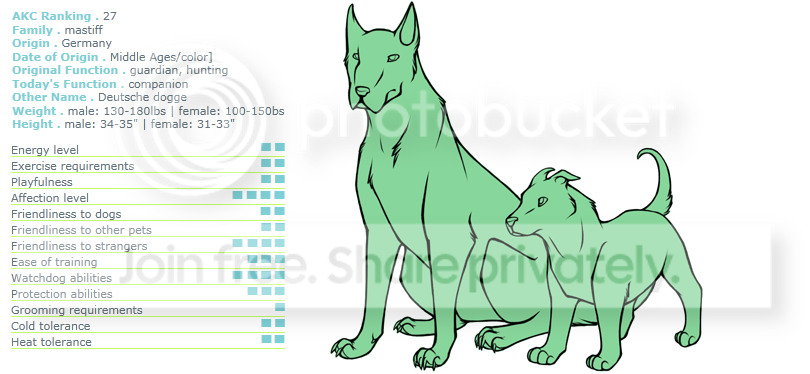
The Great Dane, also known as German Mastiff (German: Deutsche Dogge) or Danish Hound, is a breed of domestic dog known for its giant size. The breed is commonly referred to as the "Apollo of all breeds". The Great Dane is one of the world's tallest dog breeds, they're sometimes called "The World's Largest Lap Dog". The current world record holder, measuring 109 cm (43 in) from paw to shoulder; 220 cm (7.2 ft) from head to tail, is George.
g r e a txxd a n exxS T A T I S T I C S
g r e a txxd a n exxF A C T S
Breed History
Dubbed the "Apollo of Dogs," the Great Dane is probably the product of two other magnificent breeds, the old English mastiff and the Irish wolfhound. Its ancestors were used as war dogs and hunting dogs; thus, its ability as a fearless big-game hunter seemed only natural. By the 14th century, these dogs were proving themselves as able hunters in Germany, combining speed, stamina, strength and courage in order to bring down the tough wild boar. The noble dogs became popular with the landed gentry not only because of their hunting ability but also because of their imposing yet graceful appearance. They made gracious additions to any estate. British people familiar with the breed first referred to Great Danes as German boarhounds. Exactly when and why the breed was later dubbed the Great Dane is a mystery because, although undeniably great, it is not Danish. It is a German breed, and in 1880 German authorities declared that the dog should only be referred to as the Deutsche dogge, the name by which it still goes in Germany. The English paid no heed, and the old name stuck for the English-speaking world. By the late 1800s, the Great Dane had come to America. It quickly attracted attention, as it does to this very day. The breed has since achieved great popularity in spite of some of the difficulties that owning a giant dog entails.
Breed Temperament
The Great Dane is gentle, loving, easygoing and sensitive. It is generally good with children (although its friendly overtures may overwhelm a small child) and usually friendly toward other dogs and pets. It is powerful but sensitive and responsive to training. It makes a pleasant, well-mannered family companion.
Upkeep
The Great Dane needs daily moderate exercise. Its needs can be met with a good walk or romp. Despite its sturdy appearance, it is not well-suited to living outdoors and is best suited to dividing its time between indoors and out. Inside, it needs soft bedding and sufficient room to stretch out when sleeping. Some tend to drool.
Form and Function
This regal breed combines great size and power with elegance. It is square-proportioned and well-balanced. Its gait is strong and powerful with long, easy strides. These attributes are necessary in a dog required to overtake and then over-power relatively swift but formidable quarry. Its coat is short, thick and glossy. The Great Dane is most noteworthy for its majestic carriage and appearance — the "Apollo of Dogs."
▀▀▀▀▀▀▀▀▀▀▀▀▀▀▀▀▀▀▀▀ ▀▀▀▀▀▀▀▀▀▀ ▀▀▀▀▀▀▀▀▀▀▀▀▀▀▀▀▀▀▀▀
|
|
|
|
|
|
|
|
|
|
|
|
|
|
|
|
|
|