|
|
|
|
|
|
|
|
|
 Posted: Tue Jul 13, 2010 10:46 am Posted: Tue Jul 13, 2010 10:46 am
Mistress...
A Roleplay based completely off of the books "The Wheel of Time" written by amazing best-seller author Robert Jordan, may he rest in peace.
Here I've posted resources to information on this fantastical world, as well as information on his world, conveniently located so you don't have to go searching for it.
**THIS IS STILL UNDER CONSTRUCTION - Please Do Not post in here, even after I'm done setting it up...lol**
!!!The majority of the content on this page are direct quotes taken from wot.wikia.com - some of the information posted is of my own knowledge, but proper credit must be given to this site, since they provided MOST of the information!!!
~TABLE OF CONTENTS~
1 - Intro.
2 - Resource Links
3 - Map of the Overall World
4 - Setting for the RP
5 - Places & People
6- Coastal Countries & People
7 - Other Nations
8 - The Aiel Waste
9 - The Seanchan
10 - Historical Nations
11 - Aes Sedai
12 - Aes Sedai cont.
13 - Aes Sedai cont.
14 - Maps
15 - Maps cont.
...Root Beer
|
 |
|
|
|
|
|
|
|
|
|
|
|
|
|
Posted: Wed Jul 14, 2010 7:40 am
|
|
|
|
|
|
|
|
|
|
|
|
|
Posted: Wed Jul 14, 2010 8:02 am
Mistress...
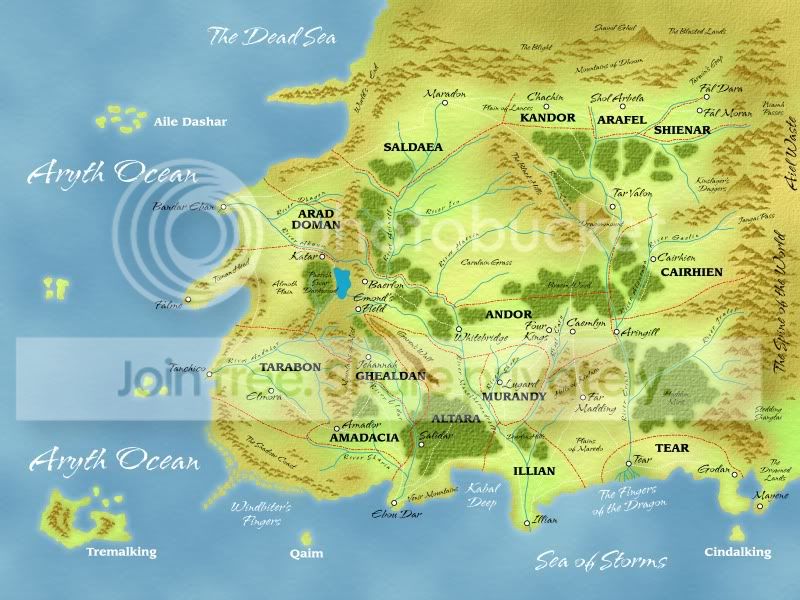
AhaHA! A map smile
...Root Beer
|
|
|
|
|
|
|
|
|
|
|
|
|
|
|
Posted: Wed Jul 14, 2010 8:31 am
Mistress...
What's Happening In The World Now?
Our setting is going to start at the beginning of book Six - Lord Of Chaos.
What Happened in the last book:
Rand chased after the Shaido all the way from Rhiudean to Cairhien, where they had a big heated battle. Mat ended up the one killing Couladin (the Aiel who was claiming to be the Car'a'carn). Egwene is still studying DreamWalking with the Aiel Wise Ones while Elayne, Nyneave, and Brigitte just arrived at the Rebel Aes Sedai camp in Salidar. Perrin is married to Faile (Zarene) and they're living in the Two Rivers for now, with Aram (the Tinker w/ a sword) following Perrin around like a sick puppy or something...Also, Rhavin is in Caemlyn, and Sammael is in Illian. Mesaana is in the White Tower while Moghedien is chasing after Nyneave. Min is in the Rebel Aes Sedai camp too.
If you have anymore questions about what is going on you can PM me, ask them in the OOC thread OR you can look it up on Wikipedia razz
...Root Beer
|
|
|
|
|
|
|
|
|
|
|
|
|
|
|
|
|
|
Posted: Wed Jul 14, 2010 8:31 am
Mistress...
Places/People
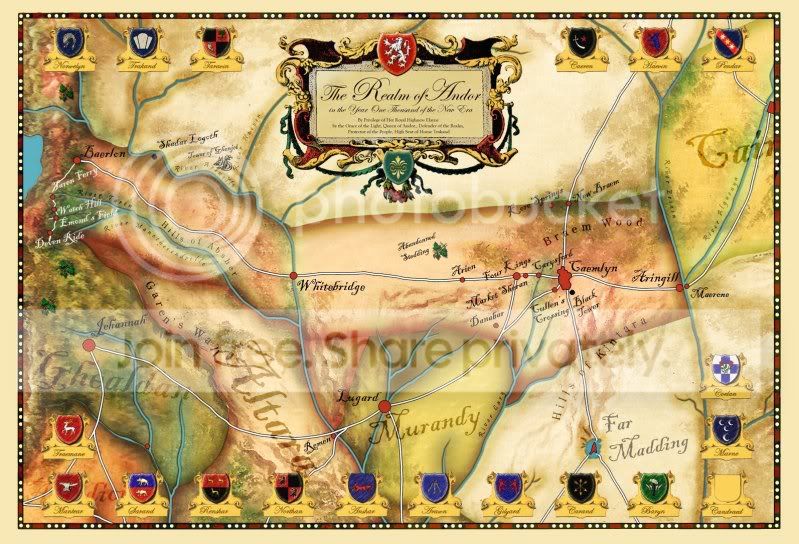
Andor
Andor is a country in the heart of the Westlands. It is the largest and most populous country in the West. After the Borderlands, it also has the largest and most well-trained army.
Formerly a province under gubernatorial rule[1], it was declared a sovereign nation, and is the oldest and largest[2] of the nations formed after Artur Hawkwing's empire collapsed. The capital of Andor is Caemlyn.
History/Traditions
After the death of Artur Hawkwing in FY 994, Ishara and the new Amyrlin Seat, Deane Aryman persuaded Souran Maravaile to lift the siege of Tar Valon. Ishara and Souran returned to Andor[3] and married. Endara withdrew any claim to the governorship or crown and swore fealty to Ishara. Ishara declared herself the first Queen of Andor, establishing an unbroken bloodline of female rulers:
Many of Andor's traditions were established during these early years. Unlike many nobles of the time, Queen Ishara knew that no one ruler would be able to take control of Hawkwing's entire empire. Instead, she focused on controlling only what she could. As a result, Andor began only with the capital city of Caemlyn and the small surrounding villages. Cautious expansion marked the reigns of the early queens of Andor.
The oldest tradition of Andor is that only a queen must sit on the Lion Throne of Andor, and wear the Rose Crown. However it wasn't always intended that a queen would rule - it just so happened that the first two Queens of Andor's sons were killed and so their daughters became queens. After this it became tradition that a queen would rule. The eldest daughter is known as the Daughter-Heir, and is always sent to Tar Valon to study. The eldest brother of the Daughter-Heir is sworn to protect her with his life, and is prepared from an early age to take control of Andor's army. He is given the title First Prince of the Sword. If the Daughter-Heir does not have a brother, another man is appointed to the post.
If a Queen does not have a daughter, then another successor is appointed, judged by the number of blood ties she can establish to Ishara. Four times in Andor's history this method has been disputed, leading to the Succession Wars.
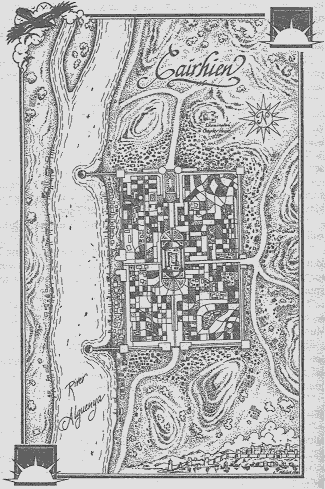
Cairhien
The sign of Cairhien is a golden sun rising on a field of deep blue. Cairhienin (along with Aes Sedai) are known to all but have invented Daes Dae'mar (the Game of Houses), a system of intrigue and plotting. Cairhienin are usually short in stature and of rather pale complexion. They are also, outwardly at least, a very reserved people. Their love of order and control is best illustrated by the perfect grid of their capital's streets.
The politics of Cairhien are dominated by the Game of Houses. The nobles took the plotting and intricacies of politics within the White Tower, and gave it their own twist. To the Cairhienin, everyone has a hidden motive, every word has a hidden meaning, every action is believed to be a move to gain more power and strength. Unsurprisingly, Daes Dae'mar has been the cause of almost every disaster in Cairhien's history.
It is said that when Cairhienin reserve breaks, it can do so to a surprising degree. A good example is Cairhien during the Feast of Lights. During this two day celebration, all social barriers fall, and any man may kiss any woman, and any woman may kiss any man; nobles and commoners alike can be seen in the streets in various states of undress. After the two days are over, life proceeds as if nothing had occurred.
Far Madding
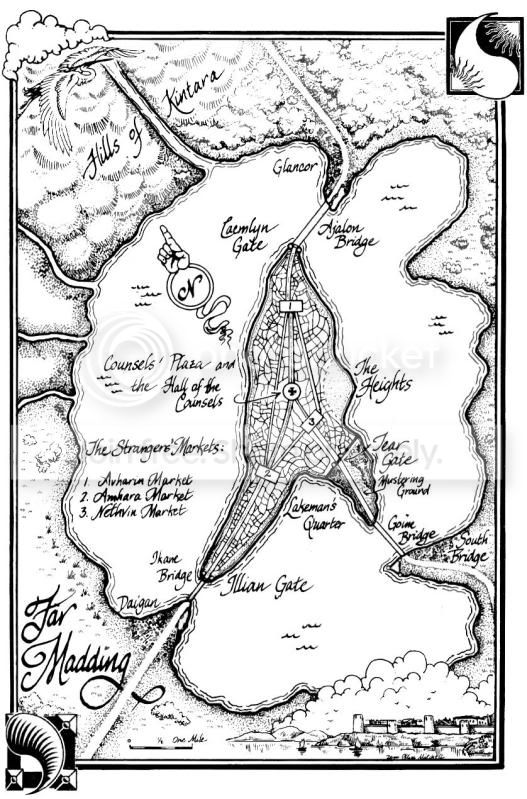
A city-state in the east central part of the Westlands. It lies at the north end of the Plains of Maredo near the borders of Andor, Illian, and Tear. There is a Waygate nearby.
Far Madding lies on an island in the center of a lake. There are three gates and three bridges connecting the city to the mainland. The Caemlyn Gate leads to the Ajalon Bridge and the village of Glancor. The Illian Gate leads to the Ikane Bridge and the village of Daigan. The Tear Gate leads to the Goim Bridge and the village of South Bridge.
There are three Strangers' Markets in Far Madding where foreigners are allowed to trade. They are the Amhara Market, the Avharin Market and the Nethvin Market. They are named after the three most revered women in Far Madding history. At the center of the city is the Counsels' Plaza and the Hall of the Counsels.
In the time after the Breaking, the city was known as Aren Mador and was the capital of Essenia. After the Trolloc Wars, the city was known as Fel Moreina. After the War of the Hundred Years, Far Madding was the capital of Maredo until the nation fell apart. Far Madding is now an independent city-state and a major center of commerce.
In the Hall of the Counsels there is a ter'angreal known as the guardian. This ter'angreal simulates the effects of an Ogier Stedding, rendering it impossible for channellers to sense or touch the True Source. The area of influence is far greater for men than for women. The ter'angreal will also pinpoint the location of anyone channelling in the vicinity.
Borderlands
The Borderlands are the northern nations that border the Blight. For 3000 years the nations of the Borderlands have guarded the Westlands against Shadowspawn from the Great Blight. The culture of the Borderlands is the most martial of all Westlands and many of the best soldiers hail from the Borderlands. Because of the Borderlands' close proximity to the Great Blight and Shayol Ghul, Aes Sedai are highly respected and revered.
Arafel
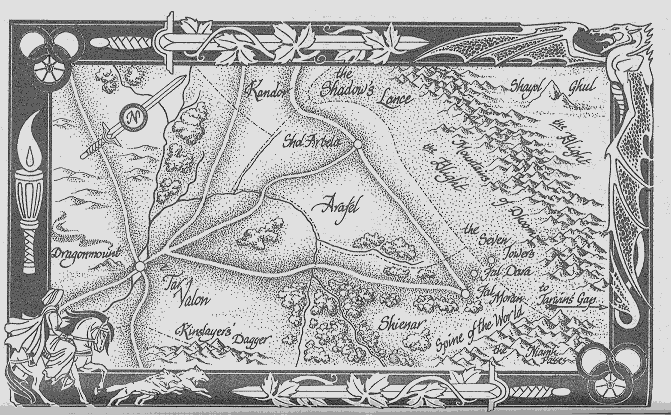
One of the Borderlands, located between Kandor on the west and Shienar on the east. The current ruler is King Paitar Nachiman; his sister Kiruna is an Aes Sedai of the Green Ajah allied with the Salidar sisters.
As with all the Borderlands, Arafel is a martial nation. Arafellin men tend to wear two curved swords on their backs, one hilt above each shoulder. Both genders wear their hair in long braids, with bells on the end. Sometimes they will also wear bells on their coat sleeves or dangling from the tops of their boots, as decoration.
Kandor
One of the four Borderlands. Kandori men are noted for wearing pearl earrings and forked beards; Kandori are also famous merchants. The current Queen of Kandor is Ethenielle, who rules from the capital city of Chachin.
Saldaea
Saldaea is the westernmost of the four Borderlands, larger than Shienar and Arafel combined. The capital of Saldaea is Maradon. Saldaeans have bold, prominent noses and slightly upturned, almond-shaped eyes. While as ferocious in battle as any of the Border nations, their equestrian skills are undoubtedly superior; No other nation in Randland can match Saldaea for her famed and effective use of light cavalry. Saldaean soldiers often carry serpentine swords. Saldaean men usually have long moustaches.
Saldaean women are almost a breed apart, known as they are for their fierce loyalty and strength of will (not to mention temper). For Saldaeans, war is a family affair. The wives of officers and nobles accompany their husbands on all campaigns except those into the Blight. A traditional farewell from a Saldaean wife to a husband going to battle is "If you fall, I will take up your sword." While not trained with the sword, Saldaean girls are quite skilled both with knives and in hand-to-hand combat. All Saldaeans are armed with at least a knife at all times; in Saldaea, steel is not bared unless it will be used.
The Saldaean economy is strong; built upon the trade of furs, wood, and ice peppers, Saldaean goods fetch high prices at markets as far away as Tear.
Another important part of Saldaean life is the sa'sara, a dance outlawed by several Saldaean queens for its indecency. While known by virtually every noblewoman, few would ever admit to the knowledge. Apparently, the sa'sara has the ability to drive men wild. The sa'sara is known to have started three wars and sparked two rebellions, among many other smaller disturbances.
Shienar
Shienar is the easternmost of the Borderlands; the capital is Fal Moran. The current ruler of Shienar is Easar. Shienarans are a very polite people, which might seem at odds with their ferocity in battle and long history of defending against the Blight. Shienaran men (especially soldiers) often wear a long topknot with the rest of their head shaved. Shienar has excelled at effectively deploying heavy cavalry.
The closeness of the Blight to Shienar colors all aspects of Shienaran life and culture. The constant fighting greatly affects the way the Shienaran warriors view life, who view peace, beauty, and life as their three most important values: peace, because they have never known it; beauty, because they are so near the corruption of the Blight; and life, because they are sworn to death.
Like all cities along the Blightborder, no man is permitted to wear a hood or to cover his face within the city walls. This is an effort to prevent Myrddraal from entering the cities. Also, the streets of these cities are very well lighted, to try and prevent the shadows the Myrddraal need to appear and disappear at will.
...Root Beer
|
|
|
|
|
|
|
|
|
|
|
|
|
|
|
Posted: Wed Jul 14, 2010 8:34 am
Mistress...
Western coast nations
Arad Doman
Domani women are the source of the nation's fame; only the Sea Folk women are thought to be more graceful. Domani women wear diaphanous, form-fitting clothing considered scandalous in most countries, and have raised the practice of seduction to an art. It is said that Domani mothers begin teaching their daughters this business at an early age.
If Arad Doman owes its fame to its women, it similarly owes its national wealth to them. Most Domani merchants are women, and few men can best them in a bargaining session. Most men, however, consider losing to be worth the experience.
The capital of Arad Doman is Bandar Eban, which also serves as a center of trade. Katar is an important mining city in the Mountains of Mist whose nobles are powerful enough that they have to be occasionally reminded that they are part of Arad Doman. The Domani trade a great deal with the Sea Folk, and are among the few merchants in the land who can hold their own against in bargaining with the Sea Folk.
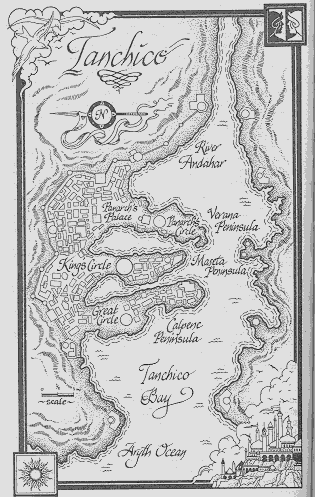
Tarabon
Tarabon formed after the demise of Artur Hawkwing's empire, and the founders set a pattern that continues to modern times: joint rule by a male King and a female Panarch, with clear division of responsibility and authority.
Taraboners believe that they have some of the most ancient lineage of all nations, and refer to themselves as the "Tree of Man". They wear veils that cover all but their eyes.
Its capital is the coastal city of Tanchico.
Southern coast nations
Altara
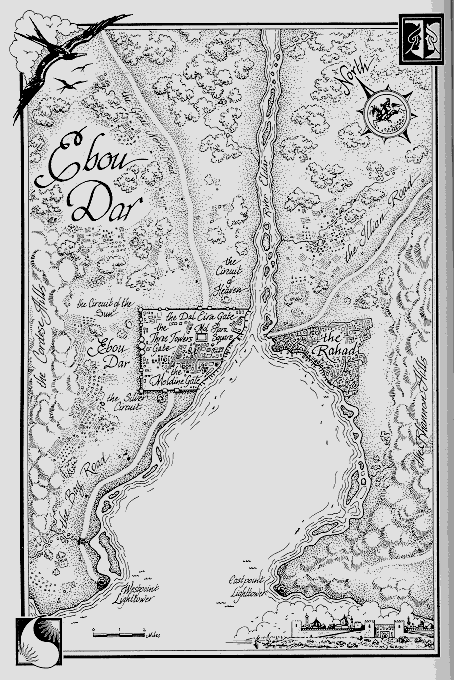
Altara is located between Illian and Amadicia. The river Eldar forms its western border. The nation is not united and often times some nobles have more power than the King or Queen. Its capital, a port, is Ebou Dar, located in the south. The banner of Altara is two golden leopards on a field checked four-by-four in red and blue.
Ebou Dar celebrates more festivals and feastdays than any other city on the map. Even so, it is a wild and dangerous place, especially in the Rahad, where the poorer classes live. Outside the city, the country consists of inhabitants who associate themselves with a particular town or lord rather than the Queen or Altara.
Women in Altara are dominant, especially in Ebou Dar. In fact, in many situations an Altaran woman has the right to kill a man unquestioned. Knives and swords are an important part of Altaran life. Both men and women fight duels over trivial disputes, often with fatal results. Altaran women carry marriage knives, which serve both as a formal way to broadcast marital status (its color and decorations describe marital and motherly status), and a way to deal with their men.
Illian
Illian is located in the extreme south of "Randland." Illian is a rich and powerful nation, whose commerce relies on trade and fishing. The capital of Illian is the city of Illian. Her sign is nine golden bees. The crown of Illian is the Laurel Crown (Crown of Swords). Historically Illian has been at odds with Tear, a rival nation to the east.
Illian's elite troops are known as the Companions. This organization is rare in that foreigners can rise to become Captain-General (the top rank in the Companions). They are placed wherever fighting is heaviest, and follow the king into danger. Whenever a Great Hunt (for the Horn of Valere) is called, it always happens in the Great Square of Tammuz in the city of Illian. Illian is jointly ruled by a King and a Council of Nine Lords.
The dialect of Illian is distinct: Illianers use the emphatic tense of nearly every verb, shun the progressive tense, and use "no" in place of "not." Thus, "That man doesn't serve the Dragon Reborn" becomes in the dialect of Illian "That man do no serve the Dragon Reborn" and "He made sure every stick of bread went to the army" becomes "He did make sure every stick of bread did go to the army."
Illianer men typically wear beards, but with shaven moustaches, creating a face-framing, circular effect.
Mayene
Mayene is a small but wealthy nation historically dominated by its powerful neighbor Tear. The ruler of Mayene is called the First, who, like all of her family, claims to be the direct descendants of Artur Paendrag Tanreall (Artur Hawkwing), the most powerful ruler since the Breaking of the World. Similarly, Mayene's sign is a golden hawk, Artur Hawkwing's sign. This affectation probably has claim in truth, given Mayene's status as the smallest and weakest of modern nations, and the Wheel of Time's habit of "Raising up that which was cast down, and casting down that which was raised up."
The First's primary duty is to keep Mayene independent from Tear, which claims Mayene as a province. Mayene's independence despite these claims relies on the Mayener's knowledge of the location of the secret oilfish shoals, the oil from which is highly valued and competes with similar products from Tear, Illian, and Tarabon.
Another tool the Mayener rulers once used to maintain Mayene's autonomy was a ter'angreal doorway which took them to the land of the Aelfinn. Anyone may enter this doorway once in their life; on the other side, they are allowed to ask any three questions, and will receive three true answers. These answers were a great aid to the Firsts in maintaining Mayene's independence, but one young First, who had already stepped through the doorway in his lifetime, eventually bargained it away to Tear. Despite this loss, the Mayeners are intent on remaining apart from the High Lords of Tear.
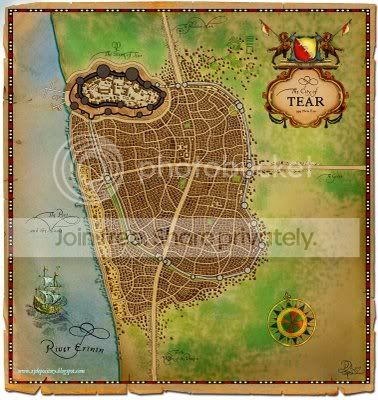
Tear
Tear is one of the richest nations in the land. This comes in part from controlling the greatest port on the Sea of Storms, at the mouth of the Erinin river. A great deal of Tear's wealth comes from the oil produced on the country's numerous olive farms. Lucrative trade in grain and fish also brings money into rich nation of Tear.
The word "Tear," when referring to the nation, is pronounced with a long E, as if in reference to an emotional sign of grief. Its natives, the "Tairens," however, are named with a flat A, as if referring to a rip in a piece of paper.
Tear's distribution of wealth is highly top-heavy; the vast majority of it resides with the Tairen nobility. Tairen lords believe that commoners are actually lesser beings, and the societal rift between haves and have-nots is intense, to the point where they even dress differently. Furthermore, the inner city is surrounded by a high wall of gray stone, which protect the finer houses and palaces of the nobles, which line streets paved with stone. Outside the wall, commoners trudge through unpaved, muddy streets. Until the coming of the Dragon Reborn, it was not possible for a commoner to call a noble before a magistrate.
Unlike most nations, Tear is not ruled by a king or queen, but rather a council of High Lords. The number of High Lords has varied over time from six to twenty, as they are chosen by societal rank.
The location of the city of Tear is unclear. At the beginning of Chapter 48 of The Dragon Reborn, the city docks are said to be on the west bank of the River Erinin, but at the beginning of Chapter 50, Perrin, Moiraine, and Lan arrive by ferry from the west. At the beginning of Chapter 22 of The Shadow Rising, Rand leads the Aiel "out of the Stone and eastward."
The city of Tear is dominated by the Stone of Tear, which towers above the city like a small mountain. It is believed to be the oldest stronghold of mankind, erected shortly after the Breaking of the World. It was built by Aes Sedai using the One Power, Earth, Air, and Fire fusing stones together without joint or mortar.
Deep within the Stone is the Heart of the Stone. This is where the crystal sword Callandor sits, waiting for the Dragon Reborn to claim it. No one except the High Lords are allowed to enter the Heart, and even they rarely do so: four times a year for the Rite of Guarding there, and also to raise a Lord of the Land to the office of High Lord. Indeed, if the High Lords could manage to forget that the Heart of the Stone and Callandor existed, they undoubtedly would: Tairens of all classes have an avowed fear of anything to do with the One Power. This is due partly to the fact that it is prophesied that the Stone of Tear will never fall until the Dragon has been Reborn. The High Lords like to think that by protecting Callandor, they are protecting the world from the Dragon Reborn.
Ironically, the Stone also houses a collection of angreal and ter'angreal second only to the White Tower. It is unsure exactly why the Tairens have collected such an array; perhaps to prevent their use by Aes Sedai, or maybe to diminish by comparison the knowledge that they possess one of the greatest of them, Callandor, whose drawing by the Dragon Reborn will herald the coming of another Breaking of the World.
Tear is thought by many to be based in part on Spain during the height of the Spanish empire; the nobles and soldiers of Tear bear a particularly strong resemblance, while the common people more closely resemble the peasants of China and Korea.
...Root Beer
|
|
|
|
|
|
|
|
|
|
|
|
|
|
|
|
|
|
Posted: Fri Jul 16, 2010 10:47 pm
Mistress...
Other Nations
Falme
Falme, formerly known as Miereallen, is a city that lies at the far end of Toman Head.
Amadicia
Amadicia is a nation in the southwest of the main continent, consisting of the southern end of the Mountains of Mist and the southwestern shores. It is best known as the home of the Children of the Light, a highly militaristic religious order that claims to serve the Light and oppose the Dark One "wherever he is found". Amadicia has historically had a king, but the Children were the real ruling power in Amadicia before the coming of the Seanchan.
Due to the Children's belief that Aes Sedai are servants of the Dark One, both Aes Sedai and channeling are outlawed in Amadicia, and the merest suspicion of such "witchcraft" can result in harsh punishment and even execution. Similarly, the denouncment, trial, and execution of suspected "darkfriends" are common, though the accused are often little more than social outcasts, the unlucky participants in disagreements, or merely in the wrong place at the wrong time. The Children's expansionist aspirations have led to a number of wars in Amadicia, most recently the "Whitecloak War" with Illian and Altara, which the Children call "the Troubles."
The dress and mannerisms of Amadicia, as well as its harsh punishments and disdain for due process of law, are evocative of early Puritan settlements of North America and the witch trials held there. The name "Amadicia" bears this out; in Latin it means "The [land of] the saying of the right" and is similar to the name "Amadeus", which means "He who loves God".
Ghealdan
Ghealdan is a relatively minor country, known for its production of alum. (Alum=These salts are employed in dyeing and various other industrial processes.) Its capital is Jehannah, where Queen Alliandre currently rules in name only.
Murandy
The people of Murandy, much like the people of Altara, do not really considers themselves the residents of a nation. They are more likely to claim allegiance to one or another of the local lords. The ruler of Murandy seldom controls events outside of the capital city of Lugard, and sometimes not even there. The only reason a monarch is tolerated in Murandy is as a deterrent to incursions by foreign nations, and such an invasion is just about the only thing that will compel rival Murandian lords to cooperate.
The capital city of Lugard is located in central Murandy, and trade there always flourishes, regardless of whatever political upheaval may be engulfing the city or nation; it is this trade which keeps the city alive. It is one of few cities in the world which has more inns and stables than residences and shops. Lugard was once surrounded by a tall stone wall, but it has since crumbled. The many thieves who call Lugard home consider any foreigner a fair mark, and the unpaved roads and alleys are dangerous to travel alone.
Murandy plays a minor role in world politics. The lack of an effective ruler makes it difficult for Murandy to defend itself, much less to make its presence felt in the rest of the land.
Tar Valon
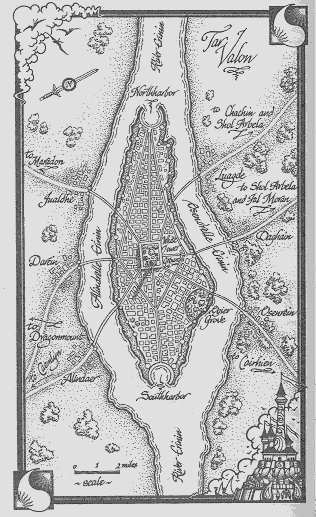
Tar Valon
An island city in the River Erinin, within sight of the Dragonmount, and center of Aes Sedai power. "The Wheel of Time turns around Tar Valon, and Tar Valon turns around the Tower." Kings and Queens bow before the power that Tar Valon holds.
Tar Valon is the home of the White Tower, where the Aes Sedai reside and train. The Tower, and much of the city, was built by the Ogier. Tar Valon is a city-state of sorts, over which the Amyrlin Seat rules. The "Shining Walls" of Tar Valon are thought to be impregnable (never mind the difficulty in taking a city filled with Aes Sedai), and the common belief is that no army has ever breached them. In fact, this last is Aes Sedai deception, as in the Trolloc Wars the armies of the Shadow actually managed to breach the Tower itself.
Dragonmount
Dragonmount is a massive volcanic mountain formed during the Breaking of the World after Lews Therin Telamon was confronted by Elan Morin Tedronai (Ishamael). Lews Therin drew enough of the One Power that, "The air turned to fire, the fire to liquified light," a lightning bolt struck from a clear sky to the point where Lews Therin was standing, bored into the earth and created a volcano, and split the river Erinin in twain creating an island, now the home of Tar Valon. The mountain became known as Dragonmount, where the Dragon would be Reborn according to prophecy, and its summit, which often smokes like a volcano, is high enough to cast a shadow over Tar Valon at certain times of day.
The White Tower
The central feature of Tar Valon, the Tower is the home to the Aes Sedai, with different sections within the Tower for the different ranks and factions, including guards, Novices, Accepted and even the servants. The White Tower was built by Ogier and the Aes Sedai, and soars to heights unparalleled anywhere in the world.
Atha'an Miere
Sea Folk
The Sea Folk control serveral islands and archipelagos. The known Sea Folk islands are: the Aile Somera and Aile Jafar in the Aryth Ocean (it is assumed but unconfirmed that the Aile Dashar are also inhabited by the Sea Folk); and Tremalking, Qaim and Cindaking in the Sea of Storms. Two additional Sea Folk archipelagos are known to exist, one some considerable distance to the south-west of Tremalking in the southern hemisphere, slightly closer to the Land of the Madmen than the Westlands, and another on the equator south-east of Mayene, roughly a thousand miles west of Shara. The names of these islands are unknown.
The Atha'an Miere are headed by a Mistress of the Ships, roughly equivalent to a queen, but without a fixed geographic territory. Her consort and/or male counterpart is the Master of the Blades, responsible for trade and security concerns. Under this leadership, the Sea Folk are further organized into clans, headed by a Wavemistress. The male counterpart at this level is a Swordmaster.
The Atha'an Miere have a hierarchy that is very strict and, in some cases, complex. The rank of a Sea Folk can be determined, among other things, by the number of earrings (typically ear and nose, with a chain in between for higher ranks) a man or woman has and the number of medals the have on their honor chain.
Windfinders can be found on every ship the Sea Folk inhabit. Most Windfinders can channel, and are ranked only under the Sailmistress and Cargomaster on a ship. Windfinders who can channel can typically handle Air and Water most skillfully, creating thick and powerful flows to aid their ship's travel. Conversely, many have little to no skill with Fire or Earth, even less than most female channelers, due to the nature of their society. Windfinders typically fear being found by Aes Sedai, as they believe the Aes Sedai may take them to the White Tower against their will to train them. Because of this, a Windfinder has the right to refuse passage to a passenger who can channel, something usually reserved for the Sailmistress of the ship.
...Root Beer
|
|
|
|
|
|
|
|
|
|
|
|
|
|
|
Posted: Fri Jul 16, 2010 10:47 pm
Mistress...
The Aiel Waste/Three-Fold Land
The Aiel
The Aiel (pronounced: eye-EEL) are a race of people who live between the "wetlanders" in the Westlands and the Sharans in the east, in a desert which the Aiel call the Three-fold Land and which everyone else calls the Aiel Waste, a desert much like Death Valley in California. They have earned a reputation as skilled warriors; little else is known about them in the wider world. Physically, Aiel can be recognized through their unusual height, characteristic pale eyes and light-colored hair, as well as their distinctive clothing. The Language of the Aiel is derived from the same Old Tongue as known to the rest of the known world in the series, though with a particular stress on maintaining many of the traditional terms of importance, such as titles and legal terminology.
History
Not much is known about the Aiel by the outside world. Any wetlanders (as they call those who live to the west) are killed on sight; only peddlers, gleemen and Aes Sedai are given free passage. Tinkers can also move freely in the Waste if they so choose, as no Aiel will go near them. Aiel have a reputation for being vicious fighters, and "black-veiled Aiel" is a common epithet for belligerence.The Aiel once allowed a fourth class of wetlander to traverse their lands: the citizens of Cairhien, in honor of the help they had given the Aiel during their wandering. The Cairhienin were allowed to travel through the Waste to Shara, where the Cairhienin were able to obtain precious silks, spices and other luxury goods. The Aiel also gave Cairhien a small tree: Avendoraldera, a cutting of Avendesora, the Tree of Life. Unfortunately, several centuries later, a Cairhienin king with more ambition than sense, Laman Damodred, cut down Avendoraldera to make himself a throne. Four clans of outraged Aiel boiled out of the Waste to bring back Laman's head. Led by a charismatic Tardaad clan chief named Janduin, the assassination was complicated when several "wetlander" armies mistook the Aiel for an invasion force and started fighting back. The Aiel cut them to ribbons, chasing King Laman across the nations, and by 978 NE they had pursued him all the way to Tar Valon. The Battle of the Blood Snow, as it was later called, saw the Aiel finally succeed in killing King Laman; the next day, they went home. Wetlanders call this the Aiel War; the Aiel called it justice. Since then, however, the Aiel have been even more hostile to the Cairhienin than to other wetlanders, calling them "treekillers" and "oathbreakers."
Customs/Culture
The Aiel have a number of cultural practices that are quite strange to outsiders. For example, women frequently become soldiers and fight alongside men. In addition, the taboo against nudity in practical settings is much weaker amongst the Aiel than in some cultures, much to the astonishment of many Wetlanders. On the other hand, their capacity for public display of affection is almost nonexistent, and they are mortified to watch lovers kiss or even embrace. The Aiel moral code is called ji'e'toh, an Old Tongue word which roughly translates to "honor and duty" or "honor and obligation"; it codifies the Aiel responses to honor and shame (which is essentially synonymous with obligation). Outsiders consider it labyrinthine -- one Aes Sedai who studied it for a month reportedly ended more confused than she started -- but the Aiel live and die by it.
One of the most bizarre convolutions of ji'e'toh concerns the taking of gai'shain, "those sworn to peace in battle". Aiel earn honor and prestige for deeds in battle--or accumulate shame by misdeeds--but killing an opponent earns the least honor; "any child can kill". What earns the most honor is touching the opponent while they are holding a weapon, but without harming them, much like the practice of counting coup performed by the Native Americans. An Aiel so shamed is considered to have toh -- obligation -- to the person who touched them, and will march straight to that person and demand to be made gai'shain, at which point they don white robes, become that person's peaceful servant in all but name for a year and a day, and swear not to touch a weapon, or even defend themselves, during that time. Becoming gai'shain is a way to answer for toh; it is totally voluntary and can be used to atone for non-battle-related shaming as well. Gai'shain are not slaves, and any wetlander who suggests it is soon straightened out. Conversely, Aiel are horrified and confused by the concept of "servants", people who work throughout their life in the service of others.
Wise Ones, children, pregnant women, women with a child under the age of ten, and black smiths cannot be taken gai'shain. Exact "ownership" of the gai'shain is a variable matter; though each gai'shain swears only to one person, they can be and are often instructed to obey commands from other people as well. On occasion a man will allow himself to be taken gai'shain by a Maiden he wishes to marry in an attempt to get her to fall in love with him during his time of servitude. The Maiden never does because they would never look at a gai'shain as a potential mate, and usually "teach them to sing", something Aiel men do not do unless a battle hymn or dierge for the slain.Though only men can become clan chiefs, only women can hold property. The owner of any given roof (house) or holding (settlement) is the roofmistress, and she must give permission to step under her roof. Only women, likewise, can become Wise Ones. Only women can ask for marriage; a man may accept or decline, but may not ask, although he may make his interest known in other ways, such as giving a gift.
There are twelve Aiel clans, each of which has a clan chief; clans are further divided into septs, and septs subdivide into holdings (which are individual settlements; each clan and sept also has a central hold). Aiel warriors also affiliate themselves with various warrior societies, of which there are twelve: Mountain Dancers, Thunder Walkers, Stone Dogs, Brothers of the Eagle, etc. The only society to accept women is the Far Dareis Mai, the Maidens of the Spear; their members 'marry' their spears and are forbidden to take men into their lives on a permanent basis without forfeiting membership. The lines of loyalty amongst clan, sept and society are tangled; but, roughly, allegiance to one's warrior society trumps clan allegiance. This appears counter-intuitive until one remembers that the clans are in a state of almost perpetual multidirectional warfare; since Aiel from any clan can join any society, and will not raise spear against fellow society members, this allows open lines of diplomacy between all clans at all times. Some Aiel even sojourn with their societies to avoid participating in clan feuds.
Clans and Septs
Chareen: - Cosaida - Jarra - White Mountain
Codarra: - Jaern Rift
Daryne: - Bent Peak - Shelan
Goshien: - High Plain - Jhirad - Mosaada - Red Salt - Red Water - Stones River
Miagoma: - Cold Peak - Smoke Water - Spine Ridge
Nakai: - Black Cliffs - Black Water - Salt Flat
Reyn: - Musara - Two Spires
Shaarad: - Black Rock - Haido - Imran
Shaido: - Domai - Green Salts - Jonine - Jumai-Morai - Moshaine - White Cliff
Shiande: - Neder
Taardad: - Bitter Water - Bloody Water - Chumai - Four Holes - Four Stones - Iron Mountain - Jagged Spire - Jindo - Miadi - Nine Valleys
Tomanelle: - Jenda - Serai - Shorara
Jenn Aiel
War Societies
-Far Dareis Mai (Maidens of the Spear)
-Shae'en M'taal (Stone Dogs)
-Aethan Dor (Red Shields)
-Seia Doon (Black Eyes)
-Far Aldazar Din (Brothers of the Eagle)
-Rahien Sorei (Dawn Runners)
-Sha'mad Conde (Thunder Walkers)
-Hama N'dore (Mountain Dancers)
-Sovin Nai (Knife Hands)
-Cor Darei (Night Spears)
-Tain Shari (True Bloods)
-Duadhe Mahdi'in (Water Seekers)
Rhuidean, Wise Ones, etc.
Rhuidean is a small city located in the Aiel Waste. After the Breaking of the World, the Jenn Aiel and female Aes Sedai who accompanied them to escape the insane male channelers, built the first and only city there, which they named Rhuidean. The city was never strongly inhabited, and was abandoned after the disappearance of the Jenn Aiel; however, it is still used for raising clan chiefs and Wise Ones.
Aiel women who can channel are not sent to the White Tower; instead, they remain among the Aiel and become Wise Ones. Some Aiel women are also skilled in dreamwalking Tel'aran'rhiod, the World of Dreams; they too become Wise Ones (even if they cannot channel). Wise Ones undergo a grueling testing period, culminating in a trip to Rhuidean; inside there are ter'angreal which administer the final test.
Aiel clan chiefs must also undergo a test by traveling to the center of Rhuidean, four Wise Ones must say yes for them to do so. They come out marked with an iridescent dragon tattoo around one forearm--or do not come out at all. Women receive no such marking. Two of three who go, do not return; what they learn in Rhuidean is too much for some to bear as they learn the full complete history of the Aiel. Eventually, it is told, a man will emerge from Rhuidean at daybreak with two dragons, one on each forearm: a Car'a'carn, a chief-of-chiefs, He Who Comes With The Dawn. “He shall spill out the blood of those who call themselves Aiel as water on sand, and he shall break them as dried twigs, yet the remnant of a remnant shall he save, and they shall live.”
...Root Beer
|
|
|
|
|
|
|
|
|
|
|
|
|
|
|
|
|
|
Posted: Fri Jul 16, 2010 10:48 pm
Mistress...
The Seanchan
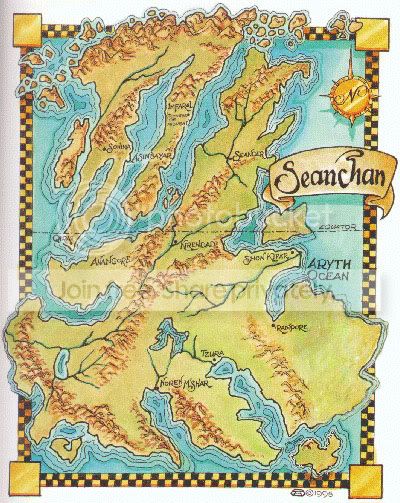
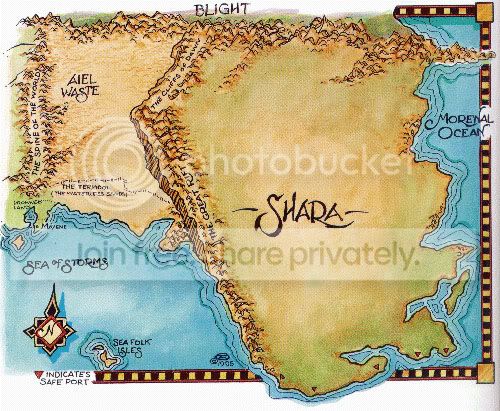
Seanchan (pronounced SHAWN-chan) is a continent located across the Aryth Ocean. Its nearest shores are over 5,000 miles to the west of the Westlands. The name "Seanchan" also applies to the Empire that occupies the continent, and the people living there. It is divided into two landmasses separated by a wide dividing channel, and is longer north-to-south than east-to-west, although it is split by many fissures and fjords. The Morenal Ocean separates Seanchan from Shara to the west.
History
A thousand years after the Trolloc Wars, after unifying the Westlands, Artur Hawkwing sent a vast fleet led by his son, Luthair Paendrag Mondwin, across the Aryth Ocean. Luthair's fleet never returned to the continent from which they came, and was presumed lost. The fleet had actually made it across the ocean to arrive in Seanchan. By pitting the native nations against each other, Luthair and his descendants eventually subjugated and unified the continent into the Seanchan Empire, a process called the Consolidation. Luthair's heirs continue to rule the Empire. During this time the Seanchan began to use animals from this continent. With the use of these creatures they killed all of the Shadowspawn on the continent.
Recently, the Seanchan Empire has engaged in a concerted effort to retake the continent from which the Empire's rulers' ancestors hailed, known as the Return. The Seanchan made their first attempt, seizing the city of Falme and surrounding lands, but were driven back. Later, the Seanchan were successful in taking Tarabon and Amadicia, and continued their advance, taking Ebou Dar and southern Altara. They were then halted when the forces of Rand al'Thor fought the Seanchan to a standstill. With the arrival of the main Seanchan fleet and the Daughter of the Nine Moons, the Seanchan are poised to make further advances. Locked in an uneasy stalemate, Rand al'Thor currently seeks to make a truce with the Seanchan.
Culture/Customs
The rule of Seanchan is provided by an Empress or Emperor who has absolute power. He or she reigns from the Crystal Throne at the Court of the Nine Moons, located in Seandar; the throne itself is a ter'angreal, inspiring awe and wonder of the person who sits on it. Below the Empress and those of her immediate family is the Blood, the noble class of the Empire. The elite guard around the throne is provided by the Deathwatch Guards, while the Seekers for Truth hunt Darkfriends and act as a secret police.
The nation of Seanchan is ruled by a rigid class structure. The lowest class of people are the da'covale, or "those who are property." However, not all servants hold low rank in Seanchan society. The hereditary servants of the Imperial family, called so'jhin hold higher rank than free men and women.
he highest tier of Seanchan society is held by those who are of the Blood. Initially, it was only the descendants of Luthair and his armies who were of the Blood, but over time others have been raised to the Blood. Being raised to the Blood, while exceptionally rare, is the greatest honor possible for one who was born a commoner. The Blood are divided into two groups, the Low Blood, and the High Blood. Members of the Low Blood have their hair cut into a bowl-type cut with a tail in the back and lacquer the last one or two nails on each hand. The High Blood shave the sides of their heads, leaving a long crest running along the top of their heads and lacquer the first one or two nails on each hand, depending on their rank (two is higher than just one). Members of the Imperial Family shave their heads bald and lacquer all of their fingernails.
The Deathwatch Guards are perhaps the most honored and valued of the Imperial servants. They are charged with the protection of the Imperial family. They are easily recognized by both their dark green tasseled spears and dark green lacquered shields. The green on their armor is so dark that it is easily mistaken for black by those who do not already know. These fearsome warriors are known for their willingness to kill or die, as necessary, to protect the Imperial family. Sometimes a segment of the Deathwatch Guards is loaned, as an honor, to other nobles. The most elite members of the Deathwatch Guards are never loaned, and are responsible for the life of the Empress herself and her immediate family. Some members of the Deathwatch Guards are Ogier; they are called the Gardeners and are not da'covale. These Ogier are more somber than their relatives across the ocean, and carry large battle axes taller than most men.
The One Power
Damane
Women who can channel are regarded as animals, and are kept on a silvery metal leash, the a'dam, that allows control of their channeling by a trainer known as a sul'dam. The leashed women are called damane, meaning "Leashed One." Women who can channel but are not kept as damane are referred to as marath'damane, or "those who must be leashed." Most damane have been treated this way their entire lives, and tend to become hysterical at the very mention of marath'damane.
Damane are kept and treated as sentient pets, but are also used extensively in warfare by the Seanchan. They are trained in the art of using the One Power as a weapon, preferring fireballs and lightning to more indirect methods.
Sul'dam
A trainer of damane is known as a sul'dam, meaning "Leash Holder" in the Old Tongue. Like damane, only certain women can use the a'dam, but the reason for this is largely unknown to the Seanchan. Recent discoveries show that sul'dam have the ability to learn the use of the One Power, showing that the a'dam must be used by two women who can channel.
A'dam
he a'dam is a silvery metal leash attached to a collar made of the same material, which seems to be made all of one piece. It is a specialized ter'angreal that actually creates a link between two female channelers.
The collar, at one end of the leash must be fastened onto the female channeler's neck, and the other end clasps around the wrist of the sul'dam in the form of a bracelet. A leash is usually present between a damane and sul'dam, but it is not necessary for the ter'angreal to function. The sul'dam may then direct and guide the flows of the damane, or even block access to the One Power altogether. Commands may also be issued, and the damane is compelled to obey, even if the a'dam is removed from the trainer's wrist.
The a'dam has no effect on either end for men and women who cannot channel. At times, the Seanchan have been known to force a man to take the a'dam, sometimes with disastrous results. It is unknown whether this is related to a man's ability to channel, though it is assumed to be the case.
Creatures & etc.
Raken
A raken has a body considerably longer than a horse and is about equal in girth, with leathery gray skin and large powerful wings much like those of a bat. While the raken is not used as a weapon, it will often lash its tail in anger when perched or on the ground. It normally crouches rather than standing erect, and stands erect only when alarmed or preparing to fly. Raken are omnivorous, but are content with an all-plant diet.
They are ideal mounts for scouting and/or sending messages, as the raken can fly at approximately three to four times the speed of a running horse, and can actually be ridden up until the point it dies. A morat'raken is a Seanchan flier who rides the raken, and three out of four morat'raken are women.
Grolm
Weighing in at three hundred to five hundred pounds, grolm are the size of large bears, only with the gray green coloration and skin texture of very tough frogs. Like the torm, they have three eyes. They appear to be carnivorous scavengers, as their diet is known to include their own dead.
When walking, grolm appear almost awkward, moving with a waddling motion. All traces of awkwardness vanish when they run.
Grolm are used in battle, though normally only against lightly armoured opponents to break holes in an enemy line which will then be quickly exploited by human soldiers. They are very useful against cavalry, as horses often panic in their presence unless specifically trained to tolerate the grolm. They are extremely difficult to kill, given that nonfatal wounds seldom incapacitate them, and they heal rapidly. They also have very good vision, a keen sense of smell, and are extremely territorial.
Corlm
Corlm appear as large, flightless birds, perhaps similar to some prehistoric ostrich such as a moa.
Lopar
The lopar is the main combat animal of the Seanchan. Its average size is between fifteen hundred and two thousand pounds, with a leathery hairless hide which is dark brown or a pale reddish hue. Lopar have six toes on both front and rear paws, and all have large retractable claws. They have no visible external ears. Lopar sometimes rear upon their hind legs when fighting, and can reach as high as ten feet. They are also armored similar to the style the Seanchan soldiers use.
Torm
A torm is a cross between a horse-sized cat and a lizard, it has bronze scales, six-clawed feet that can grip stones in a road, and three eyes. The torm is the most intelligent of the Seanchan creatures, being well above that of a very bright dog, and can come close to human levels in certain areas of problem solving, such as maze tests. As riding animals their speed and endurance are superior to that of a horse, but they are particular about their riders. Once it has found its rider, the torm will not allow another to mount. If its rider dies, it takes some time to get a torm to accept another.
The torm suffers from fighting frenzy if in battle for too long. It rarely will turn on its rider during one of these frenzies, but will strike at anyone else within reach. Torm will also immediately attack any corlm within reach, making them additionally unsuitable for protracted combat. They are not widely available and are difficult to replace.
S'redit
S'redit are used as war animals. They are massive, with thick gray skin. The bull s'redit has long tusks, but they are used mostly as large cargo animals. They are called by different names in other lands; Valan Luca calls them giant boar-horses to make them more pronounceable and interesting. They appear to be much like elephants.
Kaf
The Seanchan form of coffee, brewed from dark beans into a black liquid and drunk steaming hot, sometimes sweetened, but often not. It is known for its stimulating effect and bitter taste.
Cities/Towns/Regions
Seandar - the capital
Abunai - on the Sea of L'Heye
Aldael Mountains
Alqam
Ancarid
Asinbayar
Barsabba
Dalenshar
Ijaz Mountains - source of kaf beans
Imfaral
Jeranem
Jianmin
Kaensada Hills
Khoweal
Maram Kashor - an island at the southeastern tip of Seanchan
Marendalar - an island
Mechoacan
Merinloe
Muyami
N'Kon
Noren M'Shar
Pujili
Salaking
Semalaren
Sen T'jore
Serengada Dai
Shon Kifar
Sohima
Tuel
...Root Beer
|
|
|
|
|
|
|
|
|
|
|
|
|
|
|
Posted: Wed Jul 21, 2010 8:48 am
Mistress...
Historical Nations
Essenia
Essenia was one of the Ten Nations. Although it survived the Trolloc Wars, the resulting chaos after the Trollocs were defeated caused Essenia to fall from within. Essenia was famous for its philosophers and seats of learning. The capital city was Aren Mador (Far Madding). Other important cities were Tear and Dalsande. Essenia covered what is today Tear and the Plains of Maredo.
Coremanda
One of the Ten Nations destroyed in the Trolloc Wars. Coremanda was renowned for its wealth and power. The capital city was Shaemal, famous for its crystal dome. Other major cities include Braem, Nailine Samfara, and Hai Caemlyn, today known as Caemlyn. Coremanda covered much of the central Westlands.
Jaramid
One of the Ten Nations of the Covenant formed after the Breaking, Jaramide lay in the area most recently known as Saldaea and Arad Doman, During the time of the signing of the Compact, the ruler was High Queen Egoridin.
Safer
Safer lay in the area most recently known as Almoth Plain and Toman Head, During the time of the signing of the Compact, the ruler was King Eawynd
Manetheren
One of the Ten Nations destroyed in the Trolloc Wars. Manetheren means "the Mountain Home" in the Old Tongue. Manetheren's sign was a red eagle. The touching and tragic story of Manetheren's destruction, and her last king and queen, is retold by Moiraine Damodred in The Eye of the World.
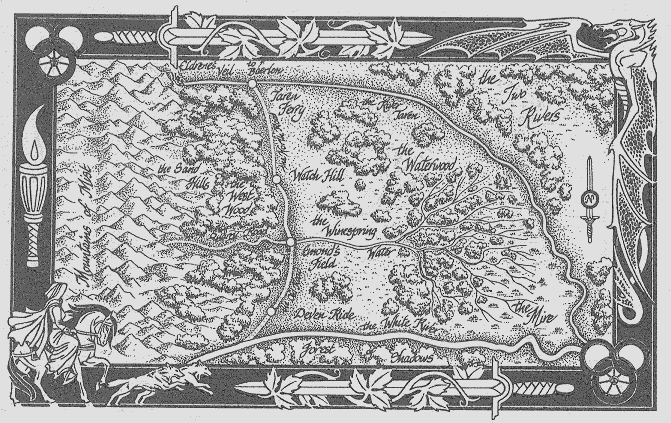
The area currently known as The Two Rivers was part of Manetheren. Ghealdan was also within Manetheren's boundaries.
Malkier
This nation was part of the Borderlands, lying north of Shienar. The sign of Malkier was a golden crane. Malkieri men are recognized by a braided leather cord they wear called a hadori. The nation was swallowed by the Blight in 955 NE, causing Shienar to become the northernmost of the Borderlands. Malkier is now a desolate wilderness, overrun by the Blight. The Thousand Lakes are poisonous and inhabited by foul creatures, whilst the Seven Towers are toppled ruins.
...Root Beer
|
|
|
|
|
|
|
|
|
|
|
|
|
|
|
|
|
|
Posted: Wed Jul 21, 2010 9:28 am
Mistress... Aes Sedai“An Aes Sedai never lies, but the truth she speaks, may not be the truth you think you hear.” - Tam Al'ThorAjahs"Browns seek knowledge, Blues meddle in causes, and Whites consider the questions of truth with implacable logic. We all do some of it all, of course. But to be a Green means to stand ready. In the Trolloc Wars, we were often called the Battle Ajah. " -Alanna Mosvani of the Green Ajah.When a woman is raised to the shawl, becoming Aes Sedai, she is brought into a group within the tower, these groups are called Ajahs. Each group has a specific purpose/devotion. In the Age of Legends, Ajah (pronounced: AH-jah) meant a temporary group of people banded together for a specific purpose. During the founding of the present White Tower, there were more ajahs than exist now. The first Amyrlin, Elisane Tishar, was the head of one of twelve groups of women who represented a particular viewpoint or purpose at that time. Sometime between 47 and 98 AB, the number of Ajahs decreased from this twelve to the current seven, though it is not known if these seven had any purpose that was close to the purposes of the current seven Ajahs, nor what the purposes of the lost Ajahs were. These "ajahs" and the early Tower were particularly competitive and vicious. Mesaana notes that the machinations of the current Ajahs almost matched the ajahs at times and it is stated in The World of Robert Jordan's The Wheel of Time that the assassination of the early Amyrlins was not unusual. Presently the Aes Sedai divide themselves into seven Ajahs. Each of these sub-societies has representation on the administrative councils, its own ideology and purpose for its members, own ruling head or heads, and its own spy network. They also have secret weaves that are only taught to initiates, and own traditions governing things ranging from conduct in everyday life to what one might wear inside the White Tower. Each Ajah is dedicated particular tasks, though they all do some of everything. Red AjahThe Red Ajah of the Aes Sedai is dedicated to locating men with the ability to channel and subsequently gentling them. The leader of the Red Ajah is known as Highest. The Red Ajah is the largest Ajah. According to the The Guide, approximately 20% of sisters are Reds. Given that there are approximately 1,000 Aes Sedai, Red membership stands at approximately 200. It also has the greatest concentration of Black sisters. The Red has, for millennia, been seeking out men who can channel and gentling them. They do this mostly by detecting the residue of weaves made from saidin. Red sisters generally do not have friends outside of their Ajah. Nor do they ever have warders, in fact, during the time in which the The Wheel of Time series takes place, it is said that most Red sisters hate all men, not just those who can channel. Green AjahThe Green Ajah of the Aes Sedai holds itself ready for the final battle between good and evil, Tarmon Gai'don, when the Dark One breaks free and must be opposed. They are sometimes called the "Battle Ajah". The head of the Green Ajah is known as the Captain-General. Greens have a long history of friendship with the Blues, and generally oppose the Red. However, they do not oppose the gentling of men who can channel. Not only are members of the Green Ajah fantastic at utilizing their Power in times of war, but they are also wonderful strategists who can plan effective battle strategies. In ancient times, the Greens were the counterpart of the Dreadlords -- male and female channelers who had openly accepted the Shadow. The Dreadlords were the generals who lead the armies of Trollocs, Myrddraal, and Draghkar. Dreadlords were the only members of the Shadow's armies who could match the power of the Green Ajah, and the battles between the two were climactic enough to destroy many from either side. According to The Guide, the Greens are the second largest Ajah, following close behind the Reds, who have approximately 200 sisters. Greens are willing to bond more than one Warder. Even though it may be a source of humor in the White Tower to find a member of the Green Ajah with nearly a half-dozen Warders, it was not entirely a frivolous practice: in the old wars, their amount of Warders made a positive difference. The Greens are also known for their love of men; this can be reflected in their amount of Warders. They are also the Ajah that has the most cheerful and cajoling members: in a world where the White Ajah is cold and remote, the Red Ajah is proud to a fault, and the Brown Ajah oblivious and dreamy, the Green Ajah acts like a breath of fresh air with their nonchalant and carefree nature. In this, the Green Ajah is almost the ideological opposite of the Red Ajah. Some of the Greens like men to such an extent that they may even marry their Warder, although those Greens that do only have one, perhaps in an attempt not to create marital problems by constantly being bonded to multiple men. Yellow AjahThe Yellow Ajah of the Aes Sedai primarily studies Healing. The head of the Yellow Ajah is called the First Weaver. Healing is a Talent that not all sisters possess, but is considered a requirement for entry into the Yellow Ajah. The best Healers are always Yellow sisters, and it is said they will try to Heal anything. Blue AjahThe Blue Ajah of the Aes Sedai normally involve themselves with righteous causes and justice. While the body of the Blue Ajah is a relatively small one, it has the most extensive network of spies throughout the land. The leader of the Blue Ajah is called the First Selector. The Blue Ajah are closely allied with the Green Ajah, a friendship that has lasted a thousand years, and are on good terms with the Brown Ajah as well. They have a long-standing feud with the Red Ajah. Traditions for members of the Blue Ajah include never wearing red inside the tower, wearing all blue the first of each month, wearing blue stockings when leaving Tar Valon, greeting the newest members of their ajah with a kiss of welcome and requiring a newly raised member of the Ajah to bake a pie for the sixth member of the Ajah to kiss her. Gray AjahThe Gray Ajah of the Aes Sedai favors harmony and consensus above all else. Members are often conflict mediators or ambassadors. The leader of the Gray Ajah is called the Head Clerk. The Grays attempted to hold together the coalition of nations that fought against the Aiel during the Aiel War, but failed. They have been responsible for drawing to a close countless conflicts and wars over the last three thousand years, through their skill in crafting agreements and treaties. Brown AjahThe Brown Ajah of the Aes Sedai is devoted to knowledge and the collection of ancient wisdom. For the past few centuries they have been at odds with the Blue Ajah, but are not enemies with them. Unlike the other six Ajahs, the Browns are run by an internal council, and not a solitary woman. This council is colloquially called the 'Brown Council,' which has a designated sister to sit at its head. This leadership position was simply refered to as the 'Head of the Brown Council,' but was later named as First Chair. It is currently held by Jesse Bilal. The size of the Brown Council has not been revealed, nor the manner in which a sister may sit upon it. The Browns dedicate themselves to knowledge and history and generally forsake the mundane world. They can be usually found in the Great Library in the White Tower, which they also administer, looking for something new to study. White AjahThe White Ajah of the Aes Sedai is dedicated to the value of logic, and devotes itself to questions of philosophy and truth. The head of the White Ajah is called the First Reasoner. They ignore the social causes that define the Blue, Gray, Green and Red Ajahs and have no room for the worldly knowledge that the Browns and to some extent the Yellows seek. It is said that they have no room in their hearts for passions. Their Ajah contains the fewest Black sisters, 17, though the head of the Black is a White. It was White sisters who first made the connection between the Reds' gentling crusade and the dwindling numbers and strength of female channelers. They proposed to the Tower that male channelers should, either before or after gentling, be allowed to mate with Aes Sedai. The idea was flatly refused by the Hall of the Tower. Black AjahThe Black Ajah is a secret Ajah, comprised of sisters who hide in other Ajahs and who have forsaken their Three Oaths in order to serve the Dark One. Reports of its existence were only recently accepted by other sisters when Liandrin, a Red, fled the Tower along with twelve other sisters, stealing several ter'angreal and killing a number of Tower personnel. Some, even then, refuse to believe that some of the sisters who fled were Black Ajah. There is a deep-seated denial of its existence among many Aes Sedai. Most sisters who join the Black Ajah were not Darkfriends before they did so. They worked for years as ordinary sisters until members of the Black Ajah suspected that they may be suceptible to swearing allegiance to the Shadow.Those who might be willing to become a member of the Black Ajah are likely those who find the Three Oaths chafing and who delight in the Power an Aes Sedai has over non-channelers, even having been known to abuse it. The Black Ajah allows them to exploit their power free of the restrictions of Tower Law and the Oaths, but at the price of swearing to the Shadow. Like most Darkfriends, they probably did not feel the truth of their fealty to the Shadow until the arrival of Ishamael a few years after the Aiel War. Obviously, the Black Ajah are not bound by the Three Oaths, but they do have three replacement oaths. We know that Galina refers to them as a "trinity", so they are also three in number. One of them is an oath to not reveal any current plots that the Black Ajah is involved in, or to expose any other Black sisters. A second was revealed by Verin Mathwin: "not to betray the Great Lord, to keep my secrets until the hour of my death". Obviously, the Black Ajah are not bound by the Three Oaths, but they do have three replacement oaths. We know that Galina refers to them as a "trinity", so they are also three in number. One of them is an oath to not reveal any current plots that the Black Ajah is involved in, or to expose any other Black sisters. A second was revealed by Verin Mathwin: "not to betray the Great Lord, to keep my secrets until the hour of my death". The Black Ajah is nominally controlled by Mesaana, who is undercover in the White Tower. The truth is, however, that the Black Ajah are as subject to the whims of the Forsaken as any other Darkfriends and know they have no choice to obey any of the Chosen should they command it. Not only that, but they would have to obey any non-channeling Darkfriend that may stand higher than them in Darkfriend circles. (To see a list of Known Black Sisters in the Tower now, go here.) Every Accepted requests acceptance into an Ajah when she becomes Aes Sedai. No woman is ever refused entry into the Ajah of her choice. The Amyrlin Seat is the only Aes Sedai who does not belong to a particular Ajah -- formally she is of all ajahs, and none. The Ajah she was raised from is often significant, however, since that Ajah often enjoys the prestige of having a sister of their Ajah as Amyrlin and key roles such as Keeper of the Chronicles and Mistress of Novices are commonly given to women from the Amyrlin's former Ajah. ...Root Beer
|
|
|
|
|
|
|
|
|
|
|
|
|
|
|
Posted: Wed Jul 21, 2010 9:52 am
Mistress...
History
In the Old Tongue, Aes Sedai means "servants of all", and the Aes Sedai of the Age of Legends lived up to this definition. They aided mankind as scientists, healers and philosophers. Women used saidar and men saidin, although it is believed that channelers in the Age of Legends were much stronger, or at least more knowledgeable in the Power than their modern equivalents; it is believed that they could fly, and things that would seem miraculous today were supposedly commonplace to them. Some of their lost Talents, such as Traveling and Dreaming, have only just been rediscovered. One thing is clear, however; the greatest works were wrought by male and female channelers working together.
It was an Aes Sedai research team at the Collam Daan that ripped open the Dark One's Prison. The researchers, headed by Mierin Eronaile, thought they had found a power that both men and women could wield. They were not entirely mistaken (see the True Power), but it allowed the Dark One to manipulate the darkest desires of those that lived in the Age of Legends. What followed was a general collapse of civilization over the course of 100-110 years, concluding in the War of Power. It is said that, during this time, almost half of all Aes Sedai went over to the Shadow. In the end, the Dragon, with the help of the Hundred Companions, sealed the Dark One and the Forsaken in his prison at Shayol Ghul, and the Dark One's final counterattack tainted saidin itself, eventually driving all male channelers mad.
The female Aes Sedai could not control them, and the men rampaged across the known world, boiling oceans, raising mountains where there were none, killing countless innocents. This was the Breaking of the World. While some of the men managed to find refuge in Ogier stedding (where they could not touch the Power, and therefore could harm no one and were protected from the effects of the taint), after a time they left the stedding hoping that the taint on saidin had disappeared. It had not, and they went insane, prolonging the breaking of the world according to some. Others hold to the view that this was not as disastrous as if all the men had gone insane all at once.
The female Aes Sedai could not control them, and the men rampaged across the known world, boiling oceans, raising mountains where there were none, killing countless innocents. This was the Breaking of the World. While some of the men managed to find refuge in Ogier stedding (where they could not touch the Power, and therefore could harm no one and were protected from the effects of the taint), after a time they left the stedding hoping that the taint on saidin had disappeared. It had not, and they went insane, prolonging the breaking of the world according to some. Others hold to the view that this was not as disastrous as if all the men had gone insane all at once.
Forty-seven years after the Breaking, the ajahs (then loose associations of Aes Sedai) established a seat in Tar Valon. They consolidated their power, punishing those "pretending" to be Aes Sedai. The Guide suggests that many of those punished may actually have been Aes Sedai who did not submit to the authority of the Tower. Eventually, the current hierarchy and seven Ajahs developed.
Hierarchy
Aes Sedai rank themselves according to a strict hierarchy. Holders of certain positions rank at the top.
Amrylin Seat
This is the leader of the Aes Sedai. She is more powerful than any monarch in the land. Theoretically, the power of the Amyrlin is absolute, but this is not the case in reality because she has to deal with the machinations of the Hall of the Tower.
Hall of the Tower
The Hall of the Tower is the deliberative body of the White Tower. It comprises 21 Sitters, three from each Ajah. The Amyrlin Seat presides over meetings of the Hall. The Hall authorizes all official policy for Tar Valon and the Aes Sedai, although some actions originate with the Amyrlin Seat. This functions as a system of Checks and balances for the White Tower. The Hall is also responsible for selecting a new Amyrlin when the office falls vacant, and can remove an Amyrlin or Keeper. In that function, they are similar to the College of Cardinals in the Vatican, which elects the new Pope.
Sitters are highly esteemed sisters who have been chosen by their Ajahs to represent their interests in the Hall of the Tower. Each Ajah has its own method for selecting new Sitters, but the Ajah Heads generally have a significant role.
Ajah Heads
The Ajah Heads have varying degrees of authority among their own Ajah, and no extra authority outside their Ajah.
Other Aes Sedai
Although Aes Sedai enjoy almost unrestricted power among the wider world, they have their own strict hierarchy that allows little room for deviation. The hierarchy is a custom as strong as law, and failure to defer to a higher ranking can lead to the offended sister setting the other a penance. The hierarchy is based on four factors:
Granted authority: Where the Amyrlin sets one sister to lead a group, all in the group defer to that sister. In the Blue Ajah, and presumably most others, the Ajah Head can set a sister above others within the Ajah in the same way.
Strength in the One Power" Aes Sedai defer to those that are stronger in the One Power than themselves. If there is a large gap in strength, that deferral becomes obedience.
Training Time: Where there is little difference in strength, a woman is deemed higher up in the Aes Sedai hierarchy if she spent less time as novice and Accepted than another. This may be a way of measuring pure ability among Aes Sedai, since training in the Tower involves both skill in the One Power and knowledge of non-Power information such as law, history, and the Old Tongue. Nevertheless, there is still a bias towards those who are stronger in the Power.
Age: Lastly, where women have roughly the same strength in the One Power and the same training time, the place on the hierarchy is based on age. Older Aes Sedai are higher up in the hierarchy.
Enrolling In The Tower
All women found by Aes Sedai who were born with the spark and all other women of appropriate age who can channel and wish to learn how are entered in the novice book to begin training. The Mistress of Novices is in charge of the training, care, and punishment of all trainees, and she has the last word regarding them. There are two levels of training: novice and Accepted.
Novices
Novices attend classes taught by sisters and Accepted concerning the One Power. They are treated as children because they could easily harm themselves with the Power and lack the knowledge to protect themselves. They have hardly any time for themselves, because when they are not training they are usually doing chores.
Novices who have little potential in the Power or who are otherwise unsuitable to eventually become Aes Sedai are taught just enough to keep them from hurting themselves. For the others, when the Mistress of Novices determines she is ready, she is summoned to a ceremony to be raised to Accepted. She has the right to refuse the ceremony twice, but on the third time if she refuses she will be put out of the Tower. Once she starts she cannot stop, or she will be put out of the Tower.
The ceremony consists of the novice stepping unclothed through a special three-arched ter'angreal that forces her to face her fears to test her dedication to the White Tower.
Accepted
Once Accepted, the women have more privileges and are not usually forced to do chores. They can also wear the Great Serpent ring of the Aes Sedai, but only on the ring finger of their left hand. They train harder and also teach courses to novices. They usually spend several years more as Accepted, and when they are deemed ready to become full Aes Sedai they are summoned for another testing ceremony.
The Accepted is brought to a chamber with a specialized ter'angreal. The Accepted steps in, seeks out a symbol on the ground and weaves a hundred very complex weaves while retaining perfect composure, seeking the symbol after each one. Sisters use the ter'angreal to attempt to distract; some of the distractions can be rather personal.
If an Accepted passes the test, she spends one last night in the Accepted quarters in quiet contemplation. The next day, she is brought to another ceremony with the Amyrlin and representatives of all seven Ajahs present. The Accepted then swears the Three Oaths on the Oath Rod. Once she has sworn the oaths, the Accepted is now an Aes Sedai and chooses her Ajah.
...Root Beer
|
|
|
|
|
|
|
|
|
|
|
|
|
|
|
|
|
|
Posted: Wed Jul 21, 2010 10:32 am
|
|
|
|
|
|
|
|
|
|
Posted: Wed Jul 21, 2010 10:49 am
|
|
|
|
|
|
|
|
|
|
|
|
|
|