

** A bit sudden, but after discussing it with a few higher ups and even PMing the owner of the old thread, we've came to the decision to make a new one. I'm sure you're all glad about this as the last thread was not very maintained and was all over the shop. So, I've decided to make a new thread. A new start for the Summer! So let's get learning some Japanese! **
 JAPANESE
So, you've decided to bite the bullet and learn that mysterious language from the Far East that you frequently see written on your favourite Soy Sauce. Or, you've been watching you're favourite anime and you want to know Inyuyasha keeps on using that odd sounding word, 'watashi', which quite frankly, to your ears sounds like 'wishywashy'. That, or you're just simply interested. I can safely say you made the right decision, no matter what your decision was based on. Japanese is a beautiful, enriching language that benefits anyone who learns it. It will be a hard and challenging time. You will feel like throwing your 'Nihon' bandana in and you will feel like you are making no progress. But, I can assure you, it is all worth it. If you grit your teeth and stick in, you'll enjoy the ride. Nothing came easy, right? Who wouldn't want to learn a language which comes from a country with such an enriching past and an interesting future? You'd be a baka to miss out on this... so grab while it's hot. Or, warm. We don't want you to burn your fingers on the way in.
If you read all that, おめでとう!(omedetou! - congratulations!) You can have a cup of tea now while you work your way through what else I have for you.
Okay, so you've gotten the soppy love story out the way. What is Japanese and where did it originate from?
Japanese is a far eastern language which finds itself being commonly spoken in Japan. According to our ever faithful Wikipedia, it is currently spoken by 130 Million people, and that's just in Japan. So, we've only just gotten started and you're already able to make 130 million new friends on top of the new friends you can make by knowing your native language. Not bad. Let's carry on.
Japanese is said to be part of the Japonic language family. Don't worry, I've no idea what that means either. No one really knows which language Japanese is related to. The obvious answer would be Chinese, but they are only related in terms of writing systems. Which are not that similar. I will explain that in detail later on though. Unlike Chinese, Japanese does not rely on tones. Instead, it uses a strange sort of 'pitch system' which I quite frankly only took notice of at the beginning of this year. I believe this is the case where, if you say HAshi, you say bridge. If you say haSHI, you say chopsticks. Don't worry yourselves though, at the beginners level you need not worry. Just watch plenty of Japanese dramas/anime, it will eventually come naturally.
As you may or may not know, Japanese is made up of 3 scripts. These are not alphabets. Instead, they are some other fancy word I cannot think of. But basically, let's just call them scripts.
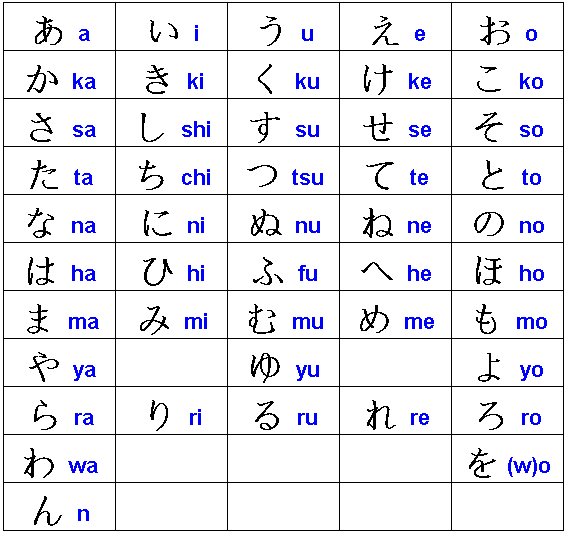
Hiragana 平仮名
Arguably the most commonly used script, but I'm no judge of that. Hiragana is learnt from an early age, and is possibly what little cute Japanese kids learn to read and write first.
According to Wikipedia,
Quote:
Hiragana are used for words for which there are no kanji, including particles such as から kara "from", and suffixes such as さん ~san "Mr., Mrs., Miss, Ms." Hiragana are also used in words for which the kanji form is not known to the writer or readers, or is too formal for the writing purpose. Verb and adjective inflections, as, for example, be-ma-shi-ta (べました) in tabemashita (食べました?, "ate"), are written in hiragana. In this case, part of the root is also written in kanji. Hiragana are also used to give the pronunciation of kanji in a reading aid called furigana. The article Japanese writing system discusses in detail when the various systems of writing are used.
Translation:
1. Hiragana is used when the word does not have a Kanji, this includes particles and suffixes such as 'san' etc.
2. Hiragana is used when it is expected the reader won't know the Kanji. (Names and Kanji not in the Joyo list is an example.)
3. Verb endings etc. are written in Hiragana, but we'll talk about that later.
4. Hiragana is used to show the pronunciation of Kanji, also know as furigana.
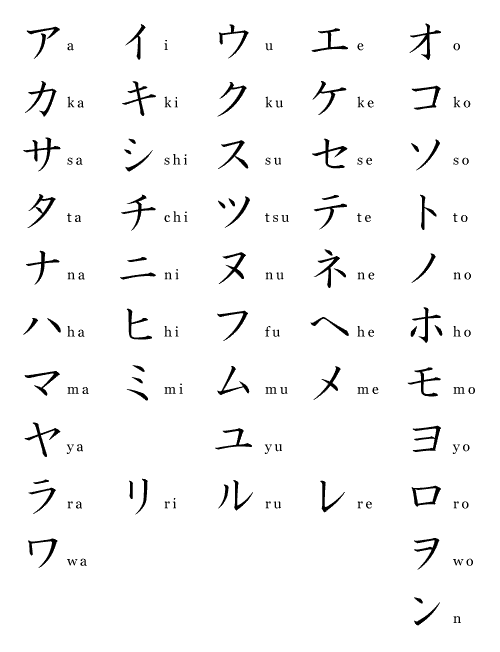
Katakana 片仮名
Katakana is used to represent borrowed words or words from foreign languages that are now used in Japanese. It can also be used to add emphasis to something, acting almost like capitals do in English.
Kanji 漢字
I'm gonna be straight with you guys. Kanji is... INSANELY HARD OH MY GOSH IT WILL KILL YOUR FAMILY AND YOUR DOG WHEN YOU TRY TO LEARN IT AND AND AND...
It won't do any of that. Kanji is not insanely hard. Kanji is a representation system on a whole new level. Kanji is beautiful. Kanji is... god. ninja
I could write about Kanji all day as I find it fascinating, but I'll cut to the chase.
You need to know Kanji. Don't be like, "Haha, yeah, I'm just gonna not learn Kanji 'cause I won't need it. I got hiragana and katakana, man! Anyone can understand me."
I hate to break it to you but knowing hiragana and katakana and being at a high level in Japanese is not how it works. It's fine to not know it when you're beginning. I say start Kanji when you feel ready. But a word of advice when you embark on your quest: Learn words, not Kanji, Luke. That'll become a lot more clear when I start up my Kanji lessons and what not.
I suppose a little bit of history about Kanji won't hurt, right? I'll go into a lot more detail when I begin to introduce Kanji properly.
Kanji first came to Japan via articles written by Chinese people. Obviously, in those days, being neighbours for so long you have to kind of talk sometime and see what kind of tea bag your neighbour uses to Japan and China did a little bit of that. At this time, it is thought that Japanese didn't have a writing system yet. So it's unclear exactly when Japanese people started to use Classical Chinese, if they ever did. It's believe that the first piece of written Japanese was done by Chinese immigrants. After a while, the Japanese started to change and shape the characters into their own so they could understand them better and use them better. Basically, Kanji is key in Japanese and helps make it a beautiful language. smile I will explain more about it when I begin the Kanji lessons.
Right, Morikko, STOP. You've written so much!
Apologies for writing so much. But basically, welcome to Japanese. Major props to you all if you read that. Important stuff now.
I'm a clean freak so all general conversation to the Japanese General Chat please!
If you want to be a student please PM me!
Multilingualism & Gaias rules apply here.
If you have a question, don't be scared to ask.
Quote: