|
|
|
|
|
|
|
|
|
 Posted: Mon Jan 11, 2010 9:04 pm Posted: Mon Jan 11, 2010 9:04 pm
 In the mountains of southern and central Asia, a shadow In the mountains of southern and central Asia, a shadow
walks on the mountain. She is rarely seen or heard, and
is spoken of in local legend. But this ghost is very real,
and is in real danger of disappearing forever. This mysterious
and beautiful creature is known as the snow leopard.
|
 |
|
|
|
|
|
|
|
|
|
|
|
|
|
Posted: Mon Jan 11, 2010 9:05 pm
About the Snow Leopard
Common Names: Snow Leopard, Ounce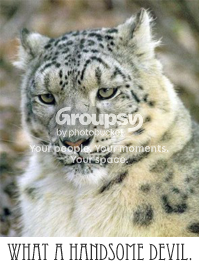
Classification:
Kingdom - Animalia
Phylum - Chordata
Subphylum - Vertebrata
Class - Mammalia
Order - Carnivora
Suborder - Feliformia
Family - Felidae
Subfamily - Pantherinae
Genus - Uncia
Habitat: The snow leopard will make its home at attitudes between 2,000 and 6,000 meters in the mountain steppes. Generally found in coniferous (evergreen) forests, they will also frequent alpine meadows and track prey well below their normal range.
Diet: The snow leopard diet is varied, with prey including wild sheep, wild boar, hares, mice, deer, marmots, and other small mammals. They will track prey for miles, stalking patiently before making the kill.
Behavior: Socially, snow leopards are thought to be much like the tiger, essentially solitary but not totally asocial. They pair only during the mating season, when couples may inhabit a range together. Unlike many other cats, snow leopards do not roar. However, they let out a slight moan when trying to attract a mate, and individuals greet each other with quiet "chuffing" sounds. Snow leopards are primarily nocturnal but are most active in the early morning and late afternoon. Snow leopards are well known for their muscularity and agility with the ability to leap up to fifty feet horizontally and twenty feet vertically.
Conservation status: The main threat to snow leopards is hunting for their fur. Snow leopard pelts are considered a trophy, and poaching for the luxurious pelts continues to be a threat to the existence of this species. Black market pelts are found in central Asian bazaars and a full length coat, consisting of six to ten full body skins, can cost around $60,000. In 1981, the International Snow Leopard Trust was created in Seattle as a non-profit corporation working on conservation of the snow leopard and its mountain habitat.
There are approximately 500 leopards in 150 zoos world-wide. Many zoos are involved in a snow leopard species survival project, a coordinated breeding program among zoos. The goal of this project is to maintain a genetically sound population in hope that these animals may someday be released into the wild. Other methods of conservation include habitat protection, captive breeding, stiff penalties for those harming them, and public education. {Citation}{Citation}
|
|
|
|
|
|
|
|
|
|
|
|
|
|
|
|
|
|
Posted: Mon Jan 11, 2010 9:06 pm
What You Can Do
You might be wondering now, what can I do to help these
amazing, beautiful creatures? Well, that has a very easy answer. There are
lots of things you can do! Many groups are dedicated to the preservation of
the snow leopard, the most well known is the Snow Leopard Trust. Each
dollar donated to this organization funds several programs designed to aid
the species.
Some of those programs include: 
- Long-term studies of snow leopard habitat in Mongolia
- Livestock-free reserves in India
- Community based projects designed to help the humans sharing snow leopard territory to coexist with the predator
- Genetic research
- Trap camera studies
- GIS mapping of snow leopard territory all over Asia
There's many things that you can do that don't cost anything at all! Write to your local government, and let them know how you feel about saving a species. Participate in endangered species movements, such as a "Run for the Zoo". If your local zoo is lucky enough to carry a pair of snow leopards, write a letter with your support for a breeding program. Sometimes just a little deed can have a very great effect.
|
|
|
|
|
|
|
|
|
|
|
|
|
|
|
Posted: Mon Jan 11, 2010 9:21 pm
|
|
|
|
|
|
|
|
|
|
|
|
|
|