|
|
|
|
|
|
|
|
|
 Posted: Tue Nov 10, 2009 7:19 am Posted: Tue Nov 10, 2009 7:19 am
Gwersi Cymraeg
Cymraeg (or Y Gymraeg) is the P-Celtic language spoken in Wales today, and also in a small part of Patagonia. It is a Celtic language, evolved from Brythonic - a language once spoken from the bottom of modern-day Scotland, right across the rest of Britain. Its sister languages are Cornish and Breton, which are more distantly related to the Gaelic languages (Irish, Scottish and Manx). The Welsh lexicon has been heavily influenced by Latin and English over the centuries and so many words will possibly already appear familiar to you. Other than that, Welsh can seem quite scary at first due to its orthography and famous consonant mutations. But don't let that put you off! The Welsh are very proud of their language and culture and will appreciate any effort made to learn or speak it.
Tafodieithoedd - Dialects.
Literary Welsh and spoken Welsh are two very different things.
Literary Welsh is generally what you'll find written on official documents, letters and other public written forms of the language. Nobody actually speaks in this way and to do so would be very strange and unusual. The dialects are also very different and although they vary from town to town (and even between villages) they are generally grouped into either Northern Welsh or Southern Welsh. Personally, being brought up surrounded by both dialects I can understand them both - however I have found myself having to "translate" for some people as they genuinely don't understand each other.
Here is one extreme example of how different they can be:
"You go up the road"
Standard: Rydech yn mynd i fyny'r ffordd.
Northern: Da chi'n mynd fyny'r lôn
Southern: Ych chi'n mynd lan yr hewl.
Southern Welsh is less difficult to learn for those whose first language is English because of pronunciation, as well as the fact that it uses more English words. Although I personally prefer Northern, I'm going to be teaching Southern because of these factors. Also if anybody's interested in learning Cornish or Breton, they are closer to Southern, too, which makes it all a little bit easier.
Is Welsh easy to learn?
Let's put it this way: I personally know someone who is fluent in Welsh after only learning it for two years, and another friend of mine has learnt more Welsh in a month than any Spanish he's learnt over the last few years.
|
 |
|
|
|
|
|
|
|
|
|
|
|
|
|
Posted: Tue Nov 10, 2009 7:22 am
Yr Wyddor
(The Welsh alphabet and pronunciation)
A B C Ch D Dd E F Ff G Ng H I [J]* L Ll M N O P Ph R Rh S T Th U W Y * J is not a native letter to the Welsh alphabet although it is becoming more and more common in the modern language, due to loanwords from English.
Llafariaid {Vowels}.
Long vowels
(These are in monosyllabic words and vowels denoted with a circumflex (^))
A - /ɑː/ - father
E - /e:/ - care
I - /i:/ - free
O - /oː/ - for
U - /i:/ - free
W - /u:/ - food
Y - /i:/ - free
Short vowels
A - /a/ - cat
E - /ɛ/ - end
I - /ɪ/ - if
O - /ɔ/ - long
U - /ɪ/ - i
W - /ʊ/ - book
Y - /ɪ/ - if , /ə/ - better
Diphthongs
[COMING SOON]
Cytseiniaid {Consonants}.
B - /b/ - book
C - /k/ - can
Ch - /x/ - Scottish 'loch'
D - /d/ - dance
Dd - /ð/ - that
F - /v/ - van
Ff - /f/ - fun
G - /g/ - gone
Ng - /ŋ/ - sing
H - /h/ - house
I - /j/ - you
L - /l/ - laugh
Ll - /ɬ/ - quite difficult to describe - put your tongue in the position you
would to make an 'l', except instead of making a noise, blow air out,
which should be going along the sides of your tongue.
M - /m/ - mouth
N - /n/ - never
P - /p/ - poem
Ph - /f/ - fun
R - /r/ - a rolled or trilled 'r' as in Scottish or Spanish.
Rh - /r̥/ - same as /r/ except voicless. Like making an /r/ and /h/ noise simultaneously.
S - /s/ - soon
T - /t/ - town
Th - /θ/ - think
W - /w/ - water
Please note with digraphs even though they are considered as one letter in Welsh, only the first part is capitalised. i.e. December - Rhagfyr, not RHagfyr.
Another digraph which does not appear in the alphabet is si, which is pronounced as /ʃ/ (English 'sh' when followed by a vowel.) For example the Welsh word siop and English word shop are pronounced exactly the same.
|
|
|
|
|
|
|
|
|
|
|
|
|
|
|
|
|
|
Posted: Tue Nov 10, 2009 8:09 am
Treigladau
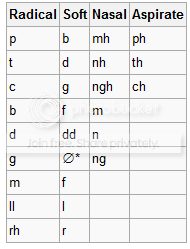
(Initial Consonant Mutation in Welsh) This is something all the Celtic languages have to put up with, so no complaining! XD There are three forms of mutation in Welsh, and here's a table to show you them (borrowed from Wikipedia):
* = the 'g' is dropped completely.
I guess this will make more sense if I give you an exmaple.
chair = cadair.
The chair = y gadair.
My chair = fy nghadair.
Her chair = ei chadair.
Scary, right? Just remember consonant mutation happens in plenty of languages, including English and Japanese! A lot of learners say that mutation isn't a problem for them, and in speech, first and second language Welsh speakers often forget to follow all of the rules anyway. Learners do end up using mutations more, which is a good thing! For a lot of people, the language sounds strange when you forget to, and it can be quite difficult to listen to.
But don't worry about it just yet. I'll go over the different sorts of mutations as they pop up, instead of going over all of the rules in one go! And it's not a problem if you don't understand them or forget to use them - even in college we were still being taught how to use them properly!
|
|
|
|
|
|
|
|
|
|
|
|
|
|
|
Posted: Tue Nov 10, 2009 8:15 am
Gwers Un - Lesson One
Yn y wers hon - In this lesson
The vocab and phrases in this lesson should be quite simple, and I know this looks like a pretty big first lesson too. I just want to introduce the simplest and most basic mutation rule in Welsh. I hope it doesn't seem too daunting. I've put the phrases up just so you can see them and use them if you ever want to. Lesson Two onwards I'll be using more conversation-based stuff and I won't be nagging you about mutations again for a while.
So anyway:
I'm going to show you a few basic greetings.
I'll show you how you ask who someone is, or what their name is.
Lastly I'm going to introduce the first basic rule about mutation that you should know.
There's an exercise on mutation at the end of this lesson if you want to have a go. You can send your answers to me via pm c:
Please let me know if you have any questions or suggestions c:
► Cyfarchion - Greetings
Right! Here are some basic greetings just to get you started.
Time specific:
Bore da – Good morning
P’nawn da – Good afternoon
Noswaith dda – Good evening
Any time of day:
Shwmae – Hi (informal greeting)*
Helô – Hello
► Pwy 'ych chi? Who are you?
Pwy 'ych chi? - Who are you?
Beth yw'ch enw chi? - What's your name?
... dw i I am...
Fy enw i yw… My name is...
There we go. Pretty simple, eh? Here's an example of a conversation, just so you can see it all in order.
Meet Dylan and Rhiannon. They've just met each other in y dafarn (the pub)!
Dylan: Noswaith dda!
Rhiannon: Shwmae!
Dylan: Pwy 'ych chi?
Rhiannon: Rhiannon dw i! Beth yw'ch enw chi?
Dylan: Fy enw i yw Dylan!
(Could this be the beginning of something beautiful? ;D)
► Treiglad - Mutation
(and a bit of basic grammar, too.)
Okay, it’s better for me to start on the mutations sooner rather than later. Luckily for us, there’s only one example of mutation here. Try and see if you can work out what it is before you carry on reading. Take a look at the mutation table in my 3rd post, and then see if you notice anything in any of the phrases that I've given in this lesson. Highlight here to see the answer: It’s a soft mutation! The initial ‘d’ in ‘da’ changed to ‘dd’ in ‘dda’ in the phrase 'Noswaith dda'.
Okay, so why did this change?! Well. Here's the fun bit.
- In Welsh, the adjective almost always follows the noun. So “Bore da” is literally “Morning good”.
- Nouns in Welsh are either masculine or feminine. Some word endings give away the gender of the noun, but it's not always as easy as that. But no worries, it's simple to pick up, and forgetting to mutate is forgiven if you're a learner (and even if you're not!) even though it can be 'uncomfortable' to listen to.
- An adjective following a singular feminine noun is affected by soft mutation.
- This does not happen at all with masculine nouns. So that's one less thing to worry about.
Alright, let's put this into a different context, and a different letter to mutate.
girl: merch
boy: bachgen
little: bach
(a) little girl: merch fach.
(a) little boy: bachgen bach.
Similarly, a singular feminine noun following the definite artile 'y' also mutates softly. (There is no indefinite article in Welsh). Again, this doesn't happen with masculine nouns.
the little girl: y ferch fach.
the little boy: y bachgen bach.
Don't worry! I'm not going to be going over any more scary mutations for a while. That's just to show you one rule, to put them into context, and so you don't get utterly confused if you notice it happening later on.
► Geirfa - Vocab
A quick bit of vocab just for you.
bach - little
bachgen - boy (m.)
beth – what?
bore – morning (m.)
chi – you (formal)
da – good
dw i - I am
eich/'ch... chi - your...
enw – name (m.)
fy... i - my...
merch - girl (f.)
noswaith – evening (f.)
p’nawn – afternoon (m.)
pwy – who?
y - the
yw – is
Allech chi gyfieithu'r rhain? Can you translate these? pm your answers to me whenever c:
A little girl.
The little girl.
The good girl.
A good morning.
The good evening.
A good boy. Secret competition! Oh look, you found me. Well since you somehow managed to find this (you clever git!), you might as well prove you're super-duper clever. Apart from what I've already pointed out, can you find another example of soft mutation in this lesson? You can win the rather handsome sum of 1k if you see it. c: PM me your answer, but shh! Don't tell anyone about my secret comps. I'm not very rich!.
|
|
|
|
|
|
|
|
|
|
|
|
|
|
|
|
|
|
Posted: Tue Nov 10, 2009 1:07 pm
is the r rolled like a spanish one by putting your tongue up towards the the gum line behind the top front teeth, or like a french one with your uvula?
|
|
|
|
|
|
|
|
|
|
|
|
|
|
|
Posted: Tue Nov 10, 2009 3:44 pm
It's definitely not a French 'r'. From what I've heard, it's the same as a Spanish 'r'. Hope that helps =)
Just to be confusing - Although in one particular Northern dialect, it is the same as a French 'r' c: but that's pretty rare to hear.
|
|
|
|
|
|
|
|
|
|
|
|
|
|
|
|
|
|
Posted: Tue Nov 10, 2009 7:02 pm
Thank you so much for doing this biggrin I doubt I'll be learning Welsh, but I love looking at it and hearing about it since I know literally nothing of it. Great job, looks good so far.
|
|
|
|
|
|
|
|
|
|
|
|
|
|
|
Posted: Thu Nov 12, 2009 6:41 am
I'm definitely up for this. :P
Sign me up!
|
|
|
|
|
|
|
|
|
|
|
|
|
|
|
|
|
|
Posted: Thu Nov 12, 2009 1:40 pm
Daionii It's definitely not a French 'r'. From what I've heard, it's the same as a Spanish 'r'. Hope that helps =) Just to be confusing - Although in one particular Northern dialect, it is the same as a French 'r' c: but that's pretty rare to hear. excellent! that's the one i have no problem saying. although, that lateral fricative(that l with the funny thing in the middle of it) is giving me a lot of trouble.
|
|
|
|
|
|
|
|
|
|
|
|
|
|
|
Posted: Sat Dec 05, 2009 5:45 pm
Mae hyn yn, wir, un o'r gwersi gorau Cymraeg dwi wedi gweld ar lein. Mae'n neis, hefyd, i ddarganfod rhywyn arall sydd yn siarad Cymraeg, a sydd yn hoffi'r iaeth digon i wneud rhywbeth fel hyn.
|
|
|
|
|
|
|
|
|
|
|
|
|
|
|
|
|
|
Posted: Mon Dec 14, 2009 1:43 am
|
|
|
|
|
|
|
|
|
|
Posted: Mon Dec 14, 2009 8:52 am
Yay! I have wanted to leanr this language for the past year! Thank you for posting.
It's funny, my bf and I were talking about where we'd like to go, but haven't been to yet. We both said Wales. XD
|
|
|
|
|
|
|
|
|
|
|
|
|
|
|
|
Henneth Annun Vice Captain
|
Posted: Mon Dec 14, 2009 4:49 pm
*wants to learn, will be referring back here for lessons*
ninja
|
|
|
|
|
|
|
|
|
|
|
|
|
|
|
Posted: Thu Dec 17, 2009 1:41 pm
Gwers Dau - Lesson Two
Yn y wers hon - In this lesson
I'll show you how to ask how someone is, and how to reply.
How to ask what someone's job is, or what they do, and how to reply.
A bit o' grammar
An exercise at the end you can have a go at, if you wish. c:
Please let me know if you have any questions or suggestions c:
► Sut 'ych chi? - How are you?
So last lesson we learnt how to ask who someone is, and to introduce ourselves. I guess the next step would be two ask how someone is, right?
Sut 'ych chi? - How are you?
Dw i'n... I am...
iawn fine
da iawn very good
grêt great
...diolch! ...thanks!
a chi? and you?
► But maybe I'm not okay?!
If there's one thing that annoys me, its when language lessons only teach you how to say "I'm fine, thanks!".
We're not always fine, are we? So here are a couple more ways to say how you really feel wink
Ddim yn ddrwg - Not bad (not particularly negative but oh well.)
Dw i wedi bod yn well - I've been better
Dw i wedi blino - I'm tired ( lit. "I have tired" )
Dw i'n drist - I'm sad
Dw i'n flin - I'm angry
► Beth 'ych chi'n gwneud? - What do you do?
Okay, so that got a bit depressing. How about we change the subject? Let's talk about what we do!
Beth 'ych chi'n gwneud? - What do you do?
Beth yw'ch swydd chi? - What's your job?
Dw i dal yn yr ysgol - I'm still at school
Myfyriwr dw i - I'm a student
Dw i'n gweithio rhan-amser - I work part-time
Athro dw i - I'm a teacher (masc.)
Athrawes dw i - I'm a teacher (fem.)
Llyfrgellydd dw i - I'm a librarian
Gweinydd dw i - I'm a waiter
Gweinyddes dw i - I'm a waitress
Ble 'ych chi'n gweithio? - Where do you work?
Dw i'n gweithio mewn... - I work in a...
siop - shop
garej - garage
tafarn - pub
caffi - café
bwyty - restaurant
archfarchnad - supermarket
(Let me know if you want to know how to say your job!)
► 'Chydig o ramadeg - A bit o' grammar
I don't want this to be just some kind of phrasebook so here's all the fun, juicy, grammary bits for you.
Order of 'dw i'
You may have noticed that sometimes 'dw i' appears at the beginning of the sentence, and sometimes at the end. This is because in Welsh, word order changes for emphasis. Generally, sentences starting with dw i are neutral, and the stress or emphasis isn't anywhere in particular.
So generally, word order in Welsh is Verb-Subject-Object (especially in the literary language).
(This isn't exactly 'official' yet, but changing word order is dying out a bit in the spoken language. Words are just stressed as they are in English rather than being swapped around.)
"Iawn"
"Iawn" is also another fun word. Just so you know:
After an adjective, 'iawn' means 'very'. Whereas on its own, it means 'fine' or 'okay'.
(To save you scrolling up):
Dw i'n da iawn - I'm very good.
Dw i'n iawn - I'm fine.
yr ysgol
In Welsh, a lot of the time we stick the definite article "y/yr" before some nouns, where they don't appear in English. It appears before the names of some countries (Yr Eidal - Italy), places of eduction (yr ysgol - school) and names of languages (Y Gymraeg - Welsh). - Although in these cases, we drop the definite article when in English there'd be an indefinite article.
E.g. "In school" - "yn yr ysgol"
"In a school" - "mewn ysgol"
mewn/yn
Well I'm sure that confused you. "Yn" means a whole load of different things, so let's just keep it simple for now.
Both "mewn" and "yn" mean "in". However:
To mean "in (the)" or "in (a place)" we use "yn".
When we mean "in (a)", we use "mewn".
Possibly this might help:
In a cupboard in school:
Mewn cwpwrdd yn yr ysgol.
► Geirfa - Vocab
Some more vocab bits.
a - and
amser - time
athro/athrawes - teacher (m./f.)
beth - what
ble - where?
blino - to tire
blin - angry
bod - to be
chi - you (formal. pl.)
da - good
dal - still
drwg - bad
garej - garage
gweithio - to work
gwell - better
gwneud - to do
iawn - fine/very
llyfrgellydd - librarian
mewn - in (a)
myfyriwr - student
rhan - part
siop - shop
sut - how
swydd - job
trist - sad
Allech chi gyfieithu'r rhain? Can you translate these? pm your answers to me whenever c:
Dylan: Noswaith dda! Sut 'ych chi, Rhiannon?
Rhiannon: Shwmai Dylan! Dw i'n iawn diolch! A chi?
Dylan: Dw i wedi blino!
Rhiannon: What do you do, Dylan?
Dylan: I'm a student. I work part time.
Rhiannon: Where do you work?
Dylan: I work in a supermarket. And you?
Rhiannon: I work in a café. I'm a waitress.
|
|
|
|
|
|
|
|
|
|
|
|
|
|
|
|
|
|
Posted: Sun Dec 20, 2009 4:10 pm
Shwmae, fy enw i yw Dratini. Dw i merch. Dw i dal yn yr ysgol. Myfyriwr dw i.
Croeso = welcome
Heddlu = Police
Ygsol = School
You see, my Welsh isn't perfect, but I once went on holiday in West Wales. Just a test smile
(I used to go on this weird website in Welsh when I was a kid, it was called Bowns. What does that mean?)
|
|
|
|
|
|
|
|
|
|
|
|
|
|
|
|
|
|