|
|
|
|
|
|
|
|
|
 Posted: Sun Feb 22, 2009 12:03 pm Posted: Sun Feb 22, 2009 12:03 pm
Devices & Equipment
From blaster rifles to anti-gravity belts, teleportation rings, and battlesuits, heroes and villains develop all manner of gadgets. Villains are forever coming up with doomsday machines and fiendish deathtraps while heroes use devices to aid them in their fight for justice. This thread looks at various sorts of devices and equipment. It also describes vehicles, headquarters, and constructs, ranging from zombie minions to giant robots.
Devices
A device is an item that provides a particular power or powers (see the container Power structure at the end of the powers thread). If the character doesn’t have the device, he doesn’t have access to those powers.
While devices are typically creations of advanced science, they don’t have to be. Many heroes and villains have magical devices such as enchanted weapons and armor, magical talismans, wands and staves of power, and so forth. Some devices are products of alien technology so advanced they might as well be magical, or focuses of cosmic power beyond the understanding of both magic and science. All devices work the same way in game terms, regardless of their origin or descriptors. Just like other powers, devices cost power points. Characters who want to have and use a device on a regular basis have to pay power points to have it, just like having any other power. The device becomes a part of the character’s abilities. If the device is lost, stolen, or destroyed, the character can replace it (3 days out of game for easy to loose, 1 day out of game for hard to loose, or a scene whichever is longer, this is assuming the character doesn't retrieve the lost item some how if it was stolen, the person who stole it also looses it after this time in some way), given time, since the device is considered a permanent part of the character. Only a re-allocation of the character’s power points will change this.
In other cases, characters may make temporary use of a device. Most devices are usable by anyone able to operate them, in which case characters may loan devices to each other, or may pick up and use someone else’s device (or even steal a device away from someone in order to use it against them). The key concept here is the use of the device is temporary, something that happens during a single encounter or, at most, a few scenes. If the character wants to continue using the device beyond that, he must pay power points to make the device part of his regular abilities. Otherwise the device is lost, reclaimed by its owner, runs out of power, breaks down, or whatever, and is therefore no longer accessible. Characters with the Inventor and Artificer feats can also create temporary devices for use in a scene or longer.
Characters to spend a luck point to make temporary use of a device that doesn’t belong to them. This helps to limit the loaning and temporary use of devices.
---Battlesuits
A common staple of comic books is the battlesuit, also known as powerarmor.
It is an advanced suit of technological armor, giving the wearer powers. Battlesuits commonly grant the following powers:
• Protection: This is the foundation power for a battlesuit. Whether it is armor plating, metallic mesh, flexible ballistic material, or some combination of these and other cutting-edge technology, a battlesuit protects its wearer from damage. Some battlesuits provide a Force Field, either in place of or in addition to their Protection.
• Immunity: A part of the protection a battlesuit offers is a sealed environment, offering Immunity to various conditions. Many battlesuits provide Immunity (life support). Some might have more extensive or specialized forms of Immunity.
• Attacks: Battlesuits are typically equipped with some kind of weapon or weapons, based around various attack powers, particularly Blast. A battlesuit with an array of weapons may have a primary attack powers and several others as Alternate Powers.
• Super-Strength: A battlesuit might have servomotors or other mechanisms to magnify the wearer’s Strength. This is typically done with the Strike and Super-Strength powers, allowing a normal-Strength wearer to strike for increased damage and lift tremendous weights. A battlesuit may also simply provide Enhanced Strength, or some combination of the two options.
• Movement: After defense and offense, battlesuits typically allow the wearer to get around, whether it’s hydraulic-assisted Leaping, bootjets or anti-gravity repulsion for Flight, turbines for Swimming, or some other movement effect.
• Sensors: Finally, battlesuits often come equipped with a suite of sensors providing Super-Senses. Blindsight (radar or sonar), darkvision, direction sense (possibly from a global positioning system), infrared vision, radio, time sense (from a chronometer), and ultra-hearing are all common battlesuit sensors.
---Costumes
In addition to being stylish, costumes may be made of unusual materials much tougher than they appear (courtesy of super-science or magic), allowing them to provide a Protection effect. Costumes may have other properties and can even be the source of a hero’s powers, such as in the case of battlesuits (above).
Comic book costumes are usually immune to their wearer’s powers. They don’t burn, tear, or otherwise suffer damage when the wearer changes size or shape, bursts into flames, freezes, and so forth. This is entirely up to the player however.
---Enhanced Equipment
Some devices are otherwise normal equipment with special properties. Magical items, normal equipment imbued with magical properties, are examples. Magical weapons may have greater damage bonuses or grant attack roll bonuses while magical armor has no armor check penalties and provides greater protection. Such enchantments move archaic weapons and armor from the realm of mundane equipment to devices. The same is true of super-alloys, bulletproof cloth, and other wonders of super-science.
Quote: Devices Vs Equipment: Under The HoodThere can sometimes be a fine line between devices and equipment. The primary differences are devices are part of the character’s abilities, they grant effects beyond the capabilities of normal equipment, and they’re only ever lost or taken away temporarily. If an item is integral to the character’s concept or abilities, it’s probably a device. Equipment, on the other hand, is limited to fairly “mundane” things, can be taken away or even destroyed with impunity, and merely supplements the character’s traits (Note that equipment may not set a DC or give a save bonus higher than +5). Equipment doesn’t grant “powers” per se (although equipment does provide certain effects similar to powers). Here are some examples of devices vs. equipment:
• A high-tech suit of powered armor. Device.
• A utility belt full of items like grapple lines, handcuffs, pepper spray, and throwing weapons. Equipment.
• A sword or other mundane melee weapon. Equipment.
• A magical weapon able to slice through tank armor. Device.
• The character can summon weapons out of thin air. These weapons never run out of ammo and vanish when taken away from the character, who can summon another weapon as a free action. Neither. This is just a descriptor for various attack effect powers. Since the “weapons” can’t really be taken away, they’re not Devices or Equipment.
• The character wears a cape allowing him to glide on air currents. Device.
• The character has a commlink installed in her costume. Equipment.
• The character has an implant allowing him to “hear” radio waves. Neither. Although it has a technological descriptor, the implant can’t be removed without surgery, so it isn’t a Device or Equipment. The same is true of devices like bionic claws or other implants.
Ultimately, it is up to a BM whether or not a particular item is considered a device or equipment, depending on the power of the object and the ranks invested.
Weapons
Weapons are common devices, ranging from super-powered versions of ordinary weapons like swords, bows, or guns to more exotic weapons like magic wands or alien power rings. A weapon device usually has one or more attack powers but may have virtually any power the player wants to include. Weapon devices often have several different attacks as Alternate Powers. One example is a set of magic rings, each with its own power, but only usable one at a time.
Other Devices
The full range of devices characters can create and use is limited solely by your imagination. Essentially any item with a power is considered a device. Players may well come up with additional devices beyond those described here. Use the guidelines in this thread to handle any new devices and their capabilities.
Plot Devices
A plot device is an item or even character whose function is important to the story, but is not a part of a character’s regular abilities. Therefore the actual power point cost or sometimes even game statistics of a plot device are irrelevant, so long as the device fulfills its role in the story. Technically, nearly any character or device characters don’t directly interact with can be seen as a plot device, freeing a mod running an event up from having to assign game stats to every single thing in the game world.
For example, part of an adventure is planned to take place on board a vast alien city-ship. While a mod running an event may want to know things like the Toughness of the city-ship’s walls or the game stats of the alien soldiers the heroes may fight, it’s not important to assign game statistics to the city-ship’s engines or it’s planet-busting main gun. They’re plot devices. It’s also not necessary to determine how much the ship costs in power points, unless the player characters are going to use it as their regular vehicle or base of operations. It’s sufficient to know the city-ship can get where it needs to go and its main gun will shatter any planet it’s fired at unless the characters manage to stop it in time. Likewise, consider a cosmic device able to reshape reality at will. This is far beyond any of the powers, so it’s best to simply treat it as a plot device: the wielder of the object can make anything happen, as called for in the adventure.
Plot devices are best kept in the hands of a neutral mod running an event who's not taking part in it, since unlimited power in the hands of the players can quickly spoil everyone’s fun.
If the characters aren’t wise enough to reject absolute power, a mod can come up with any number of reasons why a plot device no longer works once the characters get their hands on it. It may run out of power, be attuned only to particular users, or perhaps cosmic beings reclaim it. It’s fine to allow a character to use a plot device occasionally, such as the character who takes the Cosmic Crown from a villain and uses it to undo all the damage the villain has done before casting the Crown into the heart of the sun (or something similar). But long-term use (and abuse) of plot devices can ruin a game, and mod running the event would be wise to have the Cosmic Crown disappear or have powerful entities reclaim it before characters to abuse its power.
Inventing
Characters with the necessary Knowledge and Craft skills and the Inventor feat (see feats) can create inventions, temporary devices. To create an invention, the inventor defines its traits and its total cost in power points. This cost is used for the necessary skill checks, and determines the time required to create the invention. Inventions are subject to the same power level limits as other powers.
You may only have a number of inventions equal to your PL "available" on your character sheet. You put them up like one would put up minions within an extra profile posts. So at PL 3 for example, you could have a pool of 3 powers to pick from, at the beginning of combat you could spend a luck point to choose one to use.
---Design Check
First, the inventor must design the invention. This is a Knowledge (technology) skill check. The DC is 10 + the invention’s power point cost. It requires an hour’s work per power point of the invention’s cost. The character can take 10 or 20 on the check. In the latter case, the design process takes 20 times longer (20 hours per power point). You can halve the design time by taking a –5 on the Knowledge check.
Design Check = DC 10 + invention’s point cost If the check is successful, you have a design for the invention. If the check fails, the design is flawed and you must start over. If the check fails by 10 or more, the character is not aware of the design flaw; the design seems correct, but the invention won’t function (or at least won’t function properly) when it’s used.
---Construction Check
Once the design is in-hand, the character can construct the invention. This requires four hours work per power point of the invention’s cost, so an invention costing 10 points takes 40 hours (about a week’s work normally, or working two days straight without rest (aka only roleplaying construction for those 2 days or waiting a week out of game) to construct. When the construction time is complete, make a Craft skill check, using the Craft specialty appropriate to the invention (generally chemical, electronic, or mechanical). The DC is 10 + the invention’s power point cost. You can’t take 20 on this check, but you can take 10. You can halve the construction time by taking a –5 on the Craft check.
...Construction Check = DC 10 + invention’s point cost
Success means the invention is complete and functional. Failure means the invention doesn’t work. Failure by 10 or more may result in a mishap, at a mod’s discretion.
Example: Daedalus needs to whip up a mind-shielding device to confront Lady Lunar, who has seized control of his teammates in the Freedom League, and plans to use them as her army to conquer Farside City. Daedalus’ player considers and decides 10 ranks of the Mind Shield power (see powers) will suffice. It has a cost of 10 power points, so the Knowledge (technology) check is DC 20 (10 + 10) and takes 10 hours.
Daedalus’ skill bonus is +22, so he succeeds automatically. Craft (electronics) is the appropriate skill for the construction check, also DC 20 (10 + the device’s cost).
It takes 40 hours. Daedalus’ skill bonus is +20, so against he succeeds automatically. However, that’s 50 hours total to build the mind-shield, and Lady Lunar plans to launch her attack in just a few hours. Daedalus needs the new device right now, so he’s going to need to speed things up....
---Using The Invention
Once the invention is complete, it is good for use in one encounter, after which it breaks down or runs out of power. If the character wishes to use the invention again, there are two options. The first is to spend the necessary power points to acquire the Device power and make the invention a part of the character’s regular traits; in this case, the new device can be used like any other. The other option is to spend a luck point to get another one-encounter use out of the invention. Each use costs an additional luck point, but doesn’t require any further skill checks.
---Jury-Rigging Devices
An inventor can choose to spend a luck point to jury-rig a device; ideal for when a particular device is needed right now. When jury-rigging a device, skip the design check and reduce the time of the construction check to one round per power point of the device’s cost, but increases the DC of the Craft check by +5. The inventor makes the Craft check and, if successful, has use of the device for one encounter before it burns out, falls apart, blows up, or otherwise fails. You can’t take 10 or take 20 when jury-rigging an invention, nor can you speed up the process any further by taking a skill check penalty. You can jury-rig an invention again by spending another luck point.
Example: Needing to get the mind shield device ready right away, Daedalus’ player decides to spend a luck point to jury-rig it. He skips the design step altogether and reduces construction time to 10 rounds (a minute). The DC of the construction check increases to 25, but still well within Daedalus’ abilities. His player rolls a 28 on the check and, a minute later, the immortal inventor has a makeshift mind-shield he hopes will protect against Lady Lunar’s power long enough for him to try and free the rest of the League from her influence.
--Mishaps
Failure by 10 or more, or a natural roll of 1, on any required inventing skill check may result in some unexpected side-effect or mishap. Exactly what depends heavily on the invention (aka notify a mod). Inventing mishaps can become a source of adventure ideas and put the characters in some difficult situations.
Magical Rituals
Characters with the Ritualist feat (see feats) and the Knowledge (arcane lore) skill can perform magical rituals. They are similar to inventions: one-time powers requiring some time and effort to set up.
For rituals, substitute the Knowledge (arcane lore) skill for both the design and construction checks. The design portion of the ritual takes 4 hours per power point of the ritual’s cost (pouring over ancient scrolls and grimoires, drawing diagrams, casting horoscopes, meditating, and so forth). The performance of the actual ritual takes 10 minutes per point of the ritual’s cost. So a ritual costing 10 power points takes 40 hours to research and 100 minutes to perform. As with inventing, the ritual is good for one encounter. Failing the research check means the ritual isn’t usable and failure by 10 or more results in a mishap.
“Jury-rigging” a magical ritual has the same effects as mentioned previously. This allows the ritualist to skip the design check and perform the ritual in a number of rounds equal to its cost. A Knowledge (arcane lore) check against a DC equal of (15 + the ritual’s cost) is needed to successfully perform the ritual.
---Magical Inventions
For magical inventions, use the normal inventing rules, but use the Knowledge (arcane lore) skill for the design check and the appropriate Craft skill (probably artistic or structural) for the construction check.
|
 |
|
|
|
|
|
|
|
|
|
|
|
|
|
Posted: Sun Feb 22, 2009 12:23 pm
Equipment
In addition to their amazing devices, characters often make use of various mundane equipment—ordinary things found in the real world—ranging from a simple set of tools to cell phones, laptop computers, and even common appliances. These items are called equipment to differentiate them from devices. Tools allow a character to use a particular skill properly (see Tools).
---Equipment Cost
Equipment is acquired with points from the Equipment feat (see feats). Each piece of equipment has a cost in points. The character pays the item’s cost out of the points from the Equipment feat and it becomes part of the character’s regular equipment.
---Equipment Effects And Features
An item’s equipment cost is based on its effects and features. Effects cost the same as corresponding powers (see powers thread), so a ranged weapon costs the same as the damage + range power (which inflicts damage at range).
Features are particular minor things equipment can do, similar to feats. Generally, each feature costs 1 equipment point, although some features are more expensive (or actually involve multiple features). Various equipment features are described in this thread.
Masterwork Equipment
Some items are especially well-made, custom-built, or otherwise superior to normal equipment. These masterwork items grant a bonus greater than a normal item, usually a +1 with an attack roll or +2 with a check made with the item. Masterwork quality is considered an additional feature for the item of equipment.
Concealed Items
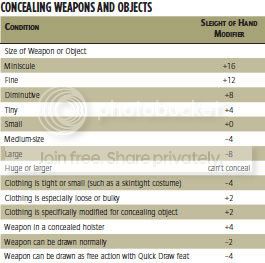
Characters may attempt to conceal items on their person. It’s assumed the character is wearing clothing offering places to conceal things. To conceal a weapon or other object, make a Sleight of Hand check. If you conceal an object before heading out into public you can usually take 10 unless you are rushed, trying to conceal it when others might see, or under other unusual constraints. Sleight of Hand can be used untrained in this instance, but you must take 10 to do so.
---Size And Concealment
The object’s size affects the check result, as shown on the Concealing Weapons and Objects Table. The type of holster used or clothing worn, and any attempt to make a weapon easier to draw, can also affect the check.
Noticing Concealed Objects
Detecting a concealed weapon or other object requires a Notice check. The DC varies: If the target made a roll when concealing an object, the DC of the check is the target’s Sleight of Hand check total. An observer attempting to Notice a concealed object receives a –1 penalty for every 10 feet distance to the target, and a –5 penalty if distracted.
Patting someone down for a concealed object requires a similar check. However, the skill employed is Search, and the searcher gets a +4 bonus for the hands-on act of frisking the target. Searchers typically take 10 or take 20 for pat-down searches. Some equipment may also offer bonuses under certain circumstances (a metal detector offers a bonus to Search checks to find metal objects, for example).
Noticing Concealed Armor
Concealable armor can be worn under clothing if the wearer wants it to go unnoticed. Don’t use the modifiers from the Concealing Weapons and Objects Table when wearing concealable armor. Instead, anyone attempting to notice the armor must make a Notice check (DC 20).
Damaging Equipment
Most equipment can be damaged like other objects (see Damaging Objects), based on its Toughness. Equipment suffering damage loses some effectiveness. The item loses 1 feature or suffers a –1 penalty on checks involving it each time it is damaged. These penalties are eliminated once the item is repaired.
Repairing And Replacing Equipment
Repairing an item requires a Craft check. You can also affect jury-rigged repairs to temporarily restore the item to normal (see Craft for details).
Replacing damaged or destroyed equipment requires only time. It’s easy to replace a lost item when the store is right around the corner, harder when it’s the middle of the night or you’re out in the middle of nowhere.
Players to spend a luck point to have a replacement for a piece of equipment as an on-hand item then and there requiring no repair time.
The Limits Of Equipment
While equipment is useful it does have its limits, particularly when compared to powers or devices. Equipment is less expensive—it’s cheaper to have a handgun than a Blast power or even a super-science blaster weapon—but equipment is also more limited. Keep the following limitations of equipment in mind.
---Technological Limits
Equipment includes only items and technology commonly available in the a modern setting. As a rule of thumb assume equipment only includes things from the real world, not battlesuits, anti-gravity devices, shrink rays, and so forth. Those are all Devices.
---Bonus Stacking
Equipment bonuses are limited compared to the bonuses granted by other effects. Generally, they do not stack with each other or other types of bonuses, only the highest bonus applies. Thus a character with a high Protection bonus doesn’t get much, if any, advantage from wearing a bulletproof vest. The only exception to this is weapons that add to the character’s Strength bonus, and there are limits on them as well (see Melee Weapons).
---No Extra Effort
Unlike devices, you do not have the choice of suffering the strain of extra effort when improving equipment, the equipment always takes the strain. You can push your equipment to the limit (eventually causing it to fail) but trying real hard on your part isn’t going to make your car go faster or your gun more effective. You also can’t use extra effort to perform power stunts with equipment. Instead, you must spend a luck point to do so.
---Damage And Loss
Equipment is vulnerable to damage, malfunctions, and loss, more so than devices. One use of a power like Disintegration or Transform can turn a character’s equipment to dust (aka if either hits no matter what rank the object is destroyed and takes one week out of game to replace), for example, and equipment tends to be delicate when it comes to super-powered attacks. Equipment may be lost or taken away from the character with impunity.
|
|
|
|
|
|
|
|
|
|
|
|
|
|
|
|
|
|
Posted: Sun Feb 22, 2009 12:39 pm
General Equipment
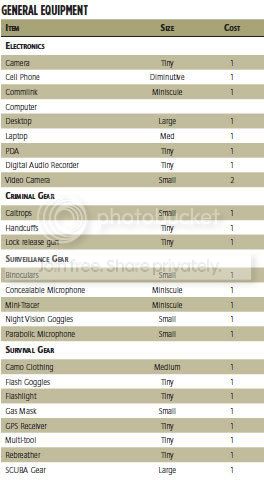
Equipment is described by a number of statistics, as shown on the General Equipment Table.
---Size
The size of a piece of equipment helps to determine how easy it is to conceal, and also indicates whether using the object requires one hand or two. In general, a character needs only one hand to use any objects of his size category or smaller.
---Equipment Cost
This is the number of equipment points the item costs (see the Equipment feat).
---Electronics
Computers and electronics are common in the modern world. These devices are fairly delicate (Toughness 5 or less) and vulnerable to electricity, radiation, and powerful magnetic fields, which can short them out entirely.
• Camera: A digital or film camera for taking still images. Most cameras have a capacity of 24 or 36 images and you can use one in conjunction with the Craft (visual art) skill.
• Cell Phone: A small handheld or headset unit for communication. The battery lasts for approximately 24 hours before it needs to be recharged.
• Commlink: A tiny button-sized device for radio communication with an effective range of about a mile (longer if patched into the cellular network or a similar network). Many hero (and villain) teams use commlinks.
• Computer: A computer includes keyboard, mouse, monitor, CD drive, printer, modem, and other standard peripherals, and may include things like a scanner. You need a computer to make Computers skill checks and do things like searching the Internet (to take 20 on a Knowledge skill check). Masterwork computers represent upgrade packages with faster processors, better software, and so forth.
• Digital Audio Recorder: These tiny recorders (about the size of a deck of playing cards) can record up to eight hours of audio and can be connected to a computer to download the digital recording.
Digital audio recorders don’t have extremely sensitive microphones; they only pick up sounds within 10 feet.
• PDA: Personal digital assistants or “palmtops” are handy tools for storing data. They can be linked to a notebook or desktop computer to move files back and forth, but can’t be used for Computers or Knowledge checks.
• Video Camera: A hand-held camera that records video and audio on tape or digitally, with a capacity of about 6 hours of footage.
---Criminal Gear
This equipment is most often used by criminals or to catch criminals.
• Caltrops: Caltrops are four-pronged metal spikes designed so one prong points up when the caltrop rests on a surface. You can scatter caltrops on the ground to injure opponents, or at least slow them down. One bag of twenty-five caltrops covers up to a 5-ft.-by-5 ft. area. Each time someone moves through an area containing caltrops at any rate greater than half speed, or each round someone spends fighting in such an area, the caltrops make an attack roll (attack bonus +0). If hit, the character must make a Toughness saving throw (DC 15). Any injury forces the character to move at half speed on foot until the damage is eliminated.
• Handcuffs: Handcuffs are restraints designed to lock two limbs— normally the wrists—of a prisoner together. They fit any Medium or Small humanoid. Handcuffs can only be placed on a pinned, helpless, or unresisting target. Steel cuffs have Toughness 10 and require a Disable Device check (DC 25) or Escape Artist check (DC 35) to remove without the key.
• Lock release gun: This small, pistol-like device automatically disables cheap and average mechanical locks operated by standard keys (no Disable Device check necessary). It does not affect other locks.
---Surveillance Gear
Characters often use surveillance gear to keep tabs on criminals and their activities.
• Binoculars: Standard binoculars reduce the range penalty for visual Notice checks to –1 for every 50 feet (instead of –1 for every 10 feet). Using binoculars for Notice checks takes five times as long as making the check unaided.
• Concealable Microphone: A tiny receiver usable as a listening device. It has a broadcast range of about a mile. It requires a Search check against the results of the Stealth or Sleight of Hand check used to conceal the microphone to find it (assume the hiding character took 20 on the check under most circumstances).
• Mini-Tracer: A tiny radio transmitter with an adhesive backing. It requires a successful attack roll to plant a tracer on a target (or a Sleight of Hand check to plant it without the target’s knowledge). Noticing the tracer is a DC 20 Notice check (or the results of the character’s Sleight of Hand check, whichever is higher). The tracer has a transmission range of about 2 miles.
• Night Vision Goggles: Night vision goggles use passive light gathering to improve vision in near-dark conditions. They grant the user darkvision—but because of the restricted field of view and lack of depth perception these goggles provide, they impose a –4 penalty on all Notice and Search checks made while wearing them. Night vision goggles must have at least a little light to operate. A cloudy night provides sufficient ambient light, but a pitch-black cave or a sealed room doesn’t. For situations of total darkness, the goggles come with an infrared illuminator that, when switched on, operates like a flashlight visible only to the wearer (or anyone else with IR vision).
• Parabolic Microphone: This apparatus has a gun-like microphone with an attached set of headphones. A parabolic mike reduces the range penalty for Notice checks to –1 for every 50 feet (instead of –1 for every 10 feet). Using a parabolic microphone for Notice checks takes five times as long as making the check unaided.
---Survival Gear
• Camo Clothing: Clothing in the right camouflage pattern for the environment grants a +5 bonus on Stealth checks in that environment. Patterns include foliage, desert, urban, and arctic.
• Flash Goggles: These tinted eye-coverings provide protection against blinding light, granting a +5 save bonus against visual Dazzle attacks involving bright light.
• Flashlight: Flashlights negate penalties for darkness within their illuminated areas. The standard flashlight projects a beam 30 feet long and 15 feet across at its end.
• Fire Extinguisher: This portable apparatus uses a chemical spray to extinguish small fires. The typical fire extinguisher ejects enough extinguishing chemicals to put out a fire in a 10-by-10-foot area as a move action. It contains enough material for two such uses.
• Gas Mask: This apparatus covers the face and connects to a chemical air filter canister to protect the lungs and eyes from toxic gases. It provides total immunity to eye and lung irritants. The filter canister lasts for 12 hours of use. Changing the filter is a move action.
• GPS Receiver: Global positioning system receivers use signals from GPS satellites to determine the receiver’s location to within a few dozen feet. A GPS receiver grants its user a +5 equipment bonus on Survival checks to navigate, but because the receiver must be able to pick up satellite signals, it only works outdoors.
• Multi-tool: This device contains several different screwdrivers, a knife blade or two, can opener, bottle opener, file, short ruler, scissors, tweezers, and wire cutters. The whole thing unfolds into a handy pair of pliers. A multi-tool can lessen the penalty for making Craft (mechanical), Craft (electronic), or Craft (structural) checks without appropriate tools to –2 instead of the normal –4.
• Rebreather: A small cylinder that fits over the mouth and provides two minutes (20 rounds) of oxygen, during which the character does not need to make suffocation checks.
• SCUBA Gear: A back-mounted oxygen cylinder and facemask, used for diving. SCUBA (Self-Contained Underwater Breathing Apparatus) gear provides two hours of oxygen, and characters using it do not need to make checks for suffocation unless the gear is damaged or disabled.
Tools
Various skills require tools. Disable Device requires lockpicking and electronics tools, for example, while Medicine requires a first aid or medical kit. Characters attempting a task without the proper tools have a –4 penalty on their skill check.
Masterwork tools cost 1 equipment point and provide a +2 bonus on skill checks using them. In all other ways, tools are like ordinary equipment.
Utility Belt
A common piece of equipment for Costumed Adventurers and espionage agents is the utility belt (or bag, pouch, backpack, etc.): a collection of useful tools and equipment in a compact carrying case. A utility belt is an array of Alternate Powers (see page 10 cool bought as equipment (and with all the usual limitations of equipment). Some characters may have an array of devices instead, allowing for more unusual effects than run-of-the-mill equipment.
Note that equipment with a cost of 1 equipment point doesn’t need to be acquired as an Alternate Power feat, since there’s no change in cost (an Alternate Power must cost at least 1 point).
By spending luck points you can temporarily add an Alternate Power feat to your utility belt, for those one-time pieces of equipment you may need in a pinch.
---Sample Utility Belt
Feel free to modify this example (adding or omitting items, for example) to create your own customized utility belts.
• Bolos: 1 point.
• Boomerangs: 1 point.
• Explosives: Equivalent to dynamite. 15 points.
• Cutting Torch: Blast 1, Drain Toughness 1. 1 point.
• Pepper Spray: 1 point.
• Power Knuckles: Strike 4 (Mighty). 1 point.
• Sleep Gas Pellets: 1 point.
• Smoke Pellets: 1 point.
• Stun Pellets: 1 point.
• Tear Gas Pellets: see weapons, lower rank to 3. 1 point.
• Throwing Blades: Blast 2. 1 point.
The explosives, as the most expensive effect, have their full cost. The other Alternate Power feats cost 1 point each, making the total equipment point cost of the utility belt 25 equipment points, or 5 power points (for Equipment 5).
|
|
|
|
|
|
|
|
|
|
|
|
|
|
|
Posted: Sun Feb 22, 2009 1:36 pm
Weapons
Weapons of various sorts are common for both heroes and villains. They range from melee weapons to ranged weapons like guns and bows and devices like shrink-rays, mind-control helmets and more. Characters who don’t have any offensive powers often rely on weapons to get the job done.
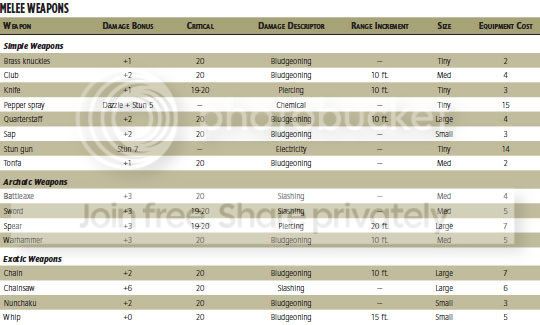
Melee Weapons
Melee weapons work like the Strike power (see powers thread) adding the wielder’s Strength bonus to the damage. Ordinary melee weapons are limited by their Toughness in terms of the amount of Strength bonus they can add. If a wielder’s Strength bonus exceeds the weapon’s Toughness (4 for wooden weapons, 7 or 8 for metal weapons), the weapon breaks when it is used. Melee weapons have the following traits:
• Category: Melee weapons are categorized as simple, archaic, and exotic.
• Damage Bonus: The weapon’s damage bonus on a successful hit. Melee weapons add the wielder’s Strength bonus to their damage (the Mighty power feat), costing a base 1 point. Each point of damage bonus costs 1 point.
• Critical: The threat range for a critical hit with the weapon. Some weapons have a larger threat range than others. Increasing a weapon’s threat range by 1 costs 1 point.
• Damage Descriptor: Melee weapon damage is classified as bludgeoning (weapons with a blunt striking surface, like a club), piercing (weapons with a sharp point), and slashing (weapons with a sharp edge). Some characters may be resistant or immune to some types of damage.
• Range Increment: Melee weapons designed for throwing can also be used to make ranged attacks. This costs 1 point. Thrown weapons have a range increment just as other ranged weapons do—but the maximum range for a thrown weapon is five range increments. Any attack at less than the given range increment is not penalized for range. However, each full range increment causes a cumulative –2 penalty on the attack roll.
• Size: Size categories for weapons and other objects are defined differently from the size categories for creatures. The relationship between a weapon’s size and its wielder’s size defines whether it can be used one-handed, if it requires two hands, and if it’s a light weapon. A Medium or smaller weapon can be used one-handed or two-handed. A Large weapon requires two hands.
• Equipment Cost: This is the weapon’s cost in points. Characters pay this cost from their equipment points to have a weapon of this type as part of their regular equipment.
---Simple Melee Weapons
• Brass knuckles: Pieces of molded metal fitting over the fingers, brass knuckles allow you to do +1 damage with your unarmed strikes. They include similar items like armored gauntlets.Club: Any of a number of blunt weapons used to strike, including nightsticks, batons, light maces, and similar bludgeoning weapons.
• Knife: A bladed weapon with a length less than 18 inches or so. This includes daggers, stilettos, sais, switchblades, bowie knives, and hunting knives, among others.
• Pepper spray: A liquid sprayed in a target’s face at close range to blind them. Pepper spray combines a visual Dazzle effect with a Stun effect. If the attack roll hits, the target makes a Reflex save (DC 15). Failure means the target is blinded. A blinded target makes a Fortitude save (DC 15) each round to recover, with a +1 bonus per save. A target blinded by pepper spray must also make a Fortitude save (DC 15). On a failure, the target is stunned. The Fortitude save to recover from being blinded is also used to recover from the stun effect.
• Quarterstaff: A fighting staff between four and six feet long, including the bo staff used in martial arts.
• Sap: A bludgeoning weapon intended to knock out targets without permanently injuring them.
• Stun gun: A stun gun hits its target with a powerful charge of electricity, requiring a Fortitude save (DC 17) to avoid a Stun effect.
• Tonfa: Police officers often carry and use a tonfa to subdue criminals. It’s also a common martial arts weapon.
---Archaic Melee Weapons
• Battleaxe: A heavy-bladed axe that can be used with one or two hands.
• Sword: A blade between 18 and 30 or more inches in length, single or double-edged. It includes longswords, katanas, sabers, scimitars, and similar weapons.
• Spear: A bladed pole-arm. Most spears can also be thrown.
• Warhammer: A heavy hammer or mace that can be wielded with one or two hands. Warhammers can also be thrown.
---Exotic Melee Weapons
• Chain: You can wield a weighted chain to strike a target up to 10 ft. away. You can use it to make trip attacks and to disarm opponents with a +2 bonus, like the Improved Trip and Improved Disarm feats (and its benefits stack if you already have those feats).
• Chainsaw: A tool that sometimes sees use as a weapon, particularly against zombies and other slasher-flick monsters. You do not add your Strength bonus to a chainsaw’s damage.
• Nunchaku: A popular martial arts weapon, made of two wooden shafts connected by a short length or rope or chain.
• Whip: A whip can strike targets up to 15 ft. away. You can use it to make trip attacks and to disarm opponents with a +2 bonus, like the Improved Trip and Improved Disarm feats (and its benefits stack if you already have those feats).
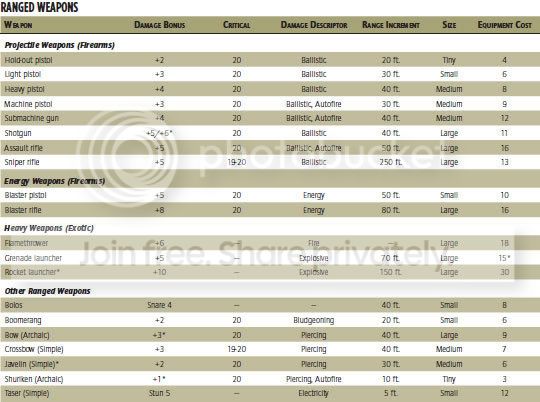
Ranged Weapons
Ranged weapons include both thrown and projectile weapons. Thrown weapons add the wielder’s Strength bonus to their damage. A thrown weapon has a maximum range of five increments. Projectile weapons include bows, crossbows, and guns as well as energy weapons like lasers and blasters.
---Projectile Weapons
• Holdout pistol: A low-caliber, easily concealed pistol, typically used as a back-up or secondary weapon.
• Light pistol: A common handgun, found in the hands of police officers and criminals alike.
• Heavy pistol: A high-caliber handgun, usually used by those who want a lot of stopping power.
• Machine pistol: A small automatic weapon, usable in one hand. Machine pistols are autofire weapons.
• Submachine gun: Compact automatic weapons that fire pistol ammunition, submachine guns are common military weapons, also used by criminals with access to more serious firepower. Submachine guns are Autofire weapons.
• Shotgun: A shotgun can fire shot, which does +5 damage with a +2 bonus to hit due to the spread, but it does only +3 damage against targets with any increase in their natural Toughness save bonus. It can also load solid slugs, which inflict +6 damage.
• Assault rifle: Rifles designed for military-use with both single-fire and autofire options.
• Sniper rifle: Rifles designed for long-range use, typically in conjunction with a powerful scope or targeting system.
---Energy Weapons
• Blaster pistol: A pistol that fires a coherent bolt of energy.
• Blaster rifle: A larger rifle-sized weapon that fires a more powerful bolt of energy.
---Heavy Weapons
• Flame-thrower: A flame-thrower shoots a stream of fire 5 feet wide and 25 feet long in front of the attacker as an area attack (see Area Attack).
• Grenade launcher: A grenade launcher fires various types of grenades, generally fragmentation grenades. Increase cost by +1 for each additional type of grenade carried.
• Rocket launcher: A rocket-launcher is generally an anti-tank weapon, although they also make useful anti-superhero weapons as well. It has the Area: Explosion extra (see page 111). Most rocket launchers can fire only one or two shots before they must be reloaded as a full-round action.
---Other Ranged Weapons
• Bolos: A set of weighted cords intended to entangle an opponent like a Snare (see powers).
• Boomerang: A common throwing weapon for heroes, a thrown boomerang returns to the thrower’s hand, ready to be thrown again on the next round. Boomerang wielders often acquire the Ricochet feat, allowing them to throw their weapon so it hits the target on the return arc as a surprise attack (see combat).
• Bow: Although outdated, some heroes and villains favor the bow as a weapon and it can be quite effective in the right hands. Bows add the wielder’s Strength bonus to their damage (although most bows are only designed to add up to a +5 Str bonus at best). A bow wielding character may have various “trick” arrows with different powers; such bows and arrows should be treated as Devices.
• Crossbow: Similar to a bow, and used for the same reasons. A crossbow does not add the user’s Strength bonus to its damage.
• Javelin: Light, flexible spears intended to be thrown. Javelins can also be used in melee combat.
• Shuriken: Flat metal stars or spikes for throwing. Shuriken can be thrown in groups (applying the Autofire extra). Although they are thrown weapons, shuriken do not add the thrower’s Strength bonus to damage.
• Taser: A compressed-air weapon firing a pair of darts. On impact they release a powerful electrical charge, requiring a Fortitude save (DC 15) against a Stun effect.
---Weapon Accessories
The following accessories can be added to the projectile weapons in this section. Each is considered a feature, which costs 1 equipment point.
• Laser Sight: A laser sight projects a non-damaging laser beam showing where the weapon is aimed. This grants a +1 bonus on attack rolls with that weapon.
• Stun Ammo: Ballistic weapons can fire rubber bullets while bows can fire blunt-tipped arrows or quarrels. This ammunition is intended to inflict nonlethal rather than lethal damage. Switching between ammo types is a move action (or a free action for a character with the Quick Draw feat).
• Suppressor: A suppressor muffles the noise of a ballistic weapon, giving it the Subtle power feat (see page 110) and making it difficult for normal hearing to detect it.
• Targeting Scope: This item gives a weapon the benefits of the Improved Aim feat (see page 61), doubling the normal benefits of aiming.
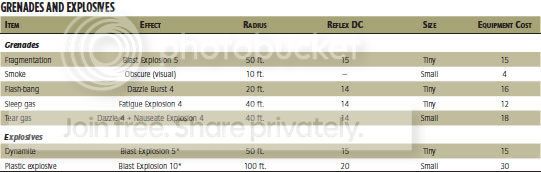
Grenades And Explosives
• Fragmentation grenade: A common military grenade that sprays shrapnel in all directions.
• Smoke grenade: A smoke grenade fills an area with thick smoke (colored as desired) providing total concealment to all visual senses except for X-ray vision (see Concealment, powers thread).
• Flash-bang grenade: A flash-bang grenade gives off a bright flash and a loud bang that can render targets temporarily blind and deaf (targets save separately against each Dazzle effect, Reflex save, DC 14).
• Sleep gas grenade: This grenade fills a 40-ft. area with a fatigue-inducing gas (Fortitude save, DC 14).
• Tear gas grenade: This type of grenade releases a cloud of gas that irritates the eyes and lungs, causing temporarily blindness and nausea (visual Dazzle plus Nauseate, Fortitude save, DC 14).
• Dynamite: A common explosive. The damage on the table is for a single stick of dynamite. Each increase of the amount of explosive on the Time and Value Progression Table increases damage by +1.
• Plastic explosive: Another common explosive, which can be worked into different shapes. The damage listed is for a 1-lb block. Each increase of the amount of explosive on the Time and Value Progression Table increases damage by +1.
|
|
|
|
|
|
|
|
|
|
|
|
|
|
|
|
|
|
Posted: Sun Feb 22, 2009 1:37 pm
Armor
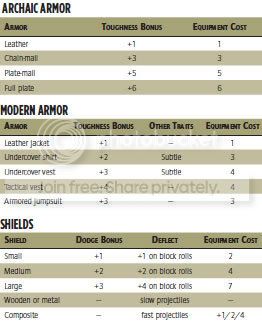
With so many weapons and super-powered attacks around, characters may need armor to protect them. Some heroes are innately tough enough to stand up to a lot of punishment, while others rely on their high Defense. Others choose to wear armor, ranging from ancient metal armors to modern composites or ultra-modern battlesuits.
All armor is based on the Protection power, providing a bonus to Toughness saves. Like other equipment, armor bonuses do not stack with other bonuses or each other, only the highest bonus applies.
---Archaic Armor
Some characters in superheroic settings still wear ancient or archaic armor, either because they are from a place or time where such armor is common or because it is tied to their motif or powers in some way.
If you want realistic archaic armor, halve the armor’s Toughness bonus against modern weapons (especially firearms) and ignore it altogether for futuristic weapons like lasers or blaster bolts.
• Leather: Heavy leather plates covering the torso and other vital areas.
• Chain-mail: A shirt of heavy metal chain, often with a hauberk (hood) to cover the wearer’s head.
• Plate-mail: This is chain-mail augmented with a metal breastplate, greaves (leg-guards) and arm-guards.
• Full plate: A full (and heavy!) suit of articulated metal plates, like that worn by medieval knights.
Modern Armor
Modern body armor is common among superheroes and villains, but even more so among people like police officers, soldiers, criminal agents, and so forth.
• Leather jacket: A heavy leather jacket (like that worn by motorcyclists) provides a measure of protection.
• Undercover shirt: A thin shirt of ballistic armor that can be worn under street clothes.
• Undercover vest: A somewhat heavier vest worn by undercover police officers and others in need of discrete protection.
• Tactical vest: A heavy bulletproof vest worn by police officers and soldiers.
• Armored jumpsuit: A full-body suit of ballistic cloth and padded armor.
---Shields
Shields provide a dodge bonus to Defense, much like the bonus provided by cover, since shields are basically mobile forms of cover. Additionally, shields provide some measure of the Deflect power (see powers), allowing the wielder to block ranged attacks. The dodge bonus is based on the size of the shield, while the Deflect power is based on the shield’s size and material composition (what sort of attacks it can resist, and therefore deflect).
|
|
|
|
|
|
|
|
|
|
|
|
|
|
|
Posted: Sun Feb 22, 2009 1:50 pm
Vehicles
Not every character can fly, teleport, or run at super-speed. Sometimes characters make use of various vehicles to get around. Vehicles are used primarily for transportation, although they may come with additional capabilities—including weapons—making them useful in other situations as well.
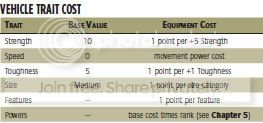
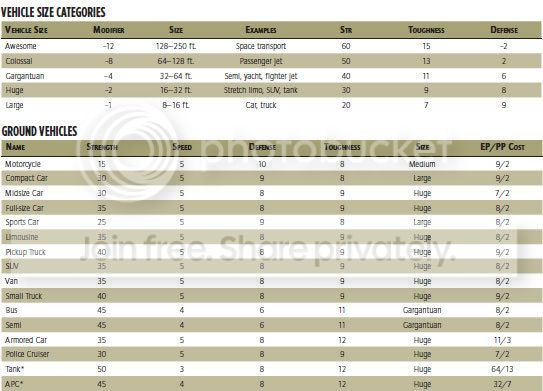
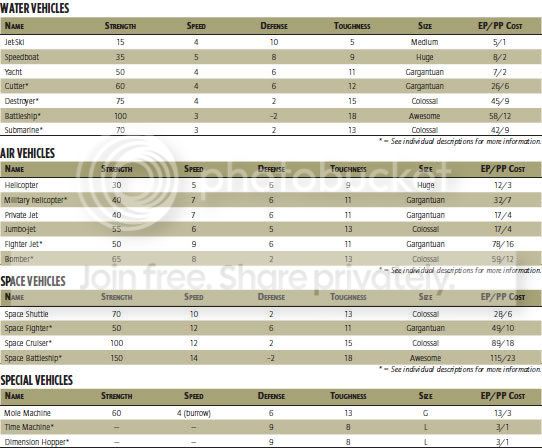
Vehicles are considered equipment and purchased with equipment points. The vehicle tables list two costs; the one before the slash is the equipment point cost and the one after the slash is the vehicle’s power point cost. “Vehicles” with limbs, manipulative capabilities, and other humanoid characteristics (such as giant, piloted robots) should be created as constructs rather than vehicles (see Constructs).
---Strength
A vehicle’s Strength, much like a character’s, determines its carrying capacity. Vehicles have a base Strength of 10 and buy up their Strength in increments of 5 for 1 power point each. A vehicle can move at normal speed carrying up to its medium load, 2/3 speed with a heavy load. It can also pull up to five times its heavy load at ½ speed (up to ten times, if equipped with the proper hauling equipment and given an unobstructed area in which to move). Each increase in size category increases a vehicle’s Strength by 10 at no additional cost.
---Speed
A vehicle buys the appropriate movement power(s) for its movement speed, paying the normal cost. Vehicles with multiple modes of movement (air, ground, and water, for example) can pay full cost for one and acquire the others as Alternate Powers.
---Defense
A vehicle’s Defense is 10 + its size modifier.
---Toughness
This is the vehicle’s Toughness rating, which starts out at 5 and costs 1 power point for +1 Toughness. Each increase in size category also increases a vehicle’s Toughness by +2 at no cost.
Vehicles toughness save caps at 5+pl.
---Size
A vehicle’s size is measured like that of a character, as shown on the Vehicle Size Categories Table. Vehicle’s start out at Medium size and each increase in size category costs 1 power point.
Features
Certain features are considered “standard” on any vehicle. These include seating, headlights, safety harnesses or seat belts, air bags, heating and air-conditioning, radio receiver, and similar things. The following features are “optional extras” for vehicles and cost 1 point each. Some “features” are actually powers, described in the following section.
• Alarm: The vehicle has an alarm system that goes off when an unauthorized access or activation attempt is made. A Disable Device check (DC 20) overcomes the alarm. For each additional equipment point, the DC increases by 5. Setting off the alarm means you must wait for a response of nearby people (especially the owner) before continuing to try and break into/steal the vehicle.
• Caltrops: A vehicle may be equipped with a dispenser for caltrops. Activating the dispenser is a standard action. Caltrops automatically blow the tires of ordinary vehicles that run over them (consider such vehicles “minions”). Heroes and villains can make Toughness saving throws for their vehicles; tires are Toughness 3, the DC of the save is 15. An injured result halves the vehicle’s movement while a disabled result brings the vehicle to a stop.
• Hidden Compartments: The vehicle has hidden compartments or cargo areas holding up to a tenth of the vehicle’s medium load in cargo. A Search check (DC 20) allows the searcher to find the hidden compartment. For each additional equipment point, the DC increases by 5.
• Navigation System: The vehicle has the equivalent of the direction sense Super-Sense (see page 103), granting a +5 bonus on all skill checks related to navigation. This can be increased by +5 per additional power point to a maximum of +20.
• Oil Slick: The vehicle can release an oil slick, covering a 20-ft. by 20- ft. area and forcing the driver of a pursuing vehicle to make a Drive check (DC 15) to retain control of the vehicle. Releasing the oil slick is a standard action.
• Remote Control: The vehicle’s owner can operate it remotely using a transmitter and control device. Remotely controlling a vehicle requires the same kind of action (usually a move action) as if you were actually behind the wheel of the vehicle.
• Smokescreen: The vehicle can generate a smoke screen, visually obscuring an area behind it 10 feet wide and up to 50-feet long (see Obscure). Activating the smoke cloud is a standard action.
Powers
A vehicle can have various powers of its own, usually reflecting the vehicle’s systems. Attack effects are suitable for vehicle-mounted weapons, while defense effects protect the vehicle (and often the passengers) from harm. Vehicle powers have their normal power point cost for the vehicle (meaning they cost one-fifth the normal amount for the vehicle’s owner, since the effects are incorporated into the vehicle and not always available).
• Armor: Armor provides Protection for a vehicle in addition to its normal Toughness, possibly including Impervious Protection. Ablative armor (Protection with the Ablative modifier) is also common for vehicles. Some vehicles may have Force Fields instead of, or in addition to, Protection.
• Cloaking Device: A vehicle may have a “cloaking device” granting Concealment from visual senses. Some vehicles may also have Concealment from auditory senses or things such as radar, giving them a “stealth mode.”
• Immunity: While vehicles are immune to many environmental conditions, they may also provide immunity to their passengers. Immunity (life support) is necessary for vehicles that travel in space or underwater.
• Weapons: Vehicle weapons are based on attack effect powers, particularly Blast with various modifiers. Vehicles may mount versions of some of the weapons listed elsewhere in this chapter.
---Ground Vehicles
-----------------------------------------------------------------------
Most cars include such standard features as air conditioning, air bags, antilock brakes, cruise control, keyless entry, and an AM/FM radio with CD player. Luxury (masterwork) vehicles often also include extras such as power seats, leather upholstery, and a sunroof.
• Tanks are heavily armed and armored vehicles. The standard tank comes equipped with a cannon (Blast 10, Explosion) and a heavy machine gun (Blast 6, Autofire). It takes a full-round action to get into or out of a tank, and another full-round action to start it up. Half of a tank’s Toughness (or 6) is Impervious.
• APCs or Armored Personnel Carriers, are designed for carrying troops. They come with a smaller cannon (Blast 6, Explosion), and are set up so soldiers on board can fire their personal weapons from behind the cover of the APC’s armor. One-third of an APCs Toughness (or 4) is Impervious.
---Water Vehicles
-----------------------------------------------------------------------
Water vehicles range from small boats and outboards to massive seagoing ships.
• Cutters are used by the Coast Guard and the Navy. They’re often equipped with light machine guns (Blast 6, Autofire).
• Destroyers are main naval ships, carrying heavy guns (Blast 10, Explosion).
• Battleships have massive gun batteries (Blast 13, Explosion) and heavy armor.
• Submarines are equipped with torpedoes (Blast 8, Explosion) and often ballistic missiles (Blast 15, Explosion, higher if the missile has a nuclear warhead).
Air Vehicles
-----------------------------------------------------------------------
Air vehicles are all capable of flight, some of them at very high speeds.
• Military helicopters are equipped with machine guns (Blast 6, Autofire) and rockets (Blast 9, Explosion).
• Fighter jets have machine guns (+6 Autofire Blast) and air-to-air missiles (Blast 11, Explosion, Homing).
• Bombers may have machine guns and missiles, but also have powerful bombs (Blast 12 or higher, Explosion) they can drop on targets. Bombers are also capable of carrying nuclear weapons and similar payloads.
Space Vehicles
-----------------------------------------------------------------------
Space vehicles are intended for use outside the atmosphere, some of them for interplanetary or even interstellar travel. Generally space vehicles are found in the possession of alien civilizations, although the GM may choose to allow some organizations and individuals on Earth to have space vehicles.
• Space fighters are armed with blaster cannons (Blast 10).
• Space cruisers have larger beam weapons (Blast 12) and often energy torpedoes (Blast 12, Explosion, Homing).
• Space battleships have the biggest weapons: blaster cannons (Blast 15) and high-energy torpedoes (Blast 15, Area: Explosion, Homing).
Special Vehicles
-----------------------------------------------------------------------
These are unique vehicles, most likely found in the possession of super villains, aliens, or eccentric inventors.
|
|
|
|
|
|
|
|
|
|
|
|
|
|
|
|
|
|
Posted: Sun Feb 22, 2009 2:25 pm
HeadquartersWhether it’s an underground cave, the top floors of a skyscraper, a satellite in orbit, or a base on the Moon, many heroes and villains maintain their own secret (or not so secret) headquarters. Teams of characters also may even pool their equipment points to have a headquarters they share, with a BMs approval (see super groups sub-forums rule thread). A headquarters is unlike other “equipment” in that it is fixed and serves as a home base, not something normally carried around. An especially large vehicle may serve as a kind of mobile headquarters, and a BM may allow characters to install some headquarters features into vehicles of Gargantuan or greater size. A character can even have multiple bases of operation. This is more common for villains, who have back-up plans and secret bases they can retreat to when their plans are defeated. If a character’s headquarters is destroyed, the character can choose to rebuild it or build a new headquarters with different features. Super villains often go through a succession of different headquarters. At a BM's option, characters can have additional headquarters as “Alternate Power” feats of the first (see Alternate Power), since they aren’t likely to be used all at once. (Note all equipment points USED to build a super groups base are earned separately from your normal pp, bought instead with "super group pp". See super group sub-forum rules for more info.)
---Headquarters Traits
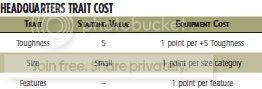
Headquarters have two main traits—Toughness and size—and a number of possible features. Each of these costs equipment points to improve.
---Toughness
A headquarters’ Toughness indicates the strength of its structural materials, particularly its outer structure (walls, ceiling, etc.). Toughness 5 is typical for most wooden structures, Toughness 10 for steel-reinforced or concrete structures, and Toughness 15 or more for special alloys or armored structures. A structure’s Toughness may be higher if its walls are especially thick. See Damaging Objects for more information.
A structure starts out with Toughness 5 for 0 points. +5 Toughness costs 1 equipment point.
---Size
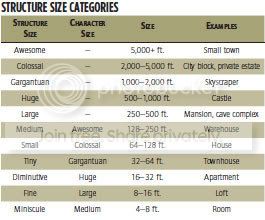
A structure’s size is measured similar to that of a character or vehicle, and gives a general idea of the overall space it occupies and how much space is available inside it. Structures are measured on a different scale, however. See the Structure Size Categories Table for guidelines. A headquarters starts out at Small size for 0 points. Each increase in size category costs 1 point, each decrease in size category gives you an additional point to spend elsewhere on your headquarters.
Features
A headquarters may have a number of features, chosen from the list below. A headquarters automatically has the basic structural amenities like doors and windows, power outlets, utilities, and so forth at no cost. Each feature costs 1 equipment point.
...Combat Simulator
A combat simulator or “danger room” is a special room equipped with various devices intended to test characters’ powers and skills and allow them to train in realistic combat situations. Generally, a combat simulator has a suite of devices that can simulate any appropriate attack effect at a rank up to equal to the strongest member of the super group’s power level. A combat simulator normally has safety interlocks so its attacks are always nonlethal damage, but these can be disengaged so the simulator’s attacks do lethal damage. For an additional feature, the combat simulator also can project realistic illusions, allowing it to recreate or simulate almost any environment. Combat simulators are useful for training and short “war games” (pitting the characters against each other or simulated opponents). Clever characters also can try to lure intruders into the combat simulator or an intruder might override the simulator’s control systems and trap the characters in it, turning it into a deathtrap.
The combat simulator starts with summon, a rank equal to the PL of the higher super group member 2. The "summons" act only as members of the super group and are built on 20pp per rank rather than 15pp per (as the normal summon power). Extras on the summon may be bought normally, also blast and other such powers may be applied for constructs to be placed in the area. Escaping the facility without getting out varies depending on whomevers blocking the door, or the headquarters security system.
...Communications
A communications system allows the headquarters to receive and transmit on a wide range of radio and TV bands, monitor police and emergency channels, coordinate communications between members of a team, and so forth. It includes communications equipment, consoles, and monitors. The system’s access to restricted communication bands depends on the clearance and skills of the user. Heroes often have access to special government channels, while a successful Computers skill check (DC 25) can grant a user illegal access to restricted systems.
...Computer
A state-of-the-art computer system serving the entire headquarters (a mainframe or mini-frame system). This allows characters to make full use of the Computers skill and the computer can be programmed to handle routine base functions (including monitoring communications channels and controlling defensive systems). For an artificially intelligent computer system, see Constructs.
...Concealed
The headquarters is hidden from the outside world in some way. It may be camouflaged behind a false façade, buried underground, and so forth. Note this is in addition to the Isolated Location feature, if any. An isolated headquarters is difficult to reach, while a concealed headquarters is difficult to find in the first place. Skill checks to locate the headquarters (Search, Knowledge, etc.) have their DC increased by +10. Each additional feature applied to this increases the DC +5.
...Defense System
A defense system consists of various weapon emplacements defending the exterior and interior of the headquarters. A defense system can have any attack effect with a cost of the SG leaders PL x2 (with their PL limiting DC of course). These attack devices try to disable or restrain anyone approaching or invading the headquarters. Their attack bonus is equal to the highest level SG members power level. Heroic HQ’s usually have nonlethal weapons while villainous defense systems are often lethal.
...Dock
A dock houses water vehicles and includes access to a nearby waterway, an airlock or lock system for moving vehicles in and out of the dock, and dry-dock facilities for repairing and maintaining water vehicles. A mod may require the headquarters be located within reasonable distance of a body of water in order to have this feature.
...Fire Prevention System
The headquarters is equipped with an automatic system for detecting and extinguishing fires. Any large open flame sets the system off (beware, fire using characters!). It functions like the Nullify power at rank 5 against fire. A computer-controlled fire prevention system can be programmed to ignore certain sources of fire or the system can be placed on manual control (requiring someone to throw a switch in order to activate it).
...Garage
A garage houses ground vehicles and includes a ramp or other access to move vehicles in and out, facilities for repairing and maintaining vehicles, and a sliding access door.
...Gym
A gym consists of weight-training and other exercise machines, space for working out, stretching, and similar exercises, and all the necessary amenities (lockers, showers, etc.). Some HQs may incorporate the gym feature into the combat simulator, for a multi-purpose training room.
...Hangar
A hangar houses air and space vehicles. It includes a hatch and/or runway for the vehicles to launch and facilities for repairing and maintaining flying vehicles. For some HQs the launch facilities of the hangar may require a long tunnel or other access to the outside.
...Holding Cells
These are cells for holding prisoners, usually temporarily, although some headquarters might have more permanent holding facilities. The cells are equipped with Nullify devices (ranked at the highest member of the super groups PL) or their basic Toughness is increased by 50%, which option should be agreed upon by both player and a BM (both options for two features). Heroes use holding cells to contain captured villains until they can be turned over to the proper authorities while villains use them to keep heroes prisoner until they can dispose of them in their latest deathtrap. Either way no player should be held for more than a week out of game time, if they are, they somehow manage to escape automatically.
...Infirmary
An infirmary consists of hospital beds and equipment for the full use of the Medicine skill. An infirmary can provide treatment for a number of characters equal to the base’s power level at one time and it can be assumed to have the necessary facilities to handle any unusual physiology of the base’s owner(s).
...Isolated
Headquarters with this feature are situated somewhere out of the way like the Antarctic, the bottom of the ocean, on top of a lonely mountain peak, even in orbit or on the Moon. The base’s owner doesn’t have to worry about things like door-to-door salesmen or other unwanted visitors but the headquarters is also far from civilization (which can be limiting for heroes unable to travel fast). The headquarters is assumed to provide all the necessary life-support for its location, but it doesn’t provide characters with the means to get to the base or travel back. They need the appropriate powers or a vehicle.
...Laboratory
A laboratory is a facility for the use of Knowledge skills in performing scientific tests or experiments. It contains all the necessary scientific equipment, including dedicated computers, if the headquarters doesn’t have its own computer system. Characters can use the laboratory to perform research, study unusual phenomena (including many super-powers), and so forth.
...Library
A library allows for use of various Knowledge skills when doing research. A library may consist of printed matter (books and periodicals), microfilm, computer databases, or a combination of all three. A library allows characters to take 20 on most Knowledge skill checks unless the information they’re looking for is particularly obscure.
...Living Space
The headquarters includes all the necessary amenities for people to live there full-time. This is usually a number of people equal to the HQ’s power level per rank (this means you can't have more members in your SG than you have available living space. It includes bedrooms or private suites, kitchen facilities, dining area, and common living areas. Characters can live in a headquarters lacking this feature short-term, but they’re not likely to be very comfortable (1 week out of game is given to bring facilities up to req, or else members must be booted and can't come back for 1 week).
...Pool
The headquarters has a large heated pool, which may be part of a gym area. At the owner’s discretion, the pool can provide access to an outside body of water (connected to a lake, river, or even to the ocean), to the base’s dock, or both at no additional cost.
...Power
A headquarters can be given any appropriate power as a feature with a BM's approval. The power cannot have a total cost greater than twice the strongest member of your sg's power level or a rank greater than the power level. Powers are assumed to affect either the headquarters itself or its occupants, if they do both, they count as two features.
...Power System
A power system makes the headquarters completely independent of outside power. It has its own generators (which may be solar, geothermal, nuclear, or anything else the designer wants). They provide for all the base’s power needs. The headquarters also has emergency back-up power should the generators fail. This generally lasts for a number of hours equal to the HQ’s power level.
...Security System
Various locks and alarms protect the headquarters from unauthorized access. A Disable Device check (DC 20) overcomes these systems. Each additional feature increases the DC by +5. The security system may be tied into a defense system (if the headquarters is equipped with that feature), so triggering an alarm activates the defense system to disable or restrain the intruder(s).
...Workshop
A workshop has all the facilities for use of various Craft skills. It includes tools, workbenches, supplies, and so forth. You need a seperate work shop for each different kind of craft. For example, a workshop can easily handle woodworking, metalworking, and machining, but might not be suitable for creating magical inventions, which require a separate dedicated workshop.
Sample Headquarters
Players can use the following sample headquarters as ready-made
lairs for supervillains, while players can use them as bases for their heroes.
---Abandoned Warehouse
Size: Medium; Toughness: 10; Features: Communications, Computer, Concealed, Garage, Gym, Living Space, Power System, Security System.
Cost: 10 equipment points.
---Moon-Base
Size: Awesome; Toughness: 20; Features: Combat Simulator, Communications, Computer, Defense System, Fire Prevention System, Gym, Hangar, Holding Cells, Infirmary, Isolated, Laboratory, Living Space, Pool, Power System, Security System (DC 25), Teleport (Affects Others), Workshop.
Cost: 27 equipment points.
---Orbiting Satellite
Size: Colossal; Toughness: 20; Features: Combat Simulator, Communications, Computer, Defense System, Fire Prevention System, Gym, Hangar, Holding Cells, Infirmary, Isolated, Laboratory, Living Space, Power System, Security System, Teleport (Affects Others).
Cost: 23 equipment points.
---Sanctum Sanctorum
Size: Medium; Toughness: 15; Features: Concealed, Laboratory, Library, Living Space, Security System, Workshop.
Cost: 9 equipment points.
---Sea-Base
Size: Gargantuan; Toughness: 15; Features: Communications, Computer, Concealed, Dock, Fire Prevention System, Isolated, Living Space, Power System, Security System.
Cost: 15 equipment points.
---Skyscraper (5 Floors)
Size: Large; Toughness: 10; Features: Communications, Computer, Defense System, Fire Prevention System, Gym, Hangar, Infirmary, Laboratory, Library, Living Space, Power System, Security System, Workshop.
Cost: 16 equipment points.
---Stately Manor
Size: Huge; Toughness: 10; Features: Communications, Computer, Concealed, Dock, Garage, Gym, Hangar, Infirmary, Laboratory, Library, Living Space, Power System, Security System, Workshop.
Cost: 18 equipment points.
---Underground Lair
Size: Huge; Toughness: 15; Features: Communications, Computer, Concealed, Defense System, Garage, Holding Cells, Isolated, Laboratory, Library, Living Space, Power System, Security System.
Cost: 17 equipment points.
---Urban Fortress
Size: Large; Toughness: 15; Features: Combat Simulator, Communications, Computer, Concealed, Defense System, Fire Prevention System, Garage, Gym, Holding Cells, Infirmary, Living Space, Power System, Security System, Workshop.
Cost: 18 equipment points.
|
|
|
|
|
|
|
|
|
|
|
|
|
|
|
Posted: Sun Feb 22, 2009 2:39 pm
Constructs
Armored robots, humanlike androids, even magically-animated golems or zombies are all examples of constructs, non-living things capable of acting on their own to one degree or another, carrying out pre-programmed instructions, or even possessing independent thought.
Since they are capable of action on their own (rather than just improving their owner’s abilities), constructs are considered minions rather than devices or equipment and are acquired using the Minions feat. Animate Objects creates temporary constructs, while the Summon power can summon them to serve a character.
Constructs are subject to the same power level limits as their creator.
You MUST list out the stats, abilities, etc that your constructs have in your profile (see dark bunny lords profile of Sykes for an example), so when you summon/create them mid combat you don't have to sit and wait for a BM's approval. (just like with shape shifting forms, etc)
---Ability Scores
Constructs have ability scores like characters do. They lack certain basic abilities, however: Constructs have no Constitution score, because they are not living beings. Constructs always fail Constitution checks. Constructs do not recover from damage; they must be repaired instead. Constructs are immune to effects requiring Fortitude saving throws unless the effect works on inanimate objects. Constructs also have either no Intelligence and Charisma scores or no Strength and Dexterity scores. These qualities of constructs: lacking three ability scores (–30 points) and Immunity to effects requiring Fortitude saves (30 points) average out to 0 points.
Constructs without Intelligence and Charisma are automatons, operating on simple instinct or programmed instructions. They are immune to mental effects and interaction skills and automatically fail Intelligence and Charisma checks.
Constructs without Strength and Dexterity scores are immobile intellects, like an artificially intelligent computer or a sentient magic item. They cannot undertake physical actions on their own, although they may be able to control other constructs. They cannot move or exert force, and automatically fail Strength and Dexterity checks.
A construct can buy up one of its nonexistent ability scores from 0 by spending power points; +1 ability score point per power point. This gives the construct the normal use of that ability. Note a construct with Intelligence but no Charisma is intelligent but non-sentient (not self-aware) and a construct needs at least 1 point in both Strength and Dexterity to be able to move and act physically. Constructs cannot buy Constitution, since creatures with Constitution are by definition living beings and not constructs.
---Toughness
Like inanimate objects, constructs have a Toughness score, which measures their ability to resist damage. A construct starts out at Toughness 0 and can increase its score by +1 for 1 power point.
---Skills
Constructs can have skills just like characters at the same cost (1 power point per 4 skill ranks). However, constructs cannot have skills based on abilities they lack. A construct with no Intelligence cannot have skills like Craft or Knowledge. A construct with no Dexterity cannot have skills like Acrobatics or Stealth, and so forth.
---Feats
Constructs can have feats at the same cost as other characters (1 power point per feat rank). Some feats are less useful or even useless to constructs.
---Powers
Constructs can have various powers, just like characters do.
---Size
Constructs larger or smaller than Medium must pay power points for Permanent Growth or Shrinking, as shown on the Size Table (See characteristics size chart).
Larger constructs gain +2 Toughness per increase in size category above Medium (but do not gain the additional Constitution from Growth).
---Commanding Constructs
A construct’s owner can give it orders verbally or through any other means the construct understands. Commanding a construct is a move action. Constructs follow orders to the best of their ability. Non-intelligent constructs do exactly as they’re told, without creativity or initiative, while intelligent constructs have the ability to interpret and improvise based on their Int score. An owner can also give a construct a series of basic orders for it to fulfill, such as “stay and guard this place and attack anyone who comes here other than me.” In the absence of new orders, constructs follow the last order they were given.
---Damaging And Repairing Constructs
Constructs suffer damage like inanimate objects (see Damaging Objects). Constructs do not heal or otherwise recover from damage. Instead, they must be repaired using the Craft skill. Repairing the construct requires the same amount of time as a recovery check for its damage condition, and a skill check in place of the recovery check. A failed check means no progress. Attempting repairs without the proper tools is at the usual –4 penalty.
A constructs with the Regeneration power are self-repairing and can make recovery checks (see Regeneration, powers thread).
|
|
|
|
|
|
|
|
|
|
|
|
|
|
|
|
|
|
|