|
|
|
|
|
|
|
|
|
 Posted: Sat Feb 21, 2009 9:16 pm Posted: Sat Feb 21, 2009 9:16 pm
Characteristics
While ability scores, skills, feats, and powers describe a lot about a character, they don’t cover everything. There are many details like your character’s name (both super identity and real name), appearance, costume, age, background, and so forth. You choose these details to fit the way you imagine the character.
This chapter rounds out the information about your character, including finishing details, personality, background, and complications, as well as the character’s drawbacks: weaknesses or vulnerabilities. It also explains how characters can go that extra mile when they need to pull out all the stops in order to succeed, using extra effort and luck points.
DETAILS
A lot of details go into making your character more than just a collection of numbers. Take a moment (if you haven’t already) to consider some of the following things about your character.
---Name
What is your character’s name? That is to say, what is the name the character uses in public, that appears in one-inch type in the newspaper headlines? Most characters adopt unique and distinctive “code names,” so consider a suitable name for your character. Code names are often based on powers, theme, or style. Here are some options to consider:
• Origin: A name may be based on the character’s origin, power source, nation (or even world) of birth, and such.
• Powers: Choose a name based on the character’s powers: Firestarter or Blaze for a flame-controlling character, Thunder or Spark for an electrical character, and so forth.
• Theme: Maybe the character has a theme or style suggesting a name: Paladin might be a medieval knight displaced into the present day, with magical sword and armor. Ms. Mystic may be all about magic and the occult.
• Titles and Ranks: Names may include various titles like Mister, Miss, Ms., Doctor, Sir, Lord, Lady, and Madam or even royal titles like King, Queen, Prince, Princess, Duke, Baron, and so forth. Military ranks are also popular parts of hero names, especially General, Major, and Captain.
• Gender: Names often include gender designations like Man/Woman, Boy/Girl, Lad/Lass, and so forth.
• Sound: Some code-names don’t really have anything to do with a character’s powers or background—they just sound cool: Kismet, Scion, Animus, Damask, and so forth. They may hint at the hero’s powers or origin, or have nothing to do with them.
• Real Name: Some heroes go by their real name, not using a code-name at all. Oftentimes these real names sound like code-names, however. For example, Alexander Atom, heroic scientist, known as Dr. Atom, the adventurer Johnny Danger, or Chuck Shepard, Space Ranger.
---Age
How old is the character? Superheroes/Villains tend to hover in that indeterminate age between 20 and 40, but some characters are younger, usually teenagers, and some are older, possibly much older, depending on a character’s background.
For example, the character might have fought in World War II but
ended up in the present day due to time travel or suspended animation.
characters with Immunity to Aging are effectively immortal—they might be
thousands of years old.
Consider the effects of age on your character. Someone who fought in the Second World War is likely to have a different worldview than a modern teenager who just acquired super-powers, to say nothing of an immortal who has seen civilizations rise and fall or a godlike being from the dawn of time. A character’s age may influence the choice of certain traits. Aged characters are likely to have lower physical ability scores, for example, while younger characters may have fewer skill ranks (having had less time to train in various skills).
---Appearance
What does your character look like? Consider things like the character’s race, sex, ethnicity, and other factors in appearance. Is the character even human? Superheroes/Villains can be aliens, robots, androids, spirits, and beings of pure energy.
Is the character short or tall? What about hair and eye color? Does the character have any distinguishing marks or unique features; is his appearance unusual in any way (apart from running around in a costume, that is)?
---Costume
A costume is a big part of a superhero’s/villains appearance. Like code names, most heroes have a distinctive costume, usually something skin-tight and colorful, often emblazoned with a symbol or logo. Other characters wear more military-style outfits, fatigues or body armor with numerous bandoleers and belts. A suit of armor may serve as the character’s costume: anything from ancient mail to a high-tech battlesuit. A few characters don’t wear a special costume, just ordinary street clothes (which can be pretty distinctive among a group of spandex-clad characters).
In the comics, costumes are generally immune to the kind of routine wear-and-tear a character’s powers should inflict on them. For example, characters who can burst into flames don’t usually incinerate their clothing. The same is true for characters who change their size or shape. Although a character's costume can be damaged or torn by attacks and other circumstances, it’s usually immune to the character’s powers. This doesn’t cost any points; it’s just the way costumes work.
---Alternate Identity
Although heroes spend a lot of time fighting crime and using their powers to help others, most also try to find time to have lives of their own. Consider the character’s “normal” life, both before acquiring super-powers and since. Does the character maintain a secret identity, hiding behind a mask or other guise in order to have a semblance of a normal life while “off duty”? Describe the character’s other identity and what the character does while not out fighting the forces of evil or terrorizing the forces of good.
Other characters abandon all pretense of a “civilian” identity, revealing their true names to the world and living in the public eye. This means no juggling two separate lives, but also no refuge from the media, adoring fans, or the character’s enemies, who can all keep track of the character more easily. Both approaches have their good and bad points. Consider which is best for your character.
---Origin
What’s the origin of your character’s powers? It can be anything from a character born with the potential for powers to someone granted them by an accident—exposure to a strange meteor, radiation, genetic engineering, or any of countless similar encounters. Here are some of the more common superhero origins.
• Accident: Perhaps the most common origin. The character gains powers accidentally from exposure to some force like radiation, chemicals, unleashed mystic energies, being struck by lightning, and so forth. Accidents are often one-time events, although sometimes there is an effort to re-create an accident to deliberately make super-beings. Accidental origins are influenced by the science of the setting. Golden Age heroes in the 1940s often gained their powers from chemical accidents while Silver Age heroes in the Atomic Age of the ‘60s got their powers from radiation and modern heroes acquire powers from accidents involving genetic engineering, nanotech, and similar cutting-edge technologies.
• Alien: A character may be a member of an alien race with unusual powers compared to humans. Either all members of the race have similar powers or particular conditions (lighter gravity, solar radiation, etc.) grant them powers on Earth. Some “alien” races in the comics are actually superhuman offshoots of humanity living isolated from the rest of the human race. “Aliens” also include mystical beings from other dimensions, from angels and demons to elementals and actual gods, as well as mortal half-breeds descended from them. An alien character’s powers might even have another origin; being an alien only explains part of the character’s powers or is merely a background element.
• Endowment: Some outside force grants the character powers. This might be an experimental procedure (see the next entry), a godlike higher power, a secret organization that hands out powerful devices, a mysterious wizard, or something similar. The patron might expect something in return from the character for this boon, or the gift could be unconditional.
• Experiment: Some characters gain powers from a deliberate attempt, such as a scientific or mystical technique for transforming someone into a super-being. Like accidents, experiments are often impossible to duplicate. The character may be a willing volunteer or a victim chosen to test out the technique. Some characters create their own powers, either by developing the procedure or building their own devices.
• Mutant: A character may simply be born “different,” with the potential for super-powers. These latent powers typically emerge in a time of stress, especially the changes brought on by puberty, although they might also appear as a result of an accident (combining the accident and mutant origins). In some settings mutants are mistrusted because they represent a new species or evolutionary step for humanity, and some fear they will ultimately displace or enslave ordinary humans.
• Training: Finally, some characters acquire powers through hard work and training, whether physical discipline, studying esoteric martial arts techniques, meditation and introspection to unlock hidden mental powers, or mastering the arcane arts of magic. Such training is typically arduous and not everyone has what it takes to accomplish it. characters who gained their powers through training may have rivals who trained with them.
Origins As Descriptors
Origins can serve as descriptors for a character’s powers. For example, a super-powered mutant has the “mutant” descriptor, meaning the character may be detected by mutant-detection powers, affected by mutant-specific devices, and so forth. The same is true for a mystic, an alien, or any other origin.
|
 |
|
|
|
|
|
|
|
|
|
|
|
|
|
Posted: Sat Feb 21, 2009 9:32 pm
Personality
How would you describe your character’s personality? While heroes tend to
share a desire to use their powers for good and uphold the law and villains to destroy or take over the world, they also show a diverse range of attitudes. One hero may be dedicated to the ideals of truth, justice, and equality while another is a vigilante willing to break the law in order to ensure justice is done. Some heroes are forthright and cheerful while others are grim and unrelenting. Consider your character’s attitudes and personality traits.
---Allegiance
characters’ beliefs and motivations are at least as important as their amazing powers and abilities. These are reflected by their allegiances. A character may have up to three allegiances, listed in order from most to least important. These allegiances are indications of what the character values. A character may have fewer allegiances, no allegiances (being either a free spirit or a loner), or may change allegiances over time. Also, just because the character fits into a certain category of people doesn’t mean that category is necessarily an allegiance. Allegiances are things toward which a character feels an especially strong devotion. If a character acts against an allegiance, a mod may choose to strip the character of that allegiance and assign one more suitable to those actions.
---Pledging Allegiance
A character’s allegiance can take the form of loyalty to a person, organization, belief system, nation, or an ethical or moral philosophy. Having an allegiance implies the ability to make moral or ethical choices. As a result, characters must have Intelligence and Wisdom scores of 3 or higher in order to have allegiances. Creatures with lower scores—such as animals—have no allegiances.
Allegiances include, but are not limited to, the following:
• Person or Group: This includes a leader or superior, a family, a team or group, and so forth.
• Organization: This may be a company or corporation, a gathering of like-minded individuals, a fraternal brotherhood, a secret society, a branch of the armed forces, a local, state, or national government, a university, an employer, or an otherwise established authority.
• Nation: This may be the nation of the hero’s birth or an adopted nation. Patriotic heroes typically have an allegiance to their nation (although not necessarily their nation’s government).
• Belief System: This is usually a particular faith or religion, but can also be a specific philosophy or school of thought. Belief systems also include political beliefs or philosophical outlooks. Silver Age comic book characters are often committed to belief systems like communism, democracy, free thought, and so forth.
• Ethical Philosophy: This describes how one feels about order, as represented by law and chaos. An individual with a lawful outlook tends to tell the truth, keep his or her word, respect authority, and honor tradition, and expects others to do likewise. An individual with a chaotic outlook tends to follow instincts and whims, favor new ideas and experiences, and behave in a subjective and open manner in dealings with others.
• Moral Philosophy: This describes one’s attitude toward others, as represented by good and evil. An individual with a good allegiance tends to protect innocent life. This belief implies altruism, respect for life, and a concern for the dignity of other creatures. An evil allegiance shows a willingness to hurt, oppress, and kill others, and to debase or destroy innocent life.
---Allegiances And Influence
An allegiance can create an empathic bond with others of the same allegiance. A character gains a +2 bonus for positive conditions on interaction skill checks when dealing with someone of the same allegiance. Similarly, the character may suffer a –2 penalty when dealing with characters of an opposing allegiance. The character must have some interaction with other characters to bring these modifiers into play.
---Allegiances As Descriptors
At a BM’s option allegiances can function as descriptors for powers (see Power Descriptors), allowing character to have a power affecting only subjects of a particular allegiance, for example, or the ability to detect characters with a particular allegiance (see Detect, power thread). An attack power affecting only “evil” targets, for example, is useless against inanimate objects, constructs, and animals (and other creatures or things with Int or Wis below 3). It also doesn’t affect characters without a specific allegiance to evil (such as selfish mercenaries, violent vigilantes, or despots devoted solely to order, but not evil per se).
---Allegiances as Origins
Some characters may derive their powers from their allegiance in some way, such as heroes who draw strength from their convictions, their faith, or their morality. This provides a descriptor for those powers, but the character may also suffer Power Loss (See power loss) from a change or wavering in allegiance.
---Allegiances In Conflict
Characters with different allegiances may find them in conflict. Such conflicts provide roleplaying opportunities and complications for players and story hooks for events. For example, a hero with allegiances to America, Truth, and Justice may discover a secret government agency acting against the interests of justice in the world. What is stronger, the hero’s patriotism or the desire to see the truth known and justice done? Some conflicts may result in characters abandoning or changing allegiances, or reordering their priorities (and therefore allegiances). See Complications, for more on handling such conflicts in the game.
---Motivation
Another important element of a character’s background is what motivated the character to become a hero/villain in the first place and what keeps the character going. Sometimes motivation is the only difference between a hero and a villain. What made your hero decide to fight for justice rather than turning toward more selfish goals? How does it affect the hero’s methods of fighting crime? Is there anything that might change or affect the hero’s motivation? Common heroic motivations include the following:
• Acceptance: The character feels different or isolated (perhaps for being a non-human in human society) and does good to gain the trust and acceptance of others and perhaps discover what it means to be human or is rebuked by society and driven to anger. Some such characters see their powers as more of a curse than a blessing, but try to do some good with them while hoping and looking for a way to have a normal life.
• Goodness: Some heroes fight the good fight simply because it’s the right thing to do and they believe in doing the right thing no matter what. Their strong moral center may come from a good upbringing (or a bad one that showed them what not to do) or the guidance or inspiration of a mentor or idol.
• Greed: There are those motivated by nothing more than the opportunity to make a profit off their heroic careers. They may be mercenaries for hire or marketing machines who do good/evil deeds but also rake in the proceeds from licensing fees and public appearances. More altruistic characters tend to look down upon their profit-mongering peers.
• Justice: An overwhelming thirst for justice drives some heroes, a need to see the innocent protected and the guilty punished, even if they are beyond the reach of the law. These heroes walk a thin line. For some justice becomes a thirst for vengeance for injury done to the hero in the past, like the death of a loved one.
• Recognition: Some characters just want recognition, and dressing up in a bright costume and fighting crime or robbing banks is one surefire way to get people to notice you. The character may be a shy nobody out of costume or a glory-hog who loves the spotlight.
• Responsibility: The responsibility of having great power can be a heavy burden but some heroes feel it is their duty to use the powers they’ve been given for the greater good. Oftentimes these characters are trying to live up to an ideal like a mentor or a predecessor who inspired them.
• Thrills: For some the life of a superhero/villain is all about excitement, thrills, danger, and challenge. These characters are in it for the action more than anything else.
---Goals
Finally, what are your character’s goals? All characters want some end goal to one degree or another, but what other things does your character want? One character may want to find his long-lost family while another may want to avenge a terrible wrong done to her in the past. A monstrous or alien character may seek acceptance and a new home on Earth, while a teen character may want to live up to the legacy of a mentor or predecessor. Giving your character a goal beyond simply “doing good” or "wreaking chaos" can help give the character more depth and provide opportunities for roleplaying and complications during the game. Don’t overlook it.
|
|
|
|
|
|
|
|
|
|
|
|
|
|
|
|
|
|
Posted: Sat Feb 21, 2009 9:37 pm
Extra EffortOften, characters are called upon to perform feats beyond even their amazing abilities. This calls for extra effort. Players can use extra effort to improve a character’s abilities in exchange for the hero suffering some fatigue. The benefits of extra effort are not limited by power level. (For more details on extra effort go here)
---Using Extra Effort
Extra effort is a free action and can be performed at any time during the character’s action (but is limited to once per round). A character using extra effort gains one of the following benefits:
• Check bonus: +2 bonus on a single ability, skill, or power check. This does not include attack rolls.
• Increase carrying capacity: +5 effective Strength for determining the character’s carrying capacity for one round.
• Increase movement: The character’s speed for all modes of movement doubles for one round.
• Increase power: Increase a power by 2 ranks for one round. This only increases the power’s rank; you cannot apply power modifiers (but see the power stunt benefit). Permanent powers cannot be improved in this way.
• Power stunt: Temporarily add a power feat to a power. This includes an Alternate Power of an existing power. The power feat must follow the normal rules for adding a power feat. The temporary power feat lasts for the duration of the encounter or until you choose to stop maintaining it, whichever comes first. This includes turning off the power or switching to a different Alternate Power. Power stunts cannot be applied to Permanent powers via extra effort.
• Willpower: Gain an immediate additional saving throw against a power with a Lasting effect, such as Mind Control or Nullify (see Duration). You get this save even if the Lasting power has a Continuous duration (which doesn’t normally allow for additional saves at all). If you’re mind-controlled, the fatigue from the extra effort doesn’t affect you until you’re free of it.
• Surge: Gain an additional standard or move action, before or after your normal actions for the round (your choice). Using this extra action does not change your place in the initiative order. You can use a standard action gained from extra effort to start or complete a full round action in conjunction with your normal actions for the round.
---Fatigue From Extra Effort
At the beginning of the round immediately after extra effort, the character becomes fatigued (see Fatigue, combat). A fatigued character becomes exhausted and an exhausted character becomes unconscious the round after using extra effort. If you spend a luck point at the start of the round following extra effort to shake off the fatigue, the character suffers no adverse effects.
|
|
|
|
|
|
|
|
|
|
|
|
|
|
|
Posted: Sat Feb 21, 2009 9:55 pm
Luck Points
Whether it’s luck, talent, or sheer determination, characters have something setting them apart from everyone else, allowing them to perform amazing deeds under the most difficult circumstances. In the game that something is luck points. Spending a luck point can make the difference between success and failure. When you’re entrusted with the safety of the world that means a lot!
Luck points allow players to “edit” the plot of the adventure and the rules of the game to a degree. They give characters the ability to do the amazing things characters do in the comics, but with certain limits. characters start each day/scene with 1 luck point +1 more per 5 PL they have +1 more per rank of the luck feat they have. Unspent luck points don’t carry over to the next day/scene, instead their points simply refresh to normal.
Using Luck Points
Unless otherwise noted, spending a luck point is a reaction, taking no time. You can spend as many luck points as you have, but only one luck point on any given benefit per round. You can spend luck points for any of the following things though make sure that you "ready" them BEFORE you roll on a turn if you would get another roll by spending it.
For example, if your making a toughness save you could say "If I fail my save by X or more I'll spend a luck point", if you don't say that, then you don't get to spend one after the fact. This is so the opponent doesn't start making their next post right away and instead can wait for you to spend the luck point on a re-roll or whatever they wish instead of moving on to their own post right away.
---Improve Roll
One luck point allows you to re-roll any die roll you make and take the better of the two rolls. On a result of 1 through 10 on the second roll, add 10 to the result, an 11 or higher remains as-is (so the second roll is always a result of 11-20). You must spend the luck point to improve a roll before your opponent respondes. You cannot spend luck points on die rolls made by other players without the Luck Control power (see powers).
---Amazing Feat
You can spend a luck point to gain the benefits of a feat (either a regular or power feat) you don’t already have for one round (see feats thread). You must be capable of using the feat and cannot gain the benefits of fortune feats, only other types of feats. If the feat has another feat as a prerequisite, you must have the prerequisite to gain the benefit of the more advanced feat. For feats acquired in ranks, you gain the benefit of one rank of the feat by spending a luck point.
---Dodge
You can spend a luck point to double your dodge bonus for one round. This includes any modifiers to your dodge bonus from feats, powers, or combat actions (such as the total defense action, combat thread). The improved dodge bonus lasts until the beginning of your next round. You can also spend a luck point whenever you are denied your dodge bonus, but still capable of action (surprised, flat-footed, etc.). In this case, you retain your dodge bonus until your next action (this is the same as spending a luck point to perform the Uncanny Dodge feat). Simply state so when making your awareness check before the "ambushing" foe attacks.
---Instant Counter
You can spend a luck point to attempt to counter a power used against you as a reaction. See Countering Powers for details.
---Cancel Fatigue
Any time you would suffer fatigue (including the effects of the Fatigue power and the use of extra effort), you can spend a luck point and reduce the amount of fatigue by one level (so you suffer no fatigue from a fatigued result, are fatigued by an exhausted result, etc.).
---Recover
You can spend a luck point to recover faster. A luck point allows you to immediately shake off a stunned or fatigued condition. If you are exhausted, spending a luck point causes you to become fatigued. If you have suffered damage, a luck point allows you an immediate recovery check as a full-round action (see Recovery). It takes two rounds for a staggered character to make a recovery check, since you can only take a standard or move action each round while staggered. This check is made normally, the hero point just allows you to make it in addition to your normal recovery checks. If the recovery check is successful, it turns out the damage wasn’t as serious as it first appeared, or your character is able to shake it off.
While disabled, you can spend a luck point to take a strenuous action for one round without your condition worsening to dying. If you spend a luck point on a normal recovery check for bruised or injured conditions, a successful check eliminates all of that condition, rather than just one. The luck point does not improve the recovery check, only its effect.
---Escape Death
Spending a luck point automatically stabilizes a dying character (you or someone you are assisting), although this doesn’t protect the character from further damage.
|
|
|
|
|
|
|
|
|
|
|
|
|
|
|
|
|
|
Posted: Sat Feb 21, 2009 10:34 pm
Drawbacks
Drawbacks are weaknesses for characters to overcome. They’re the flip side of a character’s skills, feats, and powers. Drawbacks serve two main purposes. First, they provide characters with additional depth and a degree of vulnerability, which can be important for heroes able to move mountains or bounce bullets off their chests. Second, drawbacks give you additional power points during character creation to spend on improving your character’s traits. The maximum number of points you can get from drawbacks is generally equal to the campaign’s power level.
(Note, some drawbacks are placed on powers, whilst others are a general effect that hits your character over all.)
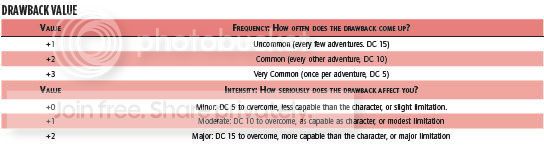
Drawback Value
A drawback’s power point value is based on two things: its frequency (how often the drawback affects your character) and its intensity (how seriously the drawback affects your character). The more frequent and intense the drawback, the more points it’s worth. Drawbacks generally range in value from 1 power point for something that comes up rarely and has little effect to 5 power points for a drawback that comes up all the time and seriously weakens the character.
Frequency
Drawbacks have three levels of frequency: uncommon, common, and very common. Uncommon drawbacks show up about a quarter of the time. Common drawbacks show up about half the time, and very common drawbacks show up three-quarters of the time or more.
Each level has a frequency check associated with it, which is a simple d20 roll with no modifiers against a DC (15, 10, or 5).
Note that frequency represents how often the drawback comes up during the game, not necessarily how common it is. Even if glowing meteors are extraordinarily rare in the setting, if they show up every other day, they’re still common in frequency.
Note it is up to the player to preform live up to these drawbacks as they rp, if they FAIL TO, for ANY reason. They go into PP debt and loose the drawback.
What this does is whenever the character earns pp weekly, it goes towards paying off the debt, once payed off excess is given to the player normally but the drawback is gone. So be sure to note how your drawback effected you each week when requesting your update.
---Intensity
The intensity of a drawback measures how much impact it has on the character. There are three levels of intensity: minor, moderate, and major.
Minor drawbacks have a slight impact or are not difficult to overcome. Moderate drawbacks impose some limits, but can be overcome about half of the time. Major drawbacks impose serious limits and are quite difficult to overcome.
---Power Drawbacks
Some drawbacks are power drawbacks, meaning they apply to a particular power rather than necessarily to the character. You can think of power drawbacks as the reverse of power feats: minor limits on the power. A power can have a total value in drawbacks equal to 1 point less than its total cost (so the power must cost at least 1 power point, regardless of how many drawbacks it has).
---Fitting Drawbacks To The Game
Although suggested values are given for various drawbacks in the following sections, the value of any drawback is based largely on its effect. So drawback values can vary from one campaign to another. For example a common Vulnerability in one setting may be uncommon in another and non-existent in a third (making it worthless as a drawback).
The mod whom looks over your prof must judge the frequency and intensity—and therefore value—of each drawback based on the context of the character and the campaign as a whole.
Drawbacks must actually limit or hinder characters in some way. A drawback that doesn’t do so isn’t really a drawback at all and isn’t worth any points.
---Eliminating Drawbacks
Players can remove a drawback from a character by paying earned power points equal to the drawback’s value. The GM should also arrange for suitable events in the story to eliminate the drawback. So a disabled character might be healed in some way, a novice learns to better control her powers (eliminating the Full Power drawback), a special treatment eliminates the character’s Weakness, and so forth.
Drawback Descriptions
Each entry here describes the drawback’s game effect and its suggested value.
---Action –1 Point/Step
An effect requiring longer than a full-round action to use is considered a drawback (see the Action flaw). Each step up the Time Table is a 1 point drawback. The drawback cannot equal or exceed the value of the associated power. So a power costing 10 points cannot have more than 9 points in this drawback (and meaning the power takes three months to use!).
This drawback can also apply to the time needed to switch between Alternate Powers (see Array) in an Array: 1 point if a move action is required, 2 points if a standard action is required, 3 points if a full action is required, each step up the Time Table thereafter is an additional 1 point drawback. In this case the drawback’s value cannot equal or exceed the power’s total Alternate Power feats, so a power with four Alternate Powers can only get 3 points out of this drawback (requiring a full action to switch between them).
---Full Power –1 POINT
You have less than full control over an effect. Effects subject to this drawback must be used at full rank or intensity, or not at all. This means you cannot pull punches with an attack (see Pulling Your Punch, combat), move at less than full speed, and so forth, depending on the effect to which this drawback is assigned. You can still turn the effect on and off as you wish (it is neither Permanent nor Uncontrolled), you just can’t fine-tune it, it’s either on at full intensity or off entirely. You can’t have the Precise feat (see feats) for any effect with this drawback. Full Power is an uncommon, minor drawback, worth 1 point.
---Involuntary Transformation –1 To –6 Points
You have two or more forms or identities you sometimes change between against your will. The value of the drawback is based on how often you change (frequency/Trigger) and how difficult it is for you to resist the change (intensity). If you cannot resist the change, no matter what, the intensity value is 3 points. If you involuntarily switch between super-powered and normal human forms, you also have the Normal Identity drawback (see the following).
---Normal Identity –3 To –5 Points
You have two identities: a super-powered one and a normal one. This is not the same as having a secret identity (although you may have that, too). The difference is your normal identity has none of the powers or extraordinary abilities of your superhuman self. So in your normal identity you might be an average teenager, businessman, or other everyday person. Characters with Devices may have this drawback, but not necessarily. For example, a hero who wears a suit of powered armor might have a Normal Identity while he’s out of the armor, but a hero who wields a magic ring doesn’t have a Normal Identity unless he can’t wear or have the ring with him in his normal identity for some reason.
To qualify for this drawback there must be some reasonable means of preventing you from changing from your normal to your super identity. For example, you might require access to a Device (which can be stolen or disabled), you might need to speak a magic word or incantation (blocked by an Auditory Obscure, a gag, or a simple chokehold), you might need to take a particular pill or formula, and so forth. The BM decides whether or not a particular condition qualifies for this drawback. If you can switch between a normal and super identity at will and nothing can prevent it, you don’t qualify for this drawback. If you can’t always control switching between identities, you also have the Involuntary Transformation drawback.
You define the traits of your Normal Identity. Your Normal Identity cannot have any powers by definition, and the BM may restrict the application of feats and ability scores above 20. Your Normal Identity must also be built on fewer points than your super-identity (how many fewer is up to the BM, but no more than half is a good rule of thumb). The simplest Normal Identity has the same traits as your super identity, minus any powers. Your two identities may have different appearances.
The intensity of this drawback is major (since you lose access to all your powers). The frequency depends on how difficult it is for you to assume your super-identity. If it takes a free action, then it’s uncommon (3 points). If it takes a full-round action, it’s common (4 points), and if it takes longer than a full-round action it’s very common (5 points).
---Noticeable –1 Point
A passive effect with this drawback is noticeable in some way (active effects are noticeable by default, see Noticing Power Effects, powers). Choose a noticeable effect of the power. For example Noticeable Mind Control might cause the subject’s eyes to glow or skin to change color. Noticeable Protection may take the form of armored plates or a tough, leathery-looking hide. Noticeable is an uncommon, minor drawback, worth 1 point.
---One-Way Transformation –3 To –5 Points
When you transform through the use of a power such as Alternate Form, Metamorph, or Shapeshift or due to the Normal Identity or Involuntary Transformation drawbacks, it takes some time for you to return to “normal.” This may be due to a need to “bleed off” excess energy, letting the transformation lapse slowly, or a requirement to reset certain mechanical system parameters. Whatever the case, undoing your transformation is involved.
One-Way Transformation is a very common drawback (less if you don’t transform every adventure). Its intensity is minor if it takes a matter of hours for you to return to normal. It’s moderate if it takes hours plus certain resources (a lab, workshop, special equipment or components, and so forth). It’s major if it takes a matter of days or longer.
---Power Loss –1 To –3 Points
You lose the use of a power with this drawback under certain conditions. Examples include when exposed to a particular substance, when immersed in water, when unable to speak, and so forth. You can also suffer power loss from a failure to do something, like not recharging a power, breaking an oath, not taking a pill, and so forth. Power Loss is minor intensity, with frequency based on how often you encounter the conditions, giving it a value of 1–3 points. You regain use of the power when the condition that triggered the loss no longer affects you. The loss of Devices and Equipment is not covered by this drawback. Losing Device and Equipment powers due to theft is a part of those traits and factored into their cost. So characters cannot take Power Loss with the condition “when devices or equipment are removed.”
---Reduces Range –1 To –2 Points
This drawback reduces the number of range increments of a ranged effect, which normally has a maximum range of ten increments. For –1 point, it reduces the effect to half that, or five increments (the same as throwing range). For –2 points, it reduces the effect to two increments. A greater reduction should be handled by making the effect touch range, possibly with some measure of the Extended Reach feat, if necessary.
---Weak Point –1 Point
This drawback makes a defense effect that provides a Toughness save vulnerable to critical hits. A critical hit completely bypasses the effect, ignoring its bonus to Toughness saves when the target saves against the attack’s damage. This is in addition to the normal effects of a critical hit (+5 damage). Weak Point is a 1-point drawback.
|
|
|
|
|
|
|
|
|
|
|
|
|
|
|
|
|
|