|
|
|
|
|
|
|
|
|
 Posted: Thu Feb 19, 2009 12:35 pm Posted: Thu Feb 19, 2009 12:35 pm
Abilities
Everyone has certain basic abilities: how strong, fast, smart, and clever they are. These ability scores influence most things your character does. Stronger characters can lift greater weights, more dexterous characters have better balance, tougher characters can soak up more damage, and so forth. Characters have six abilities: Strength (Str), Dexterity (Dex), Constitution (Con), Intelligence (Int), Wisdom (Wis), and Charisma (Cha). Strength, Dexterity, and Constitution are called physical abilities, whereas Intelligence, Wisdom, and Charisma are mental abilities. Each above average ability score provides a bonus on certain die rolls, while below average abilities apply a penalty to some die rolls.
Generating Ability Scores
Ability scores start out at 10, average for an adult human being. They can go as low as 1 (truly terrible) and as high as the power level allows.
---Buying Ability Scores
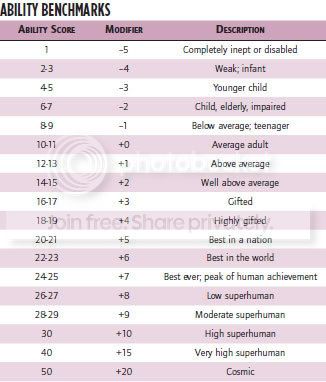
You choose your character’s ability scores by spending power points on them. One power point increases an ability score by 1, so putting one power point into Strength, for example, raises it from 10 to 11. Remember a score of 10 is average, 13-14 is a fair amount of talent or natural ability, 15-17 is exceptional, 18-19 is extraordinary, and so forth. (See the Ability Benchmarks table for guidelines.)
---Reducing Abilities
You can also lower one or more of your character’s ability scores from the starting value of 10. Each point you lower a score gives you an additional power point to spend elsewhere. You cannot lower an ability score below 0.
If you reduce an ability score to 0 (for –10 points), you lack that ability entirely (see Nonexistent Ability Scores).
-Ability Cost = Base score of 10.
-1 power point per +1 to an ability score.
-Gain 1 bonus power point per –1 to an ability score.
---Ability Modifiers
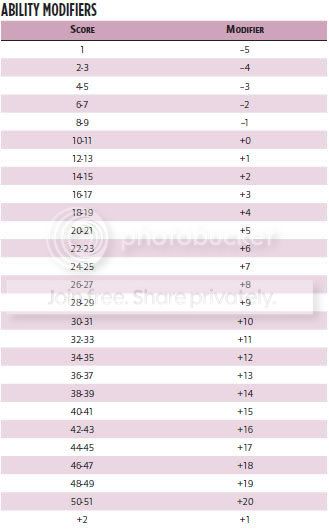
Each ability score has a modifier associated with it, based on how above or below average it is. An average ability score (10-11) has a modifier of +0. Ability scores below 10 have negative modifiers (penalties) while abilities above 11 have positive modifiers (bonuses). An ability score’s modifier is calculated by subtracting 10 from the score, dividing by 2, and rounding down any fractions. Modifiers are shown on the Ability Modifiers
table. The modifier is added to, or subtracted from, die rolls when your character does something related to that ability. For example, your Strength modifier affects the amount of melee damage you do. Your Intelligence modifier comes into play when you roll skills based on Intelligence, and so forth. Sometimes your modifier is used to calculate another value, such as when you use your Dexterity modifier to help determine how good you are at avoiding harm with your reflexes (your Reflex saving throw).
The maximum modifier you can have with an ability is equal to your power level +5. So the maximum score you can have in any ability is therefore equal to twice power level, plus 20. A power level 10 hero, for example, cannot have an ability score greater than 40 (a +15 modifier).
Strength is affected by the power level limits on damage.
The Abilities
Here are descriptions of the six abilities and how they affect your character.
---Strength (STR)
Strength measures sheer muscle power and the ability to apply it. Your Strength modifier applies to:
• Damage dealt by your melee or thrown weapon attacks.
• Climb and Swim checks.
• How far you can jump and throw things.
• The amount of weight you can lift, carry, and throw.
---Dexterity (DEX)
Dexterity is a measure of coordination, agility, speed, manual dexterity, and balance. It’s particularly useful for characters relying more on speed and agility than sheer strength and toughness. Your Dexterity modifier applies to:
• Reflex saving throws, for avoiding danger based on coordination and
reaction time.
• Initiative checks.
• Acrobatics, Stealth, Sleight of Hand, and other skill checks based on
Dexterity.
• Dexterity checks for feats of agility and coordination when a specific
skill doesn’t apply.
---Constitution (CON)
Constitution is endurance, health, and overall physical resilience. Constitution is important because it affects a character’s ability to resist most forms of damage. Your Constitution modifier applies to:
• Toughness saving throws for resisting damage.
• Fortitude saving throws, for resisting disease and poison, fatigue, and
effects involving the character’s health.
• Constitution checks to recover from damage and injury.
---Intelligence (INT)
Intelligence covers reasoning ability and learning. Intelligence is important for characters with a lot of skills like Craft and Knowledge. Your Intelligence modifier applies to:
• Craft, Knowledge, Search, and other skill checks based on Intelligence.
• Intelligence checks to solve problems using sheer brainpower when a specific skill doesn’t apply.
---Wisdom (WIS)
While Intelligence covers reasoning, Wisdom describes awareness, common sense, intuition, and strength of will. A character with a high Intelligence and a low Wisdom may be an “absent-minded professor” type, smart but not always aware of what’s going on. On the other hand, a not so bright (low Intelligence) character may have great common sense (high Wisdom). Your Wisdom modifier applies to:
• Will saving throws, for resisting attempts to influence your mind.
• Notice, Sense Motive, and other skill checks based on Wisdom.
• Wisdom checks to resolve matters of intuition when a specific skill doesn’t apply.
---Charisma (CHA)
Charisma is force of personality, persuasiveness, leadership ability and (to a lesser degree) physical attractiveness. Charisma is useful for heroes who intend to be leaders as well as those who strike fear into the hearts of criminals with their presence. Your Charisma modifier applies to:
• Bluff, Diplomacy, Intimidation, and other skill checks based on Charisma.
• Charisma checks to influence others through force of personality when a specific skill doesn’t apply.
Enhanced Abilities
Some ability scores may be acquired as Enhanced Abilities, as described elsewhere under powers. Enhanced Abilities are powers rather than entirely natural. The key differences between Enhanced Abilities and normal ability scores are Enhanced Abilities can be nullified (normal abilities cannot, see Nullify in the power thread) and Enhanced Abilities can have power feats and be used for power stunts with extra effort (normal abilities cannot, see Extra Effort). Enhanced Abilities and normal abilities have the same cost (1 power point per ability score point). The player decides if a character’s ability score is normal or enhanced and, if it is enhanced, how much of it is enhanced.
Enhanced Abilities are noted with the normal ability score in parentheses after them, such as 50 (16), indicating if the character’s Enhanced Ability is nullified, the character still has a score of 16 in that ability.
|
 |
|
|
|
|
|
|
|
|
|
|
|
|
|
Posted: Thu Feb 19, 2009 12:46 pm
Altering Ability Scores
Over the course of play, your hero’s ability scores may change for the following reasons:
• Some super-powers temporarily raise or lower ability scores.
• You can improve your ability scores permanently by spending earned power points on them, but you cannot increase an ability score above the limits set by your power level (see Power Levels). Whenever an ability score changes, all traits associated with the ability change as well. So if you increase your character’s Dexterity and gain a higher bonus, his Dexterity-based skills and Reflex saving throw bonus also increase. Likewise, if the hero’s Dexterity bonus decreases, his Dexterity-based skills and Reflex saving throws suffer.
Debilitated Ability Scores
If one of your hero’s ability scores drops to 0 for any reason, that score is said to be debilitated and the character suffers more serious effects. -Debilitated Strength means the hero collapses, helpless and unable to move.
-Debilitated Dexterity means the hero is paralyzed and helpless. -Debilitated Constitution means the hero is dying and cannot stabilize (and suffers a –5 modifier on Constitution checks to avoid death due to the low score).
-Debilitated Intelligence, Wisdom, or Charisma means the hero is unconscious and incapable of waking until the score is restored to at least 1.
Debilitated ability scores usually result from a power affecting your character. An ability score lowered to 0 during character creation is actually nonexistent; characters only suffer the effects of debilitated abilities if an ability score is lowered to 0 during play. Abilities scores cannot be lowered below 0. Traits based on ability modifiers, such as saving throws and skill bonuses, can be lowered to –5 (the “modifier” of a 0 ability score), but no lower.
Nonexistent Ability Scores
Rather than having a score of 0 in a given ability, some things or creatures in Mutants & Masterminds actually lack an ability score. The effect of lacking an ability score is as follows:
• Strength: Any creature capable of physically manipulating other objects has at least 1 point of Strength. A creature with no Strength score is incapable of exerting any physical force, either because it has no physical form (like an incorporeal ghost) or simply can’t move (like a tree). The creature automatically fails Strength checks.
• Dexterity: Any creature capable of movement has at least 1 point of Dexterity. A creature with no Dexterity cannot move (like most plants) and hence cannot make physical attacks. It automatically fails Dexterity checks and Reflex saves.
• Constitution: Any living creature has at least 1 point of Constitution. A creature with no Constitution has no physical body (like a ghost) or is not alive (like a robot or other construct). The creature always fails Constitution checks. This includes checks to avoid dying and to recover from injury, so creatures with no Constitution do not recover from damage naturally. They must be repaired in some fashion. The same is true of objects. Creatures with no Constitution suffer all damage as lethal (like objects do) and do not suffer nonlethal damage conditions. Creatures with no Constitution are immune to fatigue (see Fatigue) but cannot exert extra effort (see Extra Effort). Creatures with no Constitution are often—but not necessarily—immune to many of the things affecting living beings (see Immunity, in powers).
• Intelligence: Any creature that can think, learn, or remember has at least 1 point of Intelligence. A creature with no Intelligence is an automaton, lacking free will and operating on simple instinct or programmed instructions. Anything with no Intelligence is immune to mental effects, interaction skills, and automatically fails Intelligence checks.
• Wisdom: Any creature aware of its environment has at least 1 point of Wisdom. Anything with no Wisdom also has no Charisma. It is an inanimate object, not a creature. Objects are immune to mental effects, interaction skills, and automatically fail Wisdom checks.
• Charisma: Any creature capable of interacting with other creatures has at least 1 point of Charisma. Creatures without Charisma are immune to interaction checks and automatically fail Charisma checks.
Inanimate objects have no scores other than their Toughness (see Damaging Objects). Animate, but nonliving, beings such as robots or zombies have Strength and Dexterity, and may have Wisdom and Charisma (if aware of their environment and capable of interaction). They may have Intelligence (if capable of thought), but have no Constitution (since they are not living things). See Constructs for more information.
|
|
|
|
|
|
|
|
|
|
|
|
|
|
|
|
|
|
Posted: Thu Feb 19, 2009 12:55 pm
Attack Bonus
Your attack bonus represents overall combat ability. You add your attack bonus to your attack rolls to determine if you hit a target in combat. (For more on attack rolls and combat in general, see the Combat thread). Your attack bonus starts at +0. You spend power points to increase it, 2 points per +1 bonus. Power level limits your maximum attack bonus (see Power Level)
Defense Bonus
Your defense bonus represents your ability to avoid attacks. Your defense bonus adds to the difficulty to hit you in combat. Your defense bonus starts at +0. You spend power points to increase it, 2 points per +1 bonus. Power level limits your maximum defense bonus (see Power Level).
---Dodge Bonus
Half your defense bonus (rounded down) is a dodge bonus, which is lost under certain circumstances, such as when you are stunned, flat-footed, surprise-attacked, or otherwise unable to defend yourself normally. Other circumstances—such as when you are helpless—cause you to lose your entire defense bonus, and may apply additional penalties to your defense.
Specific circumstances are discussed in the Combat thread.
Saving Throws
Generally, when subject to an attack or hazard, you get a saving throw to avoid or reduce its effects. The types of saving throws are Toughness, Fortitude, Reflex, and Will.
• Toughness saves reflect resistance to damage or harm. They incorporate toughness, will to live, and overall durability. They are based on your Constitution modifier.
• Fortitude saves reflect health and resistance to threats like poison or disease. They incorporate stamina, ruggedness, metabolism, and immunity. They are based on your Constitution modifier.
• Reflex saves reflect reflexes and reaction time. They test your ability to dodge massive attacks or hazards, such as an explosion or a deadfall trap. They incorporate quickness, nimbleness, overall coordination, speed, and reaction time. They are based on your Dexterity modifier.
• Will saves reflect inner strength. They measure resistance to mental influence and domination. They incorporate willpower, mental stability, level-headedness, determination, self-confidence, self-awareness, and resistance to temptation. They are based on your Wisdom modifier.
You can increase your Fortitude, Reflex, and Will saving throws above the modifiers granted by your ability scores by spending power points. One power point grants you a +1 saving throw bonus. Your maximum bonus with these saves (including your ability modifiers) is the campaign’s power level +5. You can increase your Toughness save via powers such as protection.
Fortitude, Reflex, and Will Saving Throw
Cost = 1 power point per +1 save bonus
You can only increase Toughness saving throw bonus above your base Constitution bonus with feats and powers. Your maximum Toughness bonus is equal to the campaign’s power level. (See Power Level)
|
|
|
|
|
|
|
|
|
|
|
|
|
|
|
Posted: Thu Feb 19, 2009 1:11 pm
Capabilities
While abilities define the majority of a hero’s capabilities, there are a few others important to game play: movement speed, size, and carrying capacity (how much your character can lift).
Movement
Heroes and Villains in the comics move around a lot. During casual scenes, you usually won’t have to worry about movement rates. If a character arrives somewhere and takes a stroll around to get a feel for the place, or is flying around town on patrol, there’s no need to know exactly how fast the character goes, it just happens. However for combat, chasing each other, etc, it may be important to know how fast and far you can move.
Movement Pace
Characters generally move at a normal, accelerated, or all out pace. A normal person’s base movement speed is 30 feet, meaning a character can walk 30 feet as a move action. The following movement paces modify your base speed:
• Normal: A normal pace represents unhurried but purposeful movement at your speed, 30 feet per round for a normal unencumbered human.
• Accelerated: An accelerated pace is twice your speed, 60 feet per round for a normal unencumbered human. Taking two move actions in a round is accelerated movement.
• All Out: Moving four times your speed is an all out pace, the equivalent of running or sprinting, 120 feet per round for a normal unencumbered human. All out movement is a full action, and you lose your dodge bonus, since you can’t easily avoid attacks. However, if you’re using a movement power you gain a +2 bonus to Defense per rank in that power; so a hero with Flight 5 moving all out gets a +10 Defense bonus for his speed (it’s harder to hit a fast-moving target).
You can move all out for a number of rounds equal to your Constitution score. After that you must succeed at a Constitution check (DC 10) to continue moving all out. You must check again each round, and the DC increases by +1 for each check. When you fail a check, you become fatigued and must drop to an accelerated or normal pace (see Fatigue). Characters with movement powers have a normal speed granted by their rank. Accelerated movement doubles that speed. All out movement quadruples it.
Hampered Movement
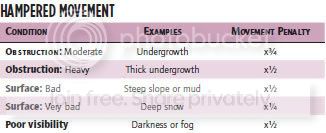
Obstructions, bad surface conditions, and poor visibility hamper movement. You may determine these before a fight, but be sure to agree before engaging in combat (see the Hampered Movement Table). When movement is hampered, multiply movement speed by the penalty (a fraction). For example, a character that normally could cover 60 feet with an accelerated move can cover only 30 feet while moving through thick undergrowth. If more than one condition applies, multiply speed by all appropriate movement penalty fractions. For instance, a character that normally could cover 60 feet with an accelerated move covers only 15 feet moving through thick undergrowth in heavy fog (one-half times one-half, or onequarter his accelerated move speed).
Jumping
Jumping is a special type of movement, based on your Strength. A jump is a move action. Distance moved by jumping counts as part of your normal movement in a round.
You can make a running long jump of (Str modifier + 10) feet, a standing long jump of half that distance, and a high (vertical) jump of a quarter that distance. Round all distances down to the nearest foot. So a Strength 10 (+0 modifier) character can make a running long jump of 10 feet, a standing long jump of 5 feet and a high jump of 2 feet (2.5, rounded down to 2). Increases to your Strength, including extra effort, increase your jumping distances as well. Super-Strength (see powers) does not increase jumping distances. Extra effort doubles your jumping distance for one jump. The Leaping power (see powers) greatly increases the distance you can jump. If you make a long jump and fail to clear the distance by your height or less, you can make a Reflex save (DC 15) to grab the far edge of a gap. You end your movement grasping the far edge. If this leaves you dangling over a chasm or gap, getting up requires a move action and a Climb check (DC 15).
|
|
|
|
|
|
|
|
|
|
|
|
|
|
|
|
|
|
Posted: Thu Feb 19, 2009 1:12 pm
Size
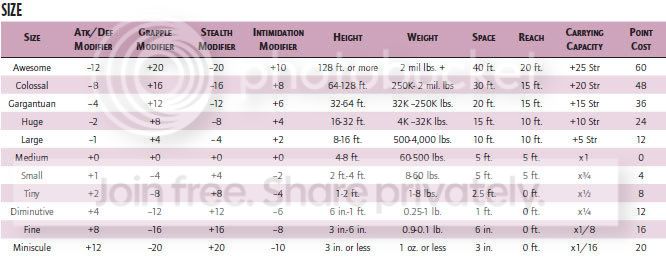
While heroes come in all sizes and shapes, most are generally within the human norms of size, ranging between four and eight feet tall or so (Medium-sized). Some heroes have the ability to alter their size using the Growth and Shrinking powers (see Chapter 5). Others are normally a different size, either larger or smaller. These characters have ranks of either Growth or Shrinking with a Permanent duration. A character’s size affects certain qualities. Modifications for size are shown on the Size Table. Permanent size modifiers count toward power level limits.
---Attack/Defense Modifier
Larger characters are easier to notice and hit relative to smaller characters, while smaller characters are harder to notice and hit. These modifiers cancel out for characters of the same size, who attack and defend normally against each other.
---Grapple Modifier
Larger characters have an advantage in trying to grapple smaller opponents. In addition to the modifier to grapple checks, a larger character can grapple more opponents of a smaller size: double the number of opponents the character can grapple at once per size category the attacker is larger than the defenders. So a Medium attacker can grapple one Medium opponent, two Small opponents (one under each arm, for example), four Tiny opponents, and so forth.
---Stealth Modifier
Larger characters have a harder time sneaking around, while smaller characters have an easier time remaining unseen and unheard. Apply this modifier to Stealth checks made at this size.
---Intimidation Modifier
Larger characters are more imposing, while smaller characters are less. Apply this modifier to Intimidation checks made at this size. Like Attack and Defense modifiers, they cancel out against opponents of the same size.
---Reach
A normal (Medium-sized) character has a 5 ft. reach, which means the character can make a melee attack at any target up to 5 ft. away. Larger and smaller characters have a longer or shorter reach, as shown on the Size Table.
---Space
A normal (Medium-sized) character is assumed to occupy a roughly 5-ft.- by-5-ft. space. Larger and smaller characters occupy more or less space, as shown on the Size Table.
---Carrying Capacity
Larger characters can lift and carry more, while smaller characters can lift and carry less. Larger characters gain an increase in effective Strength for carrying capacity: +5 points (a doubling in capacity) per size category. Smaller characters’ carrying capacities are multiplied by the value in this column. So a Tiny character with Str 10 has a heavy load of (100 × ½) or 50 lbs.
---Attack Area
If you are three size categories or more larger than your opponent, you have a chance to hit an opponent even if you miss your attack roll! If your attack roll misses due to your size modifier, your attack is considered an area attack filling the fighting space of an opponent three size categories smaller than you. So a Gargantuan attacker has a 5-ft area attack against Medium or smaller opponents. A Medium attacker has a 1-ft. “area” attack against Diminutive or smaller opponents, and so forth. If you roll a successful attack, it has the normal effect. If you miss, but would have hit if not for your size modifier, then the attack still hits, but the target gets to make a Reflex save for half effect (or none, if the target has Evasion). Other targets in the area of your attack are also hit by a normal area effect. See page 159 for details on area attacks.
...Example: A Gargantuan robot tries to stomp on the Bowman, who’s a normal (Medium-sized) target. The robot has a –4 to hit because of its size. If it succeeds, it hits Bowman square on. If it misses, but by 4 or less (the amount of its size modifier), then the stomp of its massive foot still has a chance of hitting Bowman. He gets a Reflex save to halve the damage and, since he has the Evasion feat, if he makes his save, he suffers no damage, leaping and rolling out of the way at the last second.
If the robot’s attack roll misses by more than 4, it misses Bowman completely.
---Carrying Capacity
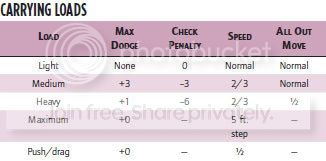
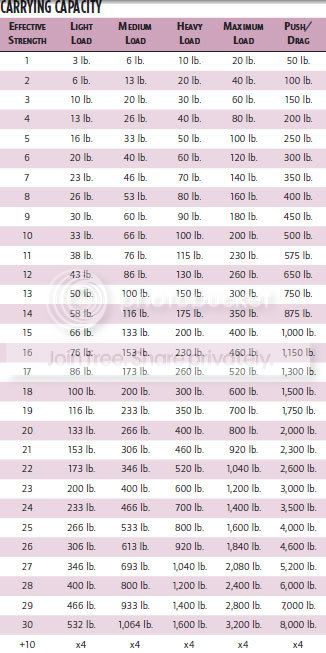
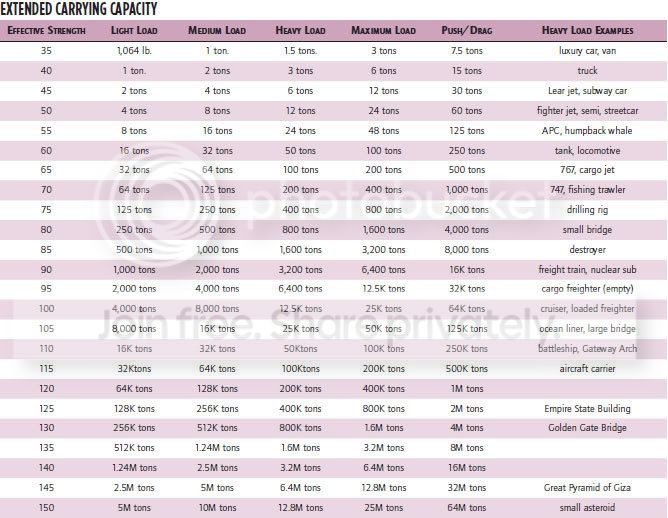
Carrying capacity determines how much weight characters can lift and how much additional weight slows them down. See the Carrying Capacity table for how much a character can lift based on Strength score. Characters with Super-Strength add +5 per rank to their Strength score when figuring carrying capacity.
• Characters can lift and carry up to a light load without any penalties or difficulties.
• Characters carrying a medium load have a maximum dodge bonus of +3 and a –3 penalty on all actions. They move at 2/3 normal speed.
• Characters can lift up to a heavy load overhead. While doing so they
have a maximum dodge bonus of +1 and a –6 penalty on all actions.
They move at 2/3 normal speed.
• Characters can lift up to the maximum load off the ground, but can only stagger around with it. While overloaded in this way, characters lose any dodge bonus to Defense and can move only 5 feet per round as a full action.
• Characters can push or drag up to five times their heavy load weight, moving at ½ normal speed. Favorable conditions (smooth ground, dragging a slick object) double these numbers, and bad circumstances (broken ground, pushing an object that snags) can reduce them to one-half or less.
• Characters can use extra effort to double their carrying capacity in all categories for one round (see Extra Effort).
---Larger And Smaller Creatures
The figures on the Carrying Capacity table are for Medium-size creatures. Larger and smaller creatures can carry more or less depending on size category as shown on the Size table. Larger and smaller creatures, as well as characters with powers such as Density, may also weigh more or less than usual. A character’s weight is not a factor in carrying capacity, only effective Strength. Carrying capacity is the lifting and carrying ability beyond that necessary to comfortably support and carry one’s own weight.
---Throwing
Characters can throw any object they can lift, up to a heavy load. (You cannot throw your maximum load, only drop it adjacent to you.) Picking up an object is a move action, while throwing it is a standard action, so it’s possible to pick up and throw an object in one round. The distance you can throw an object is based on its weight and your Strength. You can throw your heavy load 5 feet. For every 5 points of Strength you have over the minimum required to lift an object as a heavy load, move the distance you can throw it one step up the Time and Value Progression Table (see page 70). So, a Strength 40 character has 30 points more Strength than needed to lift 100 lbs. as a heavy load. That means (30 divided by 5) 6 steps up the Time and Value Progression Table. So a Strength 40 character can throw a 100-lb. object up to 500 feet!
When dealing with objects weighing less than 10 lbs., move throwing distance one step up the Time and Value Progression Table every time you halve weight. So a character can throw a 5-lb. object twice as far as a 10-lb. one, a 2-lb. object five times as far, and a 1-lb. object ten times further. Weights below 1-lb. can be treated as 1-lb. for simplicity. So the aforementioned Str 40 hero can throw a baseball (weighing less than a pound) over 25,000 feet (nearly 5 miles)! Throwing weapons in combat works off the weapon powers range.
|
|
|
|
|
|
|
|
|
|
|
|
|
|
|
|
|
|