|
|
|
|
|
|
|
|
|
 Posted: Thu Feb 19, 2009 11:04 am Posted: Thu Feb 19, 2009 11:04 am
Intro
The game system allows you to create any sort of character you want by choosing your character’s abilities, skills, powers, and other qualities. You have a starting “budget” of power points with which to build your character. There are also certain limits and guidelines imposed by your character’s power level, but within those limits you can build whatever type of character you want. The following section covers all the details of how to do it.
Be sure to read "Characteristics - Character Creation" as well for more in depth look at the role playing side and other aspects to character creation.
Creation Summary
Creating a character follows a series of simple steps, using the information presented in the other threads of the guild. You might want to use some scratch paper to start planning out your character and recording how many points you've spent.
1. Concept
Before you get started, consider what sort of character you want to create. What are the character’s basic abilities? What are the character’s powers? What’s the character’s origin? You may want to take a look at the character archetypes in others profiles for some idea of the different types of characters you can create. You also can draw inspiration from your favorite characters from comic books, television, or the movies. Take a look through the power examples thread and see if any of the powers there inspire a character idea. You may want to jot down a few notes about the sort of character you’d prefer to play, which will help guide you through the rest of the character creation process.
2. Check With A Boss Mod
Your BM may have particular house rules or restrictions on characters in the game, not allowing certain powers or concepts. Simply put some character idea's might not fit well within reasonable power limits (aka over powered), or may not have a theme that a BM approves of. Run your hero concept by a BM before you start working on it. You might also want to consult with your fellow players so you can create your characters together and ensure they’ll make a good team if you intend on role playing with them.
3. Power Level
The power level for starting characters is 1. All characters begin play at the same power level, which determines their starting power points and where you can spend them. See Power Level later for details.
4. Basic Abilities
Choose the ability scores you want your character to have and pay 1 power point for each ability score point over 10 (or you may lower these scores gaining 1 pp to spend, note this does not effect your overall "earned" to determine your PL, since it is both giving a pp, and taking away a spent pp equalizing). Choose the attack bonus and defense bonus for your character, paying 2 power points per +1 to attack or defense bonus. Choose the saving throw bonuses for your character, paying 1 power point per +1 save bonus. Keep in mind these bonuses are limited by power level. See Basic Abilities, for details on these abilities and Power Level later in this thread for more on power level limits.
5. Skills
Choose the skill ranks you want your character to have and pay 1 power point per 4 skill ranks. Keep in mind your character can’t have a rank in any skill greater than their power level +5. See Skills for details.
6. Feats
Choose the feats you want your character to have and pay 1 power point per feat or rank in a feat. See Feats for details.
7. Powers
Choose the powers you want your character to have and pay the power’s base cost, multiplied by the number of ranks. Power modifiers increase or reduce a power’s capabilities and cost. See Powers for details.
8. Complications and Drawbacks
Choose the complications you want your character to have. Choose the drawbacks you want your character to have (if any) and add their value to the power points you have to spend. Drawbacks do not effect your total PL for "pp earned" think of them as free points. Aka, normally when you earn a pp it goes towards your total PL, however for starting character creation such things do not (just like lowering a stat). See Drawbacks for more details.
9. Check Your Math
Go back through and add up the cost of your character's ability scores, attack bonus, defense bonus, saving throw bonuses, skills, feats, and powers, and subtract the value of your character's drawbacks. You should end up with a figure equal to 20. If not, double-check your math and either remove or add traits to your character to reach the starting power point total.
10. Add Up Saving Throws
Calculate your character’s total saving throw bonuses by adding together your base save bonus and ability modifier for each (Constitution for Toughness and Fortitude saves, Dexterity for Reflex saves, and Wisdom for Will saves). Remember the total for your tougness save can not exceed your PL and the total for your other saves can't not exceed your PL +5. Note if they do though that the excess is merely ignored until your PL goes up.
11. Finishing Details
Look through Characteristics and figure out details like your hero’s name, appearance, origin, background, and motivation. Choose your hero’s allegiances (if any). If you can, consider creating a sketch or detailed description of your character’s costume or appearance.
12. Boss Mod Approval
Show your new character to a Boss Mod for approval. To do so create a new thread in the profile sub-forum using the format provided, and put "your characters name - (unapproved)" in the title. The BM should check to make sure your power points are spent and added up correctly, the hero follows the power level guidelines, and is generally complete and suited to be reasonable. Once your BM has approved, your new character is ready for play!
|
 |
|
|
|
|
|
|
|
|
|
|
|
|
|
Posted: Thu Feb 19, 2009 11:27 am
Spending Power Points
Each trait costs a certain number of power points. You “spend” or allocate your power points to give your character different traits. Once spent, power points cannot be re-allocated without a BM’s permission. The basic costs of various traits are given on the Basic Trait Costs table, with specific costs for powers given in the powers thread, and specific values for drawbacks given under drawbacks.
Power Level
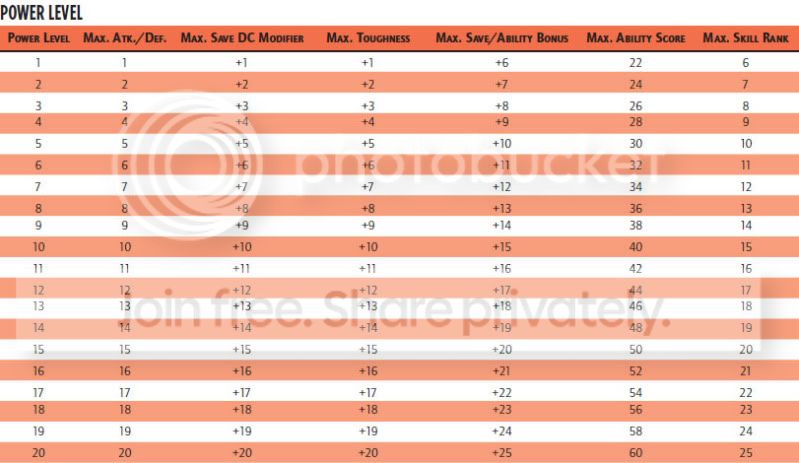
Power level is an overall measure of effectiveness and power, primarily combat ability, but also generally what sort of tasks a character can be expected to accomplish on a regular basis, assuming the ability to take 10 and take 20 (see Checks Without Rolls). It places certain limits on where and how players can spend points when creating or updating their character. Power level affects the following things:
• Attack: Your character’s total attack bonus cannot exceed the your power level.
• Defense: Your character’s total defense bonus cannot exceed your power level.
• Save Difficulty: The saving throw modifier for your character’s attacks and powers cannot exceed your power level. So at PL 8, for example, your character cannot have a save modifier greater than +8 (a
+8 damage attack, or a power with a save DC of 18, for example).
• Toughness Save: Your hero’s total Toughness saving throw modifier cannot exceed the your’s power level.
• Fortitude, Reflex, and Will Saves: Your character’s total Fortitude, Reflex, and Will save modifiers cannot exceed your power level +5.
• Skill Rank: A character cannot have more ranks in a skill than the your power level +5. So a PL10 character cannot have more than 15 ranks in any one skill (10 + 5).
• Ability Scores: Ability scores are limited to a bonus no greater than the
your power level +5. Strength is restricted by the Save Difficulty limit to a bonus no higher than the your power level, as is Constitution by the maximum Toughness limit. This means a limit of (10+ twice power level) for Strength and Constitution and (20 + twice power level) for other ability scores. The Strength and Constitution limits may be raised with an attack/defense trade off (see the following section).
• PL increase: Your power level increases by one every 20 power points you earn.
• Progression: You can not have more ranks in progression than your power level.
• Alternate Powers: You may only have a number of "alternate" powers equal to your PL.
---Note, some stances (combat options), feats (like accurate attack, power attack, etc) apply a - and increase your hit/dc/defense, these can exceed PL, as long as they have some sort of - drawback for doing so (such as accurate attack lowering your DC by 1-5 for granting an equal amount of hit, or aggressive stance increasing your hit for - defense, or slam attack increasing your DC for you taking damage as well, etc).
PL Limit Table
Attack/Defense Trade-Offs
Although your power level defines certain limits, there is some flexibility to them. Players can choose to lower one power level limit on a character to raise another related limit. You can adjust power level limits in the following ways:
(note all trade offs are limited to 3, and you may implement them, via boss mod permission, as you level up in PL)
• Attack & Save Difficulty: You can trade-off attack bonus for the saving throw Difficulty Class modifier with an attack on a one-to-one basis. So a PL 10 hero could have a +8 attack bonus in order to have a +12 save DC modifier, for example, or a character that has chosen to have a +13 attack bonus is limited to a +7 save DC modifier. This modification does not apply to powers that do not require attack rolls; they remain limited by your normal PL limit on save DC modifiers. Strength is considered an “attack” for purposes of this trade-off, so lowering your attack bonus limit increases your Strength bonus limit.
• Defense & Toughness: You can trade-off defense bonus for Toughness saving throw bonus on a one-to-one basis. So a PL 10 character with a +7 defense bonus could have a +13 Toughness save bonus. Conversely a character in the same campaign who has a +11 defense bonus is limited to a +9 Toughness save bonus.
Attack/defense trade-offs allow for some variety in combat-related bonuses while maintaining power level balance among the character's overall.
Re-Allocating Power Points
Normally a character’s traits are relatively fixed. Once power points are spent on traits, they remain there. In some cases, however, the BM may allow players to re-allocate their characters’ points, changing their traits within the limits of their power level, perhaps even losing some traits and gaining entirely new ones. This change may come about as the result of events in the series, such as a character encountering something that alters her powers (intense radiation, mutagenic chemicals, cosmic power sources, and so forth). It’s up to the BM when these character-altering events are enough to allow this, but they should be fairly rare.
|
|
|
|
|
|
|
|
|
|
|
|
|
|
|
|
|
|
Posted: Sat Feb 21, 2009 4:34 pm
Character Creation Example
For examples of how to create your own hero, let’s look at a short walk through of a hypothetical person going through the process.
The Martial Artist
Mark wants to create a hero who’s a martial artist of high caliber, someone with no super-powers, but great training and skill. Mark starts out with ability scores. He figures that his hero is going to start out weak much like everyone else in the guild, but should at least be fairly dexterous and thus starts with 14 dexterity. Each ability point above 10 costs 1 power point, so Mark has spent 4 of his 20 points.
Next, he looks at skills. He wants his adventurer to be quite skilled and makes a wish list of all the skills he wants. He figures acrobatics, spot, and listen will be fairly important and so puts 3 power points into skills, giving him 12 ranks to divide amongst them.
That leaves 13, or a little more than half, of his 20 power points remaining. Since Mark wants his adventurer to be a capable fighter, he looks next at attack and defense bonus. Since he doesn’t envision his hero either doing a lot of damage or being especially tough, he asks for, and receives, permission from the GM to lower his hero’s damage and Toughness save limits by 1 (the max when starting out), raising his attack and defense limits by the same amount. Mark then buys his hero’s attack bonus right up to the limit of +2 (1 for the game’s power level, +1 more for the trade-off). This costs 2 points per +1 to attack, or a grand total of 4 points. That leaves Mark with only 9 points, and he still has to buy his adventurer’s feats, powers, and saving throws. Fortunately, Mark has decided his hero doesn’t really have any powers, relying on skills and feats. So he first looks at his character’s saves. He buys up his Reflex save from +2 (for his 14 Dexterity) to +6 for 4 points and his Will save from +0 (for his 10 Wisdom) to +2 for another 2 points. He could increase them as high as +6, but that wouldn’t leave him many points for anything else, so he decides what he has is enough. He leaves his hero’s Fortitude save the same, since he decides his hero relies more on reflexes and strength of will. Mark has spent a total of (4+2) or 6 points on saves, half of what he has left leaving him with 3 pp.
Now he looks at his hero’s Toughness save. Mark can’t increase that directly by spending power points; you can only improve Toughness using feats and powers. His hero has a +0 bonus from his Constitution score and his Toughness save can be up to +0 (it would normally be +1, but Mark lowered his Toughness save limit to raise his defense bonus limit). Mark decides it would probably be good to have at leas one power, so he buys strike at rank 1 for 1 pp, leaving him with 2 pp remaining. He then looks at feats, knowing his martial artist over time will specialize in having them. He spots Improved Initiative and Evasion and notes they'd both be perfect for his character and decides to pick them up.
Mark looks over the list of Drawbacks but he doesn’t think any of them suit his hero, so he doesn’t take any.
Mark goes back and adds up his costumed adventurer’s points, coming up with the starting total of 20, so he presents his new hero, “the wandering stranger,” to a BM for approval and he’s ready to play!
|
|
|
|
|
|
|
|
|
|
|
|
|
|
|
|
|
|