|
|
|
|
|
|
|
|
|
 Posted: Wed Feb 18, 2009 2:09 pm Posted: Wed Feb 18, 2009 2:09 pm
This Thread looks at the components of powers, starting with effects and proceeding through modifiers, power feats, power drawbacks, power structures, and descriptors. It then looks at how to use these components to create powers. Effects:A power is made up of one or more effects. You can see examples of how effects combine to produce powers in the Example Powers thread. This section looks at the various types of effects available in the guild. These effects are the basic “building blocks” of the powers in the game; with them, you can create virtually any power you want. Effect Types:Effects fall into certain categories or types. Effects of the same type follow similar rules and provide descriptors for certain uses of other effects. This section discusses the different effect types and the rules governing them. Alteration:Alteration effects change or transform in some way. Most alteration effects work on their user, but can be modified to work on others as well. Alteration effects targeting others require a standard action and an attack roll as a default and always offer a saving throw. Attack:Attack effects are used offensively in combat. They generally require an attack roll and can damage, hinder, or otherwise harm their target in some way. Attack effects require a standard action by default and always offer a saving throw. Their duration is usually instant although their results—whether damage or hindrance—may linger until the target recovers from them. Defense:Defense effects protect in various ways, typically offering a bonus to saving throws, or granting immunity (automatic success on a save) against particular effects or conditions. Most defense effects work only on the user. Defense effects tend to be passive in nature, functioning at all times. General:General power effects don’t fit into any other particular category. They’re not governed by any special rules other than those given in the effect’s description. Movement:Movement effects allow characters to get around in various ways. There are three types of movement: normal move, accelerated move, and all out movement. A normal move is a move action and allows you to move your speed. An accelerated move is a full action (two move actions) and doubles your speed. All out movement is also a full action and quadruples your speed. You lose your dodge bonus while moving all out but gain a Defense bonus based on your speed. Movement effects always require at least a move action to use, but the move action is counted as part of the character’s normal movement. Sensory:Sensory effects enhance, alter, or work via the senses. Some sensory effects improve the user’s senses while others grant new senses or influence the senses in some way.Sensory effects that improve the user’s senses are typically passive and continuous or permanent in duration, requiring no action to use apart from that required to make the necessary skill checks (such as Notice, Search, or Sense Motive). Sensory effects that work on unwilling subjects are active, require a standard action as a default, and allow a saving throw. --- Sense Types:Senses are grouped into sense types, descriptors for how different sensory effects work. The different sense types, and the senses included in them, are: • Visual: normal sight, darkvision, detect, infravision, low-light vision, microscopic vision, ultravision, X-Ray vision • Auditory: normal hearing, detect, sonar, ultrasonic hearing • Olfactory: normal smell and taste,, detect, scent • Tactile: normal touch, blindsight (vibration), detect, tremorsense • Radio: detect, microwaves, radar, radio • Mental: detect, mental awareness, Mind Reading, Precognition, Postcognition Mental Effects:Mental senses are a special case for sensory effects that work on unwilling subjects: the subject must have an Intelligence score of at least 1 in order for the effect to work. Non-intelligent subjects are mindless and therefore unaffected. These sensory effects are noted as “(mental)” after their type. Mental effects are given as a separate effect type in the Mutants & Masterminds rulebook, but in this book (and future Mutants & Masterminds products) they’re defined as a particular type of sensory effect. Trait:Trait effects influence a target’s traits: abilities, saves, skills, powers, and so forth. Most trait effects are touch range, require a standard action, and allow a saving throw. Trait effects don’t work on traits with the Innate power feat, since they cannot be altered (see the Power Feats section for details). --- Trait Types:Traits are grouped into trait types, descriptors for how different trait effects work. The different trait types, and the traits included in them, are: • Abilities: all ability scores and saving throws • Skills: all skills, attack bonus, and defense bonus (including limited, but permanent, skill, attack, and defense bonuses) • Feats: all feats • Effects: each effect type is considered a separate trait type. Alternately, all effects of a particular descriptor (regardless of type) may be considered a single trait type, such as all magical effects or all fire effects. ProgressionMany power effects are measured in time, distance, area, mass affected, and so forth. The Time and Value Progression Table handles these measurements for effects in Mutants & Masterminds. Uses of the table are referenced in the individual power and modifier descriptions in this chapter. 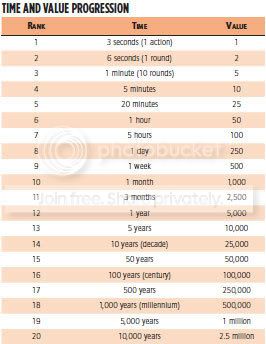
|
 |
|
|
|
|
|
|
|
|
|
|
|
|
|
Posted: Wed Feb 18, 2009 2:59 pm
Effect Descriptions
This section describes various effects available in Mutants &
Masterminds. Here is the format for effect descriptions: EFFECT NAME Type: The effect’s type. Action: The action required to use the effect. Passive effects have “(passive)” listed after their action, while active effects have “(active)” listed after it. Range: The effect’s range. Duration: The effect’s duration. Effects with lasting results have “(lasting)” listed after their duration. Saving Throw: The saving throw used to resist the effect. Harmless effects have “(harmless)” listed after the save type. Staged effects have “(staged)” listed after. Cost: How many power points the effect costs (per rank, if it is available in ranks). A description of the effect and what it does in game terms follows. Power Feats------------------------------------------------------------------------- This section describes power feats relevant to the effect. Extras------------------------------------------------------------------------- This section describes extras relevant to the effect. Flaws------------------------------------------------------------------------- This section describes flaws relevant to the effect. Drawbacks------------------------------------------------------------------------- This section describes power drawbacks relevant to the effect. Associated Effects------------------------------------------------------------------------- This section describes other effects commonly associated with the effect and how they may work together. If any of these later entries do not apply, they are omitted. So if an effect has no particular extras associated with it, for example, the Extras entry is omitted. In various parts of an effect’s description, certain circumstances may require multiplying the effect’s normal rank by a fraction (one-half, two-thirds, and so forth). Unless specified otherwise, round the results of all such fractions down to the nearest whole number. --- Profile Powers Code[align=center][size=11][u][b]POWERS[/b][/u][/align]
[b][/b]
-[u]Rank:[/u]
-[u]Cost:[/u]
-[u]Build:[/u]
-[u]Action:[/u]
-[u]Range:[/u]
-[u]Saving Throw:[/u]
-[u]Duration:[/u]
-[u]Description:[/u]
------------------------------------------------------------------------------------
[/size]
---------------------------OPTIONAL ADDITIONS---------------------------
(Note that the below codes and rules are not standard on all characters, rather "if" you have a power that uses them, THEN you add a new post that uses said codes. Otherwise there's no need to have them on your profile.
For example, you don't need a minion profile post unless you plan on having minions, etc. Even if you "might" have them later, you can simply request it be added once you acquire minions.)Linked Powers:When making a "linked" power make each power with the normal code but separate them with the following rather than the normal -------- line. ---Link--- Array:The "array" power is not built like a normal power rather it's only contains the following. [b]Name[/b]
[b]-Rank:[/b]
[b]-Cost:[/b]
[b]-Build:[/b] When making an array power separate each setting with the following rather than the normal -------- line. -----settingx----- the "x" next to setting is the number which power or set of powers is made. Remember that if a variable has a "set" of powers for one of it's settings that you don't separate them with any line, you only separate different settings (see FAQ). Device Powers:Finally for powers when you make a device you don't use the normal power code layout for the "device" bit, rather you use the following for the actual device power.
[b]Name[/b]
[b]-Rank:[/b]
[b]-Cost:[/b]
[b]-Build:[/b]
[b]-Description:[/b]
The powers built onto the device however do use a normal power build (see FAQ) just remember that they aren't separated by the -------- line like normal powers are to represent that they are all part of the same device.
|
|
|
|
|
|
|
|
|
|
|
|
|
|
|
|
|
|
Posted: Wed Feb 18, 2009 4:18 pm
Absorption
Type:Alteration
Action: None(passive)
Range: Personal
Duration: Continous
Saving Throw: None
Cost: 4 points per rank
You can absorb a particular type of damage, and use its energy to improve a trait or heal yourself. Choose physical or energy damage when you buy this effect. Subtract your Absorption rank from the damage bonus of the affected attack. If the remaining bonus is +0 or greater, make a normal Toughness save against the remaining damage bonus, otherwise you ignore the attack’s damage completely. Your Absorption rank counts as a bonus to your Toughness saves for power level purposes.
You gain 2 temporary power points per +1 damage bonus absorbed. After absorbing damage, as a reaction, you can immediately use these temporary power points, either to improve a particular trait (like a Boost effect) or to heal yourself, applying points to the Healing effect (one rank of Healing per 2 power points, as usual). Choose which effect you can do when you acquire Absorption; if you choose the Boost effect, you must also determine what trait it will be applied to. Your Absorption Boost can increase a power you don’t normally have—such as Blast—granting you temporary use of that power. If an Absorption Healing attempt fails, you can try again the next time you absorb energy (rather than having to wait or spend a hero point like Healing normally requires).
You can acquire the other effect of Absorption as an Alternate Power feat, but you can’t use both at the same time. So if you have Absorption Boost, you can acquire Healing as a power feat, but have to choose one effect or the other (Boost or Healing) each time you absorb energy. You can also acquire different forms of Absorption Boost as Alternate Powers, or apply Boost modifiers to your Absorption for a broader boosting effect (see the Boost effect description for details).
Example: Energizer has Energy Absorption 9 and is hit with a +7 damage lightning bolt. Since the damage is less than her Absorption rank, she absorbs all of it, gaining 14 temporary power points (+7 damage x 2). She can apply those absorbed points to the Blast power, of the same energy type as she absorbs; so, on the following round, she can throw a lightning Blast 7 right back.
Power Creation
Note this only applies if you have the "create" extra.
If you choose boost rather than healing for this power (shown as "Absorbtion(Boost)" or "Absorption(Healing)" you must specify what trait the boost gives. This can be done in an alternate post saying "granted absorption powers". This can give a full made power, or just give a buff to a skill, but only may give 1 pre-chosen thing which is tracked in a new profile post. To gain more choices simply use progression, each application bringing you one up the progression chart (1, 2, 5, etc).
Power Feats
• Energy Conversion: You can convert absorbed energy from one type to another (sound into light, or kinetic energy into heat, for example). This allows you to absorb one type of energy and project another, if you have a Blast power (or if your Absorption Boost grants you a Blast power).
• Slow Fade: This power feat can reduce the rate at which your stored energy fades, if you have the Energy Storage extra (see the following).
Extras
-------------------------------------------------------------------------
• Both Types (+1): You absorb physical and energy damage, not just one or the other.
• Create (+1): This allows the user to "create" a new power when gaining pp to apply as a boost. Normally you are only allowed to enhance existing effects, this rather lets you make entirely new ones, note they fade just like a normal "boost" does, ie at the rate of 1 rank per turn that passes. Only one power may be "created" at a time via application of this power, if a new one is added it simply replaces the old one (though the power added to avoid this may be an array or set of linked abilities).
• Energy Storage (+1): You can “store” absorbed energy. Each attack gives you energy equal to the damage bonus your Absorption stops. You can have up to (rank x 10) energy points at once (excess energy dissipates harmlessly). Stored energy harmlessly “bleeds off” at a rate of 1 point per round. You can reduce this rate with the Slow Fade feat. You can use your stored energy points to fuel your other absorption effects
(Boost or Healing) as desired on a 1 point per rank basis. The Progression feat increases your storage capacity by one multiple per application (x 11, x 12, and so forth).
• Power Magnet (+1): You can absorb energy from suitable sources (such as bonfires, generators, speakers, and so forth) at a distance of (power rank x 100 feet) with a ranged attack roll. It takes a standard action to absorb energy in this way. Reduce the power source’s output that round by your power rank and gain temporary power points equal to twice its rank or twice your power rank, whichever is less. This extra allows you to use Absorption to counter powers of the appropriate type at a distance and absorb their energy (see Countering Effects).
Flaws
-------------------------------------------------------------------------
• Limited (–2): Your Absorption affects only a specific type of energy, such as cold, electricity, heat, radiation, and so forth.
|
|
|
|
|
|
|
|
|
|
|
|
|
|
|
Posted: Wed Feb 18, 2009 4:55 pm
Additional Limbs
Type:Alteration
Action:None(passive)
Range:Personal
Duration:Permanent
Saving Throw:None
Cost:1 point per rank
You have one or more additional limbs, such as arms, legs, tentacles, or a prehensile tail (among others). You have one extra limb at rank 1. Each additional rank moves your number of extra limbs one step up the Progression Table: two at rank 2, five at rank 3, and so forth. In- between numbers of additional limbs should be considered the nearest higher rank. So four extra limbs, for example, is considered rank 3.
Additional Limbs do not allow you to take extra actions in a round, although they do provide benefits of the Improved Grapple feat- grappling with some of your limbs and leaving others free- and may make you more resistant to trip attacks( granting you a +4 bonus on the resistance check if they make your stance more stable.) All additional limbs except your dominate limb are considered your "off-hand." If you have Ambidexterity feat, you have no off-hand penalties with any of your limbs.
If you apply all of your Additional Limbs to a grapple attempt( rather than using the benefits of Improved Grapple to leave some of them free), you gain a +1 grapple bonus per rank in Additional Limbs.
Power Feats
-------------------------------------------------------------------------
* Extended Reach:Since Additional Limbs is a personal range effect this power feat does not affect it. To extend the reach of your limbs (additional or otherwise), use the Elongation effect.
* Innate:Additional Limbs are often innate qualities of a character or a creature's physiology, making this power feat appropriate.
* Split Attack:While Additional Limbs do not grant any additional attacks, applying this power feat to the character's unarmed attacks can reflect the ability of multiple limbs to strike at different targets.
* Subtle:The "effect" of Additional Limbs-namely having additional limbs- is not subtle, an exception to the normal guidelines on passive effects. At the Boss Mods discretion,(ether Darkbunnylord or myself), this power feat can give a character "invisible" Additional Limbs, detectable only by a certain unusual senses (rank 1) or not at all (rank 2). This works well in conjunction with the Projection extra (see the following) and may make the Additional Limbs capable of surprise attacks.
Extras
-------------------------------------------------------------------------
In general, power modifiers affecting attacks (e.g. Affects Corporeal, Area, Penetrating, etc.) should apply to the strength of the character with Additional Limbs rather than to the Additional Limbs effect itself. Such modifiers applied to strength affect all of the character's limbs.
* Duration:Additional Limbs can be made sustained in duration for a net +0 modifier. This reflects the type of power a character can turn on or off (growing or forming the additional limbs and then making them disappear just as easily). This is also the case for Additional Limbs made continuous (a +1 modifier) except the extra limbs remain until you choose to eliminate them, even if you were stunned or unconscious.
* Projection (+1):Your additional Limbs are merely a projection of your power rather then an extension of you. Therefore, they are not vulnerable to attack on their own; any attacks specifically against your Additional Limb(s) have no effect. So, for example, one of additional limbs could reach into a container of acid to pull out an object without any risk of harm. The Boss- mods (Darkbunny or myself), may require Additional Limbs with this extra to modify their duration to continuous or sustained, but this is not essential. It's likely that Additional Limbs with this extra are not eligible for the innate power feat.
* Range:Like the Extended Reach feat, this modifier does not improve the "reach" of the Additional Limbs themselves. For that, use the Elongation effect.
Flaws
-------------------------------------------------------------------------
* Distracting (-1):Coordinating the actions of multiple limbs may be distracting indeed, applying this flaw to the Additional Limbs effect results in the character losing any dodge bonus while applying any extra limbs to an action. This flaw should generally not apply to any character that has Innate Additional Limbs, especially if they are part of its natural physiology.
Drawbacks
-------------------------------------------------------------------------
* Noticeable:As noted under subtle, Additional Limbs are noticeable by default and probably shouldn't have this drawback unless they're a Projection or something truly unusual.
Associated Effects
-------------------------------------------------------------------------
Additional Limbs assumes the limbs are usable as arms or legs (or both). Other sorts of limbs-wings, for example- are better handled by other traits, such as Flight.
Common effects associated with Additional Limbs include:
* Elongation:Additional Limbs often take the form of tentacles, pseudopods, or prehensile hair with unusual stretching properties, making Elongation an appropriate additional effect. It is often Limited solely to the Additional Limbs, the rest of the character's body unable to elongate.
* Enhanced Strength:Additional Limbs may come with Enhanced Strength or Super-Strength, particularly mechanical or grafted-on limbs. As with Elongation, these effects may be Limited solely to the Additional Limbs.
* Strike:A character's Additional Limbs might have natural weapons such as claws or simply greater striking power, providing this bonus to melee damage. Note that Limited to Additional Limbs is generally not a suitable flaw for Strike, although the Boss Mods (darkbunny or myself) may approve a Power Loss drawback for Strike if the characters extra limbs are easier to restrain or avoid than normal limbs.
|
|
|
|
|
|
|
|
|
|
|
|
|
|
|
|
|
|
Posted: Wed Feb 18, 2009 7:50 pm
Anatomic Separation
Type:Alteration
Action:Move(active)
Range:Personal
Duration:Continuous
Saving Throw:None
Cost:2 point per rank
You can split off parts of your body and keep all of them functioning (relatively) normally. The process of separation causes you no harm, although it can be disconcerting to watch. You can split off a number of segments equal to your power rank; so rank 1 might allow you to detach a hand, arm, or foot (or even your head). Rank 5 could allow you to detach all your limbs (including your head), and so forth. You choose how you separate when you acquire the effect and it cannot be changed. Separating or reassembling your segments requires a move action.
Your separate parts remain fully functional, so you can see out of a separated eye, manipulate things with a separated hand, and so forth. Separated parts are limited to whatever movement their form allows, so a hand can crawl and a leg can hop, for example , an eyeball can even roll, but a separated head or torso isn't capable of much movement. You can use movement effects (such as flight) in conjunction with your separated parts. Separate parts have a modifiers based on their size. (See size chart) and retain your powers, so long as they're related to that body part.
Each segment gets a move action each round, but you can only take one standard action among them, regardless of how many segments you break into. The Boss Mods (Darkbunny or myself) assesses any suitable modifiers to your actions based on your current state of disassembly.
Separated parts have your normal Toughness save, but any failed save renders a separated part staggered or disabled. A second failed save renders the separate part immobile. When damaged part is reattached, remove its damage and add a bruised or injured condition to your character's damage track. You recover from this damage normally.
Extras
-------------------------------------------------------------------------
* Affects Others:With this Modifier, you can use this power on others, separating the body parts of another willing character. To affect an unwilling subject, you need the Attack Modifier(See the following)
* Attack:An Anatomic Separation Attack allows you to forcibly removes someone's body parts! However, the target retains control of any separated body parts, like a normal use of the Anatomic Separation effect. Although, you control which part(s) separate, the target still controls them. For the ability to control body parts you separate from the target, increase the extra to +1 to represent the addition of a linked Mind Control effect, Limited to the target's separated body parts. This control has a concentration duration, independent from the Anatomic Separation Attack, which can be increased normally with the duration extra.
* Range:An Anatomic Separation Attack can have this extra, allowing it to work at normal range. A +2 extra extends it to perception range.
* Variable Split (+1):You can choose how you separate when you use the effect. So at rank 1, you can choose to detach any individual part.
Flaws
-------------------------------------------------------------------------
* Action:With this flaw, separating your parts takes a longer than a move action. A standard action is a -1 fla, while a full-round action is a -2 flaw. Longer than one full round is a power drawback (see the Action power drawback).
* Permanent:If applied to Anatomic Separation, the Permanent flaw means you cannot re-combine your body into a whole; you are always separated into a number of segments equal to the effects rank. You cannot have the Variable Split extra, and maintaining any sort of secret identity is difficult, to say the least.
Drawbacks
-------------------------------------------------------------------------
* Involuntary Transformation:If you have circumstances where you lose control of your Anatomic Separation and literally "go to pieces," apply this drawback.
* One-Way Transformation:If you can freely separate your segments, but reattaching or reuniting them is more involved, requiring special tools or extra time, for example, apply this drawback.
|
|
|
|
|
|
|
|
|
|
|
|
|
|
|
Posted: Wed Feb 18, 2009 8:40 pm
Array
Cost: 1 point per rank
Array is whats known as a "power structure" not a power in it's own respect.
You spend X power points, each gaining a rank in "Array" and purchase 1 power with that pool of points.
You have a number of different "settings" on the array or "alternate powers". Alternate power is a power feat (see below) that you can place as many times as you want on Array, each one allows you to spend a number of power points equal to your rank in "Array" on a new power that's part of the Array.
Note, the array's alternate powers are like channels on a tv, you can turn to one or the other but not both at the same time. However this only works for "non-lasting" effects, if an effect is "lasting" it continues to effect it's target until they save, however the "user" of the lasting power can no longer use it in any fashion without sacraficing use of whatever other channel they are on.
For example, if you where using mind control, which has a lasting effect you could effect someone with it, then next round use another setting on the array for some other power. The enemy would still be mind controlled until they passed a save since it's a "lasting" effect, however you could not give them any commands.
-You may only have a number of "alternate powers" no higher than your power level.
-All powers on an array must be related, for example you might be able to have a fiery dart, a fiery dazzle, and even a fiery aura all as different settings on the shield but you couldn't have a fiery blast, the ability to go incorporeal, and the ability to heal on the same array unless they made sense. Essentially if they all seem like the same power that's "used" slightly different (such as firing a fiery blast out to harm someone or firing at the ground to fly as two different settings) then it can be included in an array, otherwise it can't.
(For array layout see the FAQ)
Power Feats
-------------------------------------------------------------------------
• Alternate Power: This provides a new "setting" for your array. You may only take this no more times than your PL. Whenever a new alternate power is activated on the array any other power you had active that was part of the array deactivates.
You can NOT link different settings, though you may have a linked set of powers as one setting as long as their total cost does not exceed your Array rank x1.
Alternate powers in an array need not be linked but they may (so you could have several cheap powers as one setting and use them all at the same time).
|
|
|
|
|
|
|
|
|
|
|
|
|
|
|
|
|
|
Posted: Fri Feb 20, 2009 12:47 am
Boost
Effect: Trait
Action: Standard (active)
Range: Touch
Duration: Instant
Saving Throw: Fortitude (harmless)
Cost: 1-5 points per rank
You can improve a trait or traits temporarily. You can boost yourself or others by touch.
Take a standard action to use Boost. Each rank improves the targeted trait by 1 power point. These temporary points fade at a rate of 1 per round until they are gone and the trait returns to its normal value (this rate can be slowed using the Slow Fade power feat). Temporary power points that restore a trait back to its normal starting value do not fade.
You can boost the trait again before the temporary power points have faded, but you cannot add more than your Boost rank in power points to a trait. Boosts are not cumulative; only the highest-ranked one applies to any given trait at any given time. So combining Boost 3 and Boost 8 results in an increase of 8 power points, not 11, and applying Boost 10 to a trait after 5 power points have faded raises the temporary power points back to 10, not 15.
The cost per rank determines the effect of Boost:
• 1 point: Boost improves a single trait, chosen when the effect is acquired (such as Strength, the Blast power, etc.). If the subject does not have the targeted trait they may gain it temporarily, at a BM’s discretion. To affect a list of specific traits, one at a time, acquire different Boosts as Alternate Power feats.
• 2 points: Boost can affect any trait suiting your descriptors, one at a time. If the subject does not have the targeted trait they may gain it temporarily, at the BM’s discretion.
• 3 points: Boost affects all of a group of traits at once (ability scores, skills, feats, or effects of a particular type or descriptor). Each affected trait gains the benefits of the Boost. The subject must have the targeted trait(s).
• 4 points: Boost affects all of the subject’s powers at once.
• 5 points: Boost affects all of the subject’s traits at once.
You cannot Boost permanent or innate effects. Boosted traits must generally remain within the campaign’s power level limits, although the BM should feel free to waive or modify this requirement as best suits the needs of the game (see Buffing Powers for further discussion).
Power Feats
-------------------------------------------------------------------------
• Slow Fade: This power feat reduces the rate at which boosted traits fade. The GM may set a limit on ranks in Slow Fade to prevent abuse (such as boosts that take days or even longer to fade).
• Subtle: Boost is not Subtle by default and requires this power feat for its effects to go unnoticed.
• Triggered: This power feat allows you to set a trigger for Boost under a particular circumstance. Note that a Triggered Boost is only good for one use before the trigger must be reset. For a triggered type Boost usable over and over when circumstances recur, change the power’s action to a reaction with the Action modifier (see the following).
Extras
-------------------------------------------------------------------------
• Action: Boost usable as a reaction can occur automatically in response to a particular circumstance, such as when you become angry or suffer damage, for example. Choose the circumstance when you apply the modifier.
• Affects Others: Boost Affects Others by default. If it only Affects Others, then it has a flaw (see Flaws, following).
• Alternate Save: You can change Boost’s save to Will to reflect a more mental-based effect.
• Create (+1): This allows the user to "create" a new power when gaining pp to apply as a boost. Normally you are only allowed to enhance existing effects, this rather lets you make entirely new ones, note they fade just like a normal "boost" does, ie at the rate of 1 rank per turn that passes. Only one power may be "created" at a time via application of this power, if a new one is added it simply replaces the old one (though the power added to avoid this may be an array or set of linked abilities).
• Duration: Boost’s duration can only be changed with the Slow Fade power feat and the Total Fade extra (see Total Fade, following). For long-lasting enhancements to traits, see the Enhanced Trait effect.
• Range: Boost is normally touch range. A +1 extra enhances it to ranged, while a +2 extra makes it perception range. Personal range Boost has a flaw (see Flaws, following).
• Selective Attack: An Area Boost can have his extra, which is quite useful in ensuring only the user’s allies receive the benefits of the Boost.
• Total Fade: A Boost effect with this modifier does not fade slowly, but all at once when its normal duration is up. This is useful for “binary” Boosts that are on/off rather than fading slowly; one moment the Boost is full-strength, then it’s gone.
Flaws
-------------------------------------------------------------------------
• Emotional (–1): Your Boost is limited to either when you are feeling a particular strong emotion or when others around you are, such as only when you as particularly angry, or only when you are surrounded by love, fear, or such. Among other things, this means your Boost effect may be countered (or enabled) by effects like Emotion Control. If your Boost activates automatically in response to an emotion, apply the Action extra to reduce it to a reaction instead; this flaw does not apply (since reactions are already limited by circumstance).
• Fades: This flaw is already a part of the Boost effect and cannot be applied to it (or removed from it).
• Others Only (–1): You can Boost other characters, but not yourself.
• Permanent: Since Boost’s duration cannot be altered this flaw cannot apply to it.
• Personal (–1): Your Boost is personal range and affects only you.
• Restorative (–1): A Boost effect with this flaw only improves traits up to their normal (purchased) values and is therefore only good for restoring power points lost to some other effect, like Drain. Traits restored to their normal value do not fade, just as with a normal use of Boost.
• Tiring: A Boost may represent some sort of superhuman extra effort (see Extra Effort). In this case, the Tiring flaw is appropriate, making the effect work just like normal extra effort by fatiguing the user.
|
|
|
|
|
|
|
|
|
|
|
|
|
|
|
Posted: Sat Feb 21, 2009 1:02 am
Burrowing
Type: Movement
Action: Move (active)
Range: Personal
Duration: Sustained
Saving Throw: None
Cost: 1 point per rank
You can burrow through the ground, leaving a tunnel behind if you choose. You move at a speed of 1 MPH at rank 1. Each additional rank moves your speed one step up the Progression Table, to a speed of around 5,000 miles per round at rank 20, allowing you to dig straight through the Earth to the other side! (Provided you can survive the conditions near the planet’s molten core.) Speeds per rank are shown on the Burrowing Movement table.
You burrow through soil and sand at your normal speed. Burrowing through hard clay and packed earth reduces speed one rank. Burrowing through solid rock reduces it by two ranks. The tunnel you leave behind is either permanent or collapses behind you immediately (your choice when you begin burrowing each new tunnel). Note that Burrowing differs from the Permeate effect of Super-Movement, which allows you to pass through an obstacle like the ground at your normal speed without disturbing it at all (see Super-Movement for details).
Power Feats
-------------------------------------------------------------------------
• Subtle: Your burrowing effect somehow dampens the usual vibrations and noise associated with rapidly tunneling through the ground, making it more difficult (or even impossible) for those on the surface to detect your approach and movements with effects like tremorsense (see the Super-Senses effect for details).
Extras
-------------------------------------------------------------------------
• Action: The action required to use Burrowing cannot be decreased, since it includes moving through the tunnel, and reducing the action needed for a character to move is not recommended.
• Affects Others: The +0 version of this extra grants another character the Burrowing effect. The +1 version is not required to bring others along with you as you burrow unless you want them to automatically keep pace with you; others can still follow down the tunnel you leave behind at their own pace, even without the Affects Others extra.
• Area: At the BM’s discretion, this extra—specifically the Burst Area—can widen the size of the tunnel you burrow from large enough to accommodate you to (rank x 5 feet) in radius, allowing you to excavate large tunnels and even artificial caverns.
• Penetrating: Normally, the hardness of the ground affects only the speed at which you burrow. At the BM’s discretion, some super-hard materials may be considered Impervious to Burrowing, in which case this extra allows you to dig through them, provided your Penetrating rank reduces the material’s Impervious Toughness to equal to your less than your Burrowing rank.
• Range: This extra either allows you to create tunnels at a greater distance (without having to be at the end-point of the tunnel as it forms) or, in conjunction with Affects Others, allows you to grant the Burrowing effect to someone else at a distance. Doing both requires two applications of the extra.
Flaws
-------------------------------------------------------------------------
• Distracting: Burrowing may well be distracting, reducing your dodge bonus while you are moving through the earth (and leaving you more vulnerable to attack while doing so). If combat while you are burrowing is unlikely in the BM’s opinion, this flaw may be disallowed or reduced to a complication.
• Limited: Burrowing may be limited to certain circumstances or materials, such as only loose sand and soil (leaving the character unable to burrow through dense clay or solid rock), or only snow and ice (being unable to burrow through earth and soil at all).
Associated Effects
-------------------------------------------------------------------------
• Damage: The same trait that allows a character to burrow through the earth—claws, drill-bits, digging beams—may also grant the ability to inflict damage as an attack.
• Immunity: Burrowing assumes a pocket of atmosphere fills the tunnel as it forms. However, for especially lengthy periods underground, or trips that may involve pockets of natural gas or the intense heat of the planet’s core, the Immunity effect (particularly life support, possibly with Affects Others) is desirable.
• Super-Senses: Burrowing does not include the ability to see where you are going while underground, so Super-Senses may be helpful for long-range or rapid burrowing. Tremorsense and X-Ray Vision are particularly useful in this regard (see the Super-Senses effect for details).
|
|
|
|
|
|
|
|
|
|
|
|
|
|
|
|
|
|
Posted: Sat Feb 21, 2009 1:15 am
Communication
Type: Sensory
Action: Free (active)
Range: Extended
Duration: Sustained
Saving Throw: None
Cost: 1 point per rank
You can communicate over a distance using a medium other than your normal voice. Choose a sense type as the medium for your communication (see the list of examples). You may also use a special sense type (neutrinos, gravitons, magical sendings, and so forth) noticeable only to an appropriate form of the detect Super- Sense (see Super-Senses in this chapter).
The following are some types of communication associated with particular sense types. This is by no means an exhaustive list, and the Boss Mod(Darkbunny or myself), is free to allow other sorts of Communication, as
best suits the character and the setting.
• Visual: laser or fiber optic link.
• Auditory: ultrasonic or infrasonic beam, “ventriloquism.”
• Olfactory: pheromones or chemical markers.
• Tactile: vibratory carrier wave.
• Radio: AM, FM, and short-wave radio bands, microwaves.
• Mental: telepathic transmission, psychic link, mystical sending.
Base range for Communication is 10 feet at rank 1. Each additional rank increases range as shown on the Extended Range Table. Communication is instantaneous with any subject within your range.
The recipient of your communication must be within range and have a means of receiving your transmission (super-sense, or a receiver of some sort; a score of 1 or more in all mental abilities is all that’s needed to “receive” Mental Communication). You can receive Communication of the same medium as your own. Receivers can choose to ignore your Communication, if they wish. Communication is language-dependent; you and the subject must share a common language (see Comprehend to communicate across language barriers). Your Communication is point-to-point (sent to a single receiver within your range). Activating your Communication effect is a free action. Communicating, however, takes the normal amount of time. You can apply the Rapid power feat to speed things up, provided your recipient is capable of receiving communication at that speed. Others with an acute sense able to detect your Communication medium can “tap into” your transmissions with a Notice check (DC 15 + your Communication rank). The eavesdropper must be within normal sensory range of you or the receiver. Your Communication
can be blocked or “jammed” by sensory effects such as Dazzle or
Obscure affecting your transmission medium.
Power Feats
-------------------------------------------------------------------------
• Affects Insubstantial: As a sensory effect, Communication does not need this power feat for insubstantial subjects to perceive it.
• Dimensional: Communication with this power feat can bridge dimensional barriers, reaching into other dimensions and planes of existence. The Communication effect still has its proximate range, and the Boss Mod may rule certain subjects “out of range” of the effect, depending on their relative position in the other dimension.
• Rapid: Your communication occurs 10 times faster than normal speech. Each additional rank of this feat increases communication speed by a factor of 10. This is useful for high-speed computer links, “deep sharing” psychic rapports, and so forth.
• Selective: If you have the Area extra, you can choose which
receiver(s) within range get your Communication, excluding everyone else. This allows you to go from a single receiver (point-to-point) to all potential receivers in range (omnidirectional) or anywhere in between.
• Subtle: Your Communication cannot be “overheard” (it is
encrypted, scrambled, or otherwise protected). If you apply the feat twice, your Communication cannot even be detected (that is, no one can even tell you are transmitting, much less what you’re saying).
Extras
-------------------------------------------------------------------------
• Area: You can broadcast omni-directionally to every receiver
within your maximum Communication range at once. Note this extra is only strictly necessary to communicate with every- one over a wide area at once; since using and maintaining.Communication are free actions, the Boss Mod may allow a communicator to establish and maintain contact with multiple discrete receivers—such as the members of the same team—all in the same round.
Flaws
-------------------------------------------------------------------------
• Duration: As a default, Communication requires only a modicum of attention to maintain, making it sustained. Some Communication effects may require greater focus, making them concentration duration (and essentially limiting the user to move and free actions while communicating).
• Distracting: Communication use may be distracting, particularly if it requires a degree of concentration to maintain (see Duration, previously).
• Limited: Communication may be limited to only members of a particular group, such as a species, family, members of an organization, and so forth. This is in addition to limitations imposed by medium (that is, requiring subjects to have a means of picking up on the Communication). Particularly limited groups may qualify for a greater flaw (–2 or more) as the Boss Mod sees fit.
• Sense-Dependent: Communication itself is already sense-dependent (in that the subject(s) must be able to sense your communication medium to pick up your transmissions) and so cannot have this flaw. However, other perception range effects can be Communication-Dependent, meaning you must be in communication with your subject for them to work (using your Communication medium as a “carrier” for the other effect). If your Communication is blocked in any way, the other effect doesn’t work. An example is a mental power that is Mental Communication Dependent.
Associative Effects
-------------------------------------------------------------------------
• Comprehend: Since Communication isn’t much use if the
person on the other end can’t understand you, or you can’t understand them, Comprehend Languages is a common effect associated with Communication.
• ESP: Communication is often Linked with ESP, allowing for
“two-way” reception: the user can both send messages and perceive the subject’s replies (assuming the subject does not also have Communication). Communication may also be linked to ESP to allow the user to both perceive a distant area and communicate with those present there.
|
|
|
|
|
|
|
|
|
|
|
|
|
|
|
Posted: Sat Feb 21, 2009 1:48 am
Comprehend
Type: Sensory
Action: None(passive)
Range: Personal
Duration: Continuous
Saving Throw: None
Cost: 2 points per rank
You can comprehend different forms of communication; even communicate with subjects normally incapable of doing so. Each rank allows you to choose one of the following options:
• Animals: You can either speak to or comprehend animals (creatures with Int 1 or 2). You can ask questions and receive answers, although animals are not any more friendly or cooperative than normal. Furthermore, wary and cunning animals are likely to be terse and evasive, while especially stupid ones tend to make inane comments. If an animal is friendly toward you, it may do some favor or service for you. For two ranks you can both speak to and understand animals.
• Codes: You can decode various codes or ciphers automatically, understanding them as if they were written or spoken in your native language.
• Electronics: You can verbally communicate with electronic devices. Most are limited by their programming and peripherals in terms of what they “know,” and may not be able to answer some inquiries. Machines tend to be cold and mechanical, and may not be cooperative. At the Boss Mods(Darkbunny or myself) discretion, you can use the Computers and Disable Device skills in place of Diplomacy and Bluff when speaking with machines. For two ranks you can both speak to machines and understand their replies.
• Languages: For one rank you can either speak or understand the language of any intelligent creature. You can speak only one language at a time, although you can understand several languages at once. For two ranks anyone able to hear you can understand what you’re saying, regardless of language (you can effectively “speak” multiple languages at once). For three ranks you can both speak and understand all languages at once. Being able to read any language requires one more rank. This effect does not enable you to communicate with creatures that don’t possess a language; see the other Comprehend effects for that.
• Objects: You can communicate with inanimate objects (other than plants and electronics), granting them the ability to speak to you or simply “reading” impressions from them. This requires two Comprehend ranks. Objects only “know” about events directly affecting them or occurring in their immediate area. Boss Mods(Darkbunny or myself) can apply the guidelines for Postcognition to this effect (see Super-Senses for details).
•Plants: You can either comprehend or communicate with plants, both normal plants and plant creatures. You can ask questions of and receive answers from plants. A plant’s sense of its surroundings is limited, so it won’t be able to give (or recognize) detailed descriptions or answer questions about events outside its immediate vicinity. For two ranks you can both speak to and understand plants.
• Spirits: You can communicate with incorporeal and normally invisible and inaudible spirit beings, such as ghosts or certain extradimensional entities, depending on what beings exist in the context of the setting. One rank essentially allows you to function as a “medium” of sorts, speaking to spirits and comprehending their replies. However, you do not gain any ability to summon or compel spirits. At the Boss Mods discretion, this effect may extend to undead creatures, demons, or other supernatural entities, depending on the setting.
Extras
-------------------------------------------------------------------------
• Affects Others: Comprehend only includes the ability to speak or understand the languages of others. If you wish to grant others the ability to do the same (speak and understand your language, for example, or give two others the ability to understand each other without you acting as a translator) then apply this modifier, usually at the +1 level to apply to yourself and others.
• Area: Comprehend that Affects Others can have this modifier to grant its benefits to everyone in the affected area. Area Comprehend can also have the Selective power feat to allow you to “filter out” who does and does not gain its benefits.
Flaws
-------------------------------------------------------------------------
• Distracting: Since the use of Comprehend in combat may not be particularly important, the Boss Mods may wish to disallow this flaw, as appropriate for the setting.
• Duration: Comprehend is normally continuous. If it requires at least a modicum of focus to maintain, it may be sustained, if it requires considerable focus or effort to maintain, its duration may be lowered to concentration. The Boss Mod can require Concentration skill checks to maintain Comprehend under difficult circumstances if its duration is reduced, such as when dealing with a babble of conversation all at once.
• Limited: You can only comprehend a broad type of subject (only elves, canines, avians, or sea creatures, for example) as a –1 flaw. You can only comprehend a narrow type of subject (dogs, falcons, or dolphins, for example) as a –2 flaw.
• Permanent: Permanent duration is not considered a flaw for Comprehend, given its effects. It does not apply.
• Unreliable: At the Boss Mods discretion, an Unreliable Comprehend effect may provide an incorrect or misleading translation on a failed roll rather than simply not working at all.
|
|
|
|
|
|
|
|
|
|
|
|
|
|
|
|
|
|
Posted: Sun Feb 22, 2009 2:19 pm
Concealment
Type: Sensory
Action: Free(active)
Range: Personal
Duration: Sustained
Saving Throw: None
Cost: 2 points per rank
Using this effect, you gain total concealment from a particular sense—usually sight or hearing—although you are still detectable to other senses (even other senses of the same sense type). Each additional rank gives you concealment from another sense; two ranks give you concealment for an entire sense type. Concealment from visual senses costs double (2 ranks for one visual sense, 4 ranks for all visual senses). You cannot have concealment from tactile senses, since that requires being incorporeal
(see Insubstantial). So at rank 5, you can have total concealment
from all visual senses (4 ranks) and normal hearing (1 rank), for example. At rank 10 Concealment you have total concealment from all sense types other than tactile. While concealed, you can make surprise attacks against targets unaware of your presence (see Surprise Attacks). Attackers have a 50% miss chance against you (a roll of
11 or better on d20), assuming they know where to attack at all! Attackers able to perceive you with an accurate sense suffer no penalties, and combat is resolved normally. Someone can sense the presence of a concealed character within three Notice range increments with an acute sense (see Super-Senses for details) and a DC 20 Notice check, such as using hearing to detect a character concealed from sight. The
observer gains a hunch that “something’s there” but can’t accurately perceive it (suffering the normal miss chance, for example). A concealed character holding still is harder to notice (DC 30). A concealed inanimate object or completely immobile creature is very hard to notice at close range (DC 40). It’s practically impossible (+20 DC) to accurately pinpoint a concealed character’s location using an acute sense.
Power Feats
-------------------------------------------------------------------------
• Close Range: The “close range” where someone can sense
your presence with an acute sense is adjacent (5 feet) rather than three Notice range increments.
• Innate:This power feat is appropriate for subjects with innate
or natural concealment qualities that cannot be nullified.
• Selective: You can vary your Concealment at will (a free action): going from total to partial to no concealment, concealing some parts of you and not others, or anywhere in-between. If your Concealment affects multiple senses, you can choose to affect some and not others with this feat as well. Concealment is normally all-or-nothing: either you are concealed or you’re not.
• Subtle: Concealment is Subtle by nature and does not require
this power feat, since going unnoticed is part of its effect. It may also conceal the display of your personal range effects (see Noticing Power Effects).
Extras
-------------------------------------------------------------------------
• Affects Others: The +1 level of this modifier allows others to
benefit from your Concealment effect while you are touching them.
• Area: Concealment with Affects Others (previously) or Attack
(immediately following) may have this extra, affecting all subjects in the area. To conceal an entire area, see the Obscure effect.
• Attack: Use this extra for a Concealment effect you can impose on others (whether they want to be concealed or not). An invisibility ray, for example, is a Visual Concealment Attack. A Concealment Attack calls for a saving throw, usually Reflex or Will.
Flaws
-------------------------------------------------------------------------
• Blending (–1): You “blend” into the background. Your Concealment only functions as long as you move no faster than your normal pace, since your blending can’t adapt faster than that.
• Limited: Your Concealment only works under certain conditions, such as in fog, shadows, or in urban locales.
• Limited to Machines (–1): Your Concealment is Limited only to senses with a technological descriptor. This includes ordinary things like cameras and microphones as well as intelligent robots (if such things exist in the setting).
• Partial (–1): Your effect provides partial rather than total concealment (see Concealment).
• Passive (–1): Your Concealment only lasts until you make an attack—defined as any action requiring a saving throw—at which point it stops working until you reactivate it, which you may do on the round after you attack.
• Phantasm (–1): Your Concealment is Limited to creatures with Intelligence 1 or greater; unintelligent creatures and machines (cameras, microphones, etc.) perceive you as if you were not concealed at all. This usually indicates Concealment that is some sort of mental or hallucinatory effect. This flaw does not apply to Mental Concealment (which is already so
limited by definition).
• Sense Dependent: Concealment is already sense-dependent and cannot have this flaw.
• Saving Throw (–1): Your Concealment offers a saving throw
(Fortitude, Reflex, or Will, chosen when the flaw is applied) for anyone aware of your presence and actively looking for you. Targets get a new save for each interval on the Time Table that passes. This flaw is often combined with Phantasm (previously).
|
|
|
|
|
|
|
|
|
|
|
|
|
|
|
Posted: Sun Feb 22, 2009 2:36 pm
Confuse
Type: Sensory(mental)
Action: Standard(active)
Range: Ranged
Duration: Instant(lasting)
Saving Throw: Will
Cost: 1 point per rank
The target of this effect becomes confused, unable to independently determine his or her actions. If the target’s Will save fails, roll on the Confused Behavior Table at the beginning of the subject’s turn each round to see what the subject does that round.
Confused Behavior Table
D20 BEHAVIOR
1-2 Attack the user of the Confuse effect.
3-5 Act normally.
6-10Do nothing but babble incoherently.
11-14Flee at top possible speed.
15-20Attack the nearest creature.
A confused character unable to carry out the indicated action does nothing (like a result of 6-10 on the table). Attackers are not at any special advantage when attacking a confused character. Any confused character who is attacked automatically attacks its attacker on its next turn, as long as it is still confused. The target gets a new Will save each round to shake off the Confuse effect, with a +1 bonus each round.
Boss Mods may allow substitutions on the Confused Behavior Table to customize the effect, such as changing “Do nothing but babble incoherently” to “Sing and dance Broadway show-tunes” or making “Flee at top possible speed” into “Close eyes and mutter ‘go away, go away, go away,’” or the like. As a general rule of thumb, a 1–2 result should always be something detrimental to the power user, and 3 –5 should remain “Act normally” but otherwise feel free to modify (or expand) the Confused Behavior Table as desired.
Power Feats
-------------------------------------------------------------------------
•Reversible: You can reverse your Confuse effect at will as a
free action.
Extras
-------------------------------------------------------------------------
• Alternate Save: Confuse may be based on Fortitude rather
than Will to reflect a biochemical effect, such as a drug or pathogen. Such forms of Confuse are also often touch range and may also have the Disease or Poison modifiers.
• Contagious: A Contagious Confuse effect might represent some sort of “plague of madness” or “telepathic virus” that spreads from subject to subject.
Flaws
-------------------------------------------------------------------------
• Sense-Dependent: This flaw may reflect a Confuse effect requiring eye contact or based on flashing lights, maddening music, or an inhaled psycho-chemical, for example, rather than affecting a target automatically. These version of Confuse must be Perception range.
|
|
|
|
|
|
|
|
|
|
|
|
|
|
|
|
|
|
Posted: Sun Feb 22, 2009 2:46 pm
Create Object
Type: General
Action: Standard(active)
Range: Ranged
Duration: Sustained
Saving Throw: (see description)
Cost: 2 points per rank
You can form solid objects essentially out of nowhere. They may be made of solidified energy, “hard” water or air, transmuted bulk matter, ice, stone, or something else entirely, depending on the effect’s descriptors.
You can form any simple geometric shape or common object (such as a cube, sphere, dome, hammer, lens, disk, etc.). The Boss Mods has final say on whether or not a particular object is too complex for this effect. Generally, your objects can’t have any moving parts more complex than a hinge. They can be solid or hollow, opaque or transparent, as you choose when you use the effect. You can create an object up to one 5-foot cube in size per power rank with Toughness up to your power rank. Created objects can be damaged or broken like ordinary objects (see Damaging Objects, see rules sub forum). They also vanish if you stop maintaining them. You can repair any damage to a created object at will by using your effect again (essentially “re-creating” the object).
Created Objects, Cover, And Concealment
---------------------------------------------------
A created object can provide cover or concealment (if the object is opaque) just like a normal object. Cover provided by a created object can block incoming attacks, but blocks outgoing attacks as well. Attacks hitting the covering object damage it normally. Indirect effects can bypass the cover a created object provides just like any other cover (see the Indirect power feat description). Selective Create Object allows you to vary the cover and concealment your objects provide.
Trapping With Ojbects
--------------------------------
You can trap a target inside a large enough hollow object (a cage or bubble, for example). The target gets a Reflex saving throw to avoid being trapped. A trapped character can break out of the object normally. Limiting the target’s mobility in addition to trapping them requires a Snare effect rather than Create Object (see Snare in this chapter). You may wish to place a Snare in an Array with Create Object (see Array in this chapter).
Dropping Objects
----------------------------
Dropping a created object on a target is treated like an Area Attack based on the object’s size (see Area Attack, see rules subforum). The object inflicts damage equal to its Toughness, and targets get a Reflex saving throw to evade the falling object. A successful save results in no damage (rather than the usual half damage). While a created object can potentially be wielded as an improvised weapon, the Create Objects effect cannot otherwise create attacks or other effects; you must acquire these separately (as Linked effects or Alternate Powers in an Array, for example).
Supporting Weight
----------------------------
If a created object needs to support weight—created as a bridge or support a weakened structure, for example—treat the object’s effective heavy load strength as (Create Object rank x 5). So a rank 8 object can support 3 tons, the same as Strength 40 (or 8 x 5). More than a heavy load causes the object to collapse. You can “shore up” a created object by taking a full-round action and concentrating, allowing it to support twice its normal heavy load for one round. You can also use extra effort to double a created object’s maximum support for one round, and these modifiers are cumulative.
Power Feats
-------------------------------------------------------------------------
• Affects Insubstantial: Created Objects with this power feat are also solid to insubstantial beings; half their normal Toughness for one rank, full normal Toughness for two. This allows a created object to block or entrap an incorporeal character, for example.
• Innate: Create Object with this feat makes objects that cannot
be nullified, they’re essentially “real” objects for all intents and purposes (although the user can “unmake” them at will unless the effect is permanent).
• Precise: You can create more precise and detailed objects. The
exact parameters of Precise Create Object are up to the Boss Mods, but generally, you can create objects with moving parts, and considerable detail. A Craft skill check may be required in some cases to create an object properly, but this feat grants a +4 bonus on the check.
• Progression: Each time you apply this power feat, the base size of your objects per power rank increases one step on the Progression Table (10-foot cube per rank, then 25-feet, etc). Other attributes based on rank (such as Toughness and save DC) do not change.
• Selective: This feat allows you to make your created objects selectively “transparent” to attacks, blocking some while allowing others (yours and your allies’, for example) to pass through them harmlessly. You can also selectively make your objects solid to some creatures and incorporeal to others, such as allowing one person to walk through a created wall, while blocking another. It takes a free action to change the selective nature of an object; permanent created objects cannot have
their selectivity changed once they are created.
• Stationary: Your created objects can hang immobile in the air.
They resist being moved with a Strength bonus equal to your power rank. Unless you have the Tether feat or the Movable extra, you cannot move a stationary created object once it’s placed any more than anyone else can.
• Subtle: The Subtle feat either makes created objects not noticeable as such for 1 rank (they look just like real objects) or not noticeable at all for 2 ranks (such as objects composed of invisible force).
• Tether: Your created objects can move along with you at your normal movement speed, maintaining their position relative to yours.
Extras
-------------------------------------------------------------------------
• Area: The size and area of created objects is improved by power rank and the Progression feat. This extra therefore does not apply to Create Object.
• Duration: Continuous Create Object makes objects that remain until they are destroyed, nullified, or you choose to dis- miss them.
• Impervious: Applied to Create Object, this extra makes the objects’ Toughness Impervious. As with Protection and related effects, the Boss Mods may choose to limit Impervious Toughness to no greater than the campaign’s power level.
• Movable: You can move your created objects around with a Move Object effect at your Create Object rank (see Move Object in this chapter for details).
Flaws
-------------------------------------------------------------------------
• Feedback: You may suffer damage when your created objects
are damaged (see Feedback flaw description for details).
• Permanent: Permanent created objects last until destroyed or
nullified. Unlike continuous Create Object, you cannot choose to dismiss such objects; they are truly permanent. You cannot repair permanent created objects or otherwise alter then once they’re created.
|
|
|
|
|
|
|
|
|
|
|
|
|
|
|
Posted: Mon Feb 23, 2009 12:13 pm
Damage
Type: Attack
Action:Standard(active)
Range: Touch
Duration: Instant
Saving Throw: Toughness(staged)
Cost: 1 point per rank
You have a damaging attack. Make an attack roll to hit the target. The attack’s damage bonus equals your rank. Damage is a basic damaging effect, but has many possible variations using different power feats and modifiers.
DAMAGE AND RANGE
-----------------------------
The basic Damage effect is touch range, usable as a melee attack. It does not take the user’s Strength modifier into account unless the effect has the Mighty power feat (see Power Feats, following), in which case the user’s Strength adds to the damage bonus. A ranged Damage effect is usable at either melee or normal (rank x 100 feet) range. A perception range Damage effect works at any range, without the need for an attack roll, so long as the user can accurately perceive the target. So a Damage effect usable at melee and normal range that adds the user’s Strength is a Mighty Ranged Damage effect. See the following power feats and modifiers for more information.
Power Feats
-------------------------------------------------------------------------
• Accurate: This power feat is functionally the same as the Attack Specialization feat, except it is a quality of the effect itself rather than a measure of the character’s skill or talent in using it.
• Affects Insubstantial: Depending on the descriptors, this power feat can represent Damage attuned to a particular wavelength, dimensional phase, radiation band, or supernatural source, allowing it to affect insubstantial targets.
• Mighty: Damage effects with this power feat stack with your normal Strength damage, allowing you to apply your muscle-power to enhance the effect. One rank of the Mighty feat is sufficient for a touch range Damage effect to stack with Strength (which is also touch range). For a normal range Damage effect, each rank of Mighty allows 1 point of Strength damage bonus to stack with the effect. So a character with +4 unarmed damage needs Mighty 4 to add his entire Str bonus to his ranged Damage effect. For perception range Damage effects, every 2 ranks of Mighty allow 1 point of Strength damage bonus to stack. Strength over the amount allowed by the Mighty power feat rank doesn’t stack and doesn’t apply to the effect. The Boss Mods should decide on a case-by-case basis if ranged or perception Mighty feats are appropriate.
• Precise: A Damage effect with this feat may be capable of precision cutting, etching, welding, or the like, depending on its descriptors. Ranged Precise Damage effects also gain the benefits of the Precise Shot feat (see Precise Shot, rules Sub forum): ignoring the –4 penalty for allies in melee with a target.
• Split Attack: This power feat is commonly used with Damage
effects to represent the ability to make a single “focused” attack or multiple smaller attacks against different targets and may suit characters with multiple clawed limbs, two- (or more) handed fighting styles, dual weapons, and so forth.
• Subtle: Damage with this power feat may involve a medium
that’s harder to notice: a near-invisible gas, for example, or an attack that occurs too quickly for the eye to follow. A Subtle Damage effect may be suitable for making surprise attacks under the right circumstances. To be most effective, Subtle Damage effects need to be normal or better range, since it’s considerably easier to know the source of touch range Damage
(although, if the Damage is delayed in some way, perhaps not
even then).
• Thrown: You can “throw” your Damage effect to hit a target at a distance, with a range increment of (Thrown feat rank x 10) feet and a maximum range of five increments (Thrown feat rank x 50 feet). This feat may represent a throwing weapon or the ability to “throw” a natural melee attack like quills or claws. If you have a Mighty Thrown Damage effect, you can add your Strength bonus to the damage, but no more than the rank of the Damage effect or the Mighty feat, whichever is greater. Once you have used Thrown with a Damage effect, you can- not use it again until you recover it. This may involve picking up a thrown weapon, re-growing a natural weapon, building up a sufficient charge, or the like. The exact circumstances are up to the Boss Mods(Darkbunny or myself), but it should usually be something you can do automatically at the end of a combat. For a “throwing attack” you can use every round, either because of unlimited ammunition or a weapon that automatically returns to you after it hits, apply the Range extra to make your Damage effect normal or perception range, possibly with the Reduced Range drawback.
Extras
-------------------------------------------------------------------------
• Action: It’s recommended the Boss Mods not allow move action and free action Damage effects, due to their potential to allow characters to make an overwhelming number of multiple attacks. Reaction Damage effects are best handled by the Aura extra (see the following) although the Boss Mods may find other suitable applications of Reaction Damage effects, provided the circumstance doesn’t create an effect so useful as to be unbalancing.
• Alternate Save: Since Damage requires a Toughness saving
throw this extra is a +1 modifier when changing that save to Fortitude or Will. A Fortitude Damage effect may involve direct damage to a target’s physiology, bypass normal physical protection, perhaps even an insidious physical degradation. Will Damage bypasses the body altogether to strike at the mind or even soul. In either case, the result of the saving throw is the same, it’s just a different save bonus that’s used, and damage
is applied in the same manner, regardless of its source; characters don’t have separate tracks for “physical” and “mental” damage, for example.
• Area: This is a common extra for Damage involving explosions
or spreading or engulfing attacks like gases, fiery clouds, and so forth (see the Area extra description for details).
• Aura: Damage is a common basic effect for an Aura. It may
represent a damaging energy surrounding you or some sort of automatic or reflexive counterattack against anyone who attacks you (see the Aura extra description for details).
• Autofire: This extra is common for Damage effects, particularly Ranged Damage like an automatic weapon.
• Contagious: Contagious Damage remains so until the target
recovers from it (including if the damage is treated with Heal or Regeneration). It may represent a damaging medium like a chemical agent coating the target. Depending on the effect and its descriptors, the Boss Mods may also allow certain other effects to counter a Contagious source of damage.
• Duration: Damage with a duration longer than instant continues to affect its target on succeeding rounds, requiring a new saving throw each round on the attacker’s initiative. This usually represents an ongoing damaging effect of some sort. This sort of Damage should have some reasonable means by which it can be countered, such as dousing or smothering fiery ongoing Damage.
• Penetrating (+1): This extra allows Damage to overcome
the effects of Impervious Toughness. Reduce the ranks of the Impervious modifier by the ranks of Penetrating Damage. So Penetrating Damage 7 reduces the Imperviousness of a target’s Toughness by 7. So Impervious Toughness 11 would be treated as +11 Toughness with only 4 ranks of Impervious (11 – 7). Any remaining Impervious Toughness is applied normally against the attack, so if the Penetrating modifier does not reduce the Impervious modifier below the attack’s damage bonus, the attack still has no effect.
• Range: The standard Damage effect is touch range. One application of this extra creates a damaging effect usable at normal range (although still useful at melee range as well), while a +2 extra gets you a perception range Damage effect.
Flaws
-------------------------------------------------------------------------
• Action: A full-round action Damage effect suits an attack requiring some preparation or additional “build-up.” For example, a “haymaker” punch might be a Full Action Mighty Damage effect. Generally speaking, Damage effects requiring longer than a full-round action are not useful in combat and tend to be better suited as plot devices, wherein a villain’s
death-ray needs to charge up for a minute or two, for example, giving the heroes time to stop it before it’s too late.
• Distracting: A Distracting Damage effect is a bit of a trade-off in combat, requiring some risk. It’s good for things like attacks that need bracing (such as certain weapons) or require extra concentration (taking attention away from potential threats).
• Limited: Damage can be Limited in a number of ways. The most common include only certain targets (living creatures, machines, or supernatural beings, for example), or a reduced effectiveness against some targets. For the latter, apply the Limited flaw only to some of the effect’s ranks, such as Damage with half effect against targets wearing armor (meaning half its ranks have the Limited to Unarmored Targets flaw).
• Range: Reducing the range of a Damage effect to personal
is more than just a flaw: it converts the effect into more of a drawback, since the only one you can damage is yourself! For characters with some sort of inherent or automatic ability to damage themselves, consider an appropriate drawback instead. For example, minions that automatically self-destruct when they’re captured have a fairly severe Weakness, worth
about 10 power points. Of course, for non-player characters, you can choose to just treat such things as plot devices and not worry about their point-values.
|
|
|
|
|
|
|
|
|
|
|
|
|
|
|
|
|
|
|