|
|
|
|
|
|
|
|
|
 Posted: Tue Dec 30, 2008 4:40 pm Posted: Tue Dec 30, 2008 4:40 pm
Disclaimer and Index Please do not post in this thread. This is basically what the booklet says, so I am not taking credit for any of it. Considering the fact that I am not claiming this as my own or selling it, it is not illegal. The following is from the Yu-Gi-Oh! Trading Card Game Official Rulebook Version 3.0.
So here we go.
Index
Post 1 ~ Disclaimer
Post 2 ~ Object of the game, Winning a duel, Getting started, The field
Post 3 ~ Game Cards, Monster Cards
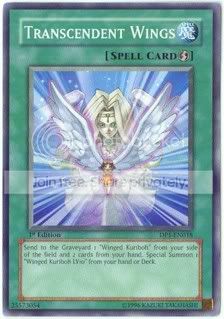
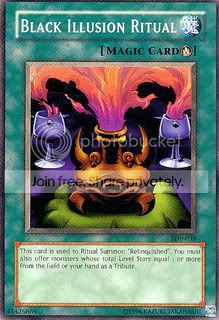
Post 4 ~ Magic Cards
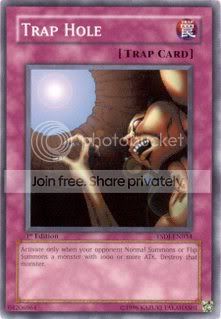
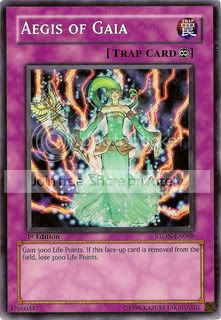
Post 5 ~ Trap Cards
Post 6 ~ Building your deck
Post 7 ~ Chains
Post 8 ~ Phases of gameplay
Post 9 ~ Phases of gameplay continued
|
 |
|
|
|
|
|
|
|
|
|
|
|
|
|
Posted: Tue Dec 30, 2008 5:52 pm
Object of the game The object of the game is to win. The end. Next!Winning a duel The outcome of a Duel is decided according to the following Official Rules.
*Each player begins a Duel with 8000 Life Points.
*Life Points decrease as a result of damage calculation after battle (see damage step, post 5). You win a Duel if you reduce your opponent's Life Points to 0. If your opponent reduces your Life Points to 0, you lose.
*If you and your opponent both reach 0 Life Points at the same time, the Duel is considered a DRAW.
*If either player's Deck runs out of cards during a Duel, the first player unable to draw a card is declared the loser (this is also called Milling your opponent).The Field The game mat is normally 2 by 7 (2 cards going up and down seven times across the field) with the exception of the removed card spot beside the Deck Zone and Graveyard OR above the Graveyard.
It goes in this order:
TOP: Field Card Zone, Monster Card Zone (5 spaces for Monster Cards), and Graveyard.
BOTTOM: Fusion Deck Zone, Magic and Trap Card Zone (5 spaces for Magic/Trap Cards), and Deck Zone.
Field Card Zone: Field Magic Cards are activated or Set here. Only 1 Field Magic Card can be in play at any one time.
Monster Card Zone: Monster Cards can be Summoned (face-up; vertically) or Set (face-down; horizontally) to the 5 spaces of the Monster Card Zone following the rules of Main Phase I. QUICK NOTE: The Monster Card Zone has a 5-CARD LIMIT. Once all 5 spaces are occupied, no further Monster Cards can be Summoned or Set until there is an open Monster Card Zone.
Graveyard: When cards are destroyed, they are placed face-up in this space. The contents of the Graveyard are public knowledge and your opponent can ask/look through it at any time.
Fusion Deck Zone: If you are playing with Fusion Monsters, put them all face-down in this space.
Magic and Trap Card Zone: Magic and Traps cab be activated (face-up) or Set (face-down) to the 5 spaces of the Magic and Trap Card Zone following the Rules of Main Phase I. QUICK NOTE: Since it only has 5 spaces you need to treat it like the Monster Card Zone.
Deck Zone: Place your Deck face-down on this space.Getting Started *The deck used for dueling should contain a minimum of 40 cards. Aside from the this minimum limit, it can contain as many cards as you want it to.
*In any duel, the deck can not contain any more than 3 copies of the same cards. Also, be aware of the Forbidden and Limited Cards (see Forbidden and Limited Cards thread).Gameplay
Both players shuffle their respective decks and place them face-down on the Deck Zone on the mat/field.
When using Fusion Monster Cards, place the cards face-down on the Fusion Deck Zone of the mat/field. The cards of the Fusion Deck are not counted in the 40 cards minimum limit of the deck.
Decides who starts the duel in any way you want (like using a dice-roll). Who ever wins can decide who goes first or second.
Finally, each player draws five cards from the top of their respective decks and the duel begins.
|
|
|
|
|
|
|
|
|
|
|
|
|
|
|
|
|
|
Posted: Fri Jan 02, 2009 10:53 am
Game Cards Quick Note: In all cases where the rules conflict with a gamecard's effect, follow the rules of the card.
Game Phrases
Activate: Whenever you use the effects of a Magic Card, Trap Card, and Effect Monster Card, you 'activate' the card's effect. When you activate a card's effect it is immediate.
Set: The act of placing a card face-down on the field. A Set card's effect is not activated until it is flipped. A Set Monster Card is not considered Summoned until it is flipped face-up by the controller. A Set Monster must be placed Horizontally in face-down defense position (A Summoned Monster is placed Vertically in face-up attack). Set Magic and Traps are placed Vertically in the Magic and Trap Card Zone.
The Field: The Monster Card Zone, Magic and Trap Card Zone and Field Card Zone all together will be considered the Field.
Destroyed: Any cards destroyed will be sent to the Graveyard.
Removed from Play: A card that is removed from play is Not sent to the Graveyard. Instead it is set aside for the whole duel and is not allowed to re-enter in the current duel.
Normal Monster Cards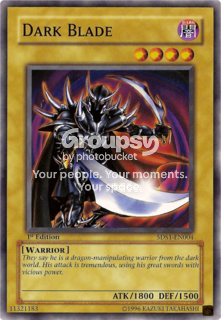 A Monster Card is the basic card used to attack your opponent. Monster Cards are catagorized by Type and Attribute. Type and Attributes will sometimes affect each monster's ability to Attack and Defend. Normal Monster Cards are color-coded yellow. Name: Dark Blade Attribute: Dark Stars: 4 Type: Warrior Attack: 1800 Defence: 1500 Depending on how many stars a monster has will determine if you have to tribute other monsters to summon it and how many. 1 to 4 Stars: No Tributes 5 to 6 Stars: 1 Tribute 7 or more: 2 Tributes
Quick Note: Whether it is a Normal Monster or an Effect Monster, you can only summon one per turn (so if you summon a Normal Monster you can not summon another Normal Monster or an Effect Monster and vice versa).Types Dragon, Spellcaster, Zombie, Warrior, Beast-Warrior, Beast, Winged Beast, Fiend, Fairy, Insect, Dinosaur, Reptile, Fish, Sea Serpent, Machine, Thunder, Aqua, Pyro, Rock, Plant Attributes Earth, Water, Fire, Wind, Light, Dark Effect Monsters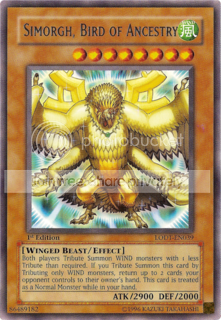 Monster Cards that possess magical effects are referred to as Effect Monster Cards. There are different kinds of effects and they will all be covered. For details of the effects, refer to the card you are using. Effect Monster Cards are color-coded Orange. Effect Monsters contain the same attributes, types and amount of tributes to summon by stars as Normal Monsters do. Types of Effects Flip: These monsters are identified by the word 'FLIP' at the begining of their card description. The monster's effect is activated when this card is flipped from face-down to face-up as a result of a Magic or Trap Card, or another person's attack. If a Flip effect monster is destroyed as a result after being activated, the Flip Effect is applied before the card is sent to the Graveyard. They can also be activated during any of the Main Phases of your turn (after one turn has passed after setting them). Quick Note: If a Flip Effect Monster is Normal summoned/Special summoned into face-up attack or face-up defence (depening on the effect of some cards) then it's Flip Effect is not activated!
Continuous Effect: As long as this Monster Card is face-up on the field, its effect remains active. When the Monster is face-down then it's effect is not active.
Cost Effect: You must discard your hand or pay Life Points in order to activate this card. Costs vary from card to card so be sure to read the instructions on each card.
Trigger Effect: These cards are activated when you have fullfilled a specific requirement indicated on the card itself (when you inflict Direct Damage to an opponent's Life Points, etc.).
Multi-Trigger Effect: These are special Effect Monsters that you can activate even during your opponent's turn. Fusion Monster Cards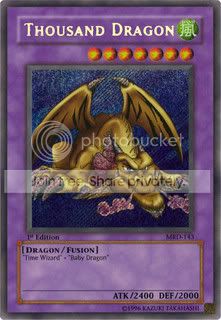 'Fusion' means using 2 or more Monster Cards together with the Magic Card 'Polymerization' or any other card that will fuse together two or more monsters, to create a new monster, represented by a Fusion Monster Card. Each Fusion Monster Card also lists the monsters necessary to create it (Fusion-Material Monsters), and is further identified as 'Fusion' next to its type. The color of these cards is violet. Gameplay Rules for Fusion Monsters If you have the Fusion-Material Monsters either in your hand or on the field (or both) you can activate Polymerization or any other fusion card to summon the appropriate Fusion Monster. If you summon a Fusion Monster, it is treated as a Special summon so you can either set or summon another monster during that turn.
Quick Note: Unless the Fusion Monster requires a tribute in order to be summoned, you may ignore the stars on the card. Fusion Deck A Fusion Deck is a group of Fusion Monsters that result from a successful fusion. When a Fusion is performed, Fusion Monsters are not randomly drawn, but selected from the Fusion Deck. The Fusion Deck should always be seperate from the Deck and placed face-down in the Fusion Deck Zone of the field. Remember that the cards in the Fusion Deck are not counted in the 40 card minimum limit of the Deck. Ritual Monster Cards A Ritual Monster is a special monster that can be summoned onto the field only when you have a designated Ritual Magic Card and the Monster Cards required to fulfill the conditions described on the Ritual Magic Card as a tribute, either on the field or in your hand. Ritual Monster cards are Blue in color.
Quick Note: Ritual Monster Cards are included in the Deck, Not in the Fusion Deck. Therefore, they are counted in the 40 card minimum limit of the Deck.
Quick Note: The Ritual Magic card is destroyed as soon as the Ritual Monster is summoned or if it is destroyed by another card.
Quick Note: When a Ritual Monster is destroyed, it is sent to the Graveyard. It is returned to your hand you can not special summon it without performing another Ritual Summon.
Quick Note: Ritual Summons are also considered Special Summons.Monster Tokens
Monster Tokens are used in place of Monster Cards. The tokens represent monsters that appear on the field as a result of a card being activated. As they are not actual cards, these monsters are not included in a Deck.
Quick Note: Use coins or a similar marker (as long as it can be flipped to indicate attack and defence positions) as a Monster Token.
When put into play, Monster Tokens are placed on the Monster Card Zone of the field. When destroyed, Monster Tokens are simply removed from the field. They are also removed from the field when a card's effect sends them to their owner's hand.
Quick Note: Monster Tokens count towards the 5-card Monster Card Zone limit.
|
|
|
|
|
|
|
|
|
|
|
|
|
|
|
Posted: Sat Jan 03, 2009 9:11 am
|
|
|
|
|
|
|
|
|
|
|
|
|
Posted: Sat Jan 03, 2009 9:28 am
|
|
|
|
|
|
|
|
|
|
Posted: Sat Jan 03, 2009 9:43 am
Building Your Deck Deck Construction Rules A Deck must contain at least 40 cards. Keep in mind that Decks with too many cards mean you will have a smaller chance of drawing the cards you need, so it is best to limit your cards to 40.
You can have up to 3 duplicates of the same card in your Deck. Beware of the Forbidden and Limited Cards: ]http://www.gaiaonline.com/guilds/viewtopic.php?t=13746019 Construction Tips 1: The building blocks of your Deck are the Monster Cards. No matter how many powerful Magic or Traps you have, no monsters on the field means you've got nothing to defend your Life Points. A general rule of thumb is that roughly half your Deck should be made up of monsters. Therefore, if you have a 40-card deck, around 20 should be Monster Cards.
2: In order to perform a Tribute Summon (reguired for a Stars Level 5 or higher monster), you have to offer monsters as a tribute. If your Deck is filled with high-leveled Starred Monsters, summoning them to the field will be very costly. Instead, include lots of Star Level 4 or lower monsters in your Deck and keep the number of high-leveled starred Monsters to a minimum.
3: Effect Monters with Magic and Trap effects play an important strategic role in your Duels. You can create a powerful Deck if you take full advantage of these effects.
4: In a duel, the basic rules is that you can only draw 1 card during the Draw Phase. Therefore, it is strategically to your advantage to be able to draw more cards than your opponent. For example, cards like 'Jar of Greed' increase your chances of drawing vital cards from your deck.
|
|
|
|
|
|
|
|
|
|
|
|
|
|
|
|
|
|
Posted: Sat Jan 03, 2009 10:02 am
Chains What is a Chain?
A 'Chain' is a rule used to easily determine a complex outcome resulting from a series of Magic or Trap Cards activated by both players. For example, let's say that a player uses a Magic Card. That Magic Card is placed in a hypothetical link called Chain Link 1. If the player's opponent responds by playing one of their own Magic or Trap Cards, a Chain has been started, with this card placed in Chain Link 2. Using this method to deal with subsequent plays, the links are stacked from bottom to top until both players have finished playing cards (the same playercan play consecutive cards if their opponent does not respond). The effects are then resolved, starting at the top link and workind down to the Chain Link 1 at the bottom.
Opponent's Chance to Respond
The player whose Magic or Trap Card has been countered always has a chance to respond with another play - an opportunity that could result in adding yet another link to the Chain.
Spell Speed
Magic, Trap and Effect Monster Cards all have different speeds. You can only respond to a card and start a Chain by playing a card of equal or greater speed. The exception to this rule are Spell Speed 1 cards, which can not be used against each other.Spell Speed 1 This is the slowest of all the Spell Speeds.
Normal Magic, Equip Magic, Field Magic, Ritual Magic, Effect Monster (Continuous, Cost, Trigger and Flip)
Spell Speed 1 cards can not be activated against each other. Spell Speed 2 These cards can be used against a card with a Spell Speed of 1 or 2.
Quick-Play Magic, Normal Trap, Continuous Trap, Effect Monster (Multi-Trigger)
Sepll Speed 2 or 3 cards can be used against them. Spell Speed 3 This card can be used against any Spell Speed.
Counter Trap
Only other Spell Speed 3 card may be used against it.
|
|
|
|
|
|
|
|
|
|
|
|
|
|
|
Posted: Sat Jan 03, 2009 10:06 am
Phases of gameplay Terms to Know Turn- Gameplay progresses in a series of alternating turns. Each player's turn consists of six phases in which a number of actions can be undertaken.
Phase- Phases define the order in which actins can be undertaken by a player during their turn. Each phase is limited to a specific set of actions.
Step- A sub-category of a phase. This is only used in the Battle Phase. 1: Draw Phase
During this phase, you are required to draw 1 card from the top of your Deck. A player who is out of cards and unable to draw during this phase is declared the loser.2: Standby Phase
If there are any cards in play on the field that specifically state that certain actions must be taken during this phase, these must be dealt with prior to entering the Main Phase. Refer to the cards specific details regarding the actions to be taken. If there are no such cards in play, proceed to Main Phase I.3: Main Phase I
During this phase, you may: (1) Normal Summon or Set 1 Monster Card, (2) activate and/or Set Magic Cards and (3) Set Trap Cards. Keep in mind that you may not exceed the 5-card limit for the Monster Card Zone and the Magic and Trap Card Zone.
During this phase, you may also change the Attack or Defence Position of you monsters placed on the field during a previous turn. The position of each card can be changed only once in a single turn, during either Main Phase I or II. However, remember that once a monster attacks, it can not be changed to Defence Position in the same turn. The Damage Step details how this position effects the outcome of the Duel.
Quick Note: You can not change the Battle Position of a Monster Card during the same turn in which has been Summoned or Set.
At the end of Main Phase I you can choose to enter the Battle Phase or proceed to the End Phase (the starting player can not conduct a Battle Phase in their first turn).Summon or Set Monster Cards During either Main Phase I or II of your turn, you can Summon or Set only 1 Monster Card on the field.
To Summon a Monster Card, select it from your hand and place it face-up vertically (Attack Position) on an open Monster Card Zone space.
To Set a monster, select if from your hand and place it face-down horizontally (Defence Position).
Normal Summon
Summoning a monster without the aid of magic or effects is called a Normal Summon. A Normal Summon can only be conducted once in a single turn, during either Main Phase I or II.
When playing a Monster Card to the field, a player must choose to place the card in 1 of 2 positions: Attack or Defence. For Attack Position, place the card face-up and vertical (a Summon). For Defence Position, place it face-down and horizontal (a Set). Keep in mindthat you can not change the Battle Position of a Monster Card during the same turn that it was Summoned or Set.
Quick Note: It is important to remember that a Monster Card Set on the field in face-down defence position is Not considered a Summon. Instead, it has simply been Set and can be summoned with a Flip Summon.
Tribute Summon
When summoning a monster that is star level 5 or higher, you must offer 1 or more of your Monster Cards on the field as a Tribute by sending them to the Graveyard. If you are summoning a monster that has 5 to 6 stars, you offer 1 monster as a Tribute and if you are summoning a monster that has 7 stars or more, you must offer 2 monsters.
Quick Note: Even if the star level 5 or higher monster is Set rather than summoned, the necessary Tribute monster must Still be offered before the monster is Set. In other words, you can not Set a star level 5 or higher monster in order to avoid offering a Tribute.
A Tribute Summon is considered a Normal Summon. Therefore, a Tribute Summon and another Normal Summon can not be performed in the same turn.
Aside from a Normal Summon, there are 2 additional ways to summon a monster in the same turn: Flip Summon and Special Summon.
Flip Summon
The act of turning a card from face-dwon to face-up is referred to as a flip. Intentionally flipping a card and positioning it for an attck is termed Flip Summon. Remember that a Monster Card placed face-down on the field (a Set) is not considered as summoned - it is considered summoned for the first time when it is flipped face-up. However, when a face-dwon Monster Card is flipped face-up as the result of an attack or an effect from another card, it is not considered a Flip Summon. Its flip effect, however, is activated as soon as it is flipped face-up. Also keep in mind that a Monster Card Set in a Main Phase can not be flipped during a Main Phase of the same turn.
A Flip Summon card is not considered a Normal Summon. Therefore, you can perform a Normal Summon and 1 or more Flip Summons in the same turn. If you hve multiple face-down monsters you Flip Summon as many or as few as you wish, but keep in mind that you can only change the position of a Monster Card once during any given turn.
Quick Note: When a Monster is attacked when it is face-down in defence position (which can only occur during the Battle Phase of your opponent's turn), it is flipped up but stays in defence position. When a monster is Flipped Summon (which can only occur during any Main Phase), then it is switched from face-down defence to face-up attack.
Special Summon
A Special Summon is when a Fusion, Ritual, Magic, Traps or Monster Effects are used to place another monster on the field.
A Special Summon is different from a Normal Summon in that it can be used repeatedly within the same turn to summon monsters onto the field. Be sure to follow the specific instructions printed on the cards when executing a Special Summon. Activate or Set Magic and Trap Cards Unlike Monster Cards, you can bring more than one Magic and/or Trap Card into play during the Main Phase, provided there is room on the Magic and Trap Card Zone. A player can have only 5 Magic and/or Trap Cards on the field at the same time in the Magic and Trap Card Zone. Field Magic Cards are not included in this 5-card limit. The 5-card limitation also applies to any Equip Cards the player may have attached to an opponent's Monster Card.
A Magic Card can either be activated (face-up) or Set (face-down) vertically on the field. When a Magic Card is placed face-up, the effect is immediately activated.
A Trap Card must always be placed face-down on the field (Set). For Magic or Trap effects, follow the instructions listed on each card.
Summary
Once a Normal Magic Card is placed face-up on the field, it is activated immediately and is then destroyed. Equip and Field Magic Cards (generally used to modify the strength of a Monster Card) and Magic Cards with a 'Continuous' icon remain on the field until they are destroyed or removed from the field.
Trap Cards are usually destroyed immediately after being activated unless they have a 'Continuous' icon. Controlling an Opponent's Monster Certain Magic and Trap Cards have the effect of giving you controll over an opponent's monster. When this occurs, use the following rules:
*When you take control of an opponent's monster, move the Monster Card to your own Monster Card Zone.
*If you control a face-dwon monster with a Flip Effect that was Set by your opponent, the card's Flip Effect is activated when you flip it face-up and its effects are applied as if you were the card's owner.
*A monster you control counts towards your 5-card Monster Card Zone limit. Therefore, you can not take control of an opponent's monster if your Monster Card Zone is filled.
*Equip Magic Cards attached to a Monaster Card always stay in the Magic and Trap Card Zone of ther person who played the card and count toward the 5-card Magic and Trap Zone limit for that player. The Equip Magic Card effects do not change, even if the Monster Card and Equip Magic Card on different player's fields.
*Monster Cards under you control can be used in the same way as your own monsters: to attack, defend, or to use as a Tribute. Controlled monsters destroyed or offered as a Tribute are sent to your opponent's Graveyard.
*If you change the Battle Position of the monster you are controlling, when control reverst back to your opponent the monster must remain in the same Battle Position it was in during your End Phase.
|
|
|
|
|
|
|
|
|
|
|
|
|
|
|
|
|
|
Posted: Sat Jan 03, 2009 11:08 am
Phases of gameplay continued 4: Battle Phase
Once attack preperations have been made in Main Phase I, you enter the Battle Phase. If you do not wish to conduct a Battle Phase, your turn proceeds to the End Phase.
Keep in mind that the starting player can not conduct a Battle Phase on their first turn, even if they placed a Monster Card on the field.Quick Reference for the Battle Phase Start Step- Declare that you are entering the Battle Phase. You and your opponent may both play Quick-Play Magic and/or Trap Cards.
Battle Step- Select and announce 1 monster to attack with, and declare 1 of your opponent's monsters your target (the monster you wish to attack). If you're opponent has no monsters on the field, you may attack their Life Points directly. You and your opponent may both play Quick-Play Magic and/or Trap Cards.
Quick Note: Each monster on your side of the field can only attack one per Battle Phase.
Damage Step- Calculate the damage points of the designated monsters. If a monster has a Flip Effect, apply it immediately after damage calculation. However, a Flip Effect does not affect monsters that have already been destroyd as a result of damage calculation.
End Step- Resolve all battles by repeating the Battle and Damage Steps as many times as necessary, then declare an end to your Battle Phase. You and your opponent may both play Quick-Play Magic and/or Trap Cards.
Announce that you are going into Battle Phase. Quick-Play Magic and/or Trap Cards can be activated by either player at this time.
Battle Step
During their respective turns, players are allowed 1 attack for every monster on their side of the field in face-up attack position. However, a single monster can only attack once per turn.
The attacking player chooses 1 of their monsters and designates 1 of the opponent's monster as a target. Play then proceeds immediately to the Damage Step, returning to the Battle Step if the attacking player wishes to attack again with another monster. If the opposing player has no monsters on the field, the selected monster's attack will inflict Direct Damage to the opposing player's Life Points.
A monster in Attack Position does not have to attack. Depending on the situation, you can choose wheter or not a monster will participate in battle. Once a monster attacks, it may bot be changed to Defence Position in the same turn. In addition to monster attacks, both players may use their Quick-Play Magic and Trap Cards during this step.
Damage Step
In this step, the players calculate the damage from the monster's attack. A monster destroyed as a result of battle is sent to the owning player's Graveyard.
The Damage Step is conducted in the manner described is as follows: During the Damage Step, only Quick-Play Magic Cards or Trap Cards that modify the ATK or DEF of a monster may be activated. In addition, these cards can only be used before the calculation of damage.
Upon completion of the Damage Step, return to the Battle Step if the attacking player wishes to attack again with another monster.
Determining DamageWhen the Opponent's Monster is in Attack Position When attacking a monster that is in Attack Position (face-up and vertical), compare the ATK of both monsters.
1) Attackers ATK > Opponent's ATK
Attack Results:
When attacking a monster's ATK is higher than the ATK of the opponent's monster that it is attacking, the opponent's monster is destroyed.
Damage:
Subtract the ATK of the opponent's monsters from the ATK of the Attacking Monster. This result is subtracted from the opponent's Life Points.
2) Attacker's ATK = Opponent's ATK
Attack Results:
When the attacking monster's ATK is equal to the ATK of the opponent's monster, the result is considered a draw and both monsters are destroyed.
Damage:
Neither player takes any damage. Their Life Points remain the same.
3) Attacker's ATK < Opponent's ATK
Attack Results:
When the attacking monster's ATK is lower than the ATK of the opponent's monster, the attacking monster is destroyed.
Damage:
Subtract the ATK of the attacking monster from the ATK of the opponent's monster. This result is subtracted from the attacker's Life Points. When the Opponent's Monster is in Defence Position When attacking a monster that is in Defence Position (face-down and horizontal or face-up horizontal), compare that ATK of tha attacking monster with the DEF of the opponent's monster.
1) Attacker's ATK > Opponent's DEF
Attack Results:
When the attacking monster's ATK is higher than the DEF of the opponent's monster, the opponent's monster is destroyed.
Damage:
Neither player takes any damage. Their Life Points stay the same.
2) Attacker's ATK = Opponent's DEF
Attack Results:
When the attacking monster's ATK is equal to the DEF of the opponent's monster, neither monster is destroyed.
Damage:
Neither player takes any damage. Their Life Points remain the same.
3) Attackers ATK < Opponent's DEF
Attack Results:
When the attacking monster's ATK is lower than the DEF of the opponent's monster, neither monster is destroyed.
Damage:
Subtract the ATK of the attacking monster from the DEF of the opponent's monster. This result is subtracted from the attacker's Life Points. Direct Damage If your opponent does not have any monsters on the field, they take Direct Damage. The full amount of the attacking monster's ATK is subtracted from the opponent's Life Ponts.
Following the Damage Step, the attacking player can return to the Battle Step, choose another monster, and engage in another battle. Keep in mind that each Attack Position monster may only attack once per turn. The player can repeat the steps as many times as they have monsters available to attack.
Once all battles have been resolved, the player enters the End Step and announces the end of their Battle Phase.
5: Main Phase II
When the Battle Phase is over, the turn proceeds to Main Phase II. As in Main Phase I, you may Set or play a Monster, Magic and/or Trap Cards. Remember that you are allowed to change Attack or Defence Position of each monster or perform a Normal Summon once per turn. Remember that if a monster attacks in the Battle Phase, it may not change to Defence Position in the same turn. Also, keep in mind that you may not exceed the 5-card limit for the Monster Card Zone or the Magic and Trap Card Zone.
6: End Phase
Announce the end of your turn. If your hand contains more than 6 cards, discard to the Graveyard until only 6 cards remain in your hand. The opposing player then begins their turn with the Draw Phase.
7: End of the Duel
Repeat Phases 1 through 6 in alternating turns until a winner is decided.
|
|
|
|
|
|
|
|
|
|
|
|
|
|
|
Posted: Sat Jan 03, 2009 12:03 pm
|
|
|
|
|
|
|
|
|
|
|
|
|
|