


SADES
In some online games and books, shades are creatures that can control shadow movement to darken a room, engulf a creature, or even sink into a shadow and appear out of another shadow. Shades are sometimes thought of as vampiric, although more commonly feeding on life force than blood. However, unlike vampires, light has little adverse effect, other than causing a mild annoyance, as they are obviously not human. Shades are sometimes presented to be virtually powerless when it's lighter, which isn't true, as they are also strong during daylight, but still more powerful in the deep hours of the night. The older these creatures become, the more their power grows. Shade elders are often thought to be able to possess other living beings or possible even fly, though this may not be true.
Shades are often described as evil, but they tend to be just powerful and misunderstood. Those that are soon become demon shades, or fallen shades. They have no morals or mercy, just kill for fun. Such creatures can achieve incredible power, many times greater than that of normal shades, by doing dark things their normal counterparts would never consider, but rarely retain it for long, for their strength draws the attention of many, and are often bound or imprisoned. Occasionally, when faced with powerful opponents, they are even killed, but this is no small feat and binding them is much easier. Also, although their dabbling gives them unimaginable power, it also gives them more weaknesses. Sunlight hurts them more than normal shades, and other related things.
SHADOW PEOPLE
Shadow people (also known as shadow men, shadow folk, or shadow beings) are said to be shadow like creatures of supernatural origin that appear as dark forms in the peripheries of people's vision and disintegrate, or move between walls, when noticed.[1]
Reports of shadow people are similar to ghost sightings, but differ in that shadow people are not reported as having human features, wearing modern/period clothing, or attempting to communicate. Witnesses also do not report the same feelings of being in the presence of something that 'was once human'. Some individuals have described being menaced, chased, or in some rare instance, attacked by shadow people. There have also been reports of shadow people appearing in front of witnesses, of which they stay there or lingering for several seconds before disappearing. Witnesses report that encounters are typically accompanied by a feeling of dread.[1][2]
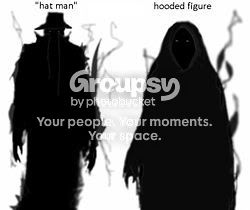
Accounts of shadow people typically describe them as being black humanoid silhouettes with no discernible mouths, noses, or facial expressions, though accounts also exist of them being child-sized humanoids or shapeless masses that sometimes change to a more human like form. The eyes are usually not described as being discernible but in some reports glowing eyes are mentioned. The color of the eyes, if any, is typically given as red. Generally, they are described as lacking mass, though their specific nature varies from a two-dimensional shadow to a vaporous or distorted three-dimensional form (as though made out of smoke or steam). Their movement is often described as being very quick and disjointed; they may first move slowly, as if they were passing through a heavy liquid, and then rapidly "hop" to another part of a witness's surroundings. Some witnesses describe this movement as though the shadow entities they have seen "danced" from one wall to the next, or as moving around the room "as if they were on a specific track". Rarely, they are seen "standing" in the middle of doorways or off the wall. Often they are described as being seen staring at the floor. Some accounts describe what appears to be the outline of a cloak, and in some instances the outline of a 1930s style fedora hat. This last type is referred as the "hat-man".[1][3]
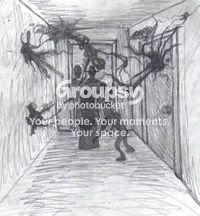
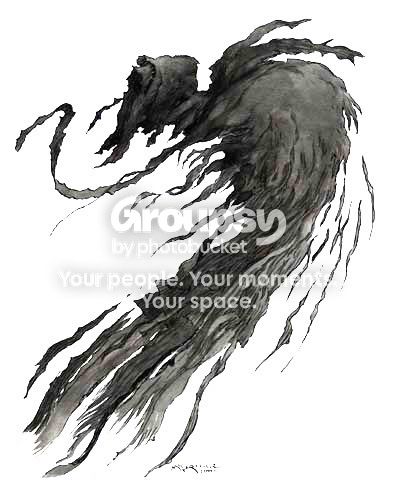
Various depictions and artists rendering have been posted on the Internet
Several explanations, ranging from the scientific to the supernatural, have been proposed to explain shadow people sightings.
Paranormal
A number of paranormal explanations for shadow people have been drawn from religion and from fields such as parapsychology, metaphysics, demonology, and the occult:
One proposed explanation is that Shadow People represent a Thoughtform (egregore), ghost or demon that was created through the accretion of negative energy created by events in which extreme physical/emotional stress/trauma has taken place, or which have been purposefully created through black magic or other occult practices.[3] They have also been claimed as being unattended shadow or shades, said in some cultures to be similar to that of a ghost: a flicker of a life unable to end for some reason. A second proposed explanation is that they are creatures from an alternate reality whose dimension occasionally overlap with ours, allowing them to be partially visible,[1][2] or that they represent creatures which exist on a separate plane of existence that become visible through similar means.
Believers in UFOs and related fields have also linked them to Grey aliens as well as to the Reptilian humanoids found in conspiracy beliefs such as those promoted by David Icke.[3][2]
Various beliefs also exist linking them to creatures found in early Christian, Pagan and Native American beliefs/stories.[3]
WRAITHS
The word "wraith" is first attested in 1513, with the meaning of "ghost or spectre" (that is, an apparition of a living or once-living being, possibly as a portent of death). In 18th century Scotland it was applied to aquatic spirits. Over time, it came to be used in a metaphoric sense to refer to wraith-like things, and to portents in general.
The word may be of Scots origin, possibly through Old Norse vörðr, meaning "guardian" (cf. the Modern English cognates "ward" and "warden"), and related to[citation needed] Irish arrach, meaning "apparition". An association with the verb "writhe" has also been claimed. Philologist and fantasy author J. R. R. Tolkien held this view [1], whose use of the word in the naming of the creatures known as the Ringwraiths has influenced creators of fantasy and horror novels, television shows, and games, who use it with its meaning of a shadow-thing, a spirit of another world, or more generally a mysterious being to be feared.
The wraith is a being of power, controlled by a greater spirit to do the creatures will. These creatures are shadows, floating amongst our realm with no purpose but that of their masters. They feed on humans, their emotions and their own strength, without these they would cease to exist. Information considering their lesser-known qualities is difficult to obtain.
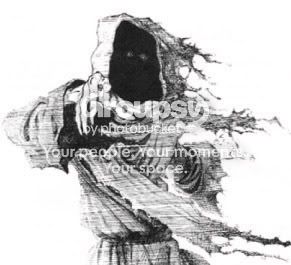
The classic depiction of a wraith is identical to the image of a tall, humanoid figure shrouded in a black cloak, under which no face can be seen, though a hand protrudes. The word "wraith" is also used in modern fiction to signify the shifting wraiths of T.A. Barron's book series The Lost Years of Merlin and the mortiwraiths of Wayne Thomas Batson's The Door Within Trilogy. Whereas the shifting wraith is a bestial, snake-like predator able to change itself into the form of any animal, albeit always having a feature uncharacteristic thereof, the mortiwraith is an anthropomorphically intelligent, gigantic, cave-dwelling, extremely photosensitive, but also snake-like predator having creased, furry ears, poisonous blood, and many clawed legs whose quantity increases with the passage of every five years. The use of the word "wraith" for either of these is not explained by either author in the respective story, though it may relate to the word "writhe".
In European pagan beliefs, the wraith is seen as a spirit of vengeance. They are said to be ghostly figures with long, sharp fingers. Wraiths are considered rare amongst the spirit realm, for they consist of pure revenge; yet not all wraiths will be truly vengeful, in that some are merely enraged to the extent of destroying anything they encounter.
In a local legend of Cornwall, the Polbreen Mine is said to be haunted by a wraith named Dorcas.
In other corners of the world, the wraith is considered to be the reflected image of a person, seen immeditately before death. This side is supported by elders' stories.
A wraith is also described as an image seen immediately before one dies, as if it were a premonition of the "Grim Reaper" figure.
PHANTOM
yet to find
Something apparently seen, heard, or sensed, but having no physical reality; a ghost or apparition; something elusive or delusive
An image that appears only in the mind; an illusion
phantom limb
(pathology) The false sensation, which is often painful, that an amputated limb is still present and attached.
HALLOWS
[edit] In legend
Some important and powerful objects in legends could be referred to as "hallows" because of their function and symbolism.[7] The Tuatha de Danaan in Ireland possessed four "hallows", the Four Treasures of Ireland: the Spear of Lugh, Stone of Fal, the Sword of Light of Nuada, and The Dagda's Cauldron. In the modern period, these were adapted to become the four suits in the Rider-Waite Tarot cards deck (swords, wands, pentacles and cups), and also took on the representation of the four classical elements of air, fire, earth and water.[8]
Coronation ceremonies for monarchs still invokes four ritual objects, now represented as the sceptre, sword, ampulla of oil, and crown. Similar objects also appear in Arthurian legends, where the Fisher King is the guardian of four "hallows" representing the four elements: a dish (earth), Arthur's sword Excalibur (air), the Holy Lance or spear, baton, or a magic wand (fire), and the Holy Grail (water).[5]
Earlier Welsh tradition, as recorded in Trioedd Ynys Prydain, also refers to Thirteen Treasures of the Island of Britain, being the Thirteen Royal Treasures of the Isle of Britain. Symbolically, these could also be interpreted as "hallows", although not actually described as such in the medieval Welsh texts.
The Fisher King or the Wounded King figures in Arthurian legend as the latest in a line charged with keeping the Holy Grail. Versions of his story vary widely, but he is always wounded in the legs or groin, and incapable of moving on his own. When he is injured, his kingdom suffers as he does, his impotence affecting the fertility of the land and reducing it to a barren Wasteland. Little is left for him to do but fish in the river near his castle Corbenic. Knights travel from many lands to heal the Fisher King but only the chosen can accomplish the feat. This is Percival in the earlier stories; in the later versions Percival is joined by Galahad and Bors.
Confusingly, many works have two wounded Grail Kings who live in the same castle, a father (or grandfather) and son. The more seriously wounded father stays in the castle, sustained by the Grail alone, while the more active son can meet with guests and go fishing. For clarity, the father will be called the Wounded King, the son the Fisher King where both appear in the remainder of this article.
FALLEN ANGELS
In some Christian mythology, a fallen angel is an angel that has been exiled or banished from Heaven. Often such banishment is a punishment for disobeying or rebelling against God. One early source for information on angelology and demonology is the Persian prophet Zoroaster. The best-known fallen angel is Lucifer. Lucifer rebelled and was cast out of Heaven and fell to Earth for his offense. According to some traditions, fallen angels will roam the Earth until Judgment Day, when they will be banished to Hell.
MOTHMAN
Mothman is the name given to a being or creature reported in the Charleston and Point Pleasant areas of West Virginia between November 12, 1966, near Clendenin,[1] and December 1967. Most observers describe the Mothman as a winged man-sized creature with large reflective red eyes and large moth-like wings. The creature often appeared to have no head, with its eyes set into its chest. A number of hypotheses have been presented to explain eyewitness accounts, ranging from misidentification and coincidence, to paranormal phenomena and conspiracy theories
On November 15, 1966, two young married couples from Point Pleasant, named David and Linda Scarberry, and Steve and Mary Mallette, were travelling late-night in the Scarberry's car. They were passing the West Virginia Ordnance Works, an abandoned World War II TNT factory, about seven miles north from Point Pleasant, in the 2,500 acre (10 km²) McClintic Wildlife Station, when they noticed two red lights in the shadows by an old generator plant near the factory gate. They stopped the car, and were startled to discover that the lights were actually the glowing red eyes of a large animal, "shaped like a man, but bigger, maybe six and a half or seven feet tall, with big wings folded against its back," according to Roger Scarberry. Terrified, they drove toward Route 62, where the creature supposedly chased them at speeds exceeding 100 miles per hour. However, as quoted in Keel's The Mothman Prophecies, the Scarberrys, despite driving more than 100 miles per hour, claimed to have noticed a dead dog on the side of the road, and in fact made such accurate note of its location that they claimed to have gone back the very next day and looked for it. Explanations for how they were able to make so accurate a mental note at a time of such great distress, or why they would go back to look for the dead dog, are not included in Keel's book.
BANSHEE
In Irish legend, a banshee wails around a house if someone in the house is about to die. There are particular families who are believed to have Banshees attached to them, and whose cries herald the death of a member of that family. Traditionally, when a citizen of an Irish village died, a woman would sing a lament (in Irish: caoineadh, [ˈkiːnʲə] or [ˈkiːnʲuː], "caoin" meaning "to weep, to wail") at their funeral. These women singers are sometimes referred to as "keeners". Legend has it that, for five great Gaelic families: the O'Gradys, the O'Neills, the O'Briens, the O'Connors, and the Kavanaghs, the lament would be sung by a fairy woman; having foresight, she would appear before the death and warn the family by wailing. When several banshees appeared at once, it indicated the death of someone great or holy.[2] The tales sometimes recounted that the woman, though called a fairy, was a ghost, often of a specific murdered woman, or a woman who died in childbirth.[3]
Banshees are frequently described as dressed in white or grey, and often having long, fair hair which they brush with a silver comb, a detail scholar Patricia Lysaght attributes to confusion with local mermaid myths. This comb detail is also related to the centuries-old traditional romantic Irish story that, if you ever see a comb lying on the ground in Ireland, you must never pick it up, or the banshees (or mermaids - stories vary), having placed it there to lure unsuspecting humans, will spirit such gullible humans away. Other stories portray banshees as dressed in green, red or black with a grey cloak.
Banshees are common in Irish and Scottish folk stories such as those recorded by Herminie T. Kavanagh. They enjoy the same mythical status in Ireland as fairies and leprechauns. Banshees continue to appear in modern fiction that deals with mythology, folklore or the supernatural. Sometimes the name "Banshee" is given to a character or object in a comic book, role-playing game, or video game, usually when part of the character's or object's power is based upon making a loud, screaming noise.
POLTERGEIST
Poltergeist activity tends to occur around a single person called an agent or a focus.[1] Foci are often, but not limited to, pubescent children. Almost seventy years of research by the Rhine Research Center in Raleigh-Durham, North Carolina, has led to the hypothesis among parapsychologists that the "poltergeist effect" is a form of psychokinesis generated by a living human mind (that of the agent). According to researchers at the Rhine Center, the "poltergeist effect" is the outward manifestation of psychological trauma.
-Poltergeist are also seen as shadows-
copied directly from wikipedia
please consider that some of this info is incorrect since
anyone can edit the info on wikipedia