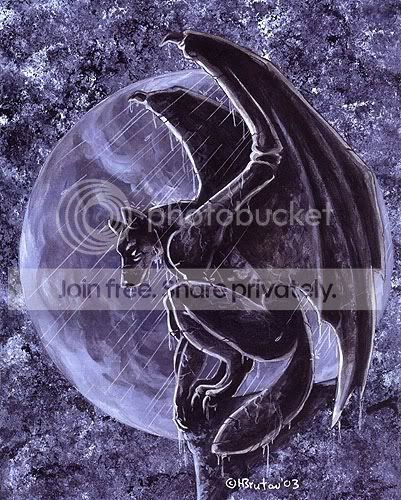


Once, long before the time of our fathers and grandfathers, the land was whole.
It was a rich and abundant land, a land of rolling hills and pristine forests, and its people were many and exotic. Some arrived on ships from distant lands and chose to stay. Some were descended from the hill-folk and could recite the names of their ancestors beyond the most ancient histories. War was not unknown, but peace was the rule: a peace born of strength and abundance.
Nowhere was the glory of that age greater than in Serpentholm, the keep of the Dragon Clan. Forgotten sculptors fashioned its walls with such cunning that the peasantry believed them alive; a forgotten shogun forged its laws both strict and fair; forgotten masters trained its warriors in fighting techniques subtle and fierce. Even its wisest scholars wrote proudly on sheaves of gilded parchment that the strength and honor of the Dragon would endure forever. . .
. . . and then, in the span of one year- one sowing, one harvest, one terrible winter- it was all lost.
Nobody knows now what they were, demons or spirits or monsters; nobody knew then, either. They were simply the Horde, black and inhuman, and they rose in thousands and tens of thousands from beyond the northern borders, somewhere in the trackless mountains. Where they passed, nothing lived. Even the trees withered and died. There were no bodies, or survivors to bury them.
Tarrant the Elder ruled Serpentholm in those days, and he was no coward. When he learned of the Horde threat, the most valiant of his samurai rode forth to meet them at first light, hundreds of heroes beneath hundreds of fluttering Dragon banners. It was two weeks before the first and only warrior returned, slumped over his saddle, his dark blood caked over dozens of vicious, ragged wounds- he was quite dead. Somehow, his horse had fled far and fast enough to escape its rider's fate. Tarrant knew in that instant that the Dragon Clan's only hope lay in a similar flight.
A week later the walls of Serpentholm- walls that had never fallen to a siege- were abandoned, and the Clan of the Dragon began its long march south. As the months of ceaseless travel passed, the great column of horses, wagons, and men swelled with refugees, those who knew the proud Dragon would never flee an opponent who might be beaten. Those who chose to stay behind and defend their lands were honored. Nobody ever heard from them again. Always, the scouts sent north failed to return, and always, the Dragon marched south.
At the end of the sixth month, they crossed the final ridge and saw the ocean. The Dragon had nowhere left to run.
Tarrant the Elder had, of course, foreseen this. He set his scholars to devise an escape for his people, and there had been plenty of time for argument and debate during the long march. But there was no time to build ships and nowhere to hide. The greater part of the Dragon's army had already fallen in the first disastrous ride against the Horde. Tarrant's only hope rested in a locked, silver-bound chest within his private wagon: the Serpent Orb, most ancient of the Dragon Clan's treasures and the symbol of his leadership. Some tales claimed that the Orb could summon the spirit of the Dragon itself, if the need were great enough. Few believed these tales, but the need was indeed great. As his weary people prepared for a final stand against the Horde, Tarrant passed leadership of the clan to his son, Tarrant the Younger. Then he stood alone- to attempt the impossible, and to die.
To his final moments, there are no witnesses. We know only that he succeeded. The gathered refugees heard the crash of the Dragon's fury as a terrible wall of air smashed men, horses, and wagons to the ground. Everywhere, the land seemed to writhe in agony. Many of those who survived the long and grueling march were crushed beneath cascades of stone, or disappeared into chasms that appeared beneath their feet. The rest huddled together and prayed for deliverance.
When the quakes subsided, the survivors of the Dragon's wrath could barely move for fear. It took all the younger Tarrant's courage to begin directing the construction of shelters from the remnants of the train. If the Horde had come upon them, they would have met with no resistance. But the Horde never came.
It was then- surveying the broken remains of his people- that Tarrant the Younger realized they were Dragon no more. It was something in the eyes of every child who had seen his home abandoned to evil; something in the stance of every warrior who knew his bravest comrades had fought, and died, rather than run away. They belonged now to the earth, not to the heavens. Yet they would still be fierce, and they would toil in their new lands with pride. Out of this humility and grim determination, the Serpent Clan was born.
Today, if you travel north beyond the mountains, you will reach a ragged cliff overlooking a swirling, vicious channel, full of rocks and debris. On a clear day, you may glimpse the outline of the opposite shore, but more likely it will be cloaked in the mists. The Dragon's fury broke the land as well as our people, and our ancestral home lies across the impassable waters of the channel. Whether the Horde still waits on those foreign shores, none can say.
We think less about it every day. This is our home now.
But the darkness is stirring again. There have been reports of strange figures hiding in the shadows, people disappearing, entire villages disappearing- no bodies, no survivors. Those of us who have studied the histories cry out that the Horde have found us again. Those who listened to the stories of old object that they never used such tactics, that it cannot possibly be them.
Whoever it may be, the Dragon is needed again. The Serpent must take up its wings again and return to the Heavens, reclaim its ancestral home and drive the darkness from our home, and this time we wont be on our own in this fight.
Once we were Dragon. We can be again.
~~~~~~~~~
There are 4 clans: Dragon, Serpent, Lotus, Wolf. They also follow the 2 Yin-Yang principles.
Dragon and Wolf both follow Yang.
Serpent and Lotus follow Yin.
{Dragon}
Today, the Dragon Clan is little more then a few old tales told in the village square, a subject for scholarly histories and a legacy of lost ideals. But in the time of Tarrant the Elder and his forefathers, the Dragon was a mighty shogunate where honor, discipline, and fairness ruled. By taking the Dragon as their totem, this clan set themselves the highest possible ideal of wisdom, honor, and ferocity in battle.
Every member of the Dragon Clan, from the peasant to the samurai, knew his role and lived it to perfection, whether it meant toiling in the fields as the seasons turned, or training year-round and dying a glorious death in battle. Nor were they without culture, for their Geisha were as unsurpassed in beauty and the gentler arts as the samurai were in battle.
When the Horde came and the land was Broken, somehow the old Dragon Clan die, and those who lived on became the Serpent. But the Dragon may come again one day, though in these times we fear even to hope for such things. Until then, we tell the old tales, we speak the words, and we remember...
The Dragon's time has come again.
{Serpent}
Everyone expected the Dragon Clan to last forever, but on the day of the Breaking of the World, Tarrant the Younger found that his father was dead, and only the broken remnants of his realm remained. They had been defeated by an implacable enemy to whom their warrior code and their ideals meant nothing. Their finest fighting men had been cut down, and only a headlong flight and a desperate sacrifice had enabled them to survive at all. Those who survived could no longer think of themselves the same way. The Dragon Clan had died.
Tarrant the Younger made the hardest choice he ever faced. He gathered together the last of the Dragon Clan, and the remnants of half a dozen other clans that had fled the Horde, and placed them under one name and one banner. They could no longer be as proud as the dragon, but they would do what they needed to survive, using cunning where strength failed them.
Thus they became the Serpent. Many ancient traditions remained, but practiced in a different spirit. Warriors no longer fought to transcend death through honor; they fought merely to avoid death. Peasants no longer farmed for the good of a harmonious world, they toiled to advance themselves and buy ale on feast days. Just as Dragon had become Serpent, Samurai had become Ronin. But at least the clan survived.
{Wolf}
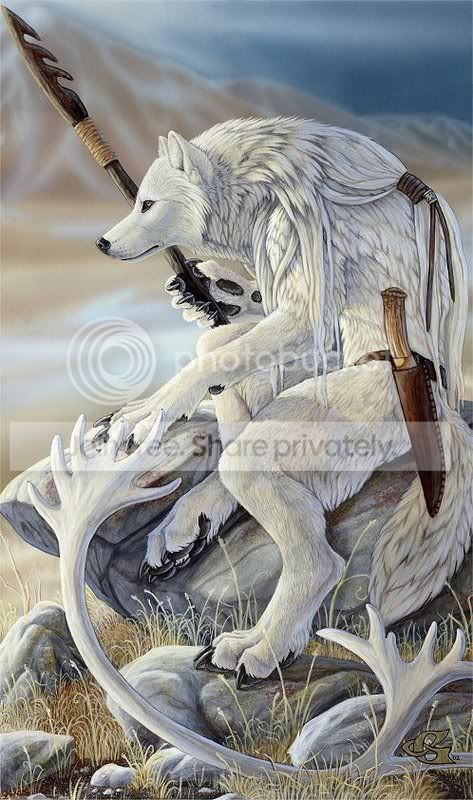
The impact of the Dragon Spirit's clash with the horde sent shockwaves for hundreds of miles and disrupted weather patterns worldwide. This became clear six months afterwards, when a fleet of wooden ships broke upon the northern shore, and a strange new clan struggled ashore. Once peaceful intentions were established on both sides, the Wolf Clan settled among the rocky hills and cold mountain streams of the northwest.
With their rough-hewn ways and druidical religion, the Wolf Clan made odd neighbors for the pragmatic, civilized Serpents. Local Serpent villagers shivered to hear animalistic howls and wild drumming from the Wolf settlements. Visitors spoke of their primitive-seeming architecture, and the warlike game of Wolfball, easily mistaken for a controlled civil war- no one without the Wolf Clan's gift for swift regeneration should attempt it. And there were stranger things glimpsed in the woods, half-man and half-animal...
When the Wolf lost its war with the Lotus, many thought it would be the end of that clan. But as slaves in the shale mines, they somehow managed to hold onto their ancient cultural identity, even as a whole generation grew up in captivity. The Lotus were not kind masters, and when the Wolf Clan rose again, decades of inhuman treatment and blood hatred were unleashed in one terrible night.
Many mysteries still surround them, from the rules (if any) to Wolfball to the rites their women practice in the full of the moon. The trauma of the war with the Lotus left deep marks on the Wolf Clan, such as a new fighting style built around bare hands, rocks, and mining implements. Through it all, their basic culture seems to have survived: a delight in nature, harmony with the seasons, and a natural wisdom rooted in balance.
{Lotus}
Like the Serpent, the Lotus Clan was formed from the remnants of an older clan devastated by the Horde. Long, long ago, there lived a peaceful tribe of wizards and foresters who worshiped the gods of balance and nature as symbolized by a great towering tree. They seldom knew trouble, or dissent, save when a group of overzealous scholars delved too deeply into certain dark magics of rot and corruption, together called the Forbidden Path.
When the Horde came, all of that tribe died except for those few renegade wizards, whose knowledge of the in gave them a chance to flee as their brothers died. The wizards eventually reached this land, and settled in the High Plateau, long known to be a place of strange energies. By that time they had formed themselves into a new clan, named for that intoxicating, perfumed blossom, the Lotus.
Free of all restriction, the twisted members of the Lotus Clan pursue the Forbidden Path in earnest, seeking to master death and corruption by immersing themselves in it. Their beliefs are a rotten parody of those of their forefathers- their tree is an unnatural nightmare, tended by undead, undying brothers. Their contempt for the nature-worshiping Wolf Clan may well have deep roots in their own history.
The leaders of this clan are ageless warlocks engaged in their own researches, pursuing power-hungry machinations in their councils and shadowy alliances. Ethics are a mere joke to them- power and knowledge are their ideals, and the conquest of the other clans merely a means to that end. Decades spent manipulating and subjugating the Wolf and Serpent clans have left deep bad blood and tensions in the land.
It was a rich and abundant land, a land of rolling hills and pristine forests, and its people were many and exotic. Some arrived on ships from distant lands and chose to stay. Some were descended from the hill-folk and could recite the names of their ancestors beyond the most ancient histories. War was not unknown, but peace was the rule: a peace born of strength and abundance.
Nowhere was the glory of that age greater than in Serpentholm, the keep of the Dragon Clan. Forgotten sculptors fashioned its walls with such cunning that the peasantry believed them alive; a forgotten shogun forged its laws both strict and fair; forgotten masters trained its warriors in fighting techniques subtle and fierce. Even its wisest scholars wrote proudly on sheaves of gilded parchment that the strength and honor of the Dragon would endure forever. . .
. . . and then, in the span of one year- one sowing, one harvest, one terrible winter- it was all lost.
Nobody knows now what they were, demons or spirits or monsters; nobody knew then, either. They were simply the Horde, black and inhuman, and they rose in thousands and tens of thousands from beyond the northern borders, somewhere in the trackless mountains. Where they passed, nothing lived. Even the trees withered and died. There were no bodies, or survivors to bury them.
Tarrant the Elder ruled Serpentholm in those days, and he was no coward. When he learned of the Horde threat, the most valiant of his samurai rode forth to meet them at first light, hundreds of heroes beneath hundreds of fluttering Dragon banners. It was two weeks before the first and only warrior returned, slumped over his saddle, his dark blood caked over dozens of vicious, ragged wounds- he was quite dead. Somehow, his horse had fled far and fast enough to escape its rider's fate. Tarrant knew in that instant that the Dragon Clan's only hope lay in a similar flight.
A week later the walls of Serpentholm- walls that had never fallen to a siege- were abandoned, and the Clan of the Dragon began its long march south. As the months of ceaseless travel passed, the great column of horses, wagons, and men swelled with refugees, those who knew the proud Dragon would never flee an opponent who might be beaten. Those who chose to stay behind and defend their lands were honored. Nobody ever heard from them again. Always, the scouts sent north failed to return, and always, the Dragon marched south.
At the end of the sixth month, they crossed the final ridge and saw the ocean. The Dragon had nowhere left to run.
Tarrant the Elder had, of course, foreseen this. He set his scholars to devise an escape for his people, and there had been plenty of time for argument and debate during the long march. But there was no time to build ships and nowhere to hide. The greater part of the Dragon's army had already fallen in the first disastrous ride against the Horde. Tarrant's only hope rested in a locked, silver-bound chest within his private wagon: the Serpent Orb, most ancient of the Dragon Clan's treasures and the symbol of his leadership. Some tales claimed that the Orb could summon the spirit of the Dragon itself, if the need were great enough. Few believed these tales, but the need was indeed great. As his weary people prepared for a final stand against the Horde, Tarrant passed leadership of the clan to his son, Tarrant the Younger. Then he stood alone- to attempt the impossible, and to die.
To his final moments, there are no witnesses. We know only that he succeeded. The gathered refugees heard the crash of the Dragon's fury as a terrible wall of air smashed men, horses, and wagons to the ground. Everywhere, the land seemed to writhe in agony. Many of those who survived the long and grueling march were crushed beneath cascades of stone, or disappeared into chasms that appeared beneath their feet. The rest huddled together and prayed for deliverance.
When the quakes subsided, the survivors of the Dragon's wrath could barely move for fear. It took all the younger Tarrant's courage to begin directing the construction of shelters from the remnants of the train. If the Horde had come upon them, they would have met with no resistance. But the Horde never came.
It was then- surveying the broken remains of his people- that Tarrant the Younger realized they were Dragon no more. It was something in the eyes of every child who had seen his home abandoned to evil; something in the stance of every warrior who knew his bravest comrades had fought, and died, rather than run away. They belonged now to the earth, not to the heavens. Yet they would still be fierce, and they would toil in their new lands with pride. Out of this humility and grim determination, the Serpent Clan was born.
Today, if you travel north beyond the mountains, you will reach a ragged cliff overlooking a swirling, vicious channel, full of rocks and debris. On a clear day, you may glimpse the outline of the opposite shore, but more likely it will be cloaked in the mists. The Dragon's fury broke the land as well as our people, and our ancestral home lies across the impassable waters of the channel. Whether the Horde still waits on those foreign shores, none can say.
We think less about it every day. This is our home now.
But the darkness is stirring again. There have been reports of strange figures hiding in the shadows, people disappearing, entire villages disappearing- no bodies, no survivors. Those of us who have studied the histories cry out that the Horde have found us again. Those who listened to the stories of old object that they never used such tactics, that it cannot possibly be them.
Whoever it may be, the Dragon is needed again. The Serpent must take up its wings again and return to the Heavens, reclaim its ancestral home and drive the darkness from our home, and this time we wont be on our own in this fight.
Once we were Dragon. We can be again.
~~~~~~~~~
There are 4 clans: Dragon, Serpent, Lotus, Wolf. They also follow the 2 Yin-Yang principles.
Dragon and Wolf both follow Yang.
Serpent and Lotus follow Yin.
{Dragon}
Today, the Dragon Clan is little more then a few old tales told in the village square, a subject for scholarly histories and a legacy of lost ideals. But in the time of Tarrant the Elder and his forefathers, the Dragon was a mighty shogunate where honor, discipline, and fairness ruled. By taking the Dragon as their totem, this clan set themselves the highest possible ideal of wisdom, honor, and ferocity in battle.
Every member of the Dragon Clan, from the peasant to the samurai, knew his role and lived it to perfection, whether it meant toiling in the fields as the seasons turned, or training year-round and dying a glorious death in battle. Nor were they without culture, for their Geisha were as unsurpassed in beauty and the gentler arts as the samurai were in battle.
When the Horde came and the land was Broken, somehow the old Dragon Clan die, and those who lived on became the Serpent. But the Dragon may come again one day, though in these times we fear even to hope for such things. Until then, we tell the old tales, we speak the words, and we remember...
The Dragon's time has come again.
{Serpent}
Everyone expected the Dragon Clan to last forever, but on the day of the Breaking of the World, Tarrant the Younger found that his father was dead, and only the broken remnants of his realm remained. They had been defeated by an implacable enemy to whom their warrior code and their ideals meant nothing. Their finest fighting men had been cut down, and only a headlong flight and a desperate sacrifice had enabled them to survive at all. Those who survived could no longer think of themselves the same way. The Dragon Clan had died.
Tarrant the Younger made the hardest choice he ever faced. He gathered together the last of the Dragon Clan, and the remnants of half a dozen other clans that had fled the Horde, and placed them under one name and one banner. They could no longer be as proud as the dragon, but they would do what they needed to survive, using cunning where strength failed them.
Thus they became the Serpent. Many ancient traditions remained, but practiced in a different spirit. Warriors no longer fought to transcend death through honor; they fought merely to avoid death. Peasants no longer farmed for the good of a harmonious world, they toiled to advance themselves and buy ale on feast days. Just as Dragon had become Serpent, Samurai had become Ronin. But at least the clan survived.
{Wolf}
The impact of the Dragon Spirit's clash with the horde sent shockwaves for hundreds of miles and disrupted weather patterns worldwide. This became clear six months afterwards, when a fleet of wooden ships broke upon the northern shore, and a strange new clan struggled ashore. Once peaceful intentions were established on both sides, the Wolf Clan settled among the rocky hills and cold mountain streams of the northwest.
With their rough-hewn ways and druidical religion, the Wolf Clan made odd neighbors for the pragmatic, civilized Serpents. Local Serpent villagers shivered to hear animalistic howls and wild drumming from the Wolf settlements. Visitors spoke of their primitive-seeming architecture, and the warlike game of Wolfball, easily mistaken for a controlled civil war- no one without the Wolf Clan's gift for swift regeneration should attempt it. And there were stranger things glimpsed in the woods, half-man and half-animal...
When the Wolf lost its war with the Lotus, many thought it would be the end of that clan. But as slaves in the shale mines, they somehow managed to hold onto their ancient cultural identity, even as a whole generation grew up in captivity. The Lotus were not kind masters, and when the Wolf Clan rose again, decades of inhuman treatment and blood hatred were unleashed in one terrible night.
Many mysteries still surround them, from the rules (if any) to Wolfball to the rites their women practice in the full of the moon. The trauma of the war with the Lotus left deep marks on the Wolf Clan, such as a new fighting style built around bare hands, rocks, and mining implements. Through it all, their basic culture seems to have survived: a delight in nature, harmony with the seasons, and a natural wisdom rooted in balance.
{Lotus}
Like the Serpent, the Lotus Clan was formed from the remnants of an older clan devastated by the Horde. Long, long ago, there lived a peaceful tribe of wizards and foresters who worshiped the gods of balance and nature as symbolized by a great towering tree. They seldom knew trouble, or dissent, save when a group of overzealous scholars delved too deeply into certain dark magics of rot and corruption, together called the Forbidden Path.
When the Horde came, all of that tribe died except for those few renegade wizards, whose knowledge of the in gave them a chance to flee as their brothers died. The wizards eventually reached this land, and settled in the High Plateau, long known to be a place of strange energies. By that time they had formed themselves into a new clan, named for that intoxicating, perfumed blossom, the Lotus.
Free of all restriction, the twisted members of the Lotus Clan pursue the Forbidden Path in earnest, seeking to master death and corruption by immersing themselves in it. Their beliefs are a rotten parody of those of their forefathers- their tree is an unnatural nightmare, tended by undead, undying brothers. Their contempt for the nature-worshiping Wolf Clan may well have deep roots in their own history.
The leaders of this clan are ageless warlocks engaged in their own researches, pursuing power-hungry machinations in their councils and shadowy alliances. Ethics are a mere joke to them- power and knowledge are their ideals, and the conquest of the other clans merely a means to that end. Decades spent manipulating and subjugating the Wolf and Serpent clans have left deep bad blood and tensions in the land.