|
|
|
|
|
|
|
|
|
 Posted: Mon Jan 07, 2008 6:54 pm Posted: Mon Jan 07, 2008 6:54 pm
This is a place to post all facts about Norse mythology that you may know to help your fellow MDLR fans. 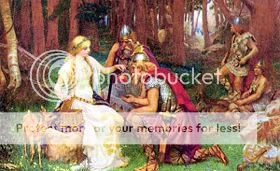
|
 |
|
|
|
|
|
|
|
|
|
|
|
|
|
Posted: Mon Jan 07, 2008 6:55 pm
The Norse gods were mortal, and they had to eat Iðunn's golden apples in order not to age until Ragnarök when most of them would die.
|
|
|
|
|
|
|
|
|
|
|
|
|
|
|
|
|
|
Posted: Mon Jan 07, 2008 7:04 pm
The beginning
According to Norse myth, the beginning of life was fire and ice, with the existence of only two worlds: Muspelheim and Niflheim. When the warm air of Muspelheim hit the cold ice of Niflheim, the giant Ymir and the icy cow Audhumbla were created. Ymir's foot bred a son and a man and a woman emerged from his armpits, making Ymir the progenitor of the Jotun, or giants. Whilst Ymir slept, the intense heat from Muspelheim made him sweat, and he sweated out Surtr, a giant of fire. Later Ymir woke and drank Audhumbla's milk. Whilst he drank, the cow Audhumbla licked on a salt stone. On the first day after this a man's hair appeared on the stone, on the second day a head and on the third day an entire man emerged from the stone. His name was Búri and with an unknown giantess he fathered Bor, the father of the three gods Odin, Vili and Ve.
When the gods felt strong enough they killed Ymir. His blood flooded the world and drowned all of the giants, except two. But giants grew again in numbers and soon there were as many as before Ymir's death. Then the gods created seven more worlds using Ymir's flesh for dirt, his blood for the Oceans, rivers and lakes, his bones for stone, his brain as the clouds, his skull for the heaven. Sparks from Muspelheim flew up and became stars.
~Continued in next post~
|
|
|
|
|
|
|
|
|
|
|
|
|
|
|
Posted: Mon Jan 07, 2008 7:05 pm
~Continued~
One day when the gods were walking they found two tree trunks. They transformed them into the shape of humans. Odin gave them life, Vili gave them mind and Ve gave them the ability to hear, see, and speak. The gods named them Ask and Embla and built the kingdom of Middle-earth for them and to keep the giants out the gods placed a gigantic fence made of Ymirs eye-lashes around Middle-earth.
The sybil goes on to describe Yggdrasil and the three norns (female symbols of inexorable fate; their names - Urðr (Urd), Verðandandi (Verdandi), and Skuld - indicate the past, present, and future), who spin the threads of fate beneath it. She then describes the war between the Æsir and Vanir and the murder of Baldr, Odin's handsome son whom everyone but Loki loved. (The story is that everything in existence promised not to hurt him except mistletoe. Taking advantage of this weakness, Loki made a mistletoe spear and tricked Höðr, Odin's blind son and Baldr's brother, into using it to kill Baldr. Hel said she would revive him if everyone in the nine worlds wept. A giantess - Thokk, who may have been Loki in shape-shifted form - did not weep. After that she turns her attention to the future.
|
|
|
|
|
|
|
|
|
|
|
|
|
|
|
|
|
|
Posted: Sat Jan 19, 2008 10:27 am
I'm just going to add that Mythical Detective Loki Ragnarok is not acurate to the original myth at all. The only real thing it has to do with the myth are the names. Loki was a bad s.o.b not a good guy and odin was the king of the gods because he was merciful and kind. i guess the only real part of the show is the relationship between heimdall and loki. (cept the good vs. evil roles were reversed.) they hated eachother and durring Ragnarok they killed eachother. Basically all the good vs. evil roles in the show should be flip flopped except for thor. thor was always good and he tried to show friendship for loki but took the side of the other gods instead.
(if none of this is accurate im sorry. im pretty sure its right but not positive)
|
|
|
|
|
|
|
|
|
|
|
|
|
|
|
Posted: Tue Feb 05, 2008 4:42 pm
Asgard, in Norse mythology, is one of the nine worlds and the homeland of the Aesir, the race of warrior gods. Located on the highest level of the Norse universe, it is surrounded by a high wall of closely fitted stone blocks. The walls surrounding Asgard were built by Blast (or Hrimthurs), who asked in payment the hand of Freya plus the sun and the moon. Odin agreed providing the walls be complete in six months. Hrimthurs had a magic horse, named Svadilfari, who helped him in his work. To Odin's (and the other gods, especially Freya's) horror, with but a few days left, Blast was almost finished. Loki, the trickster, turned himself into a mare and beguiled the stallion Svadilfari away. The job was not completed in time and no payment was given.
Also found on this level are the worlds of Alfheim and Vanaheim as well as Valhalla, an immense hall where warriors slain in battle await the final conflict.
In the middle of Asgard lies the plain of Idavoll (or Ida) where the Aesir meet to decide important issues. There the gods assemble in the hall of Gladsheim and the goddesses in the hall of Vingolf. The gods also meet daily at the Well of Urd, beneath the Asgard root of the ash tree Yggdrasil.
|
|
|
|
|
|
|
|
|
|
|
|
|
|
|
|
|
|
Posted: Tue Feb 05, 2008 4:43 pm
Balder
by Micha F. Lindemans
The god of light, joy, purity, beauty, innocence, and reconciliation. Son of Odin and Frigg, he was loved by both gods and men and was considered to be the best of the gods. He had a good character, was friendly, wise and eloquent, although he had little power. His wife was Nanna daughter of Nep, and their son was Forseti, the god of justice. Balder's hall was Breidablik ("broad splendor").
Most of the stories about Balder concern his death. He had been dreaming about his death, so Frigg extracted an oath from every creature, object and force in nature (snakes, metals, diseases, poisons, fire, etc.) that they would never harm Balder. All agreed that none of their kind would ever hurt or assist in hurting Balder. Thinking him invincible, the gods enjoyed themselves thereafter by using Balder as a target for knife-throwing and archery.
The malicious trickster, Loki, was jealous of Balder. He changed his appearance and asked Frigg if there was absolutely nothing that could harm the god of light. Frigg, suspecting nothing, answered that there was just one thing: a small tree in the west that was called mistletoe. She had thought it was too small to ask for an oath. Loki immediately left for the west and returned with the mistletoe. He tricked Balder's blind twin brother Hod into throwing a mistletoe fig (dart) at Balder. Not knowing what he did, Hod threw the fig, guided by Loki's aim. Pierced through the heart, Balder fell dead.
While the gods were lamenting Balder's death, Odin sent his other son Hermod to Hel, the goddess of death, to plead for Balder's return. Hel agreed to send Balder back to the land of the living on one condition: everything in the world, dead or alive, must weep for him. And everything wept, except for Loki, who had disguised himself as the witch Thokk. And so Balder had to remain in the underworld.
The others took the dead god, dressed him in crimson cloth, and placed him on a funeral pyre aboard his ship Ringhorn, which passed for the largest in the world. Beside him they lay the body of his wife Nanna, who had died of a broken heart. Balder's horse and his treasures were also placed on the ship. The pyre was set on fire and the ship was sent to sea by the giantess Hyrrokin.
Loki did not escape punishment for his crime and Hod was put to death by Vali, son of Odin and Rind. Vali had been born for just that purpose. After the final conflict (Ragnarok), when a new world arises from its ashes, both Balder and Hod will be reborn.
In some versions it was his mother who had these disturbing dreams about his death.
Old Norse: Baldr
|
|
|
|
|
|
|
|
|
|
|
|
|
|
|
Posted: Tue Feb 05, 2008 4:44 pm
Fenrir (or Fenris) is a gigantic and terrible monster in the shape of a wolf. He is the eldest child of Loki and the giantess Angrboda. The gods learned of a prophecy which stated that the wolf and his family would one day be responsible for the destruction of the world. They caught the wolf and locked him in a cage. Only the god of war, Tyr, dared to feed and take care of the wolf.
When he was still a pup they had nothing to fear, but when the gods saw one day how he had grown, they decided to render him harmless. However, none of the gods had enough courage to face the gigantic wolf. Instead, they tried to trick him. They said the wolf was weak and could never break free when he was chained. Fenrir accepted the challenge and let the gods chain him. Unfortunately, he was so immensely strong that he managed to break the strongest fetters as if they were cobwebs.
After that, the gods saw only one alternative left: a magic chain. They ordered the dwarves to make something so strong that it could hold the wolf. The result was a soft, thin ribbon: Gleipnir. It was incredibly strong, despite what its size and appearance might suggest. The ribbon was fashioned of six strange elements: the footstep of a cat; the roots of a mountain; a woman's beard; the breath of fishes; the sinews of a bear; and a bird's spittle.
The gods tried to trick the wolf again, only this time Fenrir was less eager to show his strength. He saw how thin the chain was, and said that was no pride in breaking such a weak chain. Eventually, though, he agreed, thinking that otherwise his strength and courage would be doubted. Suspecting treachery however, he in turn asked the gods for a token of good will: one of them had to put a hand between his jaws. The gods were not overly eager to do this, knowing what they could expect. Finally, only Tyr agreed, and the gods chained the wolf with Gleipnir. No matter how hard Fenrir struggled, he could not break free from this thin ribbon. In revenge, he bit off Tyr's hand.
Being very pleased with themselves, the gods carried Fenrir off and chained him to a rock (called Gioll) a mile down into the earth. They put a sword between his jaws to prevent him from biting. On the day of Ragnarok, Fenrir will break his chains and join the giants in their battle against the gods. He will seek out Odin and devour him. Vidar, Odin's son, will avenge his father by killing the wolf.
|
|
|
|
|
|
|
|
|
|
|
|
|
|
|
|
|
|
Posted: Tue Feb 05, 2008 4:45 pm
Freya
by Micha F. Lindemans
Freya
In Norse mythology, Freya is a goddess of love and fertility, and the most beautiful and propitious of the goddesses. She is the patron goddess of crops and birth, the symbol of sensuality and was called upon in matters of love. She loves music, spring and flowers, and is particularly fond of the elves (fairies). Freya is one of the foremost goddesses of the Vanir.
She is the daughter of the god Njord, and the sister of Freyr. Later she married the mysterious god Od (probably another form of Odin), who disappeared. When she mourned for her lost husband, her tears changed into gold.
Her attributes are the precious necklace of the Brisings, which she obtained by sleeping with four dwarfs, a cloak (or skin) of bird feathers, which allows its wearer to change into a falcon, and a chariot pulled by two cats. She owns Hildesvini ("battle boar") which is actually her human lover Ottar in disguise. Her chambermaid is Fulla. Freya lives in the beautiful palace Folkvang ("field of folk"), a place where love songs are always played, and her hall is Sessrumnir. She divides the slain warriors with Odin: one half goes to her palace, while the other half goes to Valhalla. Women also go to her hall.
Old Norse: Freyja, Friia
|
|
|
|
|
|
|
|
|
|
|
|
|
|
|
Posted: Tue Feb 05, 2008 4:47 pm
Freyr
by Micha F. Lindemans
Freyr
Freyr is the god of sun and rain, and the patron of bountiful harvests. He is both a god of peace and a brave warrior. He is also the ruler of the elves. Freyr is the most prominent and most beautiful of the male members of the Vanir, and is called 'God of the World'. After the merging of the Aesir and the Vanir, Freyr was called 'Lord of the Aesir'. Freyr was also called upon to grant a fertile marriage.
He is married to the beautiful giantess Gerd, and is the son of Njord. His sister is Freya. He rides a chariot pulled by the golden boar Gullinbursti which was made for him by the dwarves Brokk and Eitri. He owns the ship Skidbladnir ("wooden-bladed"), which always sails directly towards its target, and which can become so small that it can fit in Freyr's pocket. He also possesses a sword that would by itself emerge from its sheath and spread a field with carnage whenever the owner desired it.
Freyr's shield bearer and servant is Skirnir, to whom he gave his sword, which Skirnir demanded as a reward for making Gerd his wife. On the day of Ragnarok he will battle without weapons (for he gave his sword away to Skirnir), and will be the first to be killed by the fire giant Surt. The center of his cult was the city Uppsala in Sweden. In southern Sweden he was called Fricco.
|
|
|
|
|
|
|
|
|
|
|
|
|
|
|
|
|
|
Posted: Tue Feb 05, 2008 4:48 pm
Heimdall is the god of light, the son of nine mothers (variously given as the daughters of Geirrendour the Giant or of Aegir). He was born at the end of the world and raised by the force of the earth, seawater and the blood of a boar. Because of his shining, golden teeth he is also called Gullintani ("gold tooth"). His hall is Himinbjorg, The Cliffs of Heaven, and his horse is Gulltop. Heimdall carries the horn Gjallar.
He is the watchman of the gods and guards Bifrost, the only entrance to Asgard, the realm of the gods. It is Heimdall's duty to prevent the giants from forcing their way into Asgard. He requires less sleep than a bird and can see a hundred miles around him, by night as well as by day. His hearing is so accurate that no sound escapes him: he can even hear the grass grow or the wool on a sheep's back. At the final conflict of Ragnarok he will kill his age-old enemy, the evil god Loki, but will die himself from his wounds.
As the god Rig ("ruler"), Heimdall created the three races of mankind: the serfs, the peasants, and the warriors. It is interesting to note why Heimdall fathered them, and not Odin as might be expected. Furthermore, Heimdall is in many attributes identical with Tyr.
Old Norse: Heimdallr
|
|
|
|
|
|
|
|
|
|
|
|
|
|
|
Posted: Tue Feb 05, 2008 4:50 pm
Hel
by Micha F. Lindemans
In Norse mythology, Hel is the ruler of Helheim, the realm of the dead. She is the youngest child of the evil god Loki and the giantess Angrboda. She is usually described as a horrible hag, half alive and half dead, with a gloomy and grim expression. Her face and body are those of a living woman, but her thighs and legs are those of a corpse, mottled and moldering.
The gods had abducted Hel and her brothers from Angrboda's hall. They cast her in the underworld, into which she distributes those who are send to her; the wicked and those who died of sickness or old age. Her hall in Helheim is called Eljudnir, home of the dead. Her manservant is Ganglati and her maidservant is Ganglot (which both can be translated as "tardy").
|
|
|
|
|
|
|
|
|
|
|
|
|
|
|
|
|
|
Posted: Tue Feb 05, 2008 4:53 pm
Loki is one of the major deities in the Norse pantheon. He is a son of the giant Farbauti ("cruel striker") and the giantess Laufey. He is regarded as one of Aesir, but is on occasion their enemy. He is connected with fire and magic, and can assume many different shapes (horse, falcon, fly). He is crafty and malicious, but is also heroic: in that aspect he can be compared with the trickster from North American myths. The ambivalent god grows progressively more unpleasent, and is directly responsible for the death of Balder, the god of light.
Loki's mistress is the giantess Angrboda, and with her he is the father of three monsters. His wife is Sigyn, who stayed loyal to him, even when the gods punished him for the death of Balder. He was chained to three large boulders; one under his shoulders, one under his loins and one under his knees. A poisonous snake was placed above his head. The dripping venom that lands on him is caught by Sigyn in a bowl. But every now and then, when the bowl is filled to the brim, she has to leave him to empty it. Then the poison that falls on Loki's face makes him twist in pain, causing earthquakes.
On the day of Ragnarok, Loki's chains will break and he will lead the giants into battle against the gods. Loki is often called the Sly One, the Trickster, the Shape Changer, and the Sky Traveler.
According to Georges Dumézil, Loki shows a great resemblance with Syrdon, a demonic creature from Caucasian legends.
|
|
|
|
|
|
|
|
|
|
|
|
|
|
|
Posted: Tue Feb 05, 2008 5:12 pm
Mjollnir
by Micha F. Lindemans
In Norse myth, the hammer that belongs to the mighty god Thor. Mjollnir ("that smashes") was made for him by the dwarfs Brok and Eitri, who made many magical objects for the gods. Every time Thor threw the hammer lightning flashed, after which it returned to his right hand, on which he wore an iron glove. Mjollnir was greatly feared by the frost giants, the enemies of the gods, for Thor had dispatched a large number of them, among which the giant Hrungnir.
After Thor's death, his sons Magni and Modi will inherit the hammer.
Old Norse: Mjöllnir. The Russian word for lightning is 'molniya'.
|
|
|
|
|
|
|
|
|
|
|
|
|
|
|
|
|
|
Posted: Wed Feb 06, 2008 2:43 pm
Norns
by Micha F. Lindemans
In Norse mythology, the Norns are the demi-goddesses of destiny. They control the destinies of both gods and men, as well as the unchanging laws of the cosmos. They are represented as three sisters: Urd ("fate"), Verdandi ("necessity") and Skuld ("being"). They live at the base of the World Tree Yggdrasil in the realm of Asgard.
Nothing lasts forever, and even the mighty Yggdrasil is subject to decay. The Norns try to stop this process, or at least slow it down, by pouring mud and water from the Well of Fate over its branches. This magical liquid stops the rotting process for the time being.
In other myths, the Norns were thought to give assistance at birth, and that each person has his own personal Norn.
|
|
|
|
|
|
|
|
|
|
|
|
|
|
|
|
|
|


 Reply
Reply