|
|
|
|
|
|
|
|
|
 Posted: Tue Nov 27, 2007 11:09 am Posted: Tue Nov 27, 2007 11:09 am
Welcome to Plant of the Week!!
Every week we will add another fascinating plant and give you some general information. In order to make this topic most interesting to everyone, we hope to choose plants that fit into any of these categories:
Flowers
Garden Plants
Houseplants
Trees/Shrubs
Ferns and Fern Allies
Botanist's Bizzare Favorites
In short, we will try to have a mix to accurately represent the plant world.
*This is a site of information only, please make any comments concerning the Plant of the Week within the general FaFA forum.*
If you wish to suggest a plant for Plant of the Week, please send a message to the Guild's Official Profile Account: Fern Alli
|
 |
|
|
|
|
|
|
|
|
|
|
|
|
|
Posted: Tue Nov 27, 2007 11:20 am
November 26- December 2, 2007
"Every Botanists’ Dream to See"
Welwitschia mirabilis
Pronounced (well-wit-she-a)
Named by Hooker 1863
Common names: Tree tumbo, tumboa
This relation to pine trees (Pinophyta) looks nothing like a pine. It is a dioecious perennial plant with a short woody stem and a very long taproot. The plant has only two strap-shaped leaves that grow throughout the life of the plant. They become twisted and frayed and often grow so long that they form floppy piles on the ground. Welwitschia does produce pollen and seed cones (like its pine relations) but only one seed develops in each cone. The tree tumbo can be found only in the Namib Desert of southwestern Africa. Like other desert plants (cacti and succulents) Welwitschia performs CAM photosynthesis and obtains most of its moisture from dense fog given off by the ocean. This plant is believed to live anywhere from 500 to 1000 years.

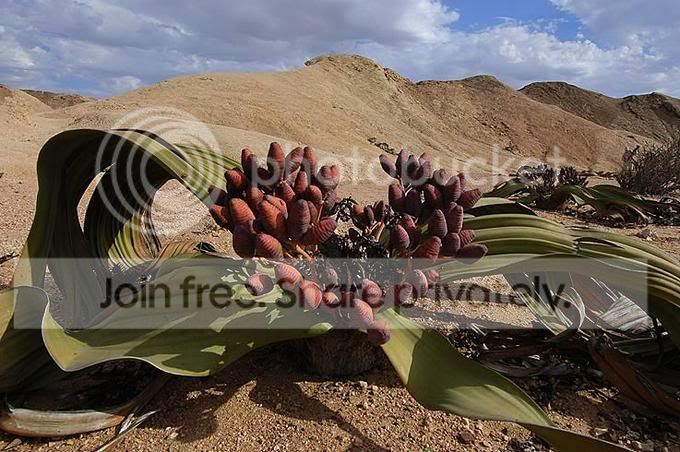

Weird, isn't it!!
|
|
|
|
|
|
|
|
|
|
|
|
|
|
|
|
|
|
Posted: Sun Dec 02, 2007 7:16 pm
December 3- December 9, 2007
"Finding the right tree is very important"
Abies concolor
Named by: (Gord. & Glend.) Lindl. ex Hildebr.

Common Name: White Fir, Silver Fir, Colorado Fir
Often used for lumber, papermaking, and Christmas trees, these members of the family Pinaceae sport flattened needles that are 2-3 inches long, silvery blue to silvery green, and quite soft to the touch. Breaking the needles will give off a citrus smell. Cones can be 2-5 inches long and the bark is ashy gray.

These trees can grow up to 100 feet tall. The White Fir can be found in many western regions of the United States but it is the only fir native to the North American Taiga (Alaska, Canada).
Try checking for grouse, squirrels, and porcupines under or in these trees as it is a preferred source of seeds and roosting sites!
|
|
|
|
|
|
|
|
|
|
|
|
|
|
|
Posted: Mon Dec 10, 2007 10:08 am
December 10 – December 16, 2007“Wreaths and Teas”Ilex spp. Common name: HollyThese 600 species of shrubs and trees (2-25 meters tall) can be found in Asia, Europe, Africa and both Americas. Ilex is the only living genus in the family Aquifoliaceae. Holly leaves are simple and may remain on the plant all year round. The margin of the leave may be anywhere from smooth to having spiny serrations. The trademark berry is small and red when mature and is mildly toxic to people. It is a valuable food source for birds and other animals.  Holly is especially popular in Christmas wreaths but is also a wonderful ornamental plant. The wood is quite hard and white in coloration. Some species of Ilex are used to make caffeine-rich herbal teas. In South America I. paraquariensis is boiled to make “Mate.” Native Americans used I. vomitoria as a ceremonial drink and I. kudingcha is used in China to make a green tea-like drink. 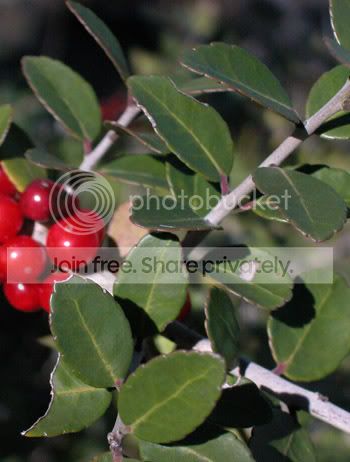 ( I. vomitoria) I wouldn’t suggest that you boil the leaves off of your holly in the backyard though. Its not called vomitoria for nothing!
|
|
|
|
|
|
|
|
|
|
|
|
|
|
|
|
|
|
Posted: Sun Dec 16, 2007 1:24 pm
December 17- December 23, 2007"And you thought honey was safe..."Rhododendron spp. Meaning of name: Greek, rhodos = ‘rose’ and dendron = ‘tree’With something near 1000 species, this genus has an amazingly beautiful array of flowery displays. Even the plants normally called ‘azaleas’ fall into this genus. True to its name, these plants can be anywhere from shrubs to trees (up to 50 m tall). The leaves are spirally arranged and leaves can be from 1-2 cm to an amazing 50 cm (and even 100 cm in R. singrande) Here is ‘Bob’ with his hand upon one such enormous leaf.  Thanks www.chimacumwoods.com/sinogrande.htm Thanks www.chimacumwoods.com/sinogrande.htmSome species of Rhododendron may keep their leaves on all year long. The undersides of leaves may sport scales or hairs. Flowers are normally large clusters of various colors depending on the species. 
Rhododendron arboreum is the national flower of Nepal and Rhododendron catawbiense is the state flower of West Virginia. Rhododendron macrophyllum is the state flower of Washington. They are mostly found in Himalayan countries and occurs throughout most of the Northern Hemisphere; and extend into southeastern Asia and northern Australasia. A few species occur in North America and Europe. Rhododendrons have not been found in South America or Africa.  Some Rhododendrons have a toxin called grayanotoxin in their pollen and nectar. People have been known to become ill from eating honey made by bees feeding on rhododendron and azalea flowers. Honey resulting from these plants have a slightly hallucinogenic and laxative effect. Rhododendron is extremely toxic to horses, with some animals dying within a few hours of ingesting the plant, although most horses tend to avoid it if they have access to good forage. Both species and hybrid rhododendrons (including azaleas) are used extensively as ornamental plants in landscaping in many parts of the world, and many species and cultivars are grown commercially for the nursery trade. Rhododendrons are often valued in landscaping for their structure, size, flowers, and the fact that many of them are evergreen. 
|
|
|
|
|
|
|
|
|
|
|
|
|
|
|
Posted: Sun Dec 30, 2007 11:13 pm
December 31, 2007 – January 6, 2008
Chinodoxa luciliae

Common name: Glory of the snow
Originally from Turkey, this low-growing plant blooms from late winter to early spring. It is 3- 6 inches in size and can have flower colors of pink, blue, blue-violet, and white lasting 3-4 weeks. Normally bulbs are planted in the autumn; the plant will continue seeding itself. Typical of early appearing plants, the foliage will disappear quickly after flowering.

There are only six species in the genus Chinodoxa and all are considered excellent garden plants. They are related to the hyacinth. Other species may produce a large number of blossoms that C. luciliae. Other species include: C. forbesii, C. sardensis.
Some sources stated that parts of this plant are poisonous if eaten but there is no explanation as to which parts or how toxic. It was challenging to find botanical information about this plant. Though it is readily available at most gardening sites.

C. sardensis
|
|
|
|
|
|
|
|
|
|
|
|
|
|
|
|
|
|
Posted: Tue Jan 08, 2008 6:22 pm
|
|
|
|
|
|
|
|
|
|
Posted: Sat Jan 26, 2008 10:10 am
January 14- January 20, 2008Lycopodium alopecuroides Common name: Foxtail ClubmossClubmosses are members of the “fern allies” but are absolutely not ferns or even moss. They belong to their own order, Lycopodiales, which is constantly rearranged. Leaves are scale-like and they reproduce by forming a sporangium (which produces spores) at the base of the leaves. An interesting historical note about these types of plants: “A powder known simply as lycopodium, consisting of dried spores of the common clubmoss, was used in Victorian theater to produce flame-effects. A blown cloud of spores burned rapidly and brightly, but with little heat. It was considered safe by the standards of the time”(Wikipedia).  Foxtail clubmoss is quite bushy and is almost evergreen. It normally grows in an arching form and can be recognized by its yellowish color in the wintertime. They prefer acidic damp soil, like bogs. They creep aross the surface of the soil and are about 10 inches tall. As you might expect from the name, they tip of the plant may be bushier than the rest.
|
|
|
|
|
|
|
|
|
|
|
|
|
|
|
|
|
|
Posted: Sat Jan 26, 2008 9:14 pm
January 21- January 27, 2008
Hedera helix

Common name: English Ivy, common ivy
Oh yes, it’s from England! Its frost hardy, it grows in shady spots, and it climbs and covers nearly everything possible. And there are varieties galore. Ivy is an amazing woody-stemmed climbers that can be grown in containers or let loose upon your garden fence. And if you desire some animal shaped topiary, this may just be your plant. English ivy does produce small green flowers and eventually black berries, but if you prune regularly you will avoid them.

There are way too many variations in leaf shape to give you just one. Several varieties are variegated. Here’s a few:
‘Atropurpurea’

‘Baltica’
‘Buttercup’

‘Erecta’
‘Glacier’
‘Goldheart’
‘Ivalace’
‘Manda’s Crested’
‘Pedata’
‘Pittsburgh’
‘Silver Queen’
|
|
|
|
|
|
|
|
|
|
|
|
|
|
|
Posted: Sat Jan 26, 2008 9:38 pm
January 28- February 3, 2008
Aloe vera

Common name: Medicinal aloe, Burn plant
Originally native to Africa, this is a plant that I’m sure you are familiar with. Succulent with thick fleshy green (and tooth-edged) these plants can grow up to 100 cm tall. Flowers are yellow and developed on a tall (90 cm) spike. They like sandy soil and moderate light and can be very easily grown in frost-free environments. If in a pot, they like to dry out before waterings.

Let’s talk about uses! I’m sure that at one time or another you have slathered some goo upon your sunburned nose that contained aloe vera. Yes, proof that syrupy leaf juice is wonderful after all. It has been actually proven to help heal burns. And then there’s the stunning array of soaps, lotions, and makeup that list this plant as an ingredient. Aloe vera juice is supposed to help some ulcer issues.
 Mmm...(yeah, I'm not real sure about how good it would taste.) Mmm...(yeah, I'm not real sure about how good it would taste.)
|
|
|
|
|
|
|
|
|
|
|
|
|
|
|
|
|
|
Posted: Sun Feb 03, 2008 8:41 pm
February 4 – February 10, 2008“Tum’s Favorite”Convallaria majalis Common name: Lily of the ValleyThis single species of the genus Convallaria is a wonderful woodland flower that is native to cooler regions of Asia, Europe, and other northern nations. A single plant will form massive colonies of underground stems (rhizomes) that will develop many stems each spring. They can be up to 30 cm tall with one or two leaves. Flowers are produced in an inflorescence pattern called a raceme (alternating blossoms on a single stalk). Wonderful smelling, white, and bell shaped, these flowers will appear in early March. An orange-red berry will develop afterwards. 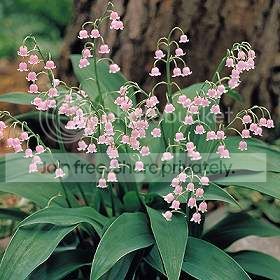 Lily of the Valley frequently appears in gardens for its pleasant smell. Some variations will have double or rose colored flowers. Be careful though, for these plants can take over large areas in a garden and are difficult to remove. Finland has claimed this plant for their national flower since 1982. It can also be called ‘Our Lady’s Tears’ according to a legend that Mary’s tears, shed at the cross, turned into the flower. Other legends claim it to have sprang from the blood of St. George after his fight with the dragon. Basically, it may have a different name wherever you go. Regardless, it remains beautiful. 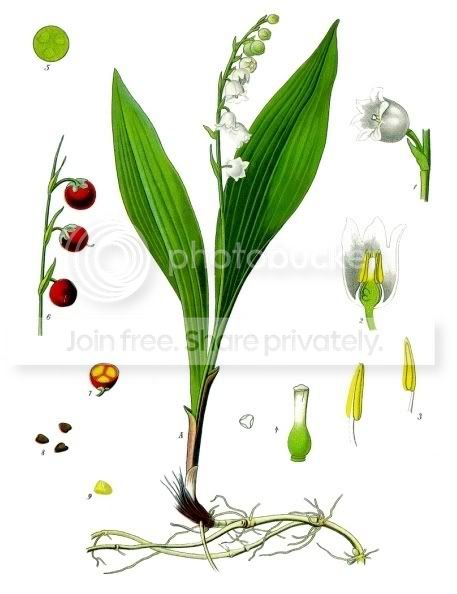
|
|
|
|
|
|
|
|
|
|
|
|
|
|
|
|
|
|








 Such as the one atop this maiden's head.