Yes this topic has evolved strangely, but I feel I must add to this most recent topic again. Here is some more info taken from Wikipedia. <(o_O)>
Here is the actual link:
Wikipedia: SeppukuSeppuku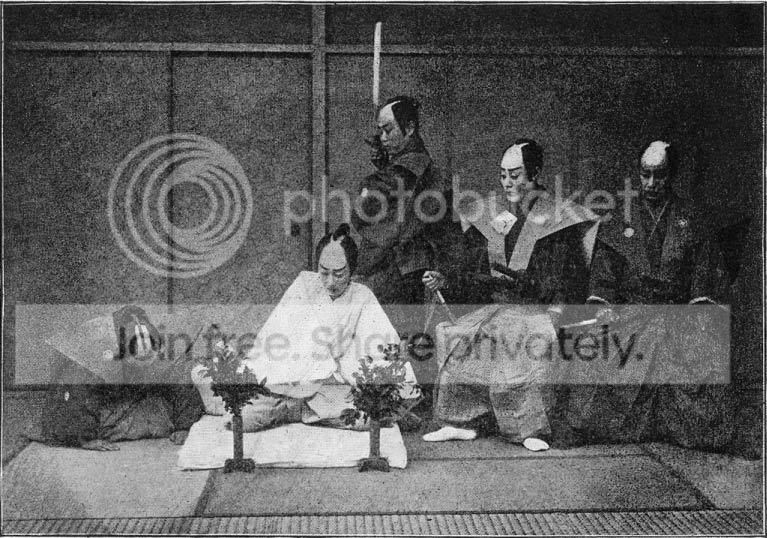
Seppuku (Japanese: 切腹, "stomach-cutting" or "belly slicing") is a form of Japanese ritual suicide by disembowelment. Seppuku is also known in English as hara-kiri (腹切り) and is written with the same kanji as seppuku but in reverse order with an okurigana. In Japanese, 'hara-kiri' is not in common usage, the term being regarded as gross and vulgar. The practice of committing seppuku at the death of one's master is known as oibara (追腹 or 追い腹) or junshi (殉死); the ritual is similar.
OverviewSeppuku was a key part of bushido, the code of the samurai warriors; it was used by warriors to avoid falling into enemy hands, and to attenuate shame. Samurai could also be ordered by their daimyo (feudal lords) to commit seppuku. Later disgraced warriors were sometimes allowed to commit seppuku rather than be executed in the normal manner. Since the main point of the act was to restore or protect one's honor as a warrior, those who did not belong to the samurai caste were never ordered or expected to commit seppuku. Samurai women could only commit the act with permission.
In his book The Samurai Way of Death, Samurai: The World of the Warrior (ch.4), Dr. Stephen Turnbull states:
Seppuku was commonly performed using a tantō. It could take place with preparation and ritual in the privacy of one's home, or speedily in a quiet corner of a battlefield while one’s comrades kept the enemy at bay.
In the world of the warrior, seppuku was a deed of bravery that was admirable in a samurai who knew he was defeated, disgraced, or mortally wounded. It meant that he could end his days with his transgressions wiped away and with his reputation not merely intact but actually enhanced. The cutting of the abdomen released the samurai’s spirit in the most dramatic fashion, but it was an extremely painful and unpleasant way to die, and sometimes the samurai who was performing the act asked a loyal comrade to cut off his head at the moment of agony.
Sometimes a daimyo was called upon to perform seppuku as the basis of a peace agreement. This would weaken the defeated clan so that resistance would effectively cease. Toyotomi Hideyoshi used an enemy's suicide in this way on several occasions, the most dramatic of which effectively ended a dynasty of daimyo forever, when the Hōjō were defeated at Odawara in 1590. Hideyoshi insisted on the suicide of the retired daimyo Hōjō Ujimasa, and the exile of his son Ujinao. With one sweep of a sword, the most powerful daimyo family in eastern Japan was put to an end.
RitualWomen have their own ritual suicide, jigai. Here, the wife of Onodera Junai, one of the Forty-seven Ronin, prepares for her suicide; note the legs tied together, a female feature of seppuku to ensure a "decent" posture in death.

In time, committing seppuku came to involve a detailed ritual. A Samurai was bathed, dressed in white robes, fed his favorite meal, and when he was finished, his instrument was placed on his plate. Dressed ceremonially, with his sword placed in front of him and sometimes seated on special cloths, the warrior would prepare for death by writing a death poem. With his selected attendant (kaishakunin, his second) standing by, he would open his kimono (clothing), take up his wakizashi (short sword) or a tantō (knife) and plunge it into his abdomen, making a left-to-right cut. The kaishakunin would then perform daki-kubi, a cut in which the warrior was all but decapitated (a slight band of flesh is left attaching the head to the body). Because of the precision necessary for such a maneuver, the second was often a skilled swordsman. The principal agreed in advance when the kaishaku made his cut, usually as soon as the dagger was plunged into the abdomen.
This elaborate ritual evolved after seppuku had ceased being mainly a battlefield or wartime practice and become a para judicial institution.
The second was usually, but not always, a friend. If a defeated warrior had fought honorably and well, an opponent who wanted to salute his bravery would volunteer to act as his second.
In the Hagakure, Yamamoto Tsunetomo wrote:
From ages past it has been considered ill-omened by samurai to be requested as kaishaku. The reason for this is that one gains no fame even if the job is well done. And if by chance one should blunder, it becomes a lifetime disgrace.
In the practice of past times, there were instances when the head flew off. It was said that it was best to cut leaving a little skin remaining so that it did not fly off in the direction of the verifying officials. However, at present it is best to cut clean through.
Some samurai chose to perform a considerably more taxing form of seppuku known as jūmonji-giri (十文字切り, lit. "cross-shaped cut"), in which there is no kaishakunin to put a quick end to the samurai's suffering. It involves a second and more painful vertical cut across the belly. A samurai performing jumonji-giri was expected to bear his suffering quietly until perishing from loss of blood, passing away with his hands over his face.
Seppuku as capital punishmentWhile the voluntary seppuku described above is the best known form and has been widely admired and idealized, in practice the most common form of seppuku was obligatory seppuku, used as a form of capital punishment for disgraced samurai, especially for those who committed a serious offense such as unprovoked murder, robbery, corruption, or treason. The samurai were generally told of their offense in full and given a set time to commit seppuku, usually before sunset on a given day. If the sentenced was uncooperative, it was not unheard of for them to be restrained, or for the actual execution to be carried out by decapitation while retaining only the trappings of seppuku; even the short sword laid out in front of the victim could be replaced with a fan. Unlike voluntary seppuku, seppuku carried out as capital punishment did not necessarily absolve the victim's family of the crime. Depending on the severity of the crime, half or all of the deceased's property could be confiscated, and the family stripped of rank.
 A tantō prepared for seppuku




 Reply
Reply