
The Cultures
The Musa have nine different varieties, who each follow a different Muse, though they are a peaceful race, tensions and creative differences can arise between them.
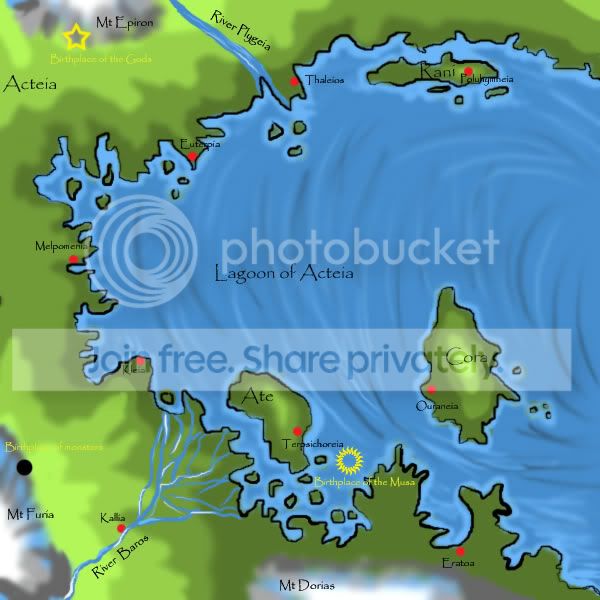
The Kalliopei - the followers of Calliope the muse of literature. These are the oldest and strongest Musa of the land and are known for their great rhetoric and power of persuation. All are trained in the written word and can be writers, politicians and diplomats. Their symbol is the wax writing tablet and they grow from golden shells. They built their city in the fertile delta of the river Baros, making it a good spot for farming and trade as well as the famed government building at the city‘s centre. However, strange monsters have been seen recently in the nearby mountains. Will their city be safe?
The Kleians - the followers of Clio the muse of history. They are the advisors outside of government and record all goings on in the world. They are closely allied with the Kalliopei and posess silver wings which allows them to master the power of flight. Their symbol is the scroll and they grow from silver shells. Their city lies upon a nearby peninsular and is famous for its ingenious lighthouse and the largest library known to Musakind.
The Eratoans - the followers of Erato the muse of eroticism and romance. They are a hedonistic and sensual race focused on physical pleasure. They are loud and bawdy and brimming with confidance. Their symbol is the rose and the lyre and they grow from ruby shells. Their city is located in a natural harbour, gifted with the finest beaches in the land. Eratoa is definitely the most fashionable city in Acteia, dedicated to aesthetic beauty. It’s most striking landmark is its pleasure dome in the city centre with its miraculous gardens and menagerie.
The Euterpians - the followers of Euterpe the muse of music. They are the most good natured of the Musa and have a strong alliance with the Musa of dance. Their aim is to bring joy through music and their symbol is the flute. They grow from quartz shells. Their home is near the base of Mt Epiron and their music is said to have been gifted by the legendary gods that live there.
The Polyhymnians - the followers of Polyhymnia the muse of Prayer and meditation. They are a sombre race and are almost the exact opposite of the Eratoans. They often choose silence over debate and wear veils over their faces. They are in charge of all religious ceremonies and sanctifications despite their secretive appearance. They tend to clash with the Eratoans and the Musa of science. Their meditation allows them the power of levitation and they grow from pearl shells. The adults built their city on the Island of Rani, the most distant, northern province. Their city is heavily cloistered and outsiders are rarely allowed to enter.
The Terpsichoreians - the followers of Terpsichore the muse of dance. They are very close to the Euterpians but choose to remain near water and are amphibious. They can breath underwater and walk on top of its surface so when the water’s calm it can provide a wonderful stage. Their symbol is the peacock feather and they grow from amathyst shells. They built their city on the Island of Ate and are the closest to the holy waters of their birthplace and act as joint guardians to the young that emerge from the sea.
The Melpomenians - the followers of Melpomene the muse of tragedy. They posess empathic powers and often take the roles of mourners and are powerful forces within the justice system as well as being dedicated warriors who make up the majority of the land army. Their symbol is the tragic mask and they grow from saphire shells. They have built their home near to the cities of Kleia and Kallia because of their involvement in government and to defend the other races from the monsters of Mt Furia.
The Thaleians - The followers of Thalia the muse of comedy. They are good spirited and full of good humour. They are also heavily involved in agriculture, fertility and protecting the natural world. They tend to disagree with the Melpomenians but also know that they are sisters and one cannot exist without the other. Their symbol is ivy and the comedic mask and they grow from emerald shells. Their city is near the fetile flood plains of the River Plygeia, Thaleios is a centre of agricultural trade and famous for its regional delicacies.
The Ouranians - the followers of Urania the muse of astronomy. They are in charge of scientific research, divination, and medicine. They are a quiet and thoughtful race and offer helpful advice to the Kalliopei. They disagree with the Kleians because of the clash between theory and fact. They also clash with the Polyhymnians because they are an atheistic group. Their symbol is the celestial orb and they grow from jet shells. Their city is located on the mountainous island of Cora and is home to the land’s largest observatory and planetarium. Cora is also home to several specialised hospitals and asylums that are otherwise not available on the mainland.
Other cultures
Human (rare)
Stages - Baby, child, adolescent, adult, elder
- Little is known about the civilisations of man who were born far away across the waters and received the blessings of Prometheus. Humans rarely venture into Actiea and are an unusual sight among the Musa cities. They are taller and more muscular than the Musa especially in the case of males. Humans have a basic grasp of magic but only among the gifted, which is achieved through many years of schooling and prayer.
Known Human Cultures
Hellenic (rare) - The Democratic peoples, admired for their naval ability and architecture. This culture is similar to the Athenians
Lacedaemonic (rare) - A warlike and secretive people. Little is known about this culture. This culture is based on the Spartans
Both Hellenic and Lacedaemonic humans tend to have pale, olive or tanned complexions. Their hair colour can range from light brown to black but can be changed with natural dyes. Their eye colour is usually brown, but blue and green eyes are also quite common.
Teutonic (extremely rare) - The most northern dwelling human civilisation. The Teutonic peoples tend to belong to small warlike villages based around farming settlements. Their skin tones are usually pale, their hair can range from blonde and red to dark brown and their most common eye colours are blue, grey and hazel.
Enharmonic (rare) - A wealthy culture from the east descended from nomadic traders. This culture is based on the Persians.
Akkadionic (Extremely rare)- A lost city, rumoured to be the gateway of the Gods. Next to nothing is known about these humans. This culture is based on the Babylonians.
Both Enharmonic and Akkadionic peoples have tanned or dark skin tones with dark hair and brown or black eyes. Only those with northern blood in their ancestry have blue eyes.
Ptolemaic (rare) - The most ancient human culture famed for it’s advanced knowledge of science and medicine. They worship the forgotten Gods with frightening animal features and built colossal structures, thought to be impossible by the outside world. This culture is based on the Egyptians.
The Ptolemaic peoples are dark skinned with black hair and eyes, although their hair is usually shaved and replaced with ornate wigs of all colours and their faces are decorated with paints and makeup.
Mythical Creatures (rare)
Strange beasts from beyond the mountains. They can either be a helpful force or a destructive one. There are many varieties of Beast, not all have been recorded. They are uncivilised and are usually solitary creatures. These will normally be held in events and competitions. Roleplay is optional with mythical beasts given away in events, but we'd love it if you joined in.
Event Creatures
Sphinxes - human headed winged lions (Raffle, Opening event)
Harpies - Part human, part bird (Auction, coming soon)
Dragons
Manticore - A winged monster with the head of a man, the body of a lion and a spiked missile-throwing tail.
Phoenix - A fabulous golden-red bird whose feathers shone with the light of the sun.
Chimera - A three headed monster, with the foreparts of a lion, the hind-parts of a goat and goat's-head rising from its back, and the tail of a headed-serpent.
Dryads
Nymphs
Centaurs (Extremely rare)
Stages - newborn/foal/adolescent/adult/elder/???
Small tribes of creatures with the heads and torsos of men and and the bodies of horses. They are part of a dying race and only four Centauric tribes are known to exist.
Cyprian, Pelloponesian, Dionysian and Thessalian.
Centaurs have a natural ability for magic and divination but even this can take years to perfect.
Beasts of Tartarus (Extremely Rare)
Stages - Each Demon has its own uniques set of stages designed by you.
It is easy to reach the underworld but nearly impossible to return to the land of the living. However some spirits and demons have the strength to break through the boundaries of death, They are often monstrous in appearance and greatly feared by all other cultures.
The Forge of Hephaestus (Extremely Rare)
Creatures Forged from metals in the workshop of Hephaestus.
Stages - Magical Ore/Molten/Moulded/Beaten/Polished/Alive
AUTOMOTONS (Automotones) Creatures crafted out of metal and endowed with life by the smith-god Hephaestus.
BULLS, BRONZE (Tauroi Khalkeoi) Four fire-breathing, bronze bulls which Hephaestus crafted for King Aeetes of Colchis.
CELEDONES (Keledones) Golden singing maidens which Hephaistos crafted for the first temple of Apollo at Delphi.
DOGS, GOLD & SILVER (Kuones Khryseos Argyreos) A pair of gold and silver dogs which Hephaestus crafted for King Alcinous of the Phaeacians.
HORSES, CABEIRIAN (Hippoi Kabeirikoi) A pair of metallic, fire-breathing horses owned by the twin Cabiri gods.
MAIDENS, GOLDEN (Kourai Khryseai) Four golden maidens which Hephaestus crafted as his own attendants.
TALUS (Talos) A bronze giant which Hephaestus crafted for Queen Europa of Crete to patrol the borders of her island.
Gods (Almost impossible)
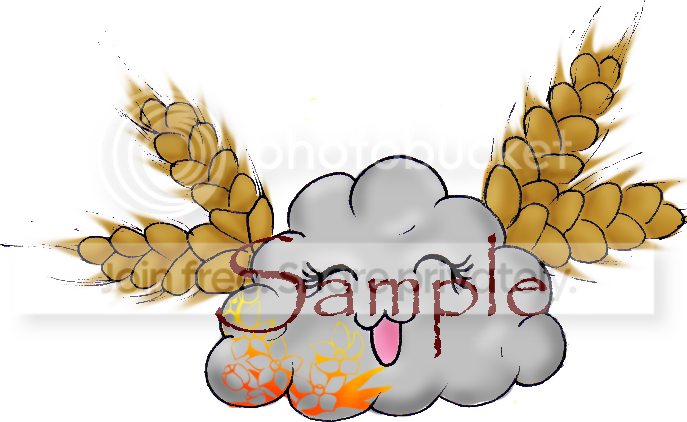
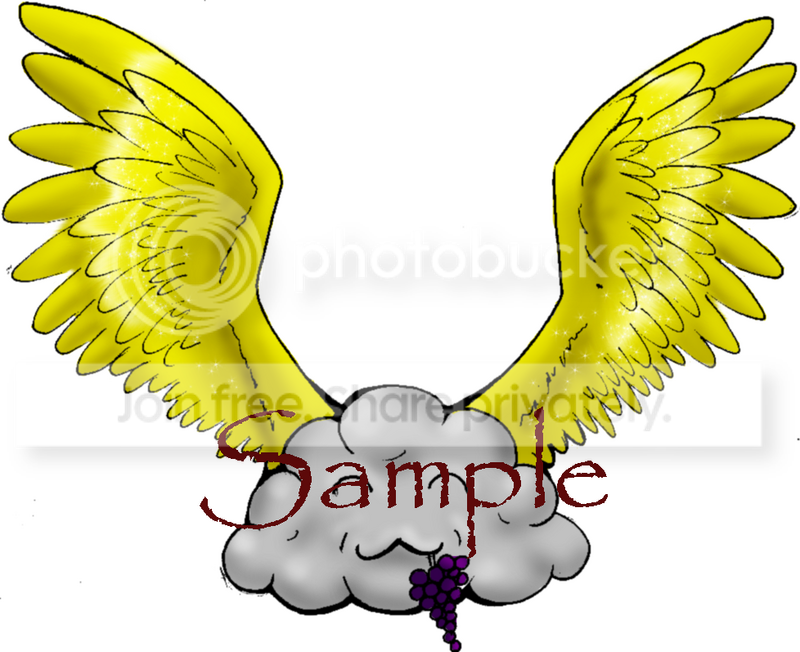
Stages - Stages vary according to the nature of the God but will usually be six or seven stages. The abilities of the Gods will develope slowly as they have been lying dormant for hundreds of years. Their first stage is literally a talking cloud with wings, and their second stage will be equivalent to an adult human with no magical ability. The Gods powers with then grow according to what each specific God represents.
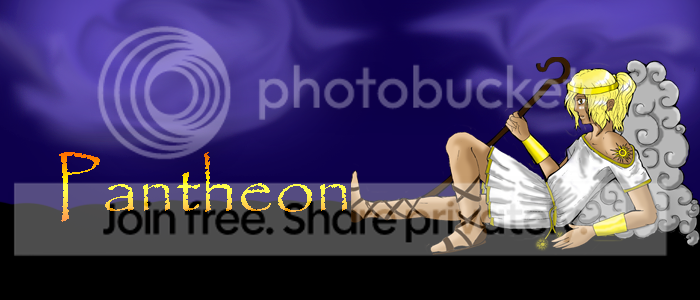
i.e - The stages for Apollo would be as follows:
arrow [1] Non-Corporeal (Holy hell a talking cloud!)
arrow [2] Shepherd (I wave my crook at you DAVE!)
arrow [3] God of Music (He'll gain some minor power like putting people to sleep with his songs or something)
arrow [4] God of Medicine (He'll gain the power of healing, and he can inflict some nasty boils too XD)
arrow [5] Apollo the Far-shooter (He gets a shiny magic bow, Dave)
arrow [6] God of Prophecy (He sees the future, Dave)
arrow [7] Apollo the Sun God (actually he isn't a sun God that's more of a Roman idea, but it's damn pretty to draw.)
The gods that created this world are a colourful lot but hardly ever get directly involved with events on the earth. No living soul has seen a God but they are still worshiped by all cultures.
Forgotten Gods (Unavailable)
The Gods of the Past from primeval origin are all but forgotten. Rumoured to have been defeated and killed by the current Pantheon many thousands of years ago in a heavenly war for possession of the universe. But Gods can’t disappear entirely…can they? The stages for these will be similar to that of ordinary Gods but with 10 stages. Yes ten! Shosetsu is officially insane and is prepared to make a 10 stage pet if you can think of something pretty enough.
burning_eyes Because these Gods can be based on non-Greek deities, they can be anthro if you really want them. This will be a similar idea to the Egyptian gods, meaning they will generally have a humanoid body and the head of an animal.