Welcome to Gaia! ::


<center>User Image</center>
This is a journal for Ronai to use as he coaxes his Fenthry out of its feather and has lots of fun adventures with it.

Please don't post here unless Ronai has given you permission!

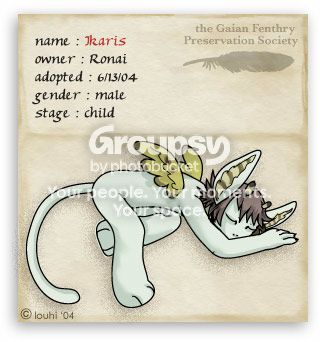
Ikaris
An inexplicable force hurls Ikaris up into the air. He hangs there for a moment, as if suspended on a string, and then plumments downward, spinning rapidly. Near the ground, a bright flash of light erupts from the feather, and when it is gone, the feather has become a child-like creature, just four inches tall, who falls to the ground sprawling at the end of his fall.
June 13, 2oo4

It all started when I was wondering along my merry way. (As it usually happens when something unexpectedly good is about to happen) When I crossed the path of twisted and rather uncrushed path. "Whoot! Exploring!" As I so unsurely strode down still hyper from a full breakfast I couldn't help but think about... lunch -- well that and all the sounds that have been causing a ruckus to my timely tune in my head as well as in my feet. (Doesn't everyone stop to take a jig once in awhile?)

As I glanced above to the skies I noticed that it suddenly stopped, I raised an eyebrow and half-way through a jig I lost balance. "EIYAH!?!" I scuffled and perked my other eyebrow curiously as this beautiful feather that lay before me. "This just gets curious-er and curious-er..." It seemed to have an ominous vibe that I just couldn't place -- so I made it into a nifty hair accessory.

June 16, 2oo4

<center> User Image </center>

These past few days have certainly been uneventful -- as much as I get compliments of my feather statement, I wonder if it holds more meaning then it does in my hair. Perhaps it truly was an ordinary feather in which case I should put it in a nest somewhere. There is just too much I don't understand -- I never had a pet in my life --till-- this day, not to mention no bird. This drove me to the nearest library. "Birds, Biology, Feathers..." Seemed interesting enough.


Ronai


Ronai's Findings:

Feathers are one of the most prominent features of a bird's anatomy, and they are unique to birds. Every bird has feathers and everything that has feathers is a bird. Feathers perform a number of functions for a bird: 1) They provide insulation, this is very important in a warm blooded animal (body temperature of most birds is maintained at around 40C); 2) Feathers allow for flight; 3) Feathers control what a bird looks like by supplying the bird with colors. Colors in birds are used for camouflage and atraction display (consider the tail feathers of a peacock).

<center>User Image - Blocked by "Display Image" Settings. Click to show.</center>

Feathers have a basic form of a hollow, central shaft called a rachis and a number of smaller side branches. The side branches are called barbs and are linked together by a set of barbules and their "hooklets" sometimes called 'Hamuli'. The base of the feather - where their are no side branches - is called the calamus or quill.

Feather Facts:

Some More Feather Facts
Some feathers particularly in the more primitive orders have a secondary smaller and less complicated shaft arising from the based of the calamus, this is called an aftershaft.

Feathers are made of keratin, a protein which is also used to make horn and hair by different animals and beaks by birds.

Owls have the outer ends of their flight feathers lacking in barbules, ii.e.they are unzipped - this makes the edges softer and reduces the noise they make, silent flight helps an owl catch its prey.

In primitive birds the feathers appear to grow at random all over the body, but in most orders the feathers appear in well defined patterns of rows or tracts called pterylae.

The number of feathers a bird has depends very much on its size and where and how it lives, in general a third of a birds feathers are on its head.

The bird with the least feathers is the Ruby Hummingbird Archilochus colubris with only 940 feathers in total

The bird with the most feathers is the Whistling Swan Cygnus columbianus which can have as many as 25,000 during winter.

The longest feathers in the world belong to an ornamental chicken bread in Japan in 1972, this specimen had tail feathers 10.59m or 34.75ft long.

The longest feathers of a wild bird belong to the Crested Argus Pheasant Rheinhartia ocellata which commonly reach lengths of 173cm or 5.7ft

The Colours of Feathers

Birds have good eyesight and colour is important to them. A bird gets its beautiful or cryptic coloration from its feathers. Feathers in turn get their colours in two ways. Firstly, coloured pigments can be present in the Keratin. These can be firstly melanins which range from black to light tan and also produce grays. Melanins are usually Eumelanin and Phaeomelanin. Secondly carotenoids such as lutein, zeaxanthin, beta-carotene, astaxanthin, rhodoxanthin and canthaxanthin which make for reds, oranges and yellows. A third group of pigments consist of Porphyrins. These are mostly brown in colour (Coproporphyrin III) but can also be red, uroprophyrin, or green, Turacoverdin.

Birds can manufacture melanins in their own bodies but can only acquire carotenoids through their food. Flamingos are a fine example of this; if they do not get the right molecules in their diet, which occur naturally in their wild diet, then they lose their stunning pink colouration. Early zoos had great problems keeping their flamingos coloured before this was understood.

Birds, of course, exhibit a much greater range of colours than blacks, browns, reds, oranges and yellows. The blues, greens and other iridescent variations arise from the physical presence of minute structures on the surface of the feathers which reflect only one wavelength of light. This creation of colour via refraction or light is not unique to birds, some fruits and insects such as the Morpho butterfly use physical microstructure to reflect selective wavelengths as well.

Blue and White are normally a structural colour as is green, though green may often be a mixture of structural and pigmental iridescence.

Abrasion plumage. When we look at a bird we see usually only the tips of the contour feathers. These tips can be a different colour to the rest of the feathers. Because feathers get worn away at the tips this can cause a bird's plumage to change colour as the feathers age. Many passerines use this method to have one plumage in winter and a more colourful one in spring. They gradually acquire their breeding plumage through abrasive wearing away of the dull or cryptically coloured tips to reveal the brighter plumage beneath. Snow buntings and Chaffinches are two good examples of this.


Ronai glances at several books he had sprawled about and decided to call it a night. Though the fasination of all he learned made his dreams swim the multicolored wings of the pictures he saw. His own Feather become this beautiful winged golden light. He couldn't make out just what it could be only that this feather would bring him the company he longed for -- but only time can tell.
June 18, 2oo4

Owyln


Very mysteriously you receive a box in the mail…inside the box is a wrapping for the latest Mobile phone in a different colour along with a little tags that went to one side of the top. There’s a note inside:
‘Hi…just wanting to say to everyone who owns a Fenthry that…this way we can all keep in touch, its got everyone else’s phone number and a top up card for about 30 pounds enclosed, enjoy’ But it doesn’t contain a name of who sent it.

<center>User Image</center>

Quick Reply

Submit
Manage Your Items
Other Stuff
Get GCash
Offers
Get Items
More Items
Where Everyone Hangs Out
Other Community Areas
Virtual Spaces
Fun Stuff
Gaia's Games
Mini-Games
//
//

Join Now

// //

Have an account? Login Now!

//
//