Background Info
General Info
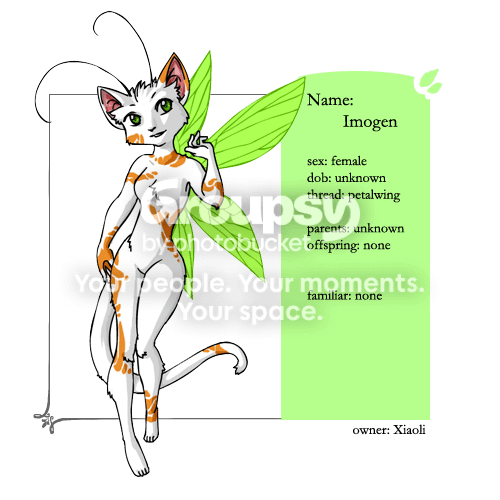
Roughly the size of a hummingbird, a Fluttercat would classify as a small mammal, and their world is full of several such furry species which share certain traits with insects, such as the friendly domestic bunbleflea.
A Fluttercat begins life as a Kittypilly, born from the womb, as unlike the butterflies they take after in their life cycle, Fluttercats do not lay eggs. As creatures of advanced intelligence and emotions, females also suffer PMS.
Growing from Kitterpilly to cocoon, the Fluttercat emerges into the active, wingless stage of adolescence called the Kitternymph. Agile and acrobatic, able to jump amazing heights among the vibrant flora they call home, their fearlessness of high places is almost a natural trait.
The Kitternymphs play, learn and grow, awaiting the day brilliant wings burst from their backs, unfurling to mark their first day of adulthood.
Food and Lifespan
Rampant omnivores and possessing raging high metabolisms because of their energy-consuming way of movement and flight, Fluttercats can consume several hundred milkbud berries during their Kitterpilly stage, and after their metamorphosis eat all varieties of nuts, berries, fungi, herbs, pollen, nectar, honey, and even tree bark. They eat several kinds of insects, small fish and invertebrates, from salty roast crickets to escargot in the shell.
Fluttercats do not appear to age after they become adults, but they are frail and injury or illness are often fatal.
The Business of Kitterpillies and Cocoons.
The helpless kitterpilly relies on its parents for all things, from the harvesting and feeding of dangling milkbud berries to the construction of its cocoon's initial sack layer, which the kitterpilly then converts into a more shell-like, safe structure in which to commence its metamorphosis.
Weaving the cocoon sack is a dangerous business. The thread used to construct the fabric must be pilfered, freshly-spun, from the web of a
Spectral Spider. It doesn't help that the Fluttercat is one of the vicious creature's most preferred meals.
The spider is usually either distracted by one partner or drugged with a sack bait filled with sleeping medicine.
There are three known species of Spectral Spider, and the threads they spin have an effect on the eventual wing formation of the Fluttercat.
Webbing from the
Spectral Strider results in a
Petalwing Fluttercat
Spectral Stalker thread produces
Featherwing Fluttercats
Finally, Spectral Striker thread results in the
Ragewing Fluttercat.
Fluttercat Society
While the Fluttercats are yet a primitive hunter/gatherer community, possessing no form of writing or technology, they're a far cry smarter than the slavering predators with whom they share a delicate and dangerous interdependence.
They've learned to mix medicines and paints, make and use simple tools and create handicrafts and art. Stories and teaching is done through word of mouth and example.
Having caught and domesticated the docile and friendly
Bunbleflea, some Fluttercats have begun talking about a dangerous new venture, one that they believed would change their world for the better, resulting in a growing group of ambitious visionaries who called themselves the Spectral Slayers.
Primitive Politics
Despite their flighty, seemingly carefree approach to life, the Fluttercats as individuals generally have a strong desire for social acceptance, and, in turn, a tendency to want others to be and think the same. Petty viciousness, gossip and whispered secrets make up the everyday social skirmishes in the community.
There is no formal council, but there is a clique of elder Fluttercats to whose collective wisdom most of the community turns to in times of trouble or dispute. Their decisions are made by consensus, and voices who were too strongly in opposition to the majority of the elder circle are simply excluded, and violent opposition is exiled, labeled "unstable," "deviant," or "senile."
The largest split in the community occurred when a certain younger group of Fluttercats, filled with a vision of a different tomorrow without the encroaching dangers of the spectral spiders constantly on their doorstep, began spreading ideas of domesticating the spectral spiders, safely farming them for the necessary silk and eventually killing off the wild and dangerous stock of the predator which threatened them daily.
The elder circle opposed the notion, believing that just as the bunbleflea had shed its stinger and lost its keen senses as well as its place in nature when turned into house pets, so would the spectral spiders change, perhaps never again producing silk of sufficient quality, or worse, no silk at all. In defiance of the uprising, the elder circle and their followers called themselves "Naturalists."